this week in film and television
EPIX MOVIE FREE FOR ALL: ANNIE HALL
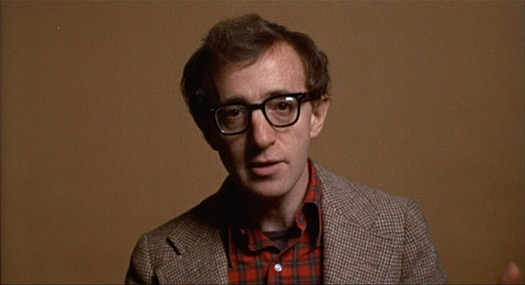
Woody Allen impersonation contest will precede free screening of ANNIE HALL in Coney Island
ANNIE HALL (Woody Allen, 1977)
Coney Island Beach
Boardwalk at West 12th St.
Monday, August 8, free, 7:00
www.epixhd.com
 One of the funniest, most-quoted romantic comedies in film history, Woody Allen’s Annie Hall is a pure delight from start to finish. It’s ostensibly a luuuuuurve story about a nebbishy Jew (Allen as Alvy Singer) and the ultimate WASPy goy (Diane Keaton as the title character), but it’s really about so much more: large vibrating eggs, right turns on red lights, television, Existential Motifs in Russian Literature, California, slippery crustaceans, driving through Plutonium, dead sharks, Freud, Hitler, Leopold and Loeb, religion, cocaine, Shakespeare in the Park, Buick-size spiders, planet Earth, and, well, la-di-da, la-di-da, la la. One of the all-time great New York City movies, it’s partly set in Coney Island, where Alvy grew up under the old Thunderbolt roller coaster. Tonight, Epix, in conjunction with Rooftop Films, will be screening the multiple Oscar winner — for Best Original Screenplay (Allen and Marshall Brickman), Best Director (Allen), Best Actress (Keaton), and Best Film — not far from that site, on the boardwalk by West 12th St. It will be preceded by a live DJ at 7:00, followed by Kirsten Lepore’s charming beach-set short, Bottle, and, yes, a Woody Allen impersonation contest. You know you so want to participate. Which section would you quote from? We’re still deciding which scene is our favorite….
KUROSAWA: YOJIMBO
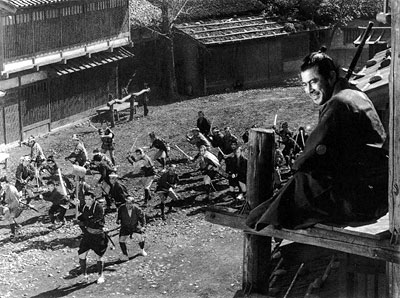
Toshirō Mifune can’t believe what he sees in YOJIMBO, being shown in HD at Symphony Space
YOJIMBO (Akira Kurosawa, 1961)
Symphony Space, Leonard Nimoy Thalia
2537 Broadway at 95th St.
Sunday, August 7, 3:00
Series continues through August 28
212-864-5400
www.symphonyspace.org
Kuwabatake Sanjuro (Toshirō Mifune) is a lone samurai on the road following the end of the Tokugawa dynasty in yet another of Akira Kurosawa’s unforgettable masterpieces. Sanjuro comes to a town with two warring factions and plays each one off the other as a hired hand. Neo’s battles with myriad Agent Smiths are nothing compared to Yojimbo’s magnificent swordfights against growing bands of warriors that include the evil Unosuke (Tatsuya Nakadai), who is in possession of a new weapon that shoots bullets. Try watching this film and not think of several Clint Eastwood Westerns (including Sergio Leone’s pasta remake, A Fistful of Dollars) as well as High Noon. The film is being screened as part of Symphony Space’s “Kurosawa” series, featuring the first time ever many of the Japanese auteur’s finest films are being shown on the big screen in HD; coming up is High and Low on August 13, Hidden Fortress on August 14, Stray Dog on August 27, and Rashomon on August 28.
HOLLYWOOD MUSICALS OF THE 1970s & 80s, PART 2: THE 1980s — GET CRAZY
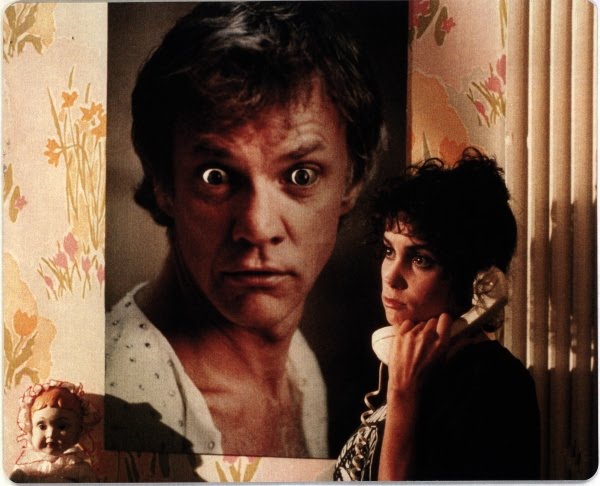
Malcolm McDowell gets plenty crazy as rock god Reggie Wanker in Allan Arkush’s GET CRAZY
GET CRAZY (Allan Arkush, 1983)
Anthology Film Archives
32 Second Ave. at Second St.
Saturday, August 6, 7:00
Series continues through August 9
212-505-5181
www.anthologyfilmarchives.org
One of the most underrated, little-seen rock-and-roll movies ever made, Get Crazy should be a cult classic. Directed by Allan (Rock ‘n’ Roll High School) Arkush, Get Crazy evokes the closing of the Fillmore East as Neil Allen (Daniel Stern) and Willy Loman (Gail Edwards) help put together a New Year’s Eve farewell concert for the beloved Saturn Theater, which the conniving Colin Beverly (Ed Begley Jr.) is trying to steal out from under Max Wolfe (Allen Garfield). Among the special guests at the show are Bill Henderson as the Muddy Waters clone King Blues, Captain Cloud (Howard Kaylan of the Turtles) and the Rainbow Telegraph, and Nada (Kid Creole Coconut Lori Eastside) with Piggy (Lee Ving of Fear), but the movie is stolen by Malcolm McDowell as the Mick Jagger ripoff Reggie Wanker, who literally lets his member do the talking, and Lou Reed as the Dylan/Donovan homage Auden, a folksinger desperate to write a song before the show, so he spends most of the film riding around in a cab, rambling on about whatever is right in front of him. And be sure to keep an eye out for John Densmore, Fabian, Bobby Sherman, Clint Howard, Linnea Quigley, and Paul Bartel. In addition to the live numbers, the soundtrack includes songs by Sparks, Marshall Crenshaw, the Ramones, and Reed, whose awesome “Little Sister” plays over the closing credits. Extremely silly but still loads of fun Get Crazy is screening August 6 at Anthology Film Archives as part of the series Hollywood Musicals of the 1970s & 80s, Part 2, which continues through August 9 with such classics and not-so-classics as Walter Hill’s Streets of Fire, John Landis’s The Blues Brothers, Robert Altman’s Popeye, John Waters’s Cry-Baby, and David Byrne’s True Stories.
FIRST SATURDAYS: CARIBBEAN COUNTDOWN
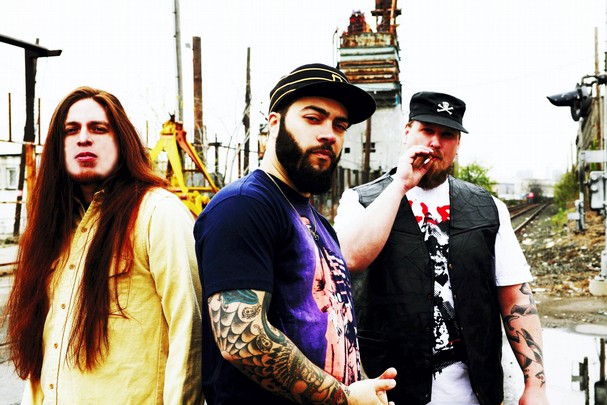
The Cool and Deadly will play at Brooklyn Museum First Saturday program on August 6
Brooklyn Museum
200 Eastern Parkway
Saturday, August 6, free, 5:00 – 11:00 (some events require free tickets distributed in advance at the Visitor Center)
212-864-5400
www.brooklynmuseum.org
The Brooklyn Museum is getting its annual Caribbean celebration under way early this year with a full slate of activities as part of its free August First Saturdays program. Things get going at 5:00 with Tribal Legacy leading a funky reggae get-down. At 6:00, visitors have their choice of curator Rich Aste giving a talk on the new acquisition “Free Women of Color With Their Children and Servants in a Landscape” and a screening of Frances-Anne Solomon’s 1995 Trinidad drama What My Mother Told Me. At 6:30, Trinidad native Hazelle Goodman will perform her one-woman show, Don’t Get Me Started, and the Hands-on Art workshop will offer participants the chance to decorate fabrics with Afro-Caribbean designs. At 7:00, NYU associate professor of anthropology Aisha Khan will discuss South Asian and Islamic cultural influences on the museum’s holdings. At 8:00, DJ Spice will get the monthly dance party going, with the Cool and Deadly and DJ Jillionaire highlighting the Afro-Punk Festival at 8:30. As always, the galleries are open until 11:00, giving everyone the chance to see such exhibitions as “Vishnu: Hinduism’s Blue-Skinned Savior,” “reOrder: An Architectural Environment by Situ Studio,” “Lorna Simpson: Gathered,” “Skylar Fein: Black Lincoln for Dooky Chase,” “Split Second: Indian Paintings,” “Four Bathers by Degas and Bonnard,” and “Sam Taylor-Wood: Ghosts.”
MASTER CLASS: STEVE JAMES —THE INTERRUPTERS

Former gang members try to stop the violence on the streets of Chicago in THE INTERRUPTERS
Maysles Institute
343 Malcolm X Blvd. between 127th & 128th Sts.
August 5-11, $10
212-582-6050
www.mayslesinstitute.org
www.interrupters.kartemquin.com
 For The Interrupters, director, producer, and editor Steve James (Hoop Dreams, At the Death House Door) teamed up with journalist Alex Kotlowitz (There Are No Children Here) to hit the dangerous inner-city streets of Chicago with the men and women of CeaseFire, a grass-roots organization of former gang members who are now trying to stop the violence. Inspired by Kotlowitz’s New York Times Magazine article, the two men concentrate on three primary stories. Ameena Matthews, the Muslim daughter of notorious gang leader Jeff Fort, is working with a deeply troubled young woman who’d rather fight than flee, even if it means being sent back to prison. Cobe Williams has his hands full with the angry, recently released Flamo, who thinks the whole world is against him. And Eddie Bocanegra is attempting to come to grips with a cold-blooded revenge murder he committed when he was a teenager by visiting schools and talking about turning his life around. One of the most poignant moments of the film occurs when Williams brings Lil Mikey back to the barbershop he and several of his cohorts robbed at gunpoint as he again faces some of his victims. Matthews, Williams, and Bocanegra are paid employees of CeaseFire, which was founded by Dr. Gary Slutkin, an epidemiologist who believes that violence is a disease that can be treated in similar ways, and is run by Tio Hardman, who handles his extremely tough task with intelligence and dignity as he deals with what he calls “the madness.” But in a society in which “words’ll get you killed,” as Matthews says early on, these tireless violence interrupters put their own lives on the line every day, battling a sickness that seems to have no end in sight. The award-winning film, a hit at numerous film festivals, felt a bit long at its original 144 minutes, but James has since edited it down to a more streamlined 124 minutes for its theatrical release, which began July 29 at the IFC Center and expands August 5-11 to the Maysles Institute as part of the “Master Class: Steve James” series curated by Sylvia Savadjian, which previously screened such James films as Hoop Dreams, At the Death House Door, and No Crossover: The Trial of Allen Iverson. The August 5 screening at 7:30 will be followed by a Q&A with Operation S.N.U.G.’s Robin Holmes and Karim Chapman, Courtney Bennett of the New York Mission Society), and local Harlem-based violence interrupters.
MASTER CLASS: STEVE JAMES — AT THE DEATH HOUSE DOOR
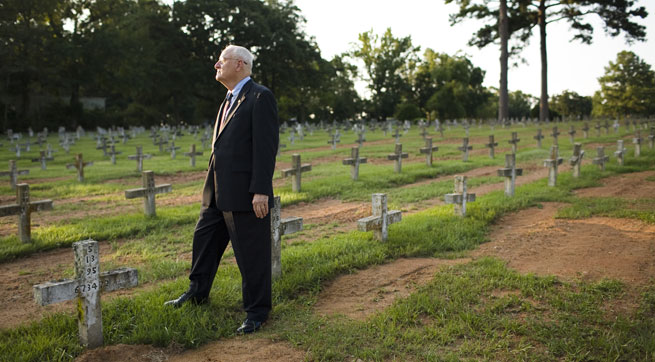
AT THE DEATH HOUSE DOOR is part of Steve James retrospective at the Maysles Institute
AT THE DEATH HOUSE DOOR (Steve James & Peter Gilbert, 2008)
Maysles Institute
343 Malcolm X Blvd. between 127th & 128th Sts.
Thursday, August 4, $10, 7:30
212-582-6050
www.mayslesinstitute.org
For more than fifteen years, Pastor Carroll Pickett served as death-row chaplain for nearly one hundred inmates at the Walls prison in Huntsville, Texas. The soft-spoken man of God would spend the last eighteen hours of each condemned man’s life with him, offering prayer, confession, and, in some cases, a hand to hold. Documentarians Steve James and Peter Gilbert, who teamed up on the Oscar-nominated Hoop Dreams in 1994, follow Pickett as he tells his compelling story with deep emotion and remarkable insight. We see Pickett as he listens to old cassettes he recorded after each execution, talking about his own complicated feelings about his job — something he never shared with his family or parish. He discusses how his personal thoughts about capital punishment changed after the 1989 execution of Carlos De Luna, a young man who claimed he was innocent — and Pickett believed him but never spoke out about it. The film often switches to investigative reporters Steve Mills and Maury Possley of the Chicago Tribune as they research a story about De Luna’s innocence, speaking primarily with one of his sisters, Rose Rhoton, who is ashamed that she didn’t do more to save her brother’s life. But what is clear is that such miscarriages of justice are not any one person’s fault but the result of a severely broken system. James and Gilbert stay out of the way of the story; they do not hit viewers over the head with facts and numbers, they include no third-person narration or random talking heads, and they avoid the expected confrontations over this extremely controversial issue. Even Leo Sidran’s score is even-handed and sensitive. At the Death House Door is a fascinating examination of the death penalty, seen through the eyes of someone who has experienced it in a very personal, powerful way. The film is screening August 4 at the Maysles Institute as part of the Master Class: Steve James series curated by Sylvia Savadjian, which concludes August 5-11 with James’s latest, The Interrupters, which follows an organized group of former gang members trying to stop the violence in Chicago.