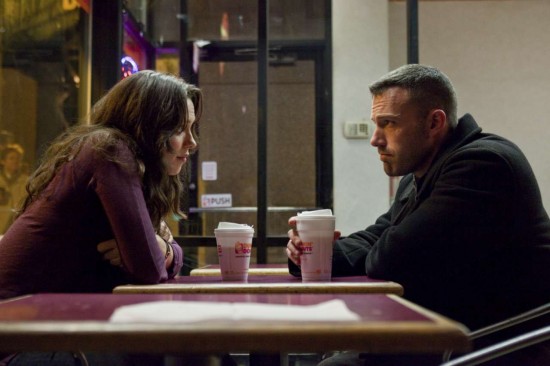
Claire (Rebecca Hall) and Doug (Ben Affleck) have a complicated relationship in THE TOWN
THE TOWN (Ben Affleck, 2010)
Pier 63 Lawn, Hudson River Park
Cross at West 22nd or 24th St.
Wednesday, August 17, free, 8:30
www.hudsonriverpark.org
www.thetownmovie.warnerbros.com
 Ben Affleck, who displayed great skill as a director in his debut feature, 2007’s Gone, Baby, Gone, has done it again with his follow-up, the romantic thriller The Town. Affleck, who also cowrote the script, stars as Doug MacRay, the leader of a small group of bank robbers in tough Charlestown, Massachusetts, the bank robbery capital of America. As the film opens, the thieves are just hitting a bank and are forced to take a hostage, manager Claire Keesey (Rebecca Hall). After later letting her go unharmed, they soon realize that she lives in their neighborhood and might be able to recognize one of them, so Doug starts hanging around her, pretending to be interested in her so he can tap her for information. Meanwhile, Boston cop Dino (Titus Welliver) and FBI Special Agent Frawley (Jon Hamm) are getting closer to the gang, who continue to pull off daring heists regardless of the heat on them. Although there are a handful of plot holes you could drive an armored truck through, The Town ends up being a compelling action film and love story, with car chases, massive shootouts, and a tender relationship as Doug begins to fall for Claire, and vice versa, even though the truth threatens to blow everything apart. Also threatening to blow everything apart is Doug’s right-hand man, Jem (Jeremy Renner, channeling James Cagney in White Heat), who likes hurting and killing way too much. Affleck, who as a director allows his actors a large amount of freedom, has gotten fine performances across the board; the cast also includes Pete Postlethwaite as an underworld florist, Chris Cooper as Doug’s long-incarcerated father, Blake Lively as a drug-dealing tramp, and Boston rapper Slaine, who contributed songs to the soundtrack as well. The film, based on the Chuck Hogan novel Prince of Thieves, also benefits from Affleck’s genuine affection for the place where he grew up, shooting on location and setting the finale in a world-famous landmark. The Town is screening August 17 in Hudson River Park as the last entry in the free Wednesday night RiverFlicks for Grown-ups series, with free popcorn. For a complete list of free outdoor summer films throughout the city, click here.
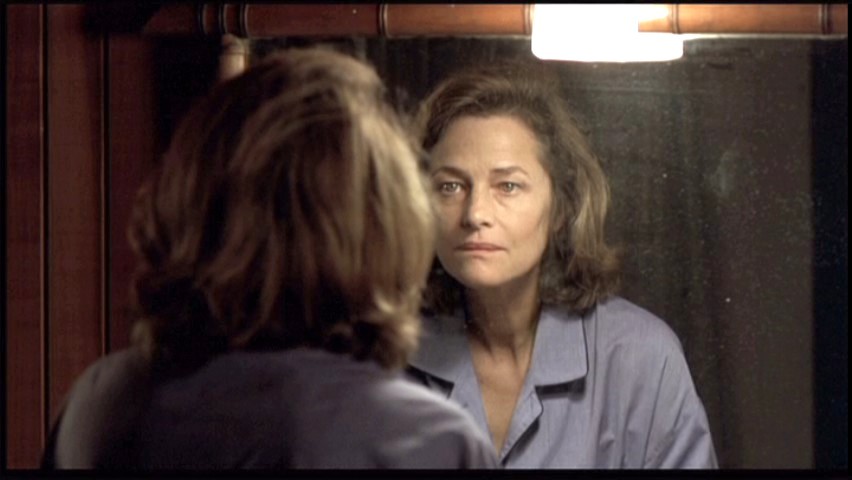
 Unlikely duo Marie (Charlotte Rampling) and Jean Drillon (Bruno Cremer) are hopelessly in love with each other. But when Jean suddenly disappears into the ocean, Marie refuses to believe he might be dead and instead continues to speak with him and think he’s actually with her. Rampling is outstanding in a very difficult role made even more challenging by François Ozon’s (Swimming Pool, Criminal Lovers) relentlessly uneasy directing. Under the Sand is screening August 20 & 21 as part of MoMA’s “Hot and Humid: Summer Films from the Archives” series, which continues through September 7 with such seasonal dramas as Spike Lee’s Do the Right Thing, Michelangelo Antonioni’s L’Avventura, and Martin Scorsese’s Taxi Driver.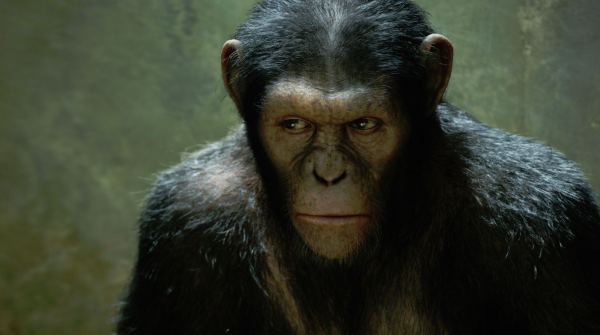
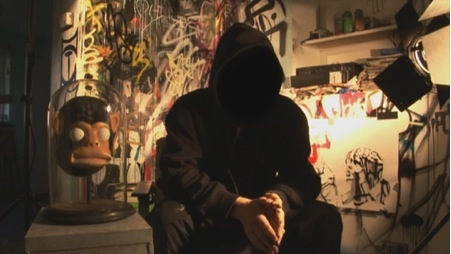
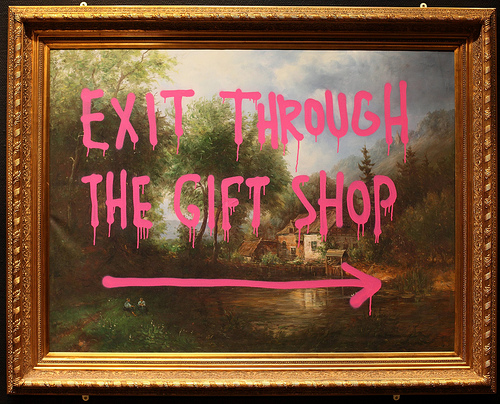
 In 1999, L.A.-based French shopkeeper and amateur videographer Thierry Guetta discovered that he was related to street artist Invader and began filming his cousin putting up his tile works. Guetta, who did not know much about art, soon found himself immersed in the underground graffiti scene. On adventures with such famed street artists as Shepard Fairey, Swoon, Ron English, and Borf, Guetta took thousands of hours of much-sought-after video. The amateur videographer was determined to meet Banksy, the anarchic satirist who has been confounding authorities around the world with his striking, politically sensitive works perpetrated right under their noses, from England to New Orleans to the West Bank. Guetta finally gets his wish and begins filming the seemingly unfilmable as Banksy, whose identity has been a source of controversy for more than a decade, allows Guetta to follow him on the streets and invites him into his studio. But as he states at the beginning of his brilliant documentary, Exit Through the Gift Shop, Banksy—who hides his face from the camera in new interviews and blurs it in older footage—turns the tables on Guetta, making him the subject of this wildly entertaining film.