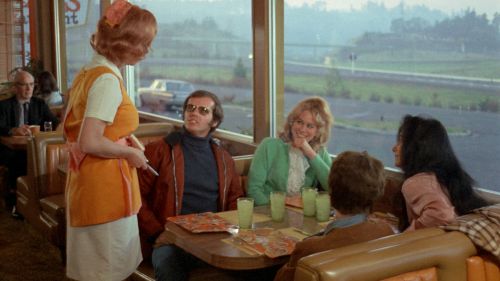
Jack Nicholson places the most famous sandwich order in film history (Sony Pictures Repertory)
CABARET CINEMA: FIVE EASY PIECES (Bob Rafelson, 1970)
Rubin Museum of Art
150 West 17th St. at Seventh Ave.
Friday, October 12, free with $7 bar minimum, 9:30
212-620-5000
www.rmanyc.org
 A key film that helped lead 1960s cinema into the grittier 1970s, Bob Rafelson’s Five Easy Pieces is one of the most American of dramas, a tale of ennui and unrest among the rich and the poor, a road movie that travels from trailer parks to fashionable country estates. Caught in between is Bobby Dupea (Jack Nicholson), a former piano prodigy now working on an oil rig and living with a well-meaning but not very bright waitress, Rayette (Karen Black). When Bobby finds out that his father is ill, he reluctantly returns to the family home, the prodigal son who had left all that behind, escaping to a less-complicated though unsatisfying life putting his fingers in a bowling ball rather than tickling the keys of a grand piano. Back in his old house, he has to deal with his brother, Carl (Ralph Waite), a onetime violinist who can no longer play because of an injured neck and who serves as the film’s comic relief; Carl’s wife, Catherine (Susan Anspach), a snooty woman Bobby has always been attracted to; and Bobby’s sister, Partita (Lois Smith), a lonely, troubled soul who has the hots for Spicer (John Ryan), the live-in nurse who takes care of their wheelchair-bound father (William Challee). Rafelson had previously directed the psychedelic movie Head (he cocreated the Monkees band and TV show) and would go on to make such films as The King of Marvin Gardens, Stay Hungry, and Black Widow; written by Carole Eastman, Five Easy Pieces fits flawlessly in between them, a deeply philosophical work that captures the myriad changes the country was experiencing as the Woodstock Generation was forced to start growing up. The film suffers from some unsteady editing primarily in the earlier scenes, but it is still a gem, featuring at least two unforgettable scenes, one that takes place in a California highway traffic jam and the other in a diner, where Bobby places an order for the ages. And as good as Nicholson is, earning the first of seven Best Actor Oscar nominations, Helena Kallianiotes nearly steals the picture as a crazy woman railing against the ills of the world from the backseat of Bobby’s car. Five Easy Pieces will be screening October 12 as part of the Rubin Museum Cabaret Cinema series “Happiness is . . .” and will be introduced by comedian Brooke Van Poppelen. “Living here . . . that’s what you want?” Bobby asks Catherine. “Yes,” his sister-in-law responds. “That will make you happy?” he says. “I hope it will. Yes,” she replies. The series continues with such other happy films as Fellini’s 8½, Truffaut’s The 400 Blows, and Bergman’s Cries and Whispers, held in conjunction with the larger program “Happy Talk.”
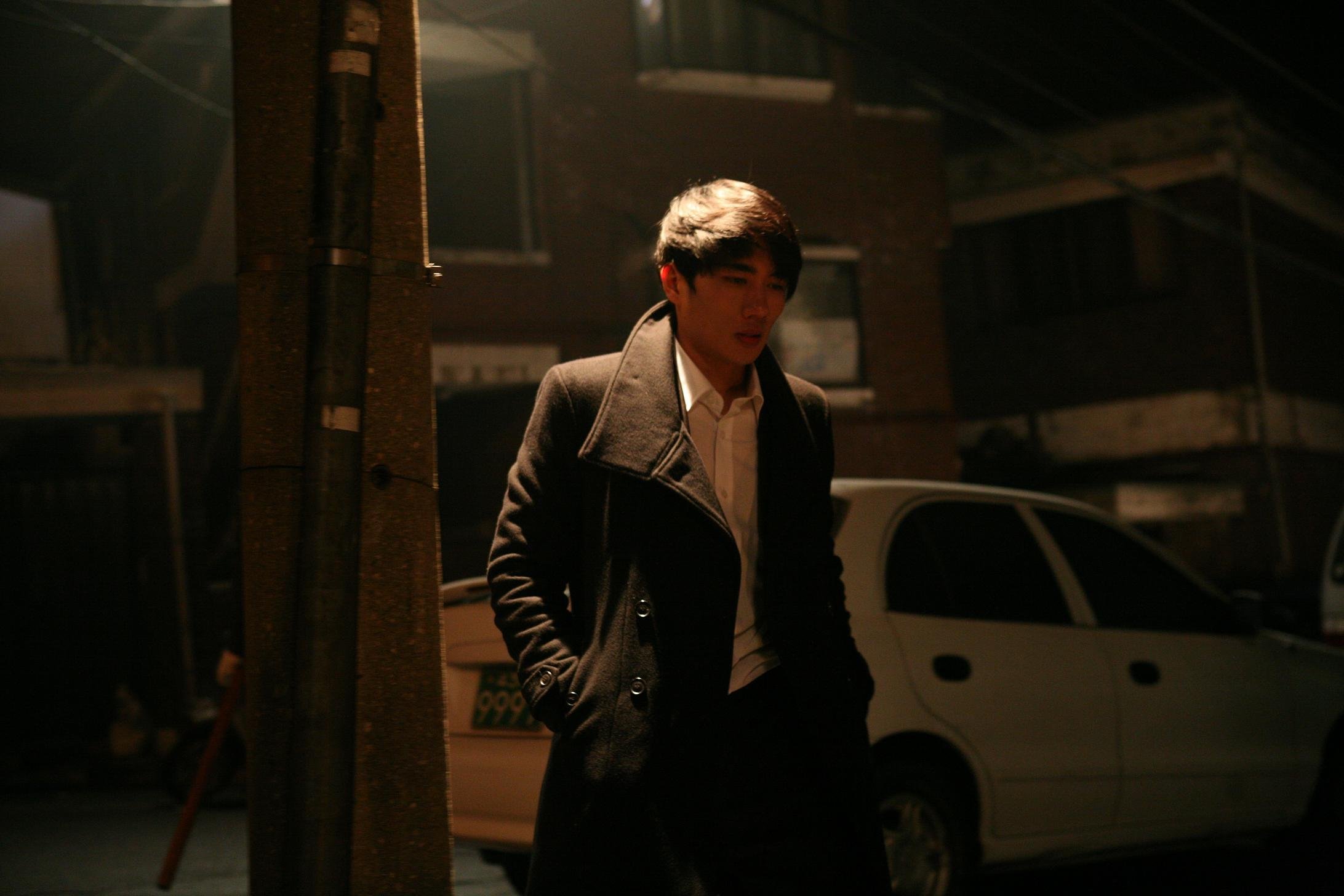
 After his mother’s (Kil Hae-yeon) get-rich-quick scheme doesn’t quite work out as planned, she disappears, leaving her laconic son, Kwon Youn-ho (Um Tae-goo), to continually fight off her ever-more-crazed business partner, Seo-hee (Park Se-jin), a divorced mother desperate to get back the money she claims she is owed. Meanwhile, Youn-ho is trying to make a life for himself and his fiancée, Se-kyung (Yoon Che-yong), but her mother doesn’t approve of his job in reconstruction — he convinces people to leave their homes with small payments so that buildings can be knocked down and fancier residences put up in their place. But neither Youn-ho nor Seo-hee is evil; both have been cast in difficult situations that lead to extreme measures that they regret as they try to put their lives back together. Kim Joon-hyun’s first feature film is a patiently paced drama that subtly examines how the global financial crisis affects families in both large and small ways. Everyone in the film is seeking to maintain or renew a relationship with a loved one, be it a parent, a child, a sibling, or a lover, but money complicates their situations. Um is excellent as Youn-ho, a young man seemingly disinterested in his own existence, letting life just happen to him, a fine counterpart to Park’s Seo-hee, a woman willing to do just about anything to prevent her life from getting completely away from her. Choked is screening for free October 9 at 7:00 at Tribeca Cinemas as part of the Korean Cultural Service film series “Gems of Korean Cinema,” which looks at recent independent works from South Korea.
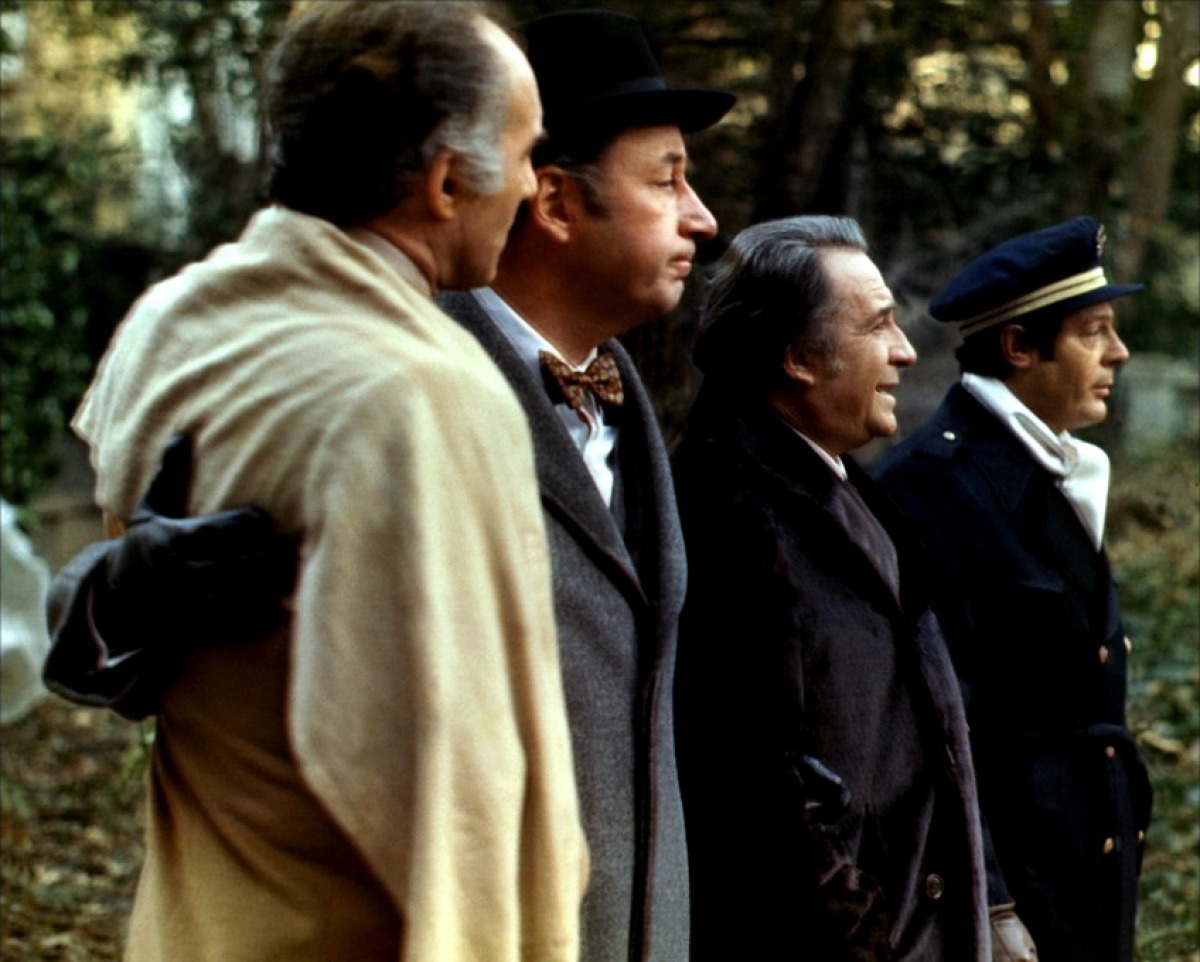
 Fed up with their lives, four old friends decide to literally eat themselves to death in one last grand blow-out. Cowritten and directed by Marco Ferreri (Chiedo asilo, La casa del sorriso), La Grande Bouffe features a cast that is an assured recipe for success, bringing together a quartet of legendary actors, all playing characters with their real first names: Marcello Mastroianni as sex-crazed airplane pilot Marcello, Philippe Noiret as mama’s boy and judge Philippe, Michel Piccoli as effete television host Michel, and Ugo Tognazzi as master gourmet chef Ugo. They move into Philippe’s hidden-away family villa, where they plan to eat and screw themselves to death, with the help of a group of prostitutes led by Andréa (Andréa Ferréol). Gluttons for punishment, the four men start out having a gas, but as the feeding frenzy continues, so does the flatulence level, and the men start dropping one by one. While the film might not be quite the grand feast it sets out to be, it still is one very tasty meal. Just be thankful that it’s not shown in Odoroma. Winner of the FIPRESCI Prize at the 1973 Cannes Film Festival, La Grande Bouffe is screening October 9 at 12:30, 4:00, and 7:00 as part of the FIAF CinémaTuesdays series “Films for Foodies!” The 7:00 showing will be introduced by pâtissier François Payard and series curator John Mariani and followed by a Q&A. The series continues October 16 with Roland Joffe’s Vatel (presented by Mariani and chef André Soltner), October 23 with Jean-Pierre Améris’s Romantics Anonymous (including a chocolate tasting with Mariani and chocolatier Laurent Gerbaud), and October 30 with Paul Lacoste’s Step Up to the Plate (presented by Mariani, chef Jean-Louis Gerin, and film producer Jaime Mateus-Tique). Bon appetit!
 Following the Tuscany-set