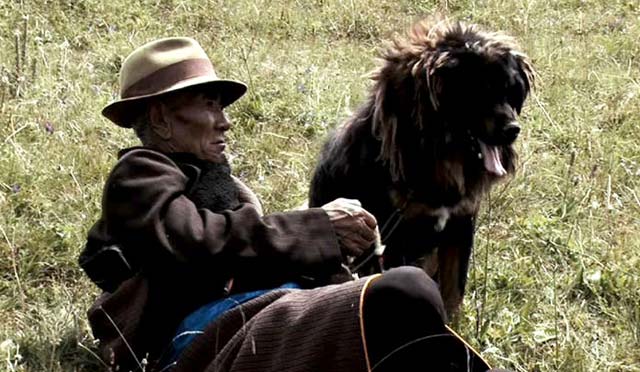
An old man (Lochey) would rather sell himself than his canine companion in Pema Tseden’s OLD DOG
OLD DOG (LAO GOU/KHYI RGAN) (Pema Tseden, 2011)
MoMA Film, Museum of Modern Art
11 West 53rd St. between Fifth & Sixth Aves.
Sunday, January 12, 3:30
Series continues through January 16
Tickets: $12, in person only, may be applied to museum admission within thirty days, same-day screenings free with museum admission, available at Film and Media Desk beginning at 9:30 am
212-708-9400
www.moma.org
 Pema Tseden’s Old Dog is a beautifully told, slowly paced meditation on Buddhism’s four Noble Truths — “Life means suffering”; The origin of suffering is attachment”; “The cessation of suffering is attainable”; and “There is a path to the cessation of suffering” — that ends with a shocking, manipulative finale that nearly destroys everything that came before it. In order to get a little money and to save the family’s sheep-herding dog from being stolen, Gonpo (Drolma Kyab) sells their Tibetan nomad mastiff to Lao Wang (Yanbum Gyal), a dealer who resells the prized breed to stores in China, where they’re used for protection. When Gonpa’s father (Lochey) finds out what his son has done, he goes back to Lao Wang and demands the return of the dog he’s taken care of for thirteen years. “I’d sell myself before the dog,” he tells his son. And so begins a gentle tale of parents and children, set in a modern-day Tibet that is ruled by China’s heavy hand. Gonpa’s father doesn’t understand why his son, a lazy man who rides around on a motorized bike and never seems to do much of anything, doesn’t yet have any children of his own, so he pays for Gonpa and his wife Rikso (Tamdrin Tso), to go to the doctor to see what’s wrong. Meanwhile, the old man keeps a close watch on his dog, wary that Lao Wang will to try to steal it again. Writer-director Pema Tseden (The Silent Holy Stones, The Search) explores such themes as materialism, family, and attachment in a lovely little film that sadly is nearly ruined by its extreme final scene. If you missed Old Dog last year as part of the MoMA series “Chinese Realities/Documentary Visions,” you have another chance to catch it, as it’s screening January 12 at 3:30 as part of MoMA’s annual series “The Contenders,” consisting of exemplary films the museum believes will stand the test of time; upcoming entries include Jehane Noujaim’s The Square, Frederick Wiseman’s At Berkeley, and Sebastián Lelio’s Gloria.
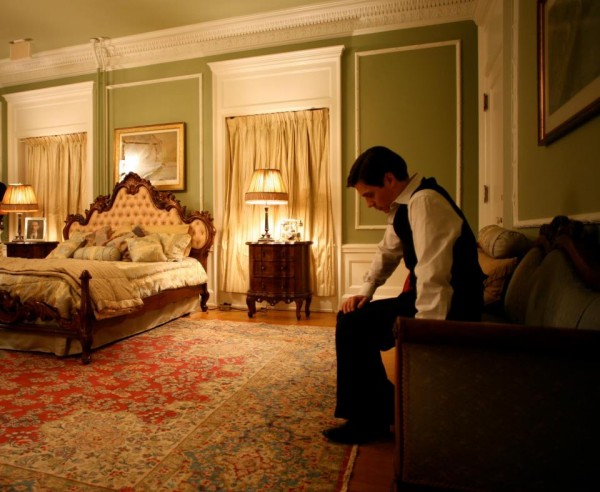
 Director and star Bruce Ramsay strips down and condenses the Bard in his 1940s-set noirish update of Hamlet, but in doing so he also drains one of Shakespeare’s most powerful tragedies of all its poetry and emotion. Trimming the tale down to a far-too-lean eighty-seven minutes, Ramsay cuts out characters and reinterprets scenes to focus on the family-related aspects of the story of betrayal, madness, murder, and revenge, using the original text for the most part while setting the entire film in one large house (actually the University Women’s Club in Vancouver). He fills the cast with veterans of Canada’s Bard on the Beach series, including Gillian Barber as Gertrude, Duncan Fraser as Polonius, Haig Sutherland as Laertes, Martin Sims as Guildenstern, Russell Roberts as the ghost of Hamlet’s father, and Lara Gilchrist as Ophelia; Welsh actor Peter Wingfield plays Claudius, with Stephen Lobo as Horatio and Bret Stait as Rosencrantz. The bare-bones film was shot in three days (for a mere — and rather admirable — $27,000), but it’s taken nearly three years for it to get a U.S. theatrical release, and it’s easy to see why. Ramsay’s Hamlet is more like a failed episode of Masterpiece Theatre, sort of Agatha Christie meets Downton Abbey in postwar London, than a fresh new look at the extremely familiar play, though it is a noble attempt. Indeed, “I must be cruel to be kind. Thus bad begins and worse remains behind.” Hamlet opens at Cinema Village on January 10, with Ramsay taking part in Q&As following the 7:10 screenings on Friday and Saturday night.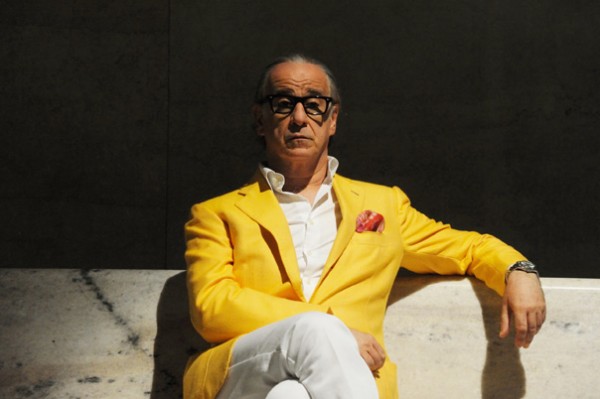
 Told with the surreal flair of Federico Fellini’s La Dolce Vita and 8½, the dark, witty cynicism of Woody Allen’s Stardust Memories and Deconstructing Harry, and the psychological intricacies of Ingmar Bergman’s Wild Strawberries and The Seventh Seal, Paolo Sorrentino’s The Great Beauty is a masterful epic about an Italian writer looking back at his life as he turns sixty-five, and not liking what he sees. Toni Servillo gives a sparkling deadpan performance as Jep Gambardella, a deeply sarcastic and intentionally hypocritical journalist in Rome who scored a huge success with his first novel, The Human Apparatus, but has been unable to write a follow-up for decades, instead spending his time attending wild parties, sleeping with woman after woman, and sharing his unique views on the sociocultural, political, and religious nature of modern-day Rome. He is surrounded by sycophants, jealous writers, a mysterious neighbor, a culinary cardinal, bizarre performance artists, an aging stripper, a magician, and many more hangers-on (played by Isabella Ferrari, Roberto Herlitzka, Sabrina Ferilli, Carlo Verdone, Massimo De Francovich, Pamela Villoresi, and others who appear to have come straight from a Fellini set), but the only person who truly understands him is his diminutive editor, Dadina (Giovanna Vignola). “You’re a spectacular woman,” he tells her. “You’ve had the career you deserve.” She responds, “But you haven’t had the career you deserve.”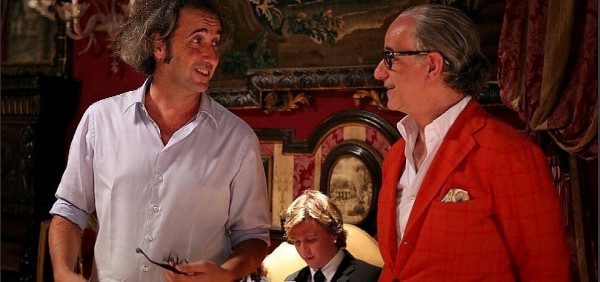

 Over the years, Joel and Ethan Coen have created a slew of offbeat protagonists and antiheroes who trudge through surreal life experiences, from the McDunnoughs in Raising Arizona and Tom Reagan in Miller’s Crossing to the title character in Barton Fink and Anton Chigurth in No Country for Old Men. But they have come up with their most despicable — and most believable — main character in Inside Llewyn Davis. The previously little-known Oscar Isaac gives a career-defining performance as Llewyn Davis, a selfish wastrel who mistreats everyone he meets. A broke singer-songwriter in 1961 Greenwich Village whose former partner (voiced on record by Marcus Mumford) killed himself, Davis loses a mentor’s (Ethan Phillips) cat, curses out his agent (Jerry Grayson), impregnates a married friend (Carey Mulligan), makes fun of the husband’s (Justin Timberlake) new song, avoids visiting his ailing father (Stan Carp), insults a portly jazzman (John Goodman) — essentially, he meets every situation by insulting someone, then turning and walking away, without even the slightest hint of regret. And the beautiful thing is, the Coens aren’t about to offer him redemption. Inspired in part by the life of Dave Von Ronk and with sly references to such other musicians as Ramblin’ Jack Elliott, Tom Paxton, Dr. John, Doc Pomus, and Jim and Jean along with music impresario Bud Grossman and Gerde’s Folk City, Inside Llewyn Davis is a bitingly funny black comedy about a nasty man living in his own egocentric world, refusing to share any part of himself with anyone else, through his music or face-to-face, even though people keep giving him opportunity after opportunity. And the audience is in on it too, wanting him to succeed despite his myriad offenses. The soundtrack, overseen by T Bone Burnett, who previously worked with the Coens on O Brother, Where Art Thou? brings it all back home, with such highlights as Isaac’s performance of “Hang Me, Oh Hang Me,” Timberlake, Mulligan, and Stark Sands teaming up on “Five Hundred Miles,” and Timberlake, Davis, and Girls hunk Adam Driver all having fun with an updated version of “Please Mr. Kennedy.”