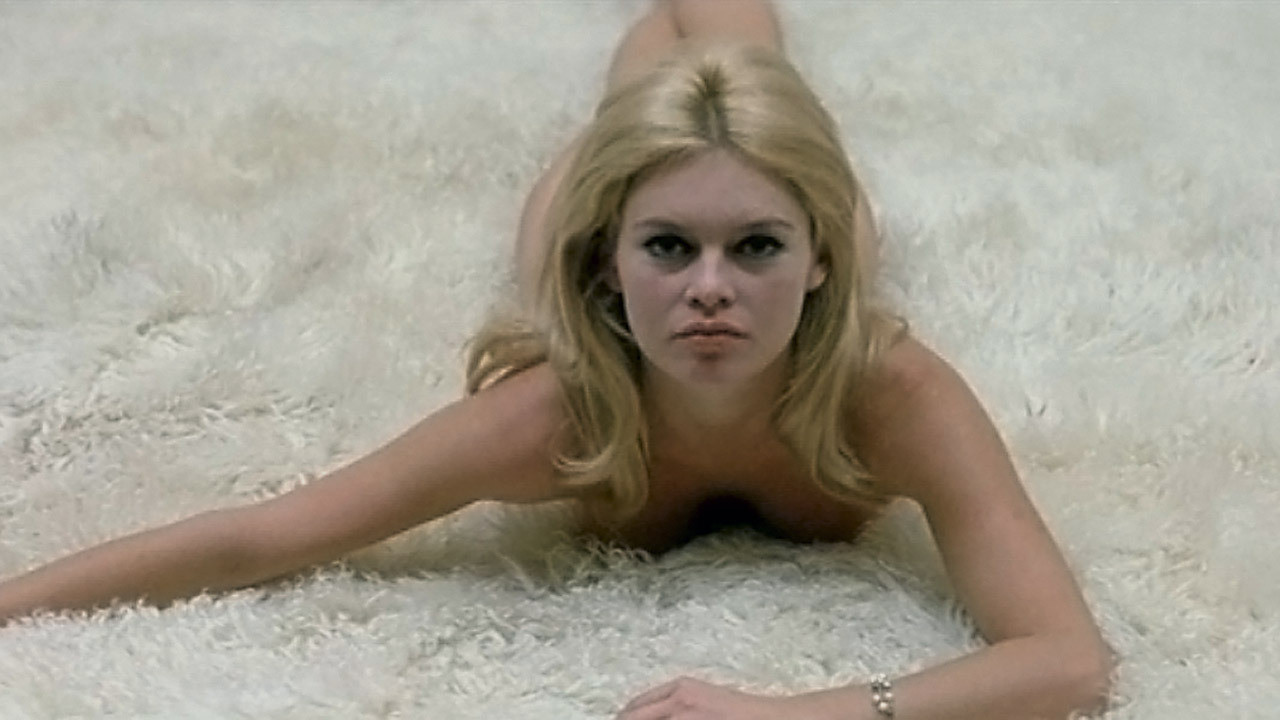
Brigitte Bardot shows off both her acting talent and beautiful body in Jean-Luc Godard’s Contempt
CONTEMPT (LE MEPRIS) (Jean-Luc Godard, 1963)
Film Forum
209 West Houston St.
June 30 – July 13
212-727-8110 www.filmforum.org
French auteur Jean-Luc Godard, who died last September at the age of ninety-one, didn’t hold back any of his contempt for Hollywood cinema in his multilayered masterpiece Contempt, which is being shown June 30 – July 13 in a sixtieth-anniversary 4K restoration at Film Forum. Loosely based on Alberto Moravia’s Il Disprezzo,Contempt stars Michel Piccoli as Paul Javal, a French screenwriter called to Rome’s famed Cinecittà studios by American producer Jeremy Prokosch (Jack Palance ) to perform rewrites on Austrian director Fritz Lang’s (played by Lang himself) adaptation of The Odyssey by ancient Greek writer Homer. Paul brings along his young wife, the beautiful Camille (Brigitte Bardot), whom Prokosch takes an immediate liking to. With so many languages being spoken, Prokosch’s assistant, Francesca Vanini (Giorgia Moll), serves as translator, but getting the various characters to communicate with one another and say precisely what is on their mind grows more and more difficult as the story continues and Camille and Paul’s love starts to crumble. Contempt is a spectacularly made film, bathed in deep red, white, and blue, as Godard and cinematographer Raoul Coutard poke fun at the American way of life. (Both Godard and Coutard appear in the film, the former as Lang’s assistant director, the latter as Lang’s cameraman — as well as the cameraman who aims the lens right at the viewer at the start of the film.)
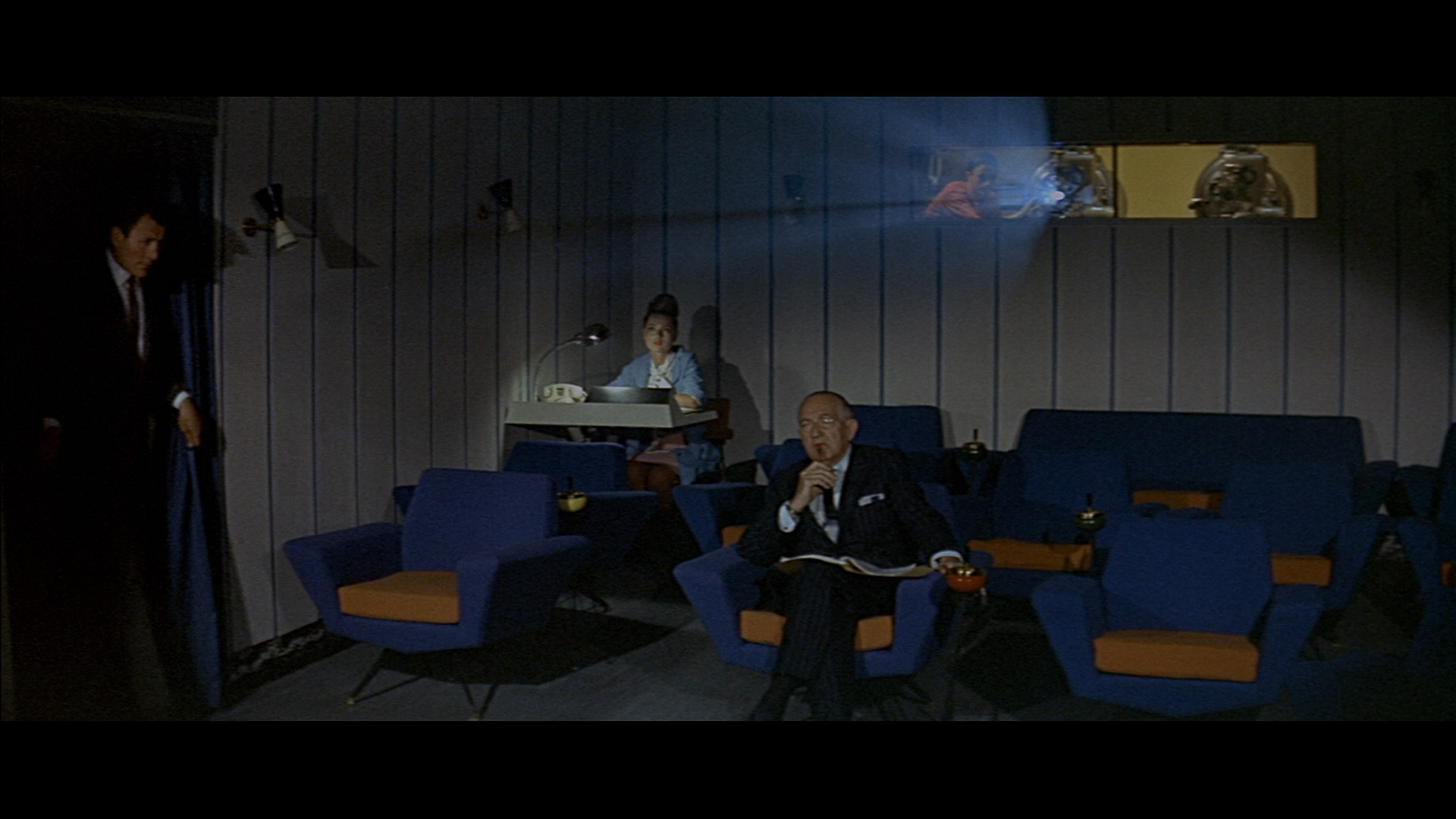
Producer Jeremy Prokosch (Jack Palance) doesn’t always have the kindest of words for director Fritz Lang in Contempt
Bardot is sensational in one of her best roles, whether teasing Paul at a marvelously filmed sequence in their Rome apartment (watch for him opening and stepping through a door without any glass), lying naked on the bed, asking Paul what he thinks of various parts of her body (while Coutard changes the filter from a lurid red to a lush blue), or pouting when it appears that Paul is willing to pimp her out in order to get the writing job. Palance is a hoot as the big-time producer, regularly reading fortune-cookie-like quotes from an extremely little red book he carries around that couldn’t possibly hold so many words. And Lang, who left Germany in the mid-1930s for a career in Hollywood, has a ball playing a version of himself, an experienced veteran willing to put up with Prokosch’s crazy demands. Vastly entertaining from start to finish, Contempt is filled with a slew of inside jokes about the filmmaking industry and even Godard’s personal and professional life, along with some of the French director’s expected assortment of political statements and a string of small flourishes that are easy to miss but add to the immense fun, all set to a gorgeous romantic score by Georges Delerue.
Ale (Alejandro Polanco) does what he needs to do to get by in Queens-set Chop Shop
CHOP SHOP (Ramin Bahrani, 2007)
Museum of the Moving Image
35th Ave. at 36th St., Astoria
Friday, June 30, at 7:30
Sunday, July 2, 2:00
718-777-6800 movingimage.us
Set amid the junkyards and auto-body shops in the shadow of Shea Stadium, Ramin Bahrani’s follow-up to his indie hit Man Push Cart is a gritty, realistic drama of family and community. Filmed in thirty days in the Iron Triangle neighborhood of Willets Point, Queens, Chop Shop stars Alejandro Polanco as Ale, a street-smart twelve-year-old boy who works for Rob (Rob Sowulski), calling cars into the repair shop, stealing spare parts, and learning virtually every aspect of the trade, legal and not. Ale lives in a small upstairs room in the garage with his sister, sixteen-year-old Isamar (Isamar Gonzalez), who by day works in a food van and at night makes extra cash by getting into cars and trucks with strange men. Neither Ale nor Izzy goes to school; instead, they’re working hard, saving up money to buy a food van and start their own business, but their life is fraught with danger and difficulty nearly every step of the way. Written by Bahrani (Goodbye Solo,At Any PriceChop Shop is an honest, frightening, yet sweet slice of life that takes place not far from a sign at Shea that announces, “Where Dreams Happen.”
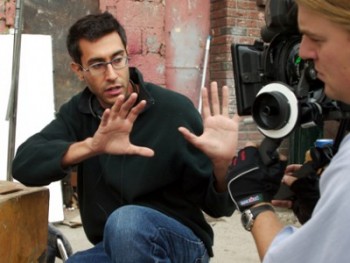
Director Ramin Bahrani frames a shot on the Willets Point set of Chop Shop
Polanco gives a remarkable performance as Ale, a rough yet vulnerable kid who has been dealt a tough hand but just forges ahead, attempting to make the most out of his meager life, trying to find his own piece of the American dream. Whether hanging out with his best friend, Carlos (Carlos Zapata), looking after his sister, doing a special job for Ahmad (Man Push Cart’s Ahmad Razvi), or counting his pay in front of his boss – Sowulski really does own the garage where most of the movie is filmed – Ale is an extraordinary character, played by an extraordinary young boy in his very first film. A subtle, unforgettable experience, Chop Shop is screening June 30 and July 2 in the ongoing Museum of the Moving Image series “Queens on Screen,” which previously presented such films as The Wiz,The Untouchables, and Kiss of Death.
THE ALARM
Gramercy Theatre
127 East 23rd St. at Lexington Ave.
Friday, June 23, and Saturday, June 24, $53-$120
Free special events June 22 and June 25 www.livenation.com thealarm.com
During the pandemic and continuing to today, one of my favorite social media messages has been “The Alarm Is Live,” referring to the Welsh rock band that goes back to the early 1980s. Most recently, the pop-up came with a second meaning, as, for decades, group cofounder and lead vocalist Mike Peters has been battling cancer, including lymph cancer in 1996 and chronic lymphocytic leukemia in 2005, which came back this past September.
As he explained on the band’s website, “I am writing today to let you all know that my leukemia (CLL) has relapsed and I have been admitted to the North Wales Cancer Centre for immediate treatment. I have already started on a brand new chemotherapy regime and so I wanted you to know, personally, that my life living with cancer is about to change for the foreseeable future. My immediate aim is to get fit and well for the Gathering. . . . This coming January will commemorate the thirtieth anniversary of the Gathering, an event that has come to represent all that we stand for — thirty years of Love Hope and Strength, thirty years of friendship and celebration and, through music, helping each other to live life and stay strong. I want you to know that I am going to beat this disease once more and be ready, willing, and able to hit the stage. . . . Since being diagnosed with pneumonia (after the last British tour), the post-recovery period provided far greater challenges for me than I could ever have envisaged (although somehow I managed to find the strength to record the backing tracks for a new Alarm album. I’ve even got my guitar with me on the ward just in case inspiration strikes!)”
Inspiration did strike, as Peters, joined by his wife, keyboardist Jules Jones Peters, kept going live on Facebook, sharing music and stories, even from his hospital bed, while continuing their series “The Big Night In.” Late last month, Peters took off on a solo acoustic tour of England, playing thirty-song sets of Alarm tunes, from the anthemic ’80s hits “Sixty Eight Guns” (“And now they are trying to take my life away / Forever young I cannot stay”), “Blaze of Glory” (“Going out in a blaze of glory / My heart is open wide / You can take anything that you want from me / There is nothing left to hide”), and “The Stand” (“Come on down and meet your maker / Come on down and make the stand / Come on down, come on down / Come on down and make the stand”) to tracks from their brand-new album, Forwards, written from the perspective of an older, wiser man who has looked death in the face — “Forwards” (“In the cities all deserted / In the streets of emptiness / In the church of nonbelievers / I’ve been searching for the way to find new faith . . . I’ve been trying to get myself back home to you / I’m living for today / Trying to find the way forwards”), “Next” (“All the clocks are set to zero, now’s the time to run / I hear the crack of the starting gun and I’m ready for what’s next / All is possible / All is understood / Whatever is trying to kill me makes me feel alive”), and “Transition” (“There’s a line I have to cross tonight / If I want to stay alive and live for a second time / Knowing time / The way it’s passing by / I can’t afford to wait / To see the light of day”).
Peters, who is sixty-four, and the Alarm return to New York City this week for the Gathering, a four-day celebration that begins June 22 at 6:00 with a solo acoustic set and record signing at Rough Trade in Rockefeller Plaza. On Friday and Saturday, Peters and his bandmates — James Stevenson on guitar and bass, Mark Taylor on keyboards and guitar, Steve “Smiley” Barnard on drums, and Jules on keyboards — will be performing at the Gramercy Theatre, with each night offering unique surprises, including acoustic sets, film screenings, and a Q&A for two-day-pass holders. The festivities conclude with a ninety-minute hike around the Central Park lake on Sunday at 11:30 am beginning at Bethesda Fountain in support of Peters’s charity, the Love Hope Strength Foundation, whose mission is “to save lives, one concert at a time”; you can register in advance here.
On the Alarm’s “Diary of a Rock & Roll Life” Facebook posts, Jules wrote on May 9, after Mike got good news from the North Wales Cancer Treatment Centre, “Just being healthy is the greatest gift of all.” Another great gift is Mike Peters and the Alarm back onstage in NYC for these special shows. “The Alarm Is Live,” and this time in person.
On August 12, 1978, the New England Patriots were playing a preseason game against the Oakland Raiders at Oakland-Alameda County Coliseum. Late in the second quarter, the Pats have a third and eight at the Raiders twenty-four-yard line. QB Steve Grogan calls the 94 Slant, and wide receiver Darryl Stingley heads downfield. At the ten-yard line, Stingley reaches for the overthrown pass and is crushed in midair by two-time Raiders All-Pro safety Jack Tatum, known as the Assassin for his punishing style of play. Stingley immediately crumples to the ground. Four Oakland defenders look down at Stingley and walk away; Patriots wide receiver Russ Francis stands over his fallen teammate, knowing something is wrong. The twenty-six-year-old Stingley is wheeled off the field on a stretcher, a quadriplegic for the rest of his life; he died in 2007 at the age of fifty-five. Tatum wasn’t penalized on the play and never apologized to Stingley, claiming it was a legal hit and that he had done nothing wrong. Tatum, who died in 2010 at the age of sixty-one, was also involved in the Immaculate Reception on December 23, 1972, in a playoff game against the Steelers; with twenty-two seconds left and Pittsburgh down by one, future Hall of Famer Terry Bradshaw was facing a fourth and ten from his own forty. He ran to his right and threw a pass down the middle. Tatum smashed into Steelers running back Frenchy Fuqua, the ball popped up into the air, and future Hall of Famer Franco Harris picked it up by his shoestrings and ran forty yards into the end zone for the winning score.
Filmmaker and installation artist Matthew Barney was eleven years old when Tatum pummeled Stingley. Seeing the collision over and over again on replay did not prevent Barney from becoming a star quarterback in high school in Idaho. But at Yale, he switched from sports to art, beginning his “Drawing Restraint” series in 1987 and making his Jim Otto Suite in 1991–92, about orifices, bodily fluids, energy, Harry Houdini, and Raiders Hall of Fame center Jim Otto, who wore the number double zero, mimicking the letters at the beginning and end of his palindromic last name.
Barney is now saying farewell to his longtime Long Island City studio with Secondary, a five-channel video installation that uses the Tatum-Stingley play to explore violence in athletic competition. Barney has transformed the studio, which is right on the East River, into a football stadium, with a long, artificial turf surface divided into geometric patterns of different colors, centered by his “Field Emblem,” his Cremaster logo, an ellipse with a line going through it, evoking –0-. There are monitors in all four corners of the field, along with a three-sided mini-jumbotron hanging from the ceiling. Visitors can sit on the field or a bench; there is also a painting on the wall, an owners booth filled with football paraphernalia, and a ditch with broken piping and mud dug into the concrete. Outside, on the facade facing the water, there is a digital countdown clock next to graffiti that says, “Saboroso,” which means “delicious.”
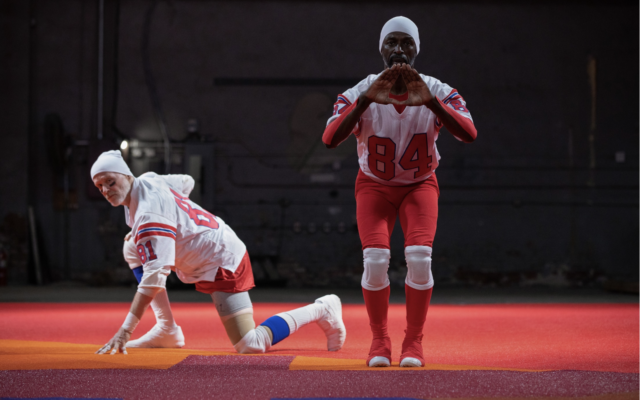
Written and directed by Barney, photographed by Soren Nielsen, and edited by Kate Williams, the film lasts sixty minutes, the length of a football game. It kicks off with indigenous rights activist Jacquelyn Deshchidn, a Two-Spirit Chiricahua Apache and Isleta Pueblo soprano, composer, poet, and public speaker, performing an alternate national anthem, a none-too-subtle jab at a league that still has teams using offensive Native American names and imagery. The cast, primarily consisting of dancers and choreographers, features movement director David Thomson as Stingley; Raphael Xavier as Tatum; Shamar Watt as Raiders safety Lester “the Molester” Hayes; Wally Cardona as Grogan; Ted Johnson as Francis; Isabel Crespo Pardo, Kyoko Kitamura, and Jeffrey Gavett as the line judges and referees; Barney as Raiders Hall of Fame QB Ken “the Snake” Stabler, who died of colon cancer but who was discovered to have had high Stage 3 chronic traumatic encephalopathy (CTE), the disease that affects so many football players, brought on by getting hit so much in the head; and Thomas Kopache as Raiders owner Al Davis, whose motto was “Just win, baby,” no matter the cost. (Football fans will also notice cameos by actors portraying such Raiders favorites as wide receiver Fred Biletnikoff and defensive end John “the Tooz” Matuszak, who became an actor and died in 1989 at the age of thirty-eight from an opioid overdose.) The actors are generally much older than the people they represent, several of whom never made it to the age the performers are today.
Matthew Barney has turned his LIC studio into a multimedia installation (photo by twi-ny/mdr)
The experimental film does not have a traditional chronological narrative; instead, Barney focuses on Tatum, Hayes, and Stingley training in slow motion in equipment rooms as if preparing for a ballet, Grogan making a football out of a gooey substance and then practicing with it, members of Raiders Nation shouting and cheering in fierce black-and-silver Halloween-like costumes, and players venturing into the muddy ditch, the broken pipe echoing Stingley’s shattered body. The music, by sound designer Jonathan Bepler, envelops the audience in a parade of noises, from hums and breathing to clangs and screams. Shots of the Manhattan skyline and the East River beckon to another life outside. The screens sometimes display the same footage, while other times they are different; it is like the viewer is at a football game, with the choice whether to watch the quarterback, the defensive alignment, or other fans in the stands. There is no actual pigskin in the film.
The game of football has always been lionized for its violence. Even as the league changes rules to try to protect the quarterback, kick returners, and receivers, the sports networks repeatedly show brutal hits like the one on Dolphins quarterback Tua Tagovailoa against the Cincinnati Bengals that resulted in severe head and neck injuries. When we think of Washington Redskins quarterback Joe Theismann, the first thing we remember is the career-ending injury he suffered on Monday Night Football in 1985 at the hands of New York Giants linebackers Lawrence Taylor and Harry Carson, brutally shattering his leg, and not his 1982–83 MVP season when he led his team to a Super Bowl victory over the Dolphins.
But Barney (River of Fundament,“Subliming Vessel”) is not merely commenting on football. Secondary is about America itself, its rituals and celebrations, its embracing of violence on and off the field. It’s about our lack of respect for the human body and one another, about a country torn apart into blue and red states like opposing teams, ready to do whatever is necessary to just win, baby.
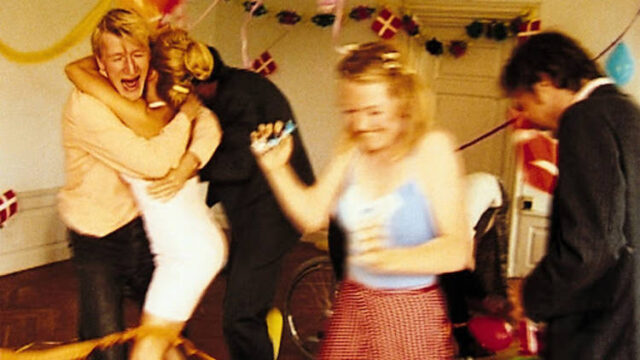
A group of nonconformers battle the status quo in Lars von Trier’s The Idiots
THE IDIOTS (IDIOTERNE) (Lars von Trier, 1998)
Metrograph
7 Ludlow St. between Canal & Hester Sts.
Opens Friday, June 16 metrograph.com mubi.com
I remember being fairly disgusted the first time I saw Lars von Trier’s 1998 film, The Idiots, about a group of men and women who pretend to be mentally ill in order to subvert bourgeois society. They “spass about,” going to restaurants, bars, a factory, a pool, and people’s homes and act like “retards” (their word, not mine), dribbling from their mouths, talking with speech impediments, and moving as if they have cerebral palsy. They pull off pranks that range from just plain silly to downright offensive, with no regret or apology. The film was booed at Cannes, then nominated for the Palme d’Or, while reviews praised and reviled it. However, over time, its reputation has grown, with more and more critics raving about its ingenuity and inventiveness.
The Idiots is the second Dogme 95 film, and von Trier’s only such movie, following a set of ten principles involving sound, light, acting, camera use, genre, location, and other elements, aiming for naturalism and immediacy without technical virtuosity. In the “Vow of chastity,” each filmmaker “swears as a director to refrain from personal taste! I am no longer an artist. I swear to refrain from creating a ‘work,’ as I regard the instant as more important than the whole. My supreme goal is to force the truth out of my characters and settings. I swear to do so by all the means available and at the cost of any good taste and any aesthetic considerations.”
The film is now back in a twenty-fifth anniversary 4K remaster that on the surface would appear to violate at least the spirit of those rules. Opening at Metrograph on June 16 before streaming on MUBI, The Idiots still challenges good taste, but it’s more difficult to merely dismiss it as some kind of goof gone wrong as the political correctness of the 1990s evolves into the wokeism of the 2020s. However, it’s hard to imagine that it’s not profoundly offensive to the disabled community. Are we allowed to think that some of the inanity is funny in this blackest of black comedies? I let out one belly laugh that shook my body, but I grimaced a lot more than I smiled.
Stoffer (Jens Albinus) is the ersatz leader of this group of misfits, which includes Susanne (Anne Louise Hassing), Henrik (Troels Lyby), Jeppe (Nikolaj Lie Kaas), Josephine (Louise Mieritz), Ped (Henrik Prip), Miguel (Luis Mesonero), Axel (Knud Romer Jørgensen), Nana (Trine Michelsen), and Katrine (Anne-Grethe Bjarup Riis), who have left their boring, materialistic, conventional lives as doctors, advertising executives, and parents in order to challenge the status quo. After pulling a stunt at a fancy restaurant in part to skip out on the bill, they are joined by Karen (Bodil Jørgensen), a quiet woman who seems lost in the world; she is essentially the cinematic representative of the audience, wondering if what they’re doing is disgraceful, exciting, or important.
A key exchange takes place in the woods, about twenty minutes into the film:
Karen: Why do they do it? Nana: That’s a bloody good question. Stoffer: They’re searching for their inner idiot, Karen. What’s the idea of a society that gets richer and richer when it doesn’t make anyone happier? In the stone age, all the idiots died. It doesn’t have to be like that nowadays. Being an idiot is a luxury, but it is also a step forward. Idiots are the people of the future. If one can find the one idiot that happens to be one’s own idiot. . . . Karen: But there are people who really are ill. It’s sad for the people who are not able like us. How can you justify acting the idiot? Stoffer: You can’t. Karen: I would just like to . . . understand. Stoffer: Understand what? Karen: Why I’m here. Why I am here. Stoffer: Perhaps because there is a little idiot in there — that wants to come out and have some company. Don’t you think?
The Idiots have taken up residence in a large house owned by Stoffer’s uncle, Svend (Erik Wedersøe), who is trying to sell it and is thus pretty unenthusiastic about how his home is being ransacked. Even a local councilman (Michael Moritzen) stops by to see just what the hell is going on. But that doesn’t stop them from continuing their exploits, although the plot heats up when Stoffer insists that some of them go back to their actual lives and still “spass” out. “Either you’re an idiot or you aren’t,” Stoffer proclaims. Editor Molly Malene Stensgaard occasionally cuts to several of the Idiots on a couch as if they are on a reality show, discussing something that went wrong but skirting around the details.
Perhaps the most important statement is made by Axel, who announces with disdain at a turning point, “Here comes reality.”
The 110-minute film features plenty of nudity (including an orgy scene with close-ups of penetration by unidentified porn actors), multiple scenes where the boom mic is visible, and even a shot in which we can see von Trier in a window reflection, holding the camera. There’s also incidental music, which Dogme 95 generally disallows, but von Trier has Kim Kristensen play Camille Saint-Saëns’s “The Swan” on the melodica live, just out of visible range, so it was deemed acceptable.
Twenty-five years later, I’ve come to terms with the film. While I can endorse such other controversial von Trier projects as Breaking the Waves,Dancer in the Dark,Zentropa,Dogville,The Element of Crime,Nymphomaniac,Melancholia, and Antichrist — many of which are now available on MUBI — I can’t unequivocally recommend The Idiots, but there is much more to it than I initially wanted to realize. It is still offensive; the disabled and young people brought up to be aware of the rights of the disabled especially might not appreciate the use of some of the language, highlighted by a word that recently popped up in songs by Beyoncé and Lizzo that they both had to apologize for and replace with an alternate lyric.
But in a world of vast income inequality, critical issues with mental health, viciousness on social media, and cancel culture, The Idiots now feels more radical than ever, with a deeply emotional, unforgettable finale.
“Idiocy is like hypnosis or ejaculation: If you want it, you can’t have it — and if you don’t want it, you can,” von Trier, whose parents both worked for the social ministry, told journalist Peter Øvig Knudsen about the film, which is meant to provoke. And provoke it still does, a quarter century after its debut.
Ryuichi Sakamoto extends his legacy with jaw-dropping Kagami at the Shed (photo courtesy Tin Drum)
KAGAMI
The Griffin Theater at the Shed
The Bloomberg Building at Hudson Yards
545 West 30th St. at Eleventh Ave.
Tuesday – Sunday through July 9, $33-$38
646-455-3494 theshed.org
“I honestly don’t know how many years I have left,” composer, musician, producer, and environmental activist Ryuichi Sakamoto says in the 2017 documentary Coda. “But I know that I want to make more music. Music that I won’t be ashamed to leave behind. Meaningful work.”
The Tokyo-born Oscar and Grammy winner died this past March 28 at the age of seventy-one, but that doesn’t mean you won’t be able to see him perform live — sort of — ever again. Over the last nine years of his life, Sakamoto battled various types of cancer. Knowing his time on Earth was limited, he continued working, releasing the album async in 2017 and 12 just before his death, composing the scores for such films as The Revenant,Rage,The Fortress, and Love After Love, and preparing the cutting-edge project Kagami, which opens today at the Shed in Hudson Yards.
On the wall outside the theater, Sakamoto writes:
There is, in reality, a virtual me.
This virtual me will not age, and will continue to play the piano for years, decades, centuries.
Will there be humans then?
Will the squids that will conquer the earth after humanity listen to me?
What will pianos be to them?
What about music?
Will there be empathy there?
Empathy that spans hundreds of thousands of years.
Ah, but the batteries won’t last that long.
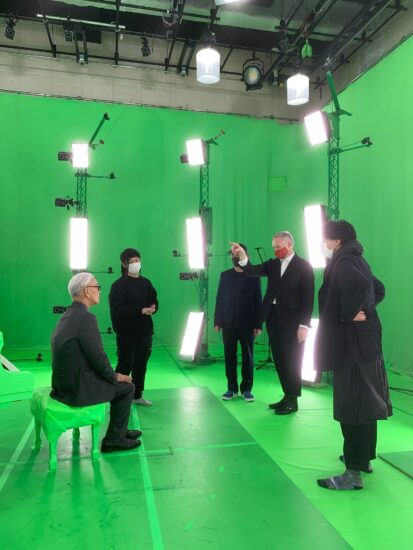
Ryuichi Sakamoto, director Todd Eckert, and Rhizomatiks work behind the scenes on Kagami (photo courtesy Tin Drum)
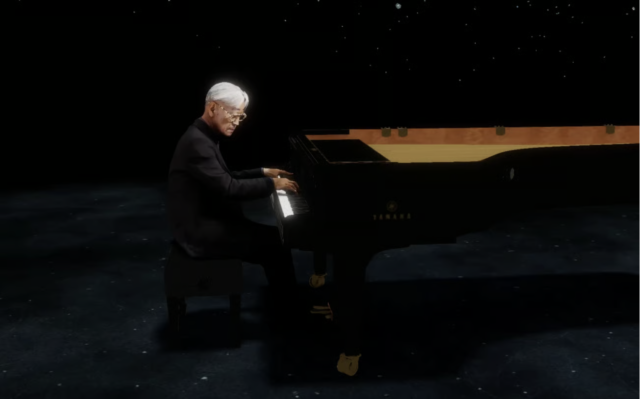
Kagami is a spectacular, breathtaking mixed-reality concert experienced with specially designed optically transparent devices, making it appear that Sakamoto is playing live piano, enveloped in augmented reality art. Visitors are first led into a room in the repurposed Griffin Theater with large-scale posters of Sakamoto and a screening of clips from Coda, in which he wanders through a lush forest and the Arctic, searching for the harmonies and melodies of nature. Sitting by a hole in the ice, he dips a microphone into the water and says, “I’m fishing with sound.”
The group of no more than eighty next enter another space, where chairs are set up in one row around a central area with cubic markings on the floor. Each person receives tight-fitting goggle-like glasses and, suddenly, a hologram of Sakamoto appears in the middle of the room, seated at his Yamaha grand piano; he was volumetrically captured in December 2020, during the height of Covid, by director Todd Eckert and his Tin Drum collective, which previously made the mixed-reality installation The Life with Marina Abramović.
The audience is warned before the show starts that the technology is not perfect — it turns out that the hologram is not very sharp, and it’s difficult to understand what Sakamoto says in brief introductions to two of the songs — but it’s jaw-droppingly gorgeous nonetheless. The fifty-minute concert begins with the jazzy “Before Long” from the 1987 album New Geo; as the white-haired Sakamoto tickles the ivories, smoky clouds rise from the floor and float in the air. Near the end of the number, one audience member got up and walked over to the image of Sakamoto at the piano. A few others, including me, soon joined him, and more followed. As Sakamoto played the ethereal, New Agey “Aoneko no Torso” from 1995’s Smoochy, I approached Sakamoto and slowly sauntered around the piano, seeing the maestro from all different angles, close enough to determine the length of his fingernails and follow his eye movement. Even though he’s slightly out of focus, it’s hard to believe he’s not really right there, questioning reality itself as a construct. Although you could walk through him, no one did, as if out of respect.
Experience KAGAMI, the remarkable final staged concert by legendary composer and artist Ryuichi Sakamoto at The Shed (@theshedny).
— ryuichi sakamoto (@ryuichisakamoto) May 25, 2023
Over the next several songs, ranging from “The Seed and the Sower” and the title track from the 1983 film Merry Christmas, Mr. Lawrence, “Andata” from async, “Energy Flow” and “Aqua” from 1999’s BTTB, and “MUJI2020” from the “Pleasant, somehow” campaign about humanity’s responsibility to the environment, raindrops created ripples in a pond at our feet; diagonal neon lights hovered ominously over our heads; snowflakes fluttered by; multiple screens projected archival black-and-white footage of old cities and a snowstorm; and a tree grew out of the piano, its roots then digging far into the ground, mimicking the circulatory system. The highlight was when the Griffin became like the Hayden Planetarium, with stars and constellations everywhere and the spinning earth underneath, making me feel like I was floating in the air, a wee bit dizzy until I let the music bring me back.
One of the most fascinating aspects of the technology is its ability to essentially allow you to see right through anyone standing in front of you. At a concert with a real pianist, if a tall person gets in your way, you can’t see the performer. But here, they are like ghosts; you can make out their outlines but still have a clear path to Sakamoto. Of course, the other people are actually there, so you have to avoid bumping into them by using your peripheral vision.
Kagami means “mirror” in Japanese, and the show certainly makes you look at who you are both as an individual and as part of the greater environment. The special effects cause sensations reminiscent of Japanese artist Yayoi Kusama’s thrilling Infinity Rooms, which use lights and mirrors to extend visions of our universe. The presentation is no mere money grab by an estate trying to resurrect their dead cash cow with posthumous holographic tours. Kagami is an intricately designed multimedia installation that the artist was deeply involved in; Sakamoto fashioned his own unique legacy, pushing the boundaries yet again, playing one last concert that can last forever, or at least as long as the planet he so loved and protected is still here and the batteries last.
Cheryl Dunye wrote, directed, edited, and stars in The Watermelon Woman
THE WATERMELON WOMAN (Cheryl Dunye, 1996)
Quad Cinema
34 West 13th St. between Fifth & Sixth Aves.
Wednesday, June 14, 5:30 & 7:30
Series continues through
212-255-224 quadcinema.com
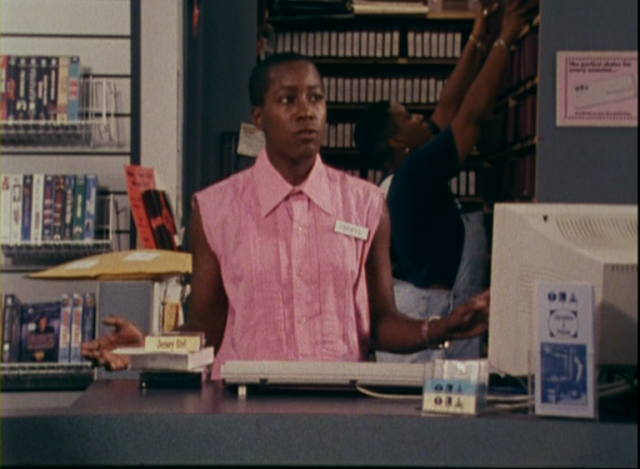
“The idea came from the real lack of information about the lesbian and film history of African American women. Since it wasn’t happening, I invented it,” Cheryl Dunye says about her 1996 debut, The Watermelon Woman, which underwent a twentieth-anniversary 2K HD restoration in 2016. In the film, the first feature by a black lesbian, Dunye plays herself, a twenty-five-year-old black lesbian working at a video store with her goofy best friend, Tamara (Valerie Walker). Searching for a topic to make a movie on, Cheryl becomes obsessed with an actress who played a mammy in Plantation Memories and other 1930s films. The actress was listed in the credits as the Watermelon Woman; Cheryl decides to find out more about her, going on a journey in and around her hometown of Philadelphia, discovering more and more about the actress, also known as Fae Richards, and the battle black lesbians had to fight in the early-to-mid-twentieth century. In the meantime, Cheryl begins a relationship with Diana (Guinevere Turner), a privileged white woman who has just moved into the area, mimicking what Cheryl has found out about Richards, who had an affair with white director Martha Page.
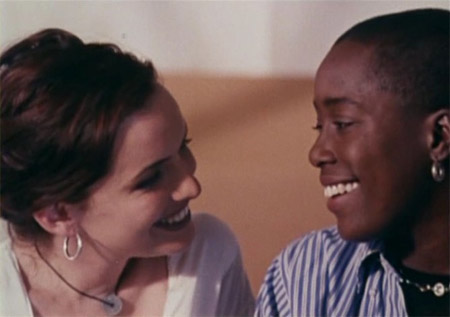
Diana (Guinevere Turner) and Cheryl Dunye (as herself) stars a relationship in The Watermelon Woman
The Watermelon Woman suffers from amateurish filmmaking techniques (Michelle Crenshaw was the cinematographer, while Dunye served as editor as well as writer, director, and star), but its central issue is a compelling one, and Dunye is engaging as her onscreen alter ego. Richards (Lisa Marie Bronson) and Page (producer Alexandra Juhasz) are seen only in photographs and archival footage shot by white lesbian artist Zoe Leonard (her photography assistant was Kimberly Peirce, who went on to make Boys Don’t Cry), while Doug McKeown (The Deadly Spawn) directed the scenes from fake movies Plantation Memories and Soul of Deceit. (The photographs became an art project of its own, touring museums around the world.) The film features numerous cameos by writers, musicians, and activists, including Camille Paglia as herself, V. S. Brodie as a karaoke singer, Sarah Schulman as the CLIT archivist, David Rakoff as a librarian, and Toshi Reagon as a street singer. The Watermelon Woman is a heartfelt tribute to black lesbians by a black lesbian who is restoring one woman’s true identity as a microcosm for all black women who have had theirs taken away. In addition, the film became part of an attempt by certain congressmen to defund the National Endowment for the Arts, which supplied a $31,500 grant to Dunye; Michigan Republican Peter Hoekstra, head of the House Education and Workforce Committee’s Subcommittee on Oversight and Investigations, singled the film out as offensive. The Watermelon Woman is also a reminder of what research was like pre-Google, less than thirty years ago. Dunye has gone on to make such films as Stranger Inside, Black Is Blue, Mommy Is Coming, and My Baby’s Daddy, continuing her exploration of multiracial, gay, and trans culture. The Watermelon Woman is screening June 14 at the Quad as part of the series “Pride Revived: Lines and Curves, Drawn and Moving”; the 7:30 show will be introduced by film critic, comedian, and podcaster Jourdain Searles. Also on the schedule are Shirley Clarke’s Portrait of Jason on June 12, Pier Paolo Pasolini’s Teorema on June 13, and Jack Sholder’s A Nightmare on Elm Street 2: Freddy’s Revenge on June 14.