Jealousy and envy are at the heart of François Ozon’s sexy thriller
CINÉSALON: SWIMMING POOL (François Ozon, 2003)
French Institute Alliance Française, Florence Gould Hall
55 East 59th St. between Madison & Park Aves.
Tuesday, November 18, $13, 4:00 & 7:30
Series continues Tuesdays through December 16
212-355-6100
www.fiaf.org
www.focusfeatures.com
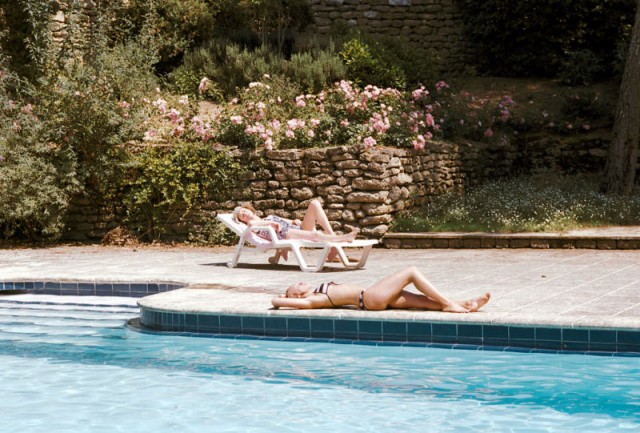
 Charlotte Rampling is divine in François Ozon’s playfully creepy mystery about a popular British crime novelist taking a break from the big city (London) to recapture her muse at her publisher’s French villa, only to be interrupted by the publisher’s hot-to-trot teenage daughter. Rampling stars as Sarah Morton, a fiftysomething novelist who is jealous of the attention being poured on young writer Terry Long (Sebastian Harcombe) by her longtime publisher, John Bosload (Game of Thrones’s Charles Dance). John sends Sarah off to his elegant country house, where she sets out to complete her next Inspector Dorwell novel in peace and quiet. But the prim and proper — and rather bitter and cynical — Sarah’s working vacation is soon intruded upon by Julie (Ludivine Sagnier), John’s teenage daughter, who likes walking around topless and living life to the fullest, clearly enjoying how Sarah looks at her and judges her. “You’re just a frustrated English writer who writes about dirty things but never does them,” Julie says, and soon Sarah is reevaluating the choices she’s made in her own life. Rampling, who mixes sexuality with a heart-wrenching vulnerability like no other actress (see The Night Porter, The Verdict, and Heading South), more than holds her own as the primpy old maid in the shadow of a young beauty, even tossing in some of nudity to show that she still has it. (Rampling has also posed nude in her sixties in a series of photographs by Juergen Teller alongside twentysomething model Raquel Zimmerman, so such “competition” is nothing to her.)

Julie (Ludivine Sagnier) and Sarah (Charlotte Rampling) come to a kind of understanding in François Ozon’s SWIMMING POOL
Rampling has really found her groove working with Ozon, having appeared in four of his films, highlighted by a devastating performance in Under the Sand as a wife dealing with the sudden disappearance of her husband. Sagnier, who has also starred in Ozon’s Water Drops on Burning Rocks and 8 Women, is a delight to watch, especially as things turn dark. Swimming Pool is very much about duality; the film opens with a shot of the shimmering Thames river while the title comes onscreen and Philippe Rombi’s score of mystery and danger plays, and later Sarah says, “I absolutely loathe swimming pools,” to which Julie responds, “Pools are boring; there’s no excitement, no feeling of infinity. It’s just a big bathtub.” (“It’s more like a cesspool of living bacteria,” Sarah adds.) Ozon (Time to Leave, Criminal Lovers) explores most of the seven deadly sins as Sarah and Julie get to know each other all too well. Swimming Pool is being shown November 18 at 4:00 and 7:30 as part of the French Institute Alliance Française CinéSalon series “The Art of Sex and Seduction,” with the later screening introduced by filmmaker Ry Russo-Young and followed by a wine reception; the series continues Tuesdays through December 16 with Alain Guiraudie’s Stranger by the Lake introduced by Alan Brown, Catherine Breillat’s The Last Mistress introduced by Melissa Anderson, and François Truffaut’s The Man Who Loved Women introduced by Laura Kipnis, all complemented by Jean-Daniel Lorieux’s “Seducing the Lens” photography exhibition.
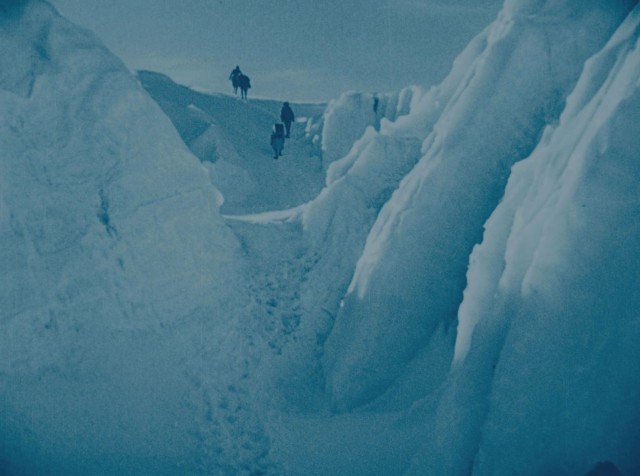
 In 1924, two British men, among the most famous mountaineers of their time, George Mallory and Andrew “Sandy” Irvine, set out with a large team to climb to the summit of Everest. Their amazing journey was documented by Captain John Noel, who used a hand-cranked camera with an impressive telephoto lens and sent the footage via yak to a lab in Darjeeling to be developed. The resulting black-and-white film, The Epic of Everest, is a poetic document of the third attempt to scale Everest, a mountain the Tibetans called “Chomo-Lung-Ma,” or Goddess Mother of the World. The eighty-seven-minute silent film has been digitally restored by the British Film Institute in a beautiful version that is making its New York premiere November 14 at the Rubin Museum, where it will be shown more than a dozen times through December 21, with most screenings introduced by a special guest and some followed by Q&As. The Epic of Everest, which is also ethnographically important for its (at times ethnocentric) depiction of local Tibetan culture, includes several scenes of Mount Everest tinted in blue, red, and violet; the ice-blue Fairyland section is especially breathtaking. Meanwhile, the restored intertitles display such dramatic text as “There is nowhere here any trace of life or man. It is a glimpse into a world that knows him not. Grand, solemn, unutterably lonely, the Rongbuk Glacier of Everest reveals itself.” and “Nor can one wonder at the invention that has clothed this extraordinary peak with a sacred character. What a terrifying thing it is! What an immensity of size, height and power it possesses!”

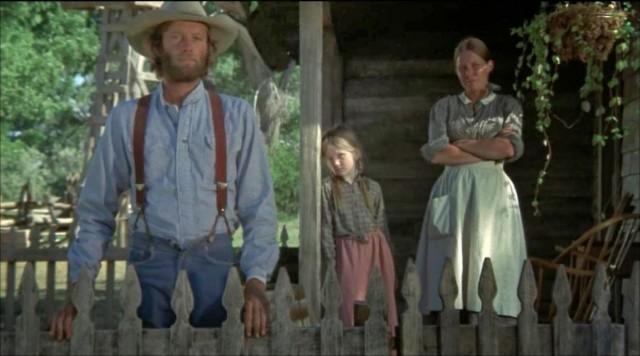
 After many years away from the homestead, Harry Collings (first-time-director Peter Fonda) returns to his farm, only to find that his wife (Verna Bloom) has kept herself rather busy once she assumed he was not coming back, in The Hired Hand, a so-called hippie Western written by Scottish novelist Alan Sharp, who also wrote Ulzana’s Raid and Night Moves. Warren Oates is his usual fine self as Harry’s dedicated sidekick, Arch Harris, as they do battle with the likes of the evil McVey (Severn Darden). The quiet, beautiful Fonda is like a Zen cowboy, trusting in karma to right the world’s wrongs, but that doesn’t always work out. Fonda considers the film, photographed by a young Vilmos Szigmond (McCabe & Mrs. Miller, The Deer Hunter), to be a Greek tragedy within a Western; indeed, it’s a little gem that that goes way beyond the trappings of the genre, laying the groundwork for such later anti-Westerns as Clint Eastwood’s Unforgiven. The film is being shown November 14 as part of the Rubin Museum Cabaret Cinema series “My Formative Years,” curated by artist Francesco Clemente in conjunction with his current solo show, “Inspired by India,” and will be introduced by playwright Neil LaBute. Clemente says about the film, “I’m in favor of psychedelia in all manifestations and to find psychedelia in a Western is always nice when it happens, but it never happens.” The film series continues with Alejandro Jodorowsky’s The Holy Mountain on November 21 and Pier Paolo Pasolini’s Salò, or the 120 Days of Sodom on November 28 (introduced by choreographer Karole Armitage), before concluding with Gianfranco Rosi’s Sacro GRA on December 5.
 Brooklyn-based documentarian Andrea B. Scott reveals the soft underbelly of contemporary America in Florence, Arizona, which is having its world premiere this week at the annual DOC NYC festival. Scott heads to the small desert town of Florence in the Grand Canyon State, an area that was a farm community until a nearby 1875 silver boom led to its becoming a more wild West kind of place. Today the town revolves around the prison system; there are twice as many prisoners in Florence as there are residents, and a call to privatize more of the jails is part of the battle for mayor between the New Age-y Lina Austin and former police chief Tom Rankin, both of whom speak openly and honestly with Scott. Scott, who directed, produced, coedited, and photographed the film — which includes gorgeous shots of sunrises and vast landscapes — also meets with prison barber and former inmate Andy Celaya, who remembers the respect ex-cons used to get after serving their time; another former prisoner, young Marcus Seitz, who can’t wait to turn twenty-one so he can work inside the prison, explaining, “That would be pretty cool”; and grizzled prison detention officer Gunny Jackson, who runs the Semper Fi Ranch with his wife, Lois, and considers himself a “dove” who can be “a very vicious man when I want to be; I know how to inflict pain.” Scott also visits the Pinal County Historical Society, which features a section on all of the people who have been executed in Florence’s prisons.