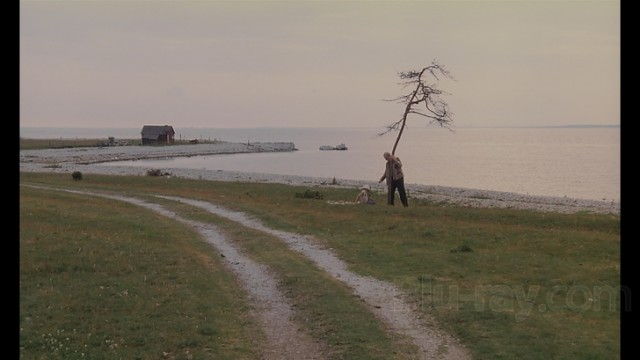
A man and his son plant a dead tree they hope will grow in Andrei Tarkovsky’s final film, THE SACRIFICE
THE SACRIFICE (OFFRET) (Andrei Tarkovsky, 1986)
Museum of Arts & Design
2 Columbus Circle at 58th St. & Eighth Ave.
Friday, August 21, $10, 7:00
Series continues Friday nights through August 28
212-299-7777
madmuseum.org
 Andrei Tarkovsky’s final film, The Sacrifice, completed shortly before his death in 1986 of cancer at the age of fifty-four, serves as a glorious microcosm of his career, exploring art, faith, ritual, devotion, and humanity in uniquely cinematic ways. Made in Sweden, the film has many Bergmanesque qualities: Bergman’s longtime cinematographer, Sven Nykvist, shot the film; the production designer is Anna Asp, who won an Oscar for her work on Fanny and Alexander; Bergman’s son Daniel served as a camera assistant; and the star is Erland Josephson, who appeared in ten Bergman films as well as Tarkovsky’s previous feature, the Italy-set Nostalghia. Josephson plays Alexander, a retired professor and former actor living in the country with his wife, the cold Adelaide (Susan Fleetwood), his stepdaughter, Marta (Filippa Franzén), and young son, Little Man (Tommy Kjellqvist), who cannot speak after a recent throat operation. It is Alexander’s birthday, and the family doctor, Victor (Sven Wollter), has come to visit, along with the odd local postman, Otto (Allan Edwall), who explains, “I collect incidents. Things that are unexplainable but true.” Also on hand are the two maids, Maria (Guðrún Gísladóttir), who Otto believes is a witch, and Julia (Valérie Mairesse). Alexander states early on that he has no relationship with God, but when a nuclear holocaust threatens, he suddenly gets down on the floor and prays, offering to sacrifice whatever it takes in order for him to survive, leading to a chaotic conclusion that is part slapstick, part utter desperation.
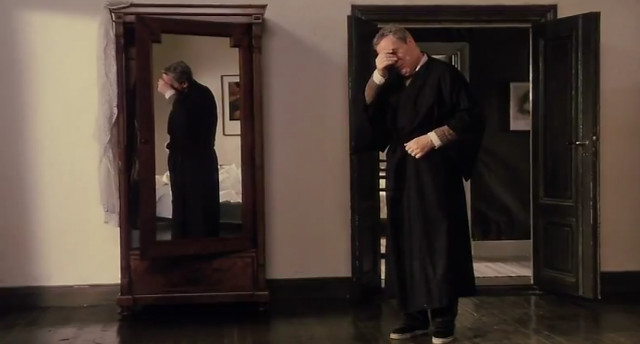
Alexander (Bergman regular Erland Josephson) is seeking redemption in THE SACRIFICE
Although it has a more focused, direct narrative than most of Tarkovsky’s other works, The Sacrifice is far from a conventional story. Tarkovsky has written that it “is a parable. The significant events it contains can be interpreted in more than one way. . . . A great many producers eschew auteur films because they see cinema not as art but as a means of making money: the celluloid strip becomes a commodity. In that sense The Sacrifice is, amongst other things, a repudiation of commercial cinema. My film is not intended to support or refute particular ideas, or to make a case for this or that way of life. What I wanted was to pose questions and demonstrate problems that go to the very heart of our lives, and thus to bring the audience back to the dormant, parched sources of our existence. Pictures, visual images, are far better able to achieve that end than any words.” The film is filled with gorgeous visual images, beautiful shots of vast landscapes, of open doorways in stark interiors, of mirrors and windows, of Alexander and Little Man planting a dead tree by the edge of the ocean, and spoken language is often kept to a minimum, saved for philosophical discussions of God, Nietzsche, and home. Several scenes are filmed in long, continuous shots, lasting from six minutes to more than nine, heightening both the reality and the surrealism of the tale, which includes black-and-white memories, floating characters, and actors staring directly into the camera. Although Christianity plays a key role in the film — Tarkovsky considered himself a religious man, and the opening credits are shown over a close-up of Leonardo da Vinci’s “Adoration of the Magi” — the redemption that Alexander is after is a profoundly spiritual and, critically, a most human one as he searches for truth and hope amid potential annihilation. Winner of three awards at the Cannes Film Festival (among many other honors), The Sacrifice is screening August 21 at 7:00 as part of the Museum of Arts & Design film series “Andrei Tarkovsky, Sculpting in Time,” which runs Friday nights through August 28 and includes all seven of Tarkovsky’s masterpieces (Solaris, Stalker, Ivan’s Childhood, Andrei Rublev, The Mirror, Nostalghia, The Sacrifice) before concluding with the behind-the-scenes documentary Directed by Andrei Tarkovsky, which lends fascinating insight to the making of The Sacrifice in particular.
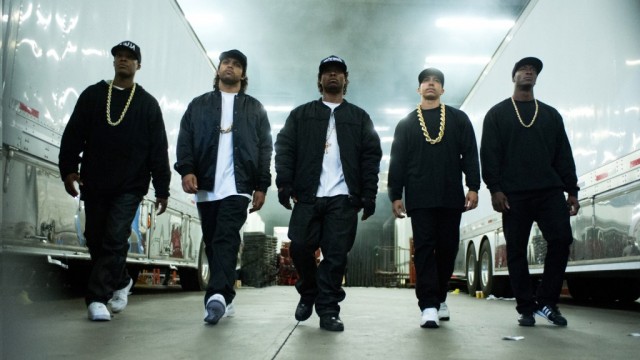
 F. Gary Gray’s Straight Outta Compton comes barreling out of the gates with all the rage and fury of the 1988 title track, which kicks off with Dr. Dre declaring, “You are now about to witness the strength of street knowledge.” The energetic film follows the rise and fall, or creation and dissolution, of N.W.A, the seminal south L.A. hip-hop group that changed music forever. In the late 1980s, Ice Cube (O’Shea Jackson Jr.), Dr. Dre (Corey Hawkins), Eazy-E (Jason Mitchell), MC Ren (Aldis Hodge), and DJ Yella (Neil Brown Jr.) formed a rap group that sought to capture the sound and feel of what was happening on the streets of Compton, from drugs and gangs to racist cops and poverty. They were a smash hit, particularly their controversial song “Fuck Tha Police,” which set up confrontations with authorities as the band hit the road on a nationwide tour. But when Cube and Dre start questioning where all the money is going — Eazy-E and manager Jerry Heller (Paul Giamatti) seem to be doing a lot better than the rest of them — everything they have built up threatens to unravel. And once Suge Knight (R. Marcus Taylor) enters the picture, the violence level increases, and things start getting even more out of control.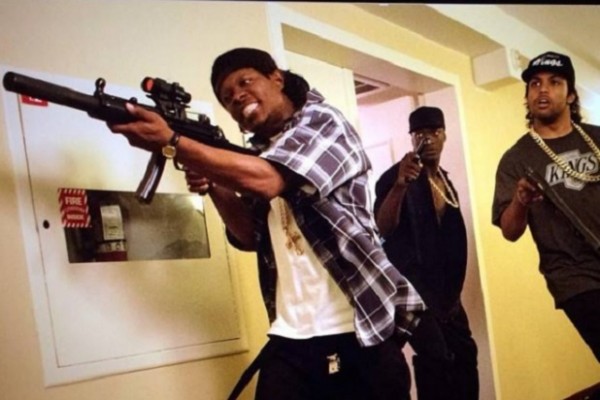
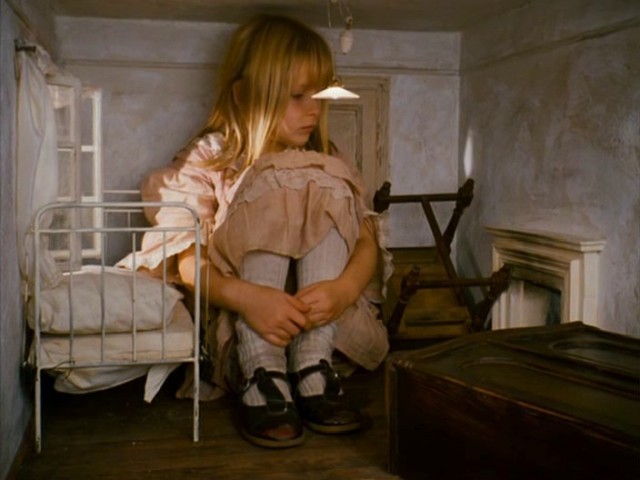
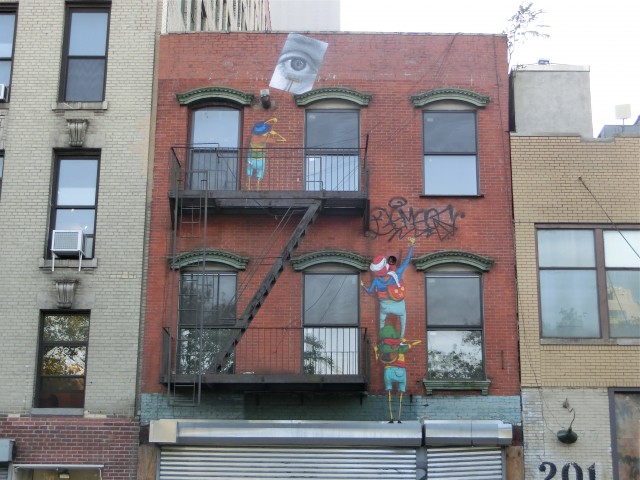
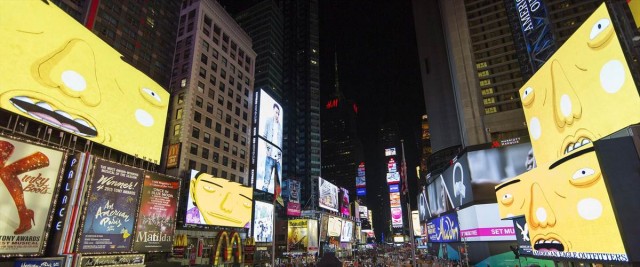
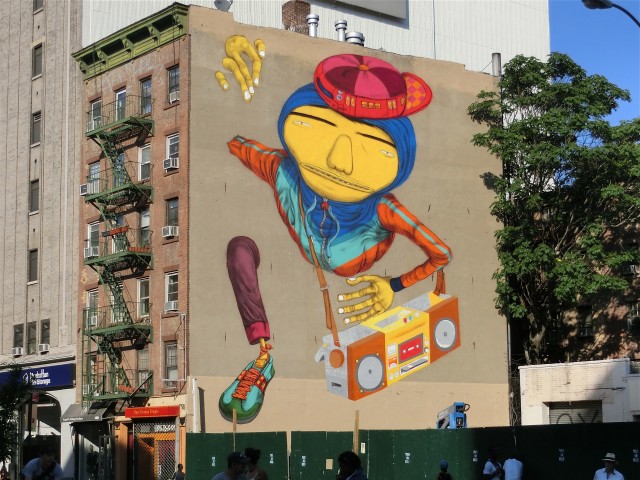
 Czech master Jan Švankmajer’s debut feature-length film is a unique and unusual trip inside Lewis Carroll’s Alice’s Adventures in Wonderland. But this being Švankmajer, who began making creepy and fun stop-motion animated shorts in 1964, this is not a traditional telling. “Alice thought to herself, Now you will see a film made for children — perhaps,” Alice (Kristýna Kohoutová) says at the beginning. “But — I nearly forgot — you must close your eyes. Otherwise, you won’t see anything.” Sitting on the bank of a river, Alice tries to look at the book being read by her older sister (the figure is possibly a doll; the audience never sees the head), but Alice gets slapped, so she soon creates her own story in her head, as a taxidermied white rabbit comes alive and she follows it into a desk drawer and enters a weird, fantastical land where she alternates between being a regular-sized girl, a giantess, and a small doll. She encounters Carroll’s Mad Hatter, the beheading-crazed queen, a live piglet, and his other oddball creatures as she keeps finding keys that lead her into stranger and stranger places. She never smiles as her curiosity grows, very much a child with natural fears about what awaits her in the future. Alice gives different voices to all the characters as she narrates the tale, with all the lines identifying the speaker (“said the white rabbit,” “cried out the Mad Hatter and the March Hare”) accompanied by an extreme and disconcerting close-up of Alice’s mouth saying the words. Alice has constructed a dark world in her imagination, one that is not nearly as playful as the one created by Carroll. Švankmajer’s (Faust, Little Otik) use of dolls, puppets, and bizarre sets is impressively peculiar as the story takes grotesque twists and turns that are certainly not for younger children. Alice is screening August 19 as part of the Socrates Sculpture Park Outdoor Cinema series and will be preceded by a live performance by Brooklyn electronics duo Xeno and Oaklander, and Eastern European food will be available from Bear; the summer festival concludes August 26 with Joann Sfar’s Gainsbourg: A Heroic Life. And be sure to get there early to check out the
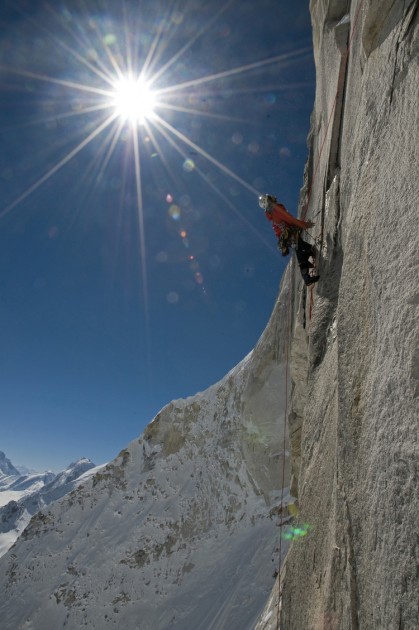
 “This climb has seen more attempts and more failures than any route in the Himalaya,” Into Thin Air author Jon Krakauer says near the beginning of Meru, which follows two recent tries to make it to the Shark’s Fin summit atop Mount Meru in India. “It’s the headwaters of the Ganges River, one of the most sacred rivers on earth, the center of the universe. It’s this weird nexus that is the point where heaven and earth and hell all come together.” In 2008, Conrad Anker, Jimmy Chin, and Renan Ozturk sought to be the first climbers ever to reach the top of the mountain, which features a 1,500-foot nearly sheer blade of granite at its apex. Scaling Mount Meru is more than just an extreme sport; it’s a passion and an obsession, and a supremely dangerous one at that. The film documents the two climbs as well as an extreme skiing photo shoot, and each time the men set out on a journey, they know that there is a chance that they might not make it back to their loved ones. Ozturk faces even more daunting odds; he attempts a second climb after a serious head injury with aftereffects that could kill him. But the trio is determined to go where no one has gone before, even as the stakes increase and their prospects for success dim considerably. “Meru is not just hard; it’s hard in this really complicated way,” Krakauer adds. “You can’t just be a good ice climber. You can’t just be good at altitude. You can’t just be a good rock climber. . . . It’s defeated so many good climbers and maybe will defeat everybody for all time. That, to a certain kind of mind-set, is an irresistible appeal.” In addition to carrying two hundred pounds of gear on their back, Chin, who is also a professional photographer, and Ozturk have small cameras, deatiling the treacherous trip up the twenty-one-thousand-foot-high mountain. The film is filled with gorgeous shots of the mountain and the surrounding area, but it is a beauty fraught with danger. Codirectors Chin and his wife, E. Chai Vasarhelyi (Youssou N’Dour: I Bring What I Love, Touba), include commentary by the three alpinists, some of their relatives, Krakauer, and big mountain snowboarding legend Jeremy Jones, which emphasizes the tremendous peril involved in the climb. “I often ask myself: Where do you draw the line between following your heart and your responsibility to others?” Chin explains in his director’s statement, and the film does an excellent job of examining that critical point, especially as potential death surrounds them. Winner of the U.S. Documentary Audience Award at the 2015 Sundance Film Festival, Meru is a tense, tantalizing look at humanity’s never-ending desire to go beyond all limits to bond with, and conquer, nature and its elements, no matter the risks. Meru opens August 14 at the Angelika, with Chin and Vasarhelyi participating in Q&As following the 5:00 and 7:20 shows on Friday and Chin by himself on August 19 at 7:20.