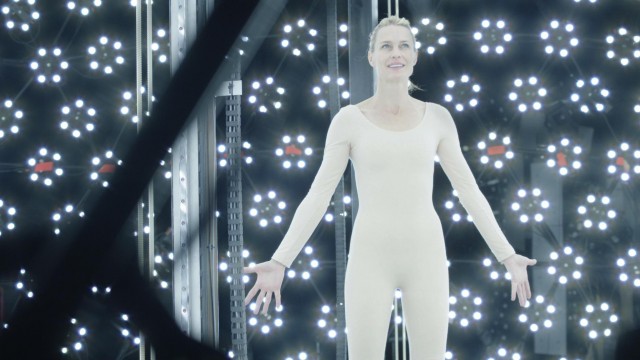
Robin Wright gets scanned for Hollywood posterity in Are Folman’s underseen gem, THE CONGRESS
CABARET CINEMA: THE CONGRESS (Ari Folman, 2013)
Rubin Museum of Art
150 West 17th St. at Seventh Ave.
Friday, September 30, $10, 9:30
212-620-5000
rubinmuseum.org
 Writer-director Ari Folman imagines a sad but visually dazzling future in the spectacular fantasy The Congress. Inspired by Stanislaw Lem’s 1971 short novel The Futurological Congress, the film follows Robin Wright playing a fictionalized version of herself, an idealistic actress about to turn forty-five who has let her career come second to raising her two children, daughter Sarah (Sami Gayle) and, primarily, son Aaron (Kodi Smit-McPhee), who is slowly losing the ability to see and hear. Wright’s longtime agent, Al (Harvey Keitel), has a last-chance opportunity for her: Jeff Green (Danny Huston), the head of Miramount, wants to scan her body and emotions so the studio can manipulate her digital likeness into any role while keeping her ageless. They don’t want the modern-day Robin Wright but the young, beautiful star of The Princess Bride, State of Grace, and Forrest Gump. The only catch is that in exchange for a substantial lump-sum payment, the real Wright will never be allowed to act again, in any capacity. With no other options, she reluctantly takes the deal. Twenty years later, invited to speak at the Futurological Congress, she enters a whole new realm, a fully animated world where men, women, and children live out their entertainment fantasies. Shocked by what she is experiencing, Wright meets up with Dylan Truliner (Jon Hamm), who has been animating her digital version for years, as a revolution threatens; meanwhile, Green has another offer for her, even more frightening than the first.

Robin Wright enters the animated, hallucinogenic fantasy world of the future in THE CONGRESS
The Congress is a stunning look at America’s obsession with celebrity culture and pharmaceutical release amid continuing technological advancements in which avatars can replace real people and computers can do all the work. The animated scenes, consisting of sixty thousand drawings made in eight countries, are mind-blowing, referencing the history of cartoons, from early Max Fleischer gems through Warner Bros. classics as well as nods to Disney, Pixar, Who’s Afraid of Roger Rabbit, and even Richard Linklater’s rotoscoped Waking Life; Folman also pays homage, directly and indirectly, to James Cameron and Stanley Kubrick. (The central part of the cartoon scenes were actually filmed live first, then animated based on the footage; be on the lookout for cameos by Frank Sinatra, Elvis Presley, Frida Kahlo, and dozens of other familiar faces.) Wright gives one of her best performances playing a modified version of herself, maintaining a calm, cool demeanor even as things threaten to completely break down around her. Paul Giamatti does a fine turn as her son’s concerned doctor, and Huston has a ball chewing the colorful scenery as the greedy, nasty studio head (as well as numerous other authority figures). The film also plays off itself in wonderful ways; the fictionalized Wright is at first against being scanned and used in science-fiction films, but the real Wright, of course, has agreed to be turned into a cartoon character in a science-fiction film. The story does get confusing in the second half, threatening to lose its thread as it goes all over the place, but Folman, whose previous film was the Oscar-nominated Waltz with Bashir, manages to bring it all together by the end, led by the stalwart Wright. Named Best European Animated Feature at the European Film Awards, The Congress is an eye-popping, soul-searching, hallucinogenic warning of what just might be awaiting all of us. It’s screening September 30 at 9:30 at the Rubin Museum, concluding the three-part Cabaret Cinema series “Consciousness Hacking: Mind-Expanding Film Experiences,” in which Consciousness Hacking founder Mikey Siegel and Consciousness Hacking NYC cofounder Dr. Christopher Kelley investigate “the three principal dimensions of consciousness hacking: 1) Contemplation, 2) Psychedelic Journey, and 3) Technological Innovation.” Dr. Kelley will host the screening, joined by special guests.
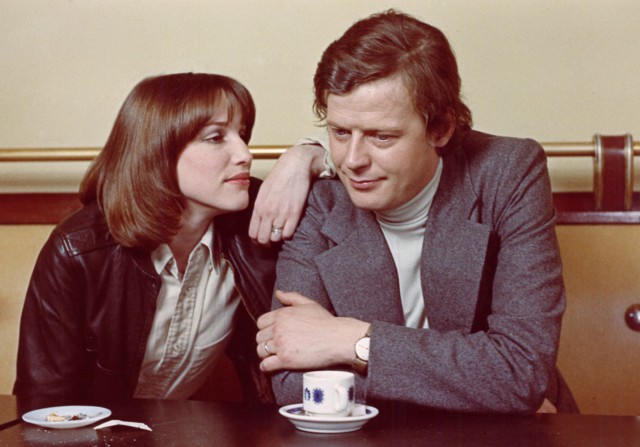
 The Film Society of Lincoln Center’s “Eric Rohmer’s Six Moral Tales” concludes with the last work in the series, the 1972 drama Love in the Afternoon, which serves not only as the chronological end but the thematic finale as well. Bernard Verley stars as Frédéric Carrelet, a nearly perfect 1970s French bourgeois character. In his mid-thirties, a partner in a two-lawyer firm, he is about to have his second child with his wife, Hélène, played by his real spouse at the time, Françoise Verley, in her only feature film. While Frédéric seems at ease with his steady suburban life, he daydreams about other women, albeit with no intention of taking action. At lunch he goes to a café, watches all the passersby outside, and thinks (in voice-over narration), “If there’s one thing I’m incapable of now, it’s trying to seduce a girl. I have no idea what to say.” However, he adds, “The prospect of quiet happiness stretching indefinitely before me depresses me.” But he also admits about women, “I feel their seductive power without giving in to it.” But when an old friend from his past, the sexy and freewheeling Chloé (Zouzou), unexpectedly arrives in his office one day and starts an unpredictable yet exciting flirtation with him, Frédéric is forced to look deep inside himself and make some choices about his life that are harder than he anticipated.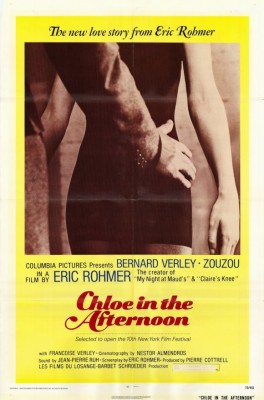

 This past spring, the FIAF CinéSalon series “EDM Anthems: French Touch on Film” concluded with Céline Sciamma’s


 Menachem Daum and Oren Rudavsky’s The Ruins of Lifta: Where the Holocaust and Nakba Meet is built on a faulty premise, but the film still manages to be a rather provocative and intriguing documentary. In their previous collaboration, Hiding and Seeking: Faith and Tolerance after the Holocaust, Rudavsky and Daum examined Daum’s relationship with his parents, Polish Jews who survived the Holocaust and taught Daum to distrust all non-Jews. Their latest film takes viewers to Lifta, the historic but now crumbling Palestinian village at the western entrance to Jerusalem that was abandoned during the 1948 war and has never been resettled by Palestinians or taken over by Israelis. A recent plan calls for it to be razed in order to make way for luxury villas. “Its ruins bear witness to the history of the Israeli-Palestinian conflict,” Daum, an Orthodox Jew, says about the village. “The story told by Lifta’s ruins challenges the narrative that I, the son of Holocaust survivors, believed in for most of my life.” Daum meets with members of the Coalition to Save Lifta, a small group of Jews and Palestinians, including cofounder Daphna Golan, Ilan Shatyer, and Yacoub Odeh. Daum also speaks with historians Benny Morris and Hillel Cohen and Palestinian lawyer Sami Arshid, who offer different perspectives on the conflict.