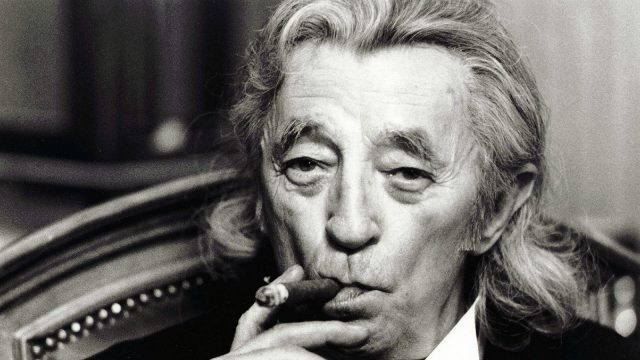
Robert Mitchum is subject of twenty-four-film retrospective at the New York Film Festival, honoring the centennial of his birth
New York Film Festival
Film Society of Lincoln Center
October 2-14
www.filmlinc.org/nyff2017
Bridgeport-born actor Robert Mitchum was a man’s man and an actor’s actor, a devilishly handsome and hunky machine operator from a working-class family who turned to acting following a nervous breakdown in the early 1940s. He went on to appear in more than 125 films, from noir thrillers and military dramas to sweeping romances and Westerns, establishing himself as a rough, rugged tough guy who was almost always cool, calm, and collected, with a deceptive easygoing manner. Mitchum, who passed away in 1997 at the age of seventy-nine, was also a recording artist and a poet. The Film Society of Lincoln Center is honoring the centenary of Mitchum’s birth with a twenty-four-movie salute at the fifty-fifth annual New York Film Festival, beginning October 2 with The Friends of Eddie Coyle, Track of the Cat, and River of No Return and including The Story of G.I. Joe, for which Mitchum received his only Oscar nomination, for Best Supporting Actor. Below is a look at several of the films being shown at this special event.
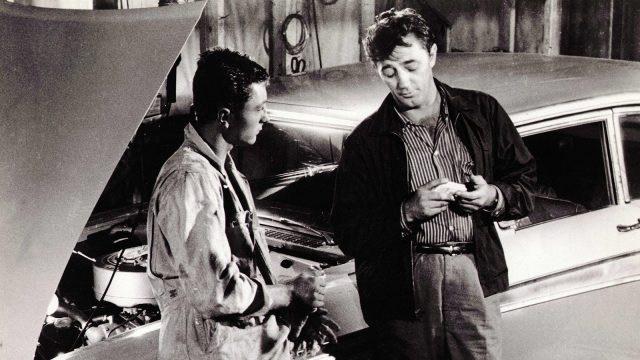
Robert Mitchum and his oldest son, James, play brothers in Thunder Road
THUNDER ROAD (Arthur Ripley, 1958)
Francesca Beale Theater
Wednesday, October 4, 3:30
www.filmlinc.org
 The film that gave Bruce Springsteen the title for one of his greatest songs is not one of Robert Mitchum’s best, although it was one of his most personal. The story of moonshining families in the backwoods of Tennessee was cowritten and produced by Mitchum, who also wrote the theme song, “The Ballad of Thunder Road,” and his sixteen-year-old son, James, plays his brother, Robin, a part originally meant for Elvis Presley. Robert Mitchum is Lucas Doolin, a daring transporter of illegal whiskey. Robin soups up his cars, giving them extra juice and an escape hatch for the moonshine in case the treasury agents, led by the determined and dedicated Troy Barrett (Gene Barry), catch him. When gangster Carl Kogan (Jacques Aubuchon) decides to take over the local trade, the whiskey runners are caught in more jeopardy, from both sides of the law. Meanwhile, Luke is in love with singer Francie Wymore (Keely Smith) but is being chased by Roxanna Ledbetter (Sandra Knight), who fellow transporter Jed Moultrie (Mitchell Ryan) is sweet on. With its opening authoritative voiceover about taxation and “the wild and reckless men” who work in the moonshine trade, the movie makes its message clear; these transporters are not heroes, and they must pay for their crimes. Director Arthur Ripley, who specialized in short films and television episodes, cannot maintain the story even for its ninety minutes, and although Mitchum is strong and sturdy in his role, James and Smith are not up to the task. There are some fine driving scenes, but the film plays too much like government propaganda, although that didn’t stop it from becoming a drive-in favorite over the years.
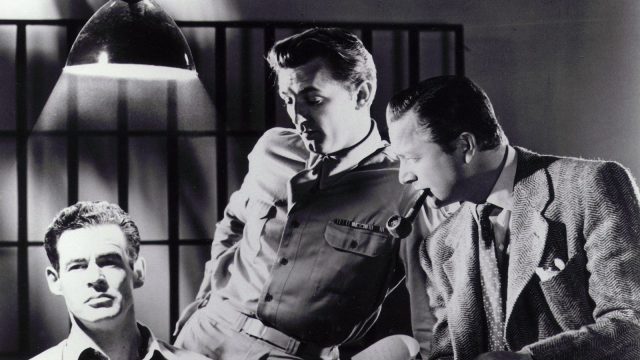
Robert Ryan, Robert Mitchum, and Robert Young star in Oscar-nominated social noir, Crossfire
CROSSFIRE (Edward Dmytryk, 1947)
Howard Gilman Theater
Friday, October 6, 3:30
www.filmlinc.org
 Edward Dmytryk’s 1947 socially conscious noir classic, Crossfire, has one of the great opening scenes of the genre, a fight that begins in shadows, plunges into darkness as a lamp is knocked over, and finally, in a sliver of light as shadows dominate the screen, J. Roy Hunt’s camera focuses on a man lying on the floor, dead. The rest of the film traces what happened that night, from the discovery of the perpetrator to how to catch the killer. There’s a fascinating twist to the story involving bigotry and hatred that is timely and relevant, involving anti-Semitism; in fact, the film was adapted by John Paxton based on screenwriter and director Richard Brooks’s novel, The Brick Foxhole, in which the victim was gay, but that had to be changed because of the Hays Code. World War II is over, and a group of recently discharged soldiers are in Washington, DC, trying to redefine their purpose in the aftermath of four years of battle. A night of drinking ends in the death of Joseph Samuels (Sam Levene), and police investigator Finlay (Robert Young) is on the case, speaking with the calm and disciplined Sgt. Keeley (Robert Mitchum) and the defensive and shifty Montgomery (Robert Ryan). The initial evidence points to Corporal Arthur Mitchell (George Cooper), who can’t remember all of the details of the night of the murder. After leaving Samuels’s apartment — also there were Monty and soldier Floyd Bowers (Steve Brodie) — the drunk and confused “Mitch” met up with tough-talking taxi dancer Ginny (Gloria Grahame), but she wants to stay out of the investigation completely. While Keeley tries to get to the bottom of everything without the police, Captain Finlay is not about to let them handle this by themselves.
Crossfire came out in 1947, the same year another, more famous film about anti-Semitism, Gentleman’s Agreement, was released. Both were nominated for the Best Picture Oscar, which Gentleman’s Agreement won a mere two months before the establishment of the State of Israel. But whereas Elia Kazan’s film, about a journalist, played by Gregory Peck, posing as a Jew for a story, is a more intellectual movie about the inherent anti-Semitism in society, Dmytryk’s (The Caine Mutiny; Murder, My Sweet) film looks much deeper at hatred and the violence it can lead to, without becoming pedantic and preachy. An Oscar-nominated Ryan, Mitchum, and Young form a marvelous trio, each of the soldiers developing a unique relationship with the police captain; it’s one of Young’s (Father Knows Best; Marcus Welby, M.D.) best roles, particularly when, with his ever-present pipe, he slinks back in his chair at a nearly impossible angle. “This business about hating Jews comes in a lot of different sizes,” Finlay explains in words that still ring true today and could be about various ethnicities, races, sexual orientations, and religions. “There’s the ‘You can’t join our country club’ kind. The ‘You can’t live around here’ kind. The ‘You can’t work here’ kind. And because we stand for all these, we get Monty’s kind. He’s just one guy; we don’t get him very often, but he grows out of all the rest. You know we have a law against carrying a gun? We have that law because a gun is dangerous. Well, hate — Monty’s kind of hate — is like a gun. If you carry it around with you, it can go off. . . . Hating is always insane, always senseless.” Also nominated for Best Director, Best Supporting Actress (Grahame), and Best Adapted Screenplay and winner of Best Social Film at Cannes, Crossfire is a gripping, bold tale about hate, war, and violence and what can happen to soldiers once the official, approved fighting is over. At one point, Finlay asks Keeley if he’s ever killed anyone, and the sergeant responds, “Where you get medals for it.” The brutality of war is central to Crossfire, which illuminates a psychological form of what became known as PTSD while also staring in the face of illogical hate in the aftermath of the Holocaust.
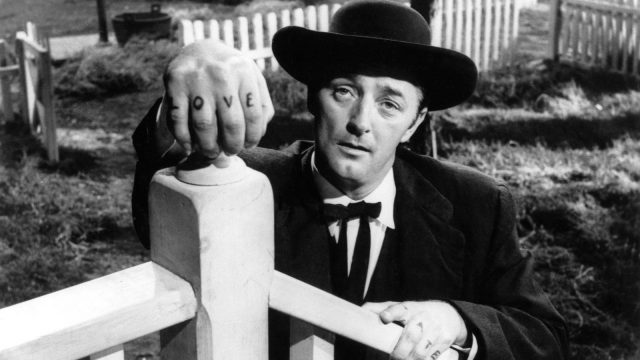
Robert Mitchum gets caught up in some dangerous dichotomies in The Night of the Hunter
THE NIGHT OF THE HUNTER (Charles Laughton, 1955)
Alice Tully Hall
Monday, October 9, 3:30
www.filmlinc.org
 Robert Mitchum redefined himself in Charles Laughton’s lurid story of traveling preacher/con man/murderer Harry Powell, who has the word “love” tattooed on one set of knuckles and “hate” on the other. While in prison, Powell bunks with Ben Harper (Peter Graves), who got caught stealing $10,000 — but the only person who knows where the money is is Ben’s young son, John (Billy Chapin). When Preacher is released from jail, he shows up on the Harpers’ doorstep, ready to woo the widow Willa (Shelley Winters) — and get his hands on the money any way he can, including torturing John and his sister, Ruby (Gloria Castillo). Laughton’s only directorial effort is seriously flawed — the scenes in the beginning and end with Lillian Gish are wholly unnecessary and detract from the overall mood. Stanley Cortez’s cinematography is outstanding, featuring his unique use of shadows, an intense battle between light and dark (which plays off of several themes: old versus young, rich versus poor, good versus evil, men versus women), and some marvelous silhouettes. Based on Davis Grubb’s 1953 novel, the film has made its way onto many best-of lists, from scariest and most thrilling to all-time great and most beautiful.
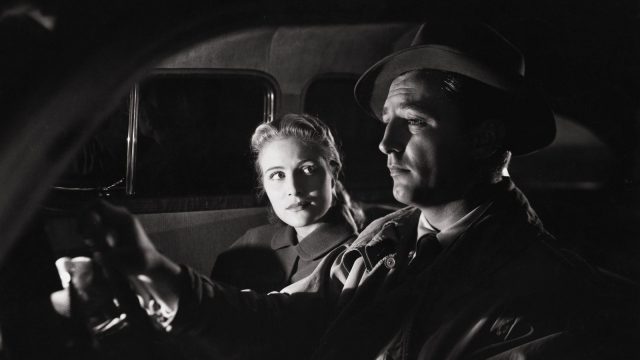
Jeff Bailey (Robert Mitchum) has quite a tale to tell Ann Miller (Virginia Huston) in film noir classic
OUT OF THE PAST (Jacques Tourneur, 1947)
Walter Reade Theater
Monday, October 9, 4:00
www.filmlinc.org
“You know, maybe I was wrong and luck is like love,” Jeff Bailey (Robert Mitchum) says in Out of the Past. “You have to go all the way to find it.” Bailey, previously known as Markham, is looking for luck and love in Jacques Tourneur’s film noir classic, considered one of the best of the genre, but he knows that it’s not going to come easy. Jeff is trying to escape his recent past by making a new life for himself in small-town Bridgeport, California (a nod to Mitchum’s real birthplace, Bridgeport, Connecticut), where he runs a gas station and is wooing Ann Miller (Virginia Huston), who is supposedly dating Jim (Richard Webb), the local policeman. But when Joe Stefanos (Paul Valentine) suddenly shows up, Jeff is thrown back into his sordid past when, as a private investigator, he got in too deep after being hired by New York gangster Whit Sterling (Kirk Douglas) to track down the kingpin’s girlfriend, Kathie Moffat (Jane Greer), who shot Whit and took off with forty grand. When Jeff finds her, he falls hard and fast and ultimately lies to Whit and Joe, Whit’s right-hand man, who never liked Jeff in the first place. To clean their slate, Whit forces Jeff to do one more job for him, involving lawyer Leonard Eels (Ken Niles), Eels’s secretary, Meta Carson (Rhonda Fleming), and, of course, Kathie. Jeff’s going to need a whole lot more than luck to get out of this one.
Adapted by Daniel Mainwaring from his 1946 novel, Build My Gallows High, Out of the Past is the quintessential noir, with shadowy cinematography by Nicholas Musuraca, moody music by Roy Webb, a bold antihero played by Mitchum, and Greer as one of the great femme fatales. Mitchum’s effortlessly cool and calm style, both onscreen and in his voiceover narration, shines through, a terrific counterpoint to Douglas’s wonderfully smarmy and sarcastic turn as the slick Sterling. Cigarettes play a major role in the film from the very start, when Joe flicks a match at Jeff’s young gas station employee (Dickie Moore, from The Little Rascals), a portent of things to come; from then on, the tension thickens as more and more butts are smoked, adding to the heavy atmosphere maintained by Tourneur, a longtime editor who also directed such films as Cat People and I Walked with a Zombie. “Look at all the angles,” Joe, seen from behind, tells Jeff, whose face is half in shadow, but he’s talking to the viewer as well. Out of the Past is screening on October 9 at 4:00 at the Walter Reade Theater and will be introduced by Mitchum’s son, Christopher, who has appeared in more than sixty films himself.
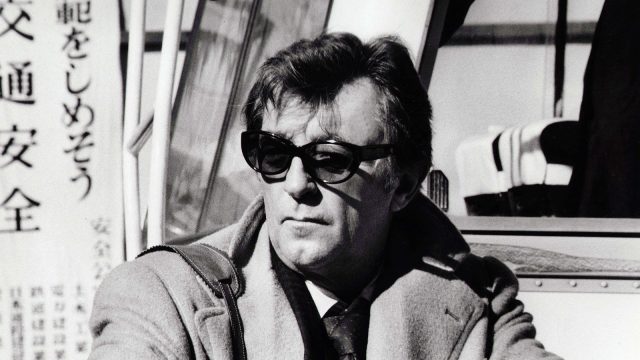
Robert Mitchum heads back to Japan in Sydney Pollack’s The Yakuza
THE YAKUZA (Sydney Pollack, 1975)
Francesca Beale Theater
Friday, October 13, 3:15
Festival runs through October 14
www.filmlinc.org
 One of Hollywood’s first forays into the Japanese underworld has quite a pedigree — directed by Sydney Pollack (coming off his success with The Way We Were) and written by Robert Towne (who had just scribed Chinatown and Shampoo) and Paul Schrader (his first writing credit, to be followed by Taxi Driver). Robert Mitchum stars as Harry Kilmer, a WWII vet who returns to Japan thirty years later to help his friend George Tanner (Brian Family Affair Keith), whose daughter has been kidnapped. Kilmer thinks he can just walk in and walk out, but things quickly get complicated, and he ends up having to take care of some unfinished business involving the great Keiko Kishi (The Twilight Samurai). Kilmer and his trigger-happy young cohort, Dusty (Richard Logan’s Run Jordan), hole up at Oliver’s (Herb “Murray the Cop” Edelman), where they are joined by Tanaka (Ken Takakura) in their battle against Toshiro Tono (Eiji Hiroshima Mon Amour Okada) and Goro (James Flower Drum Song Shigeta) while searching for a man with a spider tattoo on his head. There are lots of shootouts and sword fights, discussions of honor and betrayal, and, in the grand Yakuza tradition, the ritual cutting off of the pinkie. Oh, and there’s Robert Mitchum, of course, a cinematic giant who towers above it all.

 “We’ll have fun making a film,” legendary eighty-eight-year-old Belgian-born French auteur Agnès Varda tells thirty-three-year-old French photographer and street artist