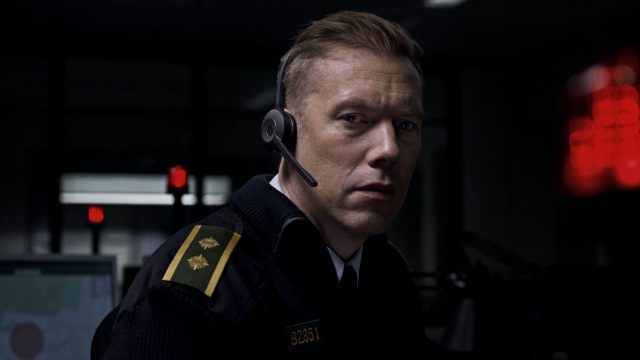
Jakob Cedergren stars as a cop on the edge in gripping thriller by debut director Gustav Möller (photo courtesy of Magnolia Pictures)
THE GUILTY (DEN SKYLDIGE) (Gustav Möller, 2018)
Quad Cinema
34 West 13th St. between Fifth & Sixth Aves.
November 13-15
212-255-2243 quadcinema.com www.theguiltyfilm.com
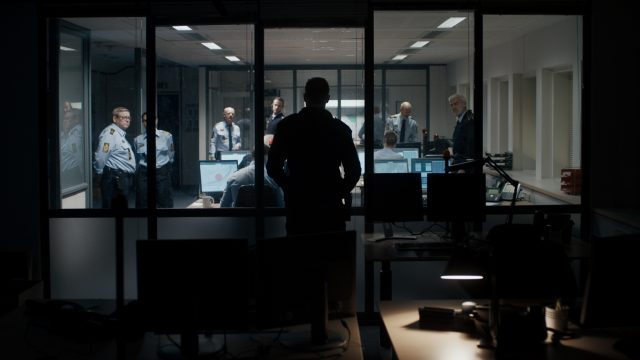
Danish director Gustav Möller’s debut feature, The Guilty, is a furiously intense, brilliant edge-of-your-seat procedural. Jakob Cedergren stars as police officer Asger Holm, who has been demoted to working in an emergency call center pending an investigative hearing into a mysterious incident; if the investigation exonerates him, he’ll be back out on the street, where he wants to be. The night before the hearing, he’s at the center, sitting in front of a computer, taking calls on a headset, mostly dismissing people’s problems with a shrug and a lack of concern, although his prowess is evident when he quickly gets to the bottom of things with callers who don’t tell him the full story. But then Iben Østergård (Jessica Dinnage) phones in, a distraught woman who apparently has been kidnapped by a crazed man (Johan Olsen), leaving her six-year-old daughter, Mathilde (Katinka Evers-Jahnsen), and infant home alone. Holm faces many of his own demons as he desperately tries to save Iben, demanding favors from dispatchers, including his friend and colleague Bo (Jacob Hauberg Lohmann); his partner, Rashid (Omar Shargawi), who is supposed to testify for him the next day; and others even as they warn him he is overstepping and needs to back off. It’s a pulse-pounding race against time as Holm continues to break the rules and protocol in order to rescue Iben — as if saving her would save him too, achieving the redemption he seeks.
Asger Holm (Jakob Cedergren) is battling more than just time in The Guilty (photo courtesy of Magnolia Pictures)
Denmark’s official submission for the 2019 Oscar for Best Foreign Language Film, The Guilty, which was written by Olsen with Emil Nygaard Albertsen, is a nonstop thrill ride and character study that takes place completely in the call center and in real time. Olsen, who also is the lead singer in two rock bands, maintains the frantic pace primarily through words, in addition to Cedergren’s facial expressions; the audience is caught up in the fierce action even though it is only heard, never seen. Cinematographer Jasper Spanning, editor Carla Luffe, and supervising sound editor Oskar Skriver expertly upend the claustrophobic nature of the story by making it seem like we can see the car chase, Iben’s terror, and Mathilde’s horrible situation. Of course, each viewer will see things slightly differently, bringing their own experiences and biases into the tale. Winner of audience awards at Rotterdam and Sundance, The Guilty is centered by an unrelenting performance by Cedergren (Submarino, Terribly Happy) as a man on a mission — and harboring some dark secrets — as the plot twists and turns. Don’t miss it.
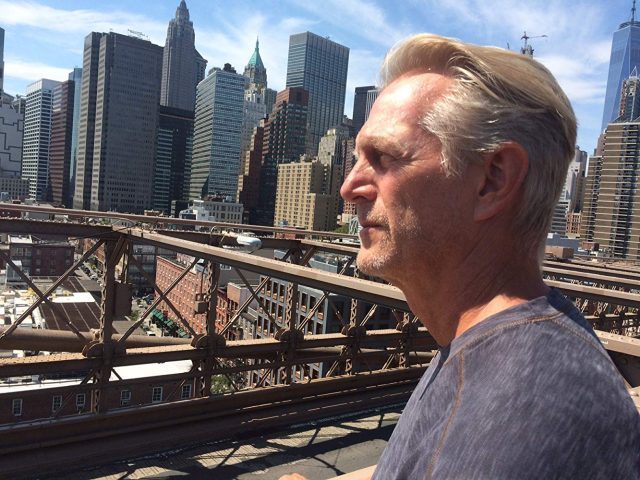
Hoyt Richards looks back at a critical decision in his life in Welcome to the Beyond
WELCOME TO THE BEYOND (Brent Huff, 2018)
Cinepolis Chelsea
260 West 23rd St. between Seventh & Eighth Aves.
Tuesday, November 13, 7:30
Festival runs November 8-15 www.docnyc.net www.welcometothebeyond.com
In the summer of 1978, Hoyt Richards, a gorgeous blond athlete from a large, successful family, was approached by a man on a beach in Nantucket who offered him a bright future. Richards, aka John Richards, appeared to already have it all, but he eventually followed the man, who turned out to be Frederick von Mierers, the leader of the Eternal Values cult, who claimed to be an alien from the planet Arcturus. Former model Brent Huff tells the bizarre story, in many ways a cautionary tale, in Welcome to the Beyond, screening November 13 at DOC NYC. In 2012, while filming a Ford Models reunion, actor, writer, and director Huff (Behind the Orange Curtain, Chasing Beauty) recognized Richards and approached him about making a documentary about his experience with Eternal Values. Richards agreed, and speaks extensively about what happened to him; Huff also meets with many of Richards’s friends and relatives. “There’s definitely a dynamic in this family that’s regrettable,” younger brother Garth says. “That dynamic had to do with, John was always my father’s favorite, and John epitomized what my father would have loved to have been: the blue-eyed, blond-haired, good-looking football player. There’s a cruel twist in all that, is that by my father making John his favorite, he created resentment from every other sibling of John. He put John on an island, and I don’t know how John internalized that, but that wasn’t a pretty place to be.”
Talking about his mother, John, who is one of the film’s producers, admits, “I always just felt like she was on a different planet.” John was the first male supermodel, went to Princeton, partied at Studio 54, and had a major career, but ultimately he came to understand that he was in a cult and that he had to get out. The psychology behind his story is related by Steven Hassan, a former cult member who became a deprogrammer and has written such books as Combatting Cult Mind Control. Richards’s five siblings, cousins, parents, and close friends as well as a fellow former cult member all share their thoughts on a situation that they still don’t really understand: Just why did Richards fall for von Mierers and Eternal Values? Welcome to the Beyond is screening November 13 at 7:30 at Cinepolis Chelsea in the Portraits section of DOC NYC, with Huff, producer Shawn Huff, and editor Pete Speneuk on hand for a Q&A.
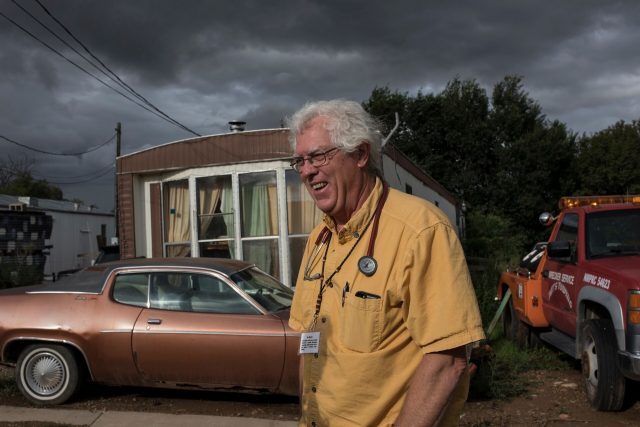
Chris Ruge is one of three health-care workers profiled in The Providers trying to make a difference in northern New Mexico
THE PROVIDERS (Anna Moot-Levin & Laura Green, 2018)
IFC Center
323 Sixth Ave. at West Third St.
Monday, November 12, 12:45
Festival runs November 8-15
212-924-7771 www.docnyc.net theprovidersdoc.com
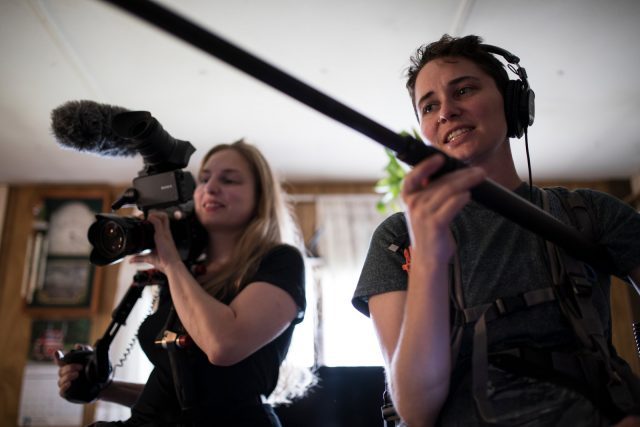
Most recent polls show that health care is the number one concern of most Americans, ahead of the economy, immigration, the environment, gun violence, and other issues. Filmmakers Anna Moot-Levin and Laura Green travel to northern New Mexico to explore a critical aspect of the health-care crisis in the moving, almost elegiac The Providers, which is making its New York City premiere at the DOC NYC festival. Moot-Levin and Green, both the children of doctors, directed, produced, photographed, recorded the sound, and edited (with Chris Brown) the film, which follows three health-care workers as they deal with poor, underserved patients with empathy, compassion, and understanding in small rural towns. “My job is to try to keep you alive,” nurse practitioner Chris Ruge tells one patient. “Health care is a relationship,” explains physician assistant Matt Probst. And family physician Leslie Hayes points out that once she retires, there is no one to take over for her. Moot-Levin and Green spent one hundred days over three years in Las Vegas, Albuquerque, and Española in New Mexico, going behind the scenes as Ruge, Probst, and Hayes treat men, women, and children, including many adults suffering from alcoholism, opioid abuse, and other addictions. The three providers are part of the ECHO Care program at El Centro clinics, which allows them to see patients who have little or no money; they visit them in the hospital and make house calls, often stopping by just to check on how things are going. “There is so much beauty here. And there is so much pain,” Probst says.
Anna Moot-Levin and Laura Green on the set of The Providers, their first film
The film also reveals how their dedication to their jobs impact their private lives; Ruge’s wife, nurse midwife Ann Ruge, complains that her husband cares more about his patients than about her, while Probst has to deal with an addicted father and troubled sister. When future funding for ECHO Care is in jeopardy, Chris Ruge notes, “If it ended, it would likely lead to the early death of a lot of our patients.” Another problem is where the next generation of health-care workers will come from to serve these indigent communities; Probst teaches physician assistant students at the University of New Mexico, where he hopes to find young men and women willing to stay local. “I want to go into the medical profession because this community is so far from medical help,” one student, Tiffany, says. The Providers is screening November 12 at IFC in the American Perspectives section of DOC NYC, with Moot-Levin participating in a Q&A after the film.
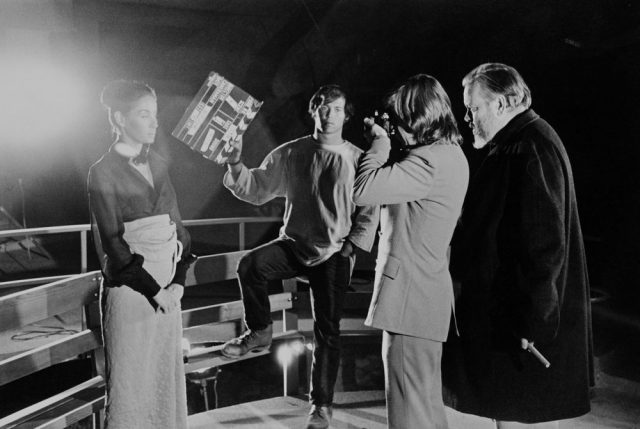
Orson Welles on the set of his final film, The Other Side of the Wind
THE OTHER SIDE OF THE WIND (Orson Welles, 2018)
MoMA Film, Museum of Modern Art
11 West 53rd St. between Fifth & Sixth Aves.
Sunday, November 11, 5:00
Series runs through January 8
212-708-9400 www.moma.org
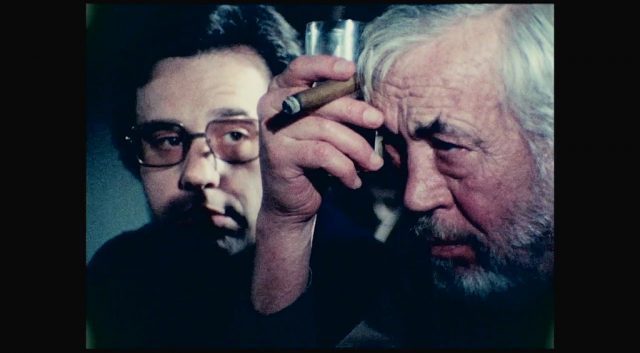
Throughout Orson Welles’s The Other Side of the Wind, characters make declarations that have been applied to Welles’s work over the years, and what audiences may even be thinking in the first minutes of this, his final film: “Does all this matter?” “What the hell is that?” “I’m bored with the whole story.” “You could tell me what’s going on here.” And “What happens here?” “I’m not really sure, Max.” But that wickedly sly self-referential commentary is one of the many reasons that The Other Side of the Wind is yet another masterpiece by the man who brought the world Citizen Kane, The Magnificent Ambersons, Touch of Evil, F for Fake, and other classics. Welles’s legendary difficulties — budgetary problems, editing and reshoots without his consent, productions that took years to finish — are both the subject and the story of the making of The Other Side of the Wind itself. Welles’s potent skewering of Hollywood was shot in the 1970s and remained incomplete until now; finally, nearly one hundred hours of footage have been edited into a two-hour gem that will be screening November 11 at MoMA in their annual “Contenders” series, made up of films the institution believes will last the test of time. The Other Side of the Wind begins with an equilibrium-challenging blast of grainy scenes photographed with shaky handheld cameras and sudden, disorienting closeups, switching from color to black-and-white, the audio track not quite synced, Michel Legrand’s jazzy noir score underlining the too-rapid pace as all the main characters are introduced. The conceit of the film is that it tells the story of the last day of iconic, ornery auteur J. J. Hannaford’s life, played by iconic, ornery auteur John Huston. (Welles always claimed that Hannaford was not based on himself but on other great directors.) “This little historical document has been put together from many sources,” Hannaford acolyte Brooks Otterlake (Peter Bogdanovich) announces in voice-over at the start, “from all the footage shot by TV and documentary filmmakers and also the students, critics, and young directors who happened to bring 16- and 8mm cameras, having been invited to Jake’s seventieth birthday party.”
Peter Bogdanovich and John Huston star in Orson Welles’s The Other Side of the Wind
Once the film calms down, it’s stupendous, a bittersweet takedown of the studio system and the end of an era, with a fabulous cast that covers nearly every aspect of the film world: Susan Strasberg as ruthless, ambitious critic Julie Rich; Edmond O’Brien as actor Pat Mullins; Mercedes McCambridge as Maggie Noonan, Hannaford’s manager; Norman Foster as Billy Boyle, an old-timer who knows how to handle things; Paul Stewart as Matt Costello, another of Hannaford’s old cohorts; Lilli Palmer as movie star Zarah Valeska, the host of the party; Cameron Mitchell as grumbling makeup artist Zimmie; Pat McMahon as journalist Marvin P. Fassbender; Joseph McBride as critic Pister; Tonio Selwart as a financier known only as the Baron; Howard Grossman as biographer Charles Higgam; Geoffrey Land as studio head Max David; Frank Marshall as one of the documentarians; Cathy Lucas as Mavis Henscher, a young woman Hannaford takes a liking to; Stafford Repp (Chief O’Hara on Batman) as Hannaford supporter Al Denny; Dennis Hopper as director Lucas Renard; Benny Rubin as Hollywood agent Abe Vogel; Gregory Sierra as screenwriter Jack Simon, who keeps throwing barbs at Hannaford; and Dan Tobin as the uptight Dr. Bradley Pease Burroughs. Among those being parodied or paid homage to in the casting and the plot are Marlene Dietrich, John Houseman, John Ford, William Wellman, Pauline Kael, Robert Evans, Charles Higham, Cybill Shepherd, and John Milius. Among the party guests are George Jessel, Curtis Harrington, Henry Jaglom, Paul Mazursky, Claude Chabrol, Cameron Crowe, Les Moonves, and Rich Little, who originally played Otterlake but was replaced by Bogdanovich, who extensively interviewed Welles for the seminal book This Is Orson Welles. (And yes, that man in the bathroom stall is William Katt, who would later become the Greatest American Hero, while 1970s/’80s star Cassie Yates is Martine.)
Cinematographer Gary Graver and editor Bob Murawski have done what must have been a nearly impossible job, creating a compelling narrative that interweaves the many styles with the making of Hannaford’s last film, also called The Other Side of the Wind, a somewhat existential erotic tale of a Native American woman played by an unnamed actress (Oja Kodar, Welles’s companion) who’s being followed by a motorcycle rebel portrayed by first-time actor John Dale (Bob Random), a new discovery of Hannaford’s. The film is Hannaford’s attempt to remain relevant in the modern age; it’s shot in bold colors, with plenty of nudity and a hip score that serve as a stark counterpoint to the predominantly black-and-white footage of Hannaford and his exploits. “It’s a whole new business,” Zimmie laments. The Other Side of the Wind is a fitting coda to Welles’s career — although he does not appear in the film, his voice can be heard off-camera at one point — a grand finale lovingly put together with respect and admiration that once again makes us wonder what Welles could have achieved had he not continually run into so much trouble as a filmmaker. The MoMA screening will be followed by a Q&A with producer Filip Jan Rymsza. It will be preceded at 2:00 by Morgan Neville’s overly fanciful They’ll Love Me When I’m Dead, which goes behind-the-scenes of The Other Side of the Wind, detailing the making of the movie through interviews with many of the participants while also delving into Welles’s working process, fundraising methods, and, of course, genius. It’s narrated by Alan Cumming and features Bogdanovich, Kodar, Shepherd, Jaglom, Graver, Random, Marshall, Little, Mitchell, McBride, Simon Callow, George Stevens Jr., Jeanne Moreau, Danny Huston, and others. Neville will take part in a Q&A after the screening.
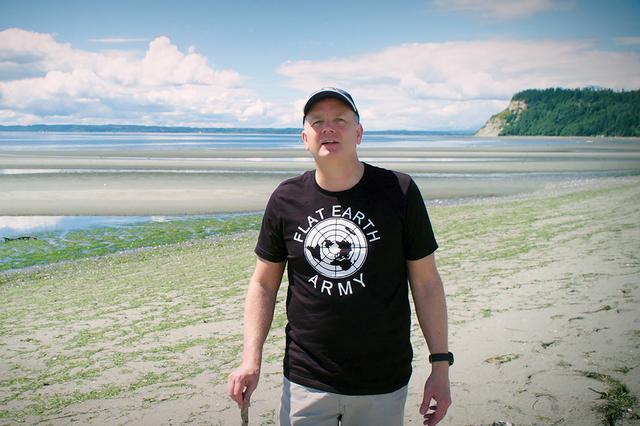
Flat Earth superstar Mark Sargent shares his theories in Behind the Curve
BEHIND THE CURVE (Daniel J. Clark, 2018)
Cinepolis Chelsea
260 West 23rd St. between Seventh & Eighth Aves.
Saturday, November 10, 8:00
Festival runs November 8-15 www.docnyc.net www.behindthecurvefilm.com
A few years ago, I got into a series of social media discussions with an old high school acquaintance who believed in a lot of conspiracy theories. It turns out he is a Flat Earther, one of a growing number of Americans who believe that the planet is not round. He asked me to watch a bunch of videos that supported his beliefs, and I did, but no matter what science-based evidence I threw back at him, he was prepared with an answer that often included claims that high-level, respected scientists were part of the conspiracy, that they were being paid off by the secret government. I ultimately ended our social media friendship when it turned into a false flag discussion and it became evident he thought reports of mass shootings were hoaxes as well. Anyway, Daniel J. Clark’s Behind the Curve brought that all back for me. In the expertly made film, screening November 10 in the Science Fiction section of DOC NYC, Clark tracks the exploits of several very public Flat Earthers as they prepare for the first annual Flat Earth International Conference in 2017 in Raleigh, North Carolina. Many are eager to hear in person from those they follow online, leaders in the movement who regularly post videos “proving” that there’s no curve to the Earth. “I didn’t choose flat earth; flat earth chose me,” Flat Earth superstar and former digital pinball champion Mark Sargent explains. Clark spends a lot of time with Sargent and his cohort, the Morrissey-loving Patricia “the Interviewer” Steere, as they attend meetups, go to a NASA museum, watch the supposed solar eclipse, and make new videos. Among the others attending the conference are Nathan “the Evangelist” Thompson, Bob “the Engineer” Knodel, Chris “the Craftsman” Pontius, and Jeran “the Experimenter” Campanella as well as people who go by such names as Infinite Plane Society and Odd Reality; the only Flat Earther who turns his back on the conference is the angry Matt “Math Powerland” Boylan, who thinks Sargent is a plant working for Warner Bros.
Clark allows the Flat Earthers to make their case, neither judging them nor portraying them as idiots. He does, however, speak with a number of concerned professionals who delve into the psychological reasons why people fall for conspiracy theories, including Caltech astrophysicist Hannalore Gerling-Dunsmore, UCLA psychiatry professor Dr. Joe Pierre, Caltech physicist Dr. Spiros Michalakis, Caltech astronomer Dr. Erika Hamden, NASA astronaut Commander Scott Kelly, psychologist and writer Dr. Per Espen Stoknes, high school teacher Stephen Hagberg, and science writer Tim Urban. (He purposely avoided such well-known debunkers as Neil “He Who Shall Not Be Named” deGrasse Tyson and Bill Nye the Science Guy.) They all show empathy and understanding for the Flat Earthers, treating them as misguided people rather than absurd zealots for a ridiculous cause, a tempting characterization of those who believe, among other things, that we are all living inside a giant dome like in The Truman Show. The experts discuss such diagnoses as impostor syndrome, the Dunning-Kruger Effect, institutional disconfirmation, information bias, miseducation, scientific superiority complex, and a general distrust of authority, never outright criticizing any of the Flat Earthers. One of the Flat Earthers humorously states that most of them do not live in their mother’s basement; however, Sargent does spend a significant amount of time with his mom, who is not fully sold on the planet being flat. Clark and producers Nick Andert and Caroline Clark will be at the Cinepolis Chelsea screening to talk about the film.
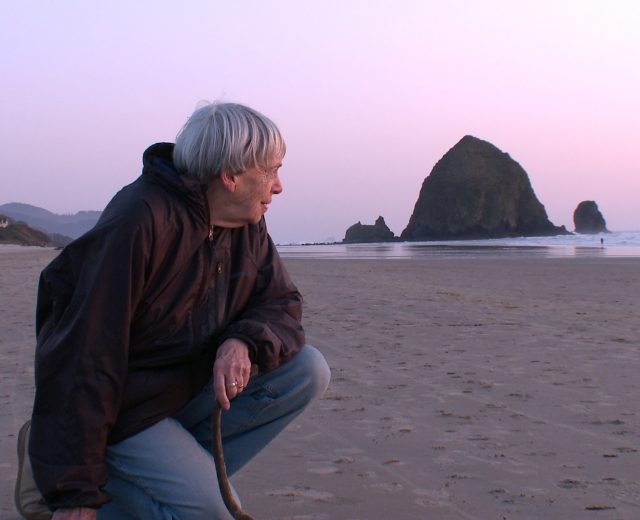
Superb documentary looks at the life and career of genre-redefining writer Ursula K. Le Guin
WORLDS OF URSULA K. LE GUIN (Arwen Curry, 2018)
SVA Theatre
333 West 23rd St. between Eighth & Ninth Aves.
Saturday, November 10, 11:45 am
Festival runs November 8-15 www.docnyc.net worldsofukl.com
If you’ve never read anything by Ursula K. Le Guin, you’re going to want to fill your bookshelf with her works after watching Arwen Curry’s superb documentary, Worlds of Ursula K. Le Guin, making its New York City premiere November 10 at the DOC NYC festival. The intimate portrait focuses on the Berkeley-born author’s writings and how she changed the face of literature for science fiction and fantasy as well as for women authors. “What Ursula was having to navigate was the societal prejudice against science fiction, against the fantastic, and against children’s fiction. All of these things were marginalized,” award-winning writer Neil Gaiman says. Le Guin points out, “The critics had dismissed science fiction and fantasy as essentially worthless, and I knew better. I knew that my work was not second rate, that it was of literary value.” Curry spent seven years researching Le Guin and following her to public appearances and filming her in her longtime home of Portland, Oregon. Le Guin, the author of such masterful novels as A Wizard of Earthsea, The Tombs of Atuan, The Left Hand of Darkness, and The Dispossessed as well as the highly influential short story “The Ones Who Walk Away from Omelas,” died in January 2018 and was interviewed for the film in her eighties; from her deeply wrinkled face emerges the voice and infectious enthusiasm of a much younger woman.
Among the authors singing Le Guin’s praises are Gaiman, David Mitchell, Michael Chabon, Samuel R. Delany, Adrienne Maree Brown, China Miéville, Theodora Goss, Margaret Atwood, and Vonda N. McIntyre, along with professor emeritus James Clifford, editor Annalee Newitz, and Le Guin biographer Julie Phillips, who universally rave not only about what a great writer she was but what a wonderful human being too. Le Guin was the daughter of highly regarded anthropologists Alfred L. Kroeber and Theodora Kroeber, who both studied indigenous cultures destroyed by colonial impact; familiarity with her parents’ work may have contributed to Le Guin’s immense skill of world-building in her books. “Imaginative fiction trains people to be aware that there are other ways to do things and other ways to be, that there is not just one civilization and it is good and it is the way we have to be,” she says in the film. Curry also speaks with Le Guin’s husband and their children and goes to Cannon Beach with Le Guin, a visit beautifully captured by cinematographer Andrew Black. Curry includes home movies, family photographs, speeches, marked-up manuscripts, and shots of Le Guin working at a typewriter; in addition, animator Molly Schwartz brings to life various book covers and a handful of scenes narrated by Le Guin. It’s utterly charming watching Le Guin discuss her career, a gentle soul in touch with who she is and what she does. She even participated in the Kickstarter campaign to fund the project, offering signed books, rare special editions, a framed sketch of her cat, a meet-and-greet, and more. The American Masters presentation is screening at the SVA Theatre at 11:45 am on November 10, with Curry and Schwartz on hand to talk about the film.
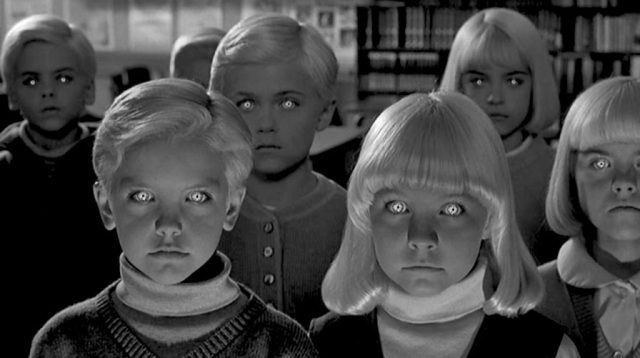
An English town has a bit of a kid problem in horror classic Village of the Damned
VILLAGE OF THE DAMNED (Wolf Rilla, 1960)
Rubin Museum of Art
150 West 17th St. at Seventh Ave.
Friday, November 9, $14, 9:30
Series continues Friday nights through April 28
212-620-5000 rubinmuseum.org
The Rubin Museum’s Cabaret Cinema series “Sci Fi Cine Club Kolkata” comes to a creepy close November 9 with the classic 1960 British sci-fi horror flick Village of the Damned. Based on John Wyndham’s 1957 novel, The Midwich Cuckoos — Wyndham also wrote The Day of the Triffids as John Harris, among other books and at least one other pseudonym — Village of the Damned was the first film shown by Indian master and self-described “science-fiction addict” Satyajit Ray at the Sci Fi Cine Club he started in Kolkata in January 1966. The story combines postwar paranoia with a fear of alien invasion — as well as the normal worries associated with childbirth. On what appeared to be a regular afternoon in the quiet little English rural town of Midwich, every living being passes out at the same exact time. When they awaken, no one’s sure what happened — but two months later, every woman able to carry a child is pregnant, including Anthea Zellaby (Barbara Shelley), who is married to Professor Gordon Zellaby (George Sanders), a much older man who did not think it possible he could become a father. When the babies are all born on the same day and on an accelerated schedule, everyone knows there is something strange — the infants’ eerie eyes are a pretty big giveaway — but they decide to raise the children nonetheless. Professor Zellaby sees this as a terrific opportunity for research — even involving the boy born to Anthea, David (Martin Stephens), who appears to be the leader of the blond-haired bunch — while military men Alan Bernard (Michael Gwynn) and General Leighton (John Phillips) are far more skeptical of the town’s, and the world’s, future.
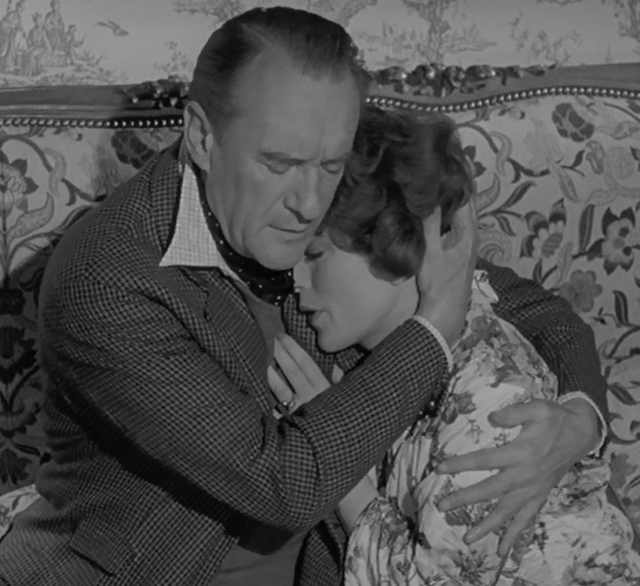
Professor Gordon Zellaby (George Sanders) tries to soothe his wife, Anthea Zellaby (Barbara Shelley), in Village of the Damned
The German-born Rilla, who primarily made crime thrillers, wrote the screenplay with Ronald Kinnoch and Stirling Silliphant (who would win an Oscar for In the Heat of the Night). The story has clear Third Reich overtones, as the alien children show all the characteristics of the so-called Aryan superior race, while also falling firmly in the evil-children genre that later produced such famous films as The Bad Seed, The Omen, Children of the Corn, Rosemary’s Baby, and The Exorcist while also evoking The Day the Earth Stood Still. It pits the value of human life against the hunger for scientific knowledge, the safety of a community against a band of beautiful, if extremely dangerous, kids. (For those who can’t get enough, the young cohorts made their way into the title of the sequel, 1964’s Children of the Damned, written by John Briley, directed by Anton M. Leader, and starring Ian Hendry.) Village of the Damned is an intense psychological drama that leads to a furious finale. Many a mother has asked herself, “Am I carrying a monster?” In Village of the Damned, the answer is clear. The film is screening Friday night at 9:30 at the Rubin, which is open for free from 6:00 to 10:00, so you should also check out such exhibits as “The Tibetan Buddhist Shrine Room,” “Shrine Room Projects: Wishes and Offerings,” Shezad Dawood/The Otolith Group/Matti Braun: A Lost Future,” “Gateway to Himalayan Art,” “Masterworks of Himalayan Art,” “A Monument for the Anxious and Hopeful,” and “The Second Buddha: Master of Time.”
 The Rubin Museum’s Cabaret Cinema series “Sci Fi Cine Club Kolkata” comes to a creepy close November 9 with the classic 1960 British sci-fi horror flick Village of the Damned. Based on John Wyndham’s 1957 novel, The Midwich Cuckoos — Wyndham also wrote The Day of the Triffids as John Harris, among other books and at least one other pseudonym — Village of the Damned was the first film shown by Indian master and self-described “science-fiction addict” Satyajit Ray at the Sci Fi Cine Club he started in Kolkata in January 1966. The story combines postwar paranoia with a fear of alien invasion — as well as the normal worries associated with childbirth. On what appeared to be a regular afternoon in the quiet little English rural town of Midwich, every living being passes out at the same exact time. When they awaken, no one’s sure what happened — but two months later, every woman able to carry a child is pregnant, including Anthea Zellaby (Barbara Shelley), who is married to Professor Gordon Zellaby (George Sanders), a much older man who did not think it possible he could become a father. When the babies are all born on the same day and on an accelerated schedule, everyone knows there is something strange — the infants’ eerie eyes are a pretty big giveaway — but they decide to raise the children nonetheless. Professor Zellaby sees this as a terrific opportunity for research — even involving the boy born to Anthea, David (Martin Stephens), who appears to be the leader of the blond-haired bunch — while military men Alan Bernard (Michael Gwynn) and General Leighton (John Phillips) are far more skeptical of the town’s, and the world’s, future.