this week in film and television

PROGRAMMERS’ NOTEBOOK: ON LOVE — ALI: FEAR EATS THE SOUL

Fassbinder

Emmi (Brigitte Mira) and Ali (El Hedi ben Salem) unexpectedly fall in love in Rainer Werner Fassbinder’s Ali: Fear Eats the Soul

ALI: FEAR EATS THE SOUL (ANGST ESSEN SEELE AUF) (Rainer Werner Fassbinder, 1974)
BAMcinématek, BAM Rose Cinemas
30 Lafayette Ave. between Ashland Pl. & St. Felix St.
Tuesday, February 19, 8:45
Series runs through February 21
718-636-4100
www.bam.org

The BAM series “Programmers’ Notebook: On Love” is not your traditional look at romance, passion, and family bonds, with such films as A.I. Artificial Intelligence, about a mother and a robot; Senna, about a race-car driver and his sport; and My Neighbor Totoro, about a young girl and the cutest animated creature ever. It also includes one of the strangest love stories, and one that is surprisingly politically relevant after all these years, Rainer Werner Fassbinder’s masterful Ali: Fear Eats the Soul. On a rainy day, sixty-year-old West German cleaning woman Emmi (Brigitte Mira), a short, stout, quiet lady, enters a Munich bar to get out of the rain. There she encounters ruggedly handsome Moroccan guest worker Ali (El Hedi ben Salem), whose friends encourage him to dance with Emmi. What begins as a joke evolves into an unusual love affair that confuses just about everyone, from Ali’s and Emmi’s friends and coworkers to local shopkeepers and her family and landlord — and even to Ali and Emmi themselves. “It will never work out. It’s unnatural,” an Arab woman (Katharina Herberg) at the bar says. Emmi’s bitter son-in-law, Eugen, played by Fassbinder, refers to migrants as “swine.” Her daughter, Krista, played by Irm Hermann, one of Fassbinder’s former lovers, calls her an “old whore.” When their relationship takes a turn for the worse, Emmi solemnly tells Ali, “When we’re together, we must be nice to each other. Otherwise, life’s not worth living.”

Fassbinder

Rainer Werner Fassbinder plays a lazy bigot in his masterful Douglas Sirk homage, Ali: Fear Eats the Soul

Forty-five years after its release, Ali: Fear Eats the Soul still packs a heavy punch. Partly an homage to German-born Douglas Sirk’s All That Heaven Allows taken to a Brechtian extreme (and expanded from a brief story told by a hotel chambermaid in Fassbinder’s The American Soldier), the film deals with racism, bigotry, xenophobia, exploitation, alienation, shame, fearmongering, and immigration in prescient ways, especially here in America under the current administration. Shot in just two weeks, the film is photographed in saturated blues, reds, greens, and yellows by cinematographer Jürgen Jürges, with limited camera movement. Fassbinder’s composition is extraordinary, with long shots that highlight the protagonists’ loneliness and exclusion. Early on, a woman in Emmi’s apartment building watches her go upstairs with Ali, the woman seen from behind, her out-of-focus hair dominating the right side of the frame, the eventual couple visible through a caged screen, as if prisoners. Later, in a restaurant, Emmi and Ali are seen through a doorway sitting in the far back of an otherwise empty restaurant, as if outcasts from society.

Life and love are not easy for Emmi (Brigitte Mira) and Ali (El Hedi ben Salem) unexpectedly fall in love in Rainer Werner Fassbinder’s Ali: Fear Eats the Soul

Life and love are not easy for Emmi (Brigitte Mira) and Ali (El Hedi ben Salem) in Fassbinder’s romantic melodrama Ali: Fear Eats the Soul

Mira and ben Salem, Fassbinder’s partner at the time, play the unexpected lovers with an intense level of uncomfortability that keeps the viewer on edge; Barbara Valentin is fabulously creepy as the bar owner and Ali’s former lover, the deep, dark circles around her eyes clashing with her long blonde hair, as if she’s a walking zombie. The film was deeply personal to Fassbinder (The Marriage of Maria Braun, The Bitter Tears of Petra von Kant), who encountered racism during his time with ben Salem, had many immigrant relatives, and had a complex relationship with his mother and business manager, Lisolette Eder (aka Lilo Pempeit), who appears as Mrs. Münchmeyer in Ali. At one point, Ali, who speaks in broken German, and Emmi are seen in a narrow space through the door to her kitchen. He reaches out and holds her as she sobs. “Why cry?” he asks. “Because I’m so happy and so full of fear, too,” she says. “Not fear. Fear not good. Fear eat soul,” he explains. “Fear eats the soul? That’s nice,” she responds with a big smile. If only love were always that simple.

PROGRAMMERS’ NOTEBOOK — ON LOVE: NOSTALGIA FOR THE LIGHT

Nostalgia for the Light offers a breathtaking look at memory and the past, from above and below

NOSTALGIA FOR THE LIGHT (NOSTALGIA DE LA LUZ) (Patricio Guzmán, 2010)
BAMcinématek, BAM Rose Cinemas
30 Lafayette Ave. between Ashland Pl. & St. Felix St.
Monday, February 18, 9:30
Series runs through February 21
718-636-4100
www.bam.org
www.nostalgiaforthelight.com

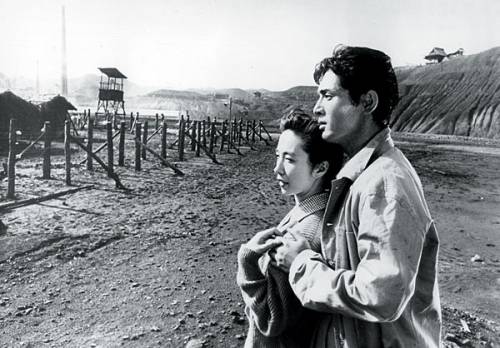
Master documentarian Patricio Guzmán’s Nostalgia for the Light is a brilliant examination of memory and the past, one of the most intelligent and intellectual films you’re ever likely to see. But don’t let that scare you off — it is also a vastly entertaining, deeply emotional work that will blow you away with its stunning visuals and heartbreaking stories. Guzmán, who chronicled the assassination of Salvador Allende and the rise of Augusto Pinochet in the landmark three-part political documentary The Battle of Chile, this time visits the Atacama Desert in his native Chile, considered to be the driest place on Earth. Situated ten thousand feet above sea level, the desert is home to La Silla and Paranal Observatories, where astronomers come from all over the world to get unobstructed views of the stars and galaxies, unimpeded by pollution or electronic interference. However, it is also a place where women still desperately search for the remains of their loved ones murdered by Pinochet’s military regime and hidden away in mass graves. In addition, archaeologists have discovered mummies and other fossilized bones dating from pre-Columbian times there. Guzmán seamlessly weaves together these three journeys into the past — as astronomers such as Gaspar Galaz and Luis Hernandez note, by the time they see stars either with the naked eye or through the lens of their massive telescopes, the celestial bodies have been long dead — creating a fascinating narrative that is as thrilling as it is breathtaking.

Constructing a riveting tale of memory, Guzmán speaks with architect Miguel Lawner, who draws detailed maps of the Chacabuca desert concentration camp where he and so many other political prisoners were held; Valentina, a young astronomer whose grandparents had to give up her parents in order to save her when she was a baby; archaeologist Lautaro Nunez, who digs up mummies while trying to help the women find “los desaparecidos”; and Victoria and Violeta, who regularly comb the barren landscape in search of their relatives. “I wish the telescopes didn’t just look into the sky but could also see through the earth so that we could find them,” Violeta says at one point. Spectacularly photographed by Katell Dijan, Nostalgia for the Light is a modern masterpiece, an unparalleled cinematic experience that has to be seen to be believed. The film is screening February 18 at 9:30 in BAM’s “Programmers’ Notebook: On Love,” a collection of works that take a different look at passion, romance, and family bonds; the series continues through February 21 with such other films as Dee Rees’s Pariah, starring Adepero Oduye, and Oduye’s To Be Free, followed by a discussion with Oduye; Asif Kapadia’s Senna; and Paul Thomas Anderson’s Phantom Thread.

I AM CUBA

I Am Cuba

A reluctant prostitute named Maria is unhappy to have to deal with American gamblers in Mikhail Kalatozov’s I Am Cuba

I AM CUBA (SOY CUBA) (Mikhail Kalatozov, 1964)
Film Forum
209 West Houston St.
February 15-21
212-727-8110
filmforum.org

The Revivals section of last year’s New York Film Festival included a rare screening of Mikhail Kalatozov’s 1964 political epic, I Am Cuba, in a 4K restoration from Milestone. It’s now back for a one-week run beginning at Film Forum on February 15. In the early 1960s, the Soviet Union wanted to cement its hold on Cuba and celebrate its new Communist regime by making a propaganda film celebrating the Cuban Revolution and the end of Fulgencio Batista’s dictatorial reign. The Soviets actually disowned the result, considering it too arty and inaccessible for their needs. But it’s quite a film, a lavishly photographed black-and-white gem that was championed by Martin Scorsese and Francis Ford Coppola when it was resurrected at the Telluride Film Festival in 1992.

I Am Cuba

The 4K restoration of I Am Cuba comes to Film Forum February 15-21

I Am Cuba is divided into four sections that tell the story of the nation from different points of view. The film opens in a casino where American men degrade Cuban prostitutes; one of the men demands to see the home of one of the women, Maria, so he trudges with her through a poverty-stricken region and meets an unexpected man. Next, Pedro, a tenant farmer, is told that the land he has been working for decades has been sold to the American company United Fruit, so he takes dire action while protecting his family. (“I used to think the most terrifying thing in life is death,” he says. “Now I know the most terrifying thing in life is life.”) In the third story, a university student named Enrique is overeager to get involved in a campus rebellion, especially after saving a young woman from drunk American soldiers and witnessing a cold-blooded shooting by the police. The final part deals with a pacifist villager named Mariano who is being goaded by a soldier to join the military fight for freedom.

I Am Cuba

A pacifist would rather stay home than fight in I Am Cuba

I Am Cuba is one of the most visually stunning films ever made. Kalatozov and cinematographer Sergei Urusevsky, who had previously collaborated on the extraordinary Palme d’Or winner The Cranes Are Flying, create breathtaking tracking shots from virtually impossible angles, high in the air and underwater, assisted by camera operator Alexander Calzatti, who was practically a stuntman to achieve whatever was necessary. A joint production of the Soviet company Mosfilm and the new Cuban Institute of Cinematographic Art and Industry, the film was written by Soviet poet and novelist Yevgeny Yevtushenko and Cuban director and writer Enrique Pineda Barnet and features interstitial narration by Havana-born actress Raquel Revuelta as the voice of the nation. “Is this a happy picture?” she asks. “Don’t avert your eyes. Look! I am Cuba. For you, I am the casino, the bar, the hotels. But the hands of these children and old people are also me.” Later she encourages her citizenry to take up arms, softly stating, “I am Cuba. Your hands have gotten used to farming tools. But now a rifle is in your hands. You are not shooting to kill. You are firing at the past. You are firing to protect your future.” The film, of course, takes on added relevance today given the US government’s relationship with Cuba and the death of Fidel Castro in November 2016; there are also scenes that seem to prefigure the coming civil rights and peace movements in the US that occurred after the film was made. [Note: The 6:40 screening on February 15 will be introduced by Amy Heller and Dennis Doros of Milestone Films.]

THE FUTURE OF FILM IS FEMALE, PART 2: BLAME / HAPPY BIRTHDAY, MARSHA!

Quinn Shepard Blame

Quinn Shepard is a sextuple threat in sexy, hard-hitting teen drama Blame

BLAME (Quinn Shephard, 2017)
MoMA Film, Museum of Modern Art
11 West 53rd St. between Fifth & Sixth Aves.
Thursday, February 14, 4:00
Series runs February 14-21
212-708-9400
www.moma.org
www.samuelgoldwynfilms.com/blame

Last summer, MoMA presented “The Future Is Female,” a week of independent features and shorts written, directed, and starring women, dealing with important issues of inclusivity and gender. The series is back for its second iteration, running February 14-21 and beginning with a recent head spinner. Twenty-two-year-old Quinn Shephard proves herself to be a sextuple threat in the daring, sexy teen thriller Blame. The New Jersey native wrote, directed, edited, produced, and stars in the film, in addition to writing the lyrics for several songs performed by Peter Henry Phillips. Her mother, Laurie Shephard, also produced and cast the movie, which takes place in a New Jersey high school where Abigail Grey (Shephard) has returned after a mysterious psychotic incident. She is immediately targeted by mean-girl leader Melissa Bowman (Nadia Alexander) and her trusted bestie, Sophie Grant (Sarah Mezzanotte), while the third member of the clique, Ellie Redgrave (Tessa Albertson), might be on the outs for showing sympathy for Abigail. Melissa sics her boyfriend, T.J. (Owen Campbell), and Sophie’s beau, Eric (Luke Slattery), on Abigail, taunting and teasing her, calling her Sybil, after the book and movie about a woman with multiple personalities. When Jeremy Woods (Chris Messina) takes over their drama class, he switches the play they’re presenting from Tennessee Williams’s The Glass Menagerie to Arthur Miller’s The Crucible, casting Abigail as protagonist Abigail Williams, who might be involved with witchcraft, and Eric as John Proctor, a married man she might be having an affair with. Melissa, who wanted the lead role, is furious when she is named Abigail’s understudy. When Eric doesn’t take things seriously, Jeremy steps in to play John, angering Melissa further as Abigail gets to spend more time with the rather attractive teacher, especially as she watches Abigail and Jeremy grow very close. And Melissa doesn’t like to lose.

Quinn Shepard

Quinn Shepard, wrote, directed, produced, edited, stars in, and composed lyrics for for her feature-film debut, Blame

Blame is a carefully crafted, intimate tale of lust, jealousy, and obsession, capturing the complicated zeitgeist of high school life, the fear and trepidation along with the experimentation and confusion. In shifting from The Glass Menagerie to The Crucible, Shephard equates mental illness with witchcraft as seen through a feminist lens as her story parallels Miller’s, much as Amy Heckerling’s Clueless follows Jane Austen’s Emma (only without the laughs) and Roger Kumble’s Cruel Intentions is based on Pierre Choderlos de Laclos’s Les Liaisons dangereuses. The scenes between Shephard (Hostages, The Miseducation of Cameron Post) and Messina (The Mindy Project, Damages) are sizzling hot as teacher and student teeter on the edge of a major taboo. Shephard, who appeared in a high school production of The Crucible, also gets to show off her fab eyebrows, which are a character unto themselves. She is one talented filmmaker deserving of attention in an industry that must do a much better job cultivating, acknowledging, celebrating, and rewarding films by and about women. Blame is screening February 14 at 4:00 with Tourmaline and Sasha Wortzel’s fourteen-minute Happy Birthday, Marsha!, about trans artist and activist Marsha P. Johnson, followed by a Q&A with the filmmakers. “The Future Is Female, Part 2” continues with such other pairings as Nia DaCosta’s Little Woods and Crystal Kayiza’s Edgecombe, Kate Novack’s The Gospel According to André and Catherine Lee’s 9at38, and Josephine Decker’s Madeline’s Madeline and Eleanor Wilson’s Low Road, all followed by discussions.

MoMA PRESENTS YERVANT AND ANGELA RICCI LUCCHI’S ANGELA’S DIARIES

Angela

Yervant Gianikian and Angela Ricci Lucchi’s final collaboration is making its US premiere at MoMA

I DIARI DI ANGELA (ANGELA’S DIARIES) (Yervant Gianikian & Angela Ricci Lucchi, 2018)
MoMA Film, Museum of Modern Art
11 West 53rd St. between Fifth & Sixth Aves.
February 7–13
212-708-9400
www.moma.org

In February 2009, MoMA hosted a retrospective of the work of Italian visual artists Yervant Gianikian and Angela Ricci Lucchi. Ten years later, MoMA is presenting the US premiere of their final film, I Diari di Angela (“Angela’s Diaries”), which Gianikian completed following the death of his longtime partner; Lucchi died in February 2018 at the age of seventy-six. The film, running through February 13, is an homage to both their private and professional life together, incorporating archival footage with scenes they shot during their travels to Moscow, Armenia, Bosnia and Herzegovina, and other locales, often tied to recent war and political and climate turmoil, in addition to home movies of Lucchi cooking and gardening. Throughout the film, Gianikian reads random pages from Lucchi’s extensive diaries, his aged fingers turning the pages filled with her attractive handwriting and drawings. “This is my memory of Angela, of our life. I reread these notebooks and discover others I didn’t know about,” Gianikian explains in his director’s statement. “Reexamining all the notebooks of Angela’s infinite Diary and the backward look of our private films, which accompanied our research. My desperate attempt to bring her back to my side, to bring her back to life, the continuation of our work as goal, as mission, through her notebooks and drawings, a sort of map for action in the present, containing its guiding principles and envisaging its continuation. Angela and I have prepared new and important projects to carry out. The promise, the oath, to continue the work.”

Angela

Angela Ricci Lucchi and Yervant Gianikian show off their Golden Lion at the Venice Biennale

It is often difficult to tell which footage is old and which is new, as the pair hand-tinted much of the archival material and eschewed the latest high-def technology for the newer shots, layering together the look of the past and the present. Early on, Lucchi describes one of their canvases, which includes watercolor images and handwritten text: “I want to use my work to express my indignation, our indignation. This is like our manifesto. It took shape during a period of great despair for today’s world, with so much upheaval. So, I wrote that our world is not political, is not aesthetic, is not pedagogical, is not progressive, is not cooperative, is not ethical, is not consistent. Above all, it’s the contemporary world, it’s contemporaneity. And I think many artists, nowadays, focus more on getting into the market and making money. We began, and go on, working out of passion. And I say that if other artists focused a bit more on these things, then maybe the world would be less wretched.” Despite such dire pronouncements, the film is a soft, touching, poetic work, told in their trademark avant-garde narrative style. Men dangerously saw wood. Gianikian and Lucchi (Dal Polo all’Equatore; Oh! uomo; Pays barbare) visit a friend’s studio. They go through canisters of old, decaying film. They tell a serious story about a terrible accident Gianikian suffered. But through it all, even with the slow pace, they display a passion for life, for justice, for love. It’s a one-of-a-kind documentary, a work that eventually sweeps you up into its welcoming atmosphere, a fitting finale for a one-of-a-kind team.

RACE, SEX & CINEMA — THE WORLD OF MARLON RIGGS: MOONLIGHT / AFFIRMATIONS

MOONLIGHT

Chiron (Alex Hibbert) looks out at a hard future in Barry Jenkins’s Oscar-winning Moonlight

MOONLIGHT (Barry Jenkins, 2016)
BAMcinématek, BAM Rose Cinemas
30 Lafayette Ave. between Ashland Pl. & St. Felix St.
Saturday, February 9, 7:00
Series runs February 6-14
718-636-4100
www.bam.org
moonlight-movie.com

BAM is paying tribute to controversial and innovative Texas-born filmmaker Marlon Riggs in conjunction with the twenty-fifth anniversary of his death with “Race, Sex & Cinema: The World of Marlon Riggs.” Riggs, who was gay and black, died in April 1994 at the age of thirty-seven from AIDS complications, leaving behind an important legacy of films, poetry, and essays. Many of his works had major impacts on the next generation of African American writers and directors, as evidenced by this program. On February 9, the series pairs Barry Jenkins’s Moonlight, which was nominated for eight Oscars and won three (Best Picture, Best Supporting Actor for Mahershala Ali, and Best Adapted Screenplay for Jenkins and Tarell Alvin McCraney), with Riggs’s ten-minute 1990 short, Affirmations, about the dreams and desires of gay black men. In Moonlight, Jenkins tells the powerful and moving story of Chiron, a shy, troubled boy growing up in Liberty City, Florida, in three chapters as Chiron goes from a young boy (Little, played by Alex Hibbert) to a teenager (Chiron, played by Ashton Sanders) to a twenty-seven-year-old man (Black, played by Trevante Rhodes). The semiautobiographical film is based on playwright and actor McCraney’s In Moonlight Black Boys Look Blue and Jenkins’s own experiences; both men are from Liberty City but did not know each other there. In the first section, Little is chased by bullies and runs into an abandoned building, where he is found by Juan (Ali), a drug dealer who brings him home to his girlfriend, Teresa (Janelle Monáe). They become a kind of surrogate family, as Little’s mother, Paula (Naomie Harris), is a crack addict who will do just about anything for her next score. Little also finds solace in his friendship with Kevin (Jaden Piner, later played by Jharrel Jerome and André Holland). In the second chapter, Chiron is taunted and bullied by Terrel (Patrick Decile) while trying to come to terms with his sexual orientation. In the third section, the passage of time reveals how much has changed, although the film turns overly melodramatic at the end.

Marlon Riggs

Karen Everett’s I Shall Not Be Removed: The Life of Marlon Riggs is part of Riggs tribute at BAM

Taking its inspiration from the source material, Moonlight is beautifully photographed by James Laxton, who has previously shot Medicine for Melancholy and Jenkins’s 2003 shorts, My Josephine and Little Brown Boy, and 2011 “Remigration” episode of Futurestates, bathing the film in lush blues. Jenkins’s subtly paced style is accompanied by a gorgeous classical-inspired score by Nicholas Britell (The Big Short). Moonlight is anchored by superb performances by Emmy nominee Ali (House of Cards, Hidden Figures) as the cool and caring Juan; Harris (Mandela: Long Walk to Freedom, 28 Days Later) as the drug-addicted Paula, who has lost control of her life; Monáe (Hidden Figures, The Electric Lady) as the sweet and understanding Teresa; and Sanders (The Retrieval) as the in-between Chiron, who feels overwhelmed by all the maelstrom swirling around him. Moonlight and Affirmations are screening at BAM February 9 at 7:00; “Race, Sex & Cinema: The World of Marlon Riggs” runs February 6-14 and includes such other evenings as Riggs’s Tongues Untied and Anthem with Isaac Julien’s The Attendant; a fifteenth-anniversary screening of Rodney Evans’s Brother to Brother, followed by a Q&A with Evans; Su Friedrich’s Hide and Seek and Cheryl Dunye’s Janine; and Lynn Hershman Leeson’s The Complete Electronic Diaries, Peter Rose’s The Man Who Could Not See Far Enough, and Jeanne C. Finley’s I Saw Jesus in a Tortilla.

FIRST SATURDAYS: SOUL OF A NATION

Roy DeCarava, Couple Walking, gelatin silver print on paper, 1979 (© 2017 estate of Roy DeCarava)

Roy DeCarava, “Couple Walking,” gelatin silver print on paper, 1979 (© 2017 estate of Roy DeCarava)

FIRST SATURDAYS
Brooklyn Museum
200 Eastern Parkway at Washington St.
Saturday, February 2, free (some events require advance tickets), 5:00 – 11:00
212-864-5400
www.brooklynmuseum.org

The Brooklyn Museum honors Black History Month in the February edition of its free First Saturday program. There will be live performances by Winard Harper, YahZarah (“I’m Taking You Back”), and Toshi Reagon with violinist Juliette Jones and bassist, guitarist, and vocalist Ganessa James; curator tours of “Soul of a Nation: Art in the Age of Black Power” and “Eric N. Mack: Lemme walk across the room” with Ashley James; a Learning Lesson discussion with artist Kameelah Janan Rasheed inspired by Octavia Butler’s idea of “primitive hypertext”; pop-up gallery talks of “Soul of a Nation” with teen apprentices; a screening of Mr. Soul (Melissa Haizlip & Samuel D. Pollard, 2018), introduced by the directors; a hands-on workshop in which participants can create wearable activist patches inspired by the messages of the Guerrilla Girls and AfriCOBRA; an artist talk featuring Shani Jamila’s new podcast, Lineage, with photographers Ming Smith and Russell Fredrick of the Kamoinge collective; “Soul of a Nation”–inspired poetry with Karisma Price, Naomi Extra, and Stephanie Jean of Cave Canem; an “Archives as Raw History” tour with archivist Molly Seegers; and Black Gotham Experience’s immersive Magnetic Resonance, consisting of a photo studio by Kamau Ware with styling by Charles Johnson, video collage by Kearaha Bryant, and music by GoodWill, P.U.D.G.E., and Rimarkable. In addition, the galleries will be open late so you can check out “Soul of a Nation: Art in the Age of Black Power,” “Eric N. Mack: Lemme walk across the room,” “One: Do Ho Suh,” “Half the Picture: A Feminist Look at the Collection,” “Something to Say: Brooklyn Hi-Art! Machine, Deborah Kass, Kameelah Janan Rasheed, and Hank Willis Thomas,” “Rob Wynne: FLOAT,” “Infinite Blue,” “A Woman’s Afterlife: Gender Transformation in Ancient Egypt,” “Kwang Young Chun: Aggregations,” and more.