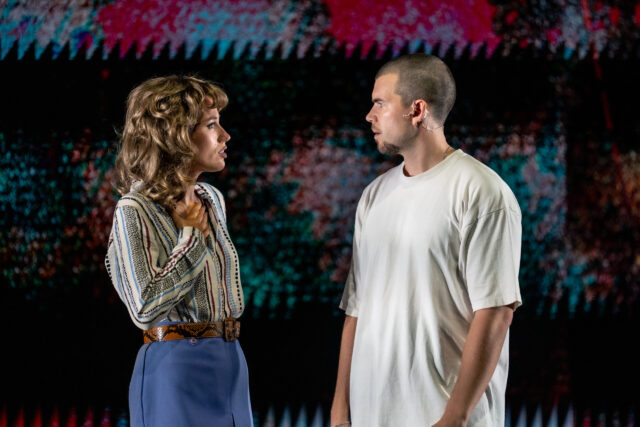
Alexander McQueen (Luke Newton) and his sister Janet (Jonina Thorsteinsdottir) face adversity in House of McQueen (photo by Thomas Hodges)
HOUSE OF McQUEEN
The Mansion at Hudson Yards
508 West 37th St. between 10th & 11th Aves.
Tuesday – Sunday through October 19, $40-$185.05
www.thehouseofmcqueen.com
“Find beauty in everything. People perceive what they are most afraid of as ugliness. I find beauty in what we fear,” Lee Alexander McQueen (Luke Newton) says halfway through the world premiere of House of McQueen. “The tragedy of it is, fashion isn’t going to cure your nightmares, or child abuse, or cancer — or anything else for that matter. At the end of the day, it’s just clothes.”
Of course, it’s not just clothes, as the play, which opened last night at the newly constructed Mansion at Hudson Yards, chaotically tells the audience over and over again. The show attempts to capture the fierce energy of a McQueen runway extravaganza but instead gets mired in overuse of technology, a narrative that offers little sense of time and place, and characters that don’t grow or develop across two hours (plus intermission).
Lee was born in 1969 in the East End of London, the youngest of six children; his father, Ron (Denis Lambert), was a taxi driver and his mother, Joyce (Emily Skinner), a teacher. While Joyce and his oldest sister, Janet (Jonina Thorsteinsdottir), encourage his artistic abilities — Janet even gives him her old album of paper dolls — his father worries about his future, particularly when it comes to his son’s apparent sexual orientation. “When are you going to listen to me? You’re gonna get hurt doin’ this!” his father argues, referring to both class and homophobia. When the teenage Lee expresses his desire to become a tailor on Savile Row, Ron declares, “Even if they hired you, they’d let you go soon enough. Those Savile Road types don’t want someone like you. And they never will. They’ll break your heart. Don’t try to be somethin’ you’re not.”
At sixteen, the ambitious and determined Lee quits school and heads to Savile Row with a garbage bag filled with samples of his work. “I want to learn everything, everything, everything,” he says. He lands a job as a tailor, which kickstarts a career that will take him around the world as he attends the prestigious Central Saint Martins university, creates designs for Gigli, Givenchy, and Gucci, and is taken under the wing of magazine editor and well-connected fashionista Isabella “Issie” Blow (Catherine LeFrere), who buys out his entire first collection, which surprises his mother and sister.
“Oh, dear, how are we gonna tell him? It was gruesome!” Joyce says to Janet, who replies, “All that blood! How could he do that? It was awful!” Issie jumps in, proclaiming, “It was perfect! I’ve never seen anything so perfect in my life.” She didn’t think his name, Lee, was perfect, advising him to go by his middle name, Alexander, professionally, although his close friends and family continued to call him Lee.
The press (Margaret Odette) agrees with Joyce and Janet, making such statements as “McQueen’s debut was a horror show” and “McQueen’s brand of misogynistic absurdity gives fashion a bad name.” But he contends, “I just want women to fight back!”
Explaining to a professor (Odette) where he gets his ideas, he comments, “Grew up East End. Same neighborhood as Jack the Ripper. Inspired by viscera, slashings, streams of blood. Happy childhood, loving parents. Tons of encouragement. Dreams of becoming the next Yves St. Laurent. Yadayadayada . . .”
But the fame and notoriety he achieves as l’enfant terrible of the fashion industry come with a price as sex, drugs, partying, and the desperate desire to remain on top take over his life.
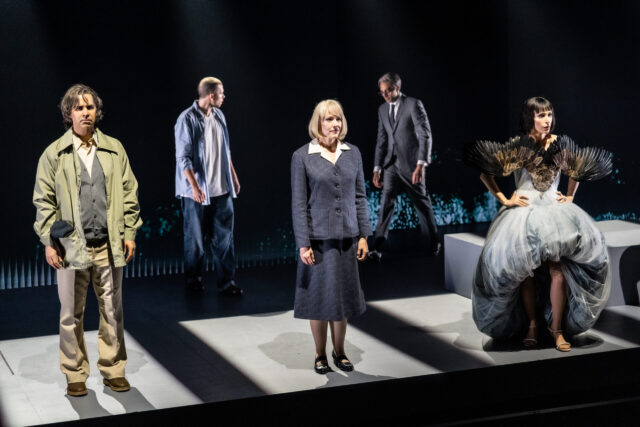
Alexander McQueen’s fashions are on display in world premiere play at Mansion at Hudson Yards (photo by Thomas Hodges)
House of McQueen is written by Darrah Cloud (Sabina, Turning) and directed by Sam Helfrich (Owned, Tape), in collaboration with Gary James McQueen, a textile designer and creative director who is Alexander’s nephew; several of his lenticular skulls are on view in the extensive lobby gift shop at the entrance to the theater. The nonlinear story feels stitched together somewhat randomly, then splattered with various bells and whistles to inject much-needed drama. A dance competition referencing McQueen’s collection inspired by Sydney Pollack’s 1969 film They Shoot Horses, Don’t They? falls flat, and surreal scenes in which the young Lee wears a diving helmet — the sea is a leitmotif, for good and bad — feels frivolous.
It’s not always clear when and where things are happening; Alexander is always in the same white T-shirt and plain pants, although he adds an unbuttoned shirt later. The costumes, which include re-creations of some of McQueen’s designs, are by Robert Wierzel, but you can check out the real deals in the exhibition “The Company of Melancholiacs,” which is open before and after the performance as well as during intermission, a kind of miniature version of the Met’s smash 2011 “Savage Beauty,” held the year after McQueen’s death at the age of forty.
Brad Peterson’s videos and projections create a nearly nonstop barrage of images on a wall of monitors and overhead screen, from crackling static to clips from actual runway shows (Highland Rape, Plato’s Atlantis, La Dame Bleue, Deliverance), pseudo-fashion reports, and seemingly endless live scenes of Joyce asking Alexander questions for a BBC program, based on a print interview mother and son did for the Guardian. Jason Ardizzone-West’s set features a pair of platforms that rise and lower; G Clausen’s sound and Robert Wierzel’s lighting don’t add to the mayhem.
Newton (The Shape of Things, The Book of Mormon), best known as Colin Bridgerton in Bridgerton, does what he can but is hampered by the uneven narrative and such aspirational and overwrought dialogue as “I’m a tailor, not a fighter,” “I’ve got to show them how wrong they are,” and “I need people to understand me!” Tony nominee Skinner (Suffs, Side Show) battles through the maelstrom as McQueen’s devoted mother, and LeFrere (Confessions of a Young Character Actress, The Green Knight) munches on the scenery as Issie. The cast includes Tim Creavin, Fady Demian, and Joe Joseph as some of McQueen’s many boyfriends; Joseph also plays Terence, Janet’s then-boyfriend and later husband who was physically abusive to her, which is in the play, but also sexually abusive to the young McQueen, which is not. (The play never mentions McQueen’s other siblings.)
In addition, the hagiographic, superficial House of McQueen depicts Alexander as a modern-day Joan of Arc, the misunderstood French military hero who fought against England and was tried and executed for blasphemy and wearing men’s clothes. McQueen’s Voss collection was influenced by Joan of Arc’s chainmail, primarily the outfit that Issie dons near the end of the show, and close-ups of Renée Falconetti in Carl Theodor Dreyer’s 1928 silent film The Passion of Joan of Arc are projected on the monitors, making McQueen both saint and demon as he searches for balance between art and commerce.
The concept of the play is credited to filmmaker Seth Koch and executive producer Rick Lazes; Lazes and Gary James McQueen are also behind Provocateur, an immersive multimedia McQueen experience, written by Cloud, that is scheduled to open October 1 in Los Angeles. In a program note, Lazes writes that “House of McQueen is flamboyant, unflinching, and achingly human — a requiem for a man who turned beauty into a weapon and fashion into art.”
McQueen said that one of his goals was to “find beauty in everything,” but it’s hard to do so with this show, which feels a lot more like commerce than art. It’s even a stretch to call the theater the Mansion at Hudson Yards, since Hudson Yards, which is anchored by a high-end shopping mall, does not technically extend to Thirty-Seventh St.
[Mark Rifkin is a Brooklyn-born, Manhattan-based writer and editor; you can follow him on Substack here.]