this week in dance

LEGENDS & LEGACIES: ELEVENTH ANNUAL STooPS BED-STUY ART CRAWL AND BLOCK PARTY

STooPS 2024 SUMMER FESTIVAL
Stuyvesant Ave. & Decatur St., Brooklyn
Saturday, July 27, free (advance registration recommended), 1:00 – 7:00
www.stoopsbedstuy.org
www.eventbrite.com

The eleventh annual STooPS Arts Crawl and Block Party takes place July 27 from 1:00 to 7:00, with live music and dance, spoken word, workshops, theater, and visual art on the stoops and shared spaces of Bedford–Stuyvesant. This year’s theme is “Legends & Legacies,” honoring the history of the community. Among the legacies participants are textile artist Aaliyah Maya, singer-songwriters Amma Whatt and YahZarah, poets Carmin Wong, Kai Diata Giovanni, and Keys Will, storyteller Christine Sloan Stoddard, musicians BSTFRND, DJ Toni B, and Zardon Za’, dancer-choreographer Kendra J. Bostock, healer Renee Kimberly Smith, and artists Ladie Ovila Lemon (Mūt’ Sun) and Shanna Sabio. Representing the legends are Black Girl Magic Row; Monique Greenwood of Akwaaba Mansion; Sincerely, Tommy founders Kai Avent-deLeon, Mama Jelani deLeon, and Ms. Doreen deLeon; Chief Baba Neil Clarke; Ms. Cathy Suarez of the Decatur St. Block Association; and organizer and educator Lumumba Akinwole-Bandele of the East.

“STooPS is a living legacy — the bridge that connects the artists, movements, organizations, and neighbors who transformed Bed-Stuy into a Black Cultural Hub with the new artists, residents, and visitors in order to forge the future of this neighborhood and Black culture,” STooPS founding director Bostock said in a statement. “For our 2024 annual summer festival we honor the national and hyperlocal hero/sheros and imagine and inspire their posterity with our theme, Bed-Stuy: Legends and Legacies.“

The festivities begin at 1:00 with a block party lasting all afternoon, including a Kiddie Korner; there will be art crawls at 1:30 and 4:30, led by playwright and poet Wong. All events are free but advance registration is recommended.

[Mark Rifkin is a Brooklyn-born, Manhattan-based writer and editor; you can follow him on Substack here.]
PAM TANOWITZ DANCE: DAY FOR NIGHT

Three-part Day for Night goes from daylight to dusk to evening (photo by Liz Devine)

DAY FOR NIGHT
The Amph at Little Island
Pier 55, Hudson River Park at West Thirteenth St.
July 17-21, $15 standing room, $25 seats sold out, 8:30
littleisland.org
www.pamtanowitzdance.org

Little Island’s inaugural season of site-specific commissions continues with Bronx-born choreographer Pam Tanowitz’s Day for Night, which blends beautifully with the surroundings of the outdoor Amph theater. As the audience makes its way past the grassy green hills that leads to the venue, the dancers are scattered along the path, offering a prologue, clad in diaphanous green costumes. As the audience is being seated in the Amph’s wooden rows, the sun is setting over the Hudson, a golden glow that evokes the title of the show, the term used when a film is shooting a nighttime scene during the day.

The sixty-minute piece was inspired by François Truffaut’s 1973 film, Day for Night, which goes behind the scenes of the making of a movie, featuring a British actress (Jacqueline Bisset) who has recently suffered a nervous breakdown, an aging French star (Jean-Pierre Aumont), an Italian diva (Valentina Cortese), and a young French actor (Jean-Pierre Léaud); Truffaut portrays the harried director.

The dance begins with Lindsey Jones, Marc Crousillat, and Maile Okamura forming an extended pony-stepping trio in which various emotions boil to the surface, including jealousy, power, and revenge. They are later joined by Morgan Amirah and Brian Lawson, who peer out over the river, in addition to Sarah Elizabeth Miele and Victor Lozano. In all black, Melissa Toogood delivers an impressive solo, looking serious and concerned.

The dancers move up the aisles, climb to a pair of scaffold balconies, and rest on the first row of benches, which is covered in fake green grass. They jump, run around in a circle, and lie down on the empty stage. The soundtrack features gentle tones as well as harsher drones, accompanied by recordings of the natural environment of Little Island, from birds and wind to lapping waves, human murmurings, and traffic. When the BBC’s Shipping Forecast plays over the sound system, I initially thought it was coming from a boat passing in the distance. (The immersive sound and music are by Justin Ellington.)

Reid Bartelme and Harriet Jung’s costumes come in multiple colors echoing the environs, with loose-fitting tops and tighter bottoms; old-fashioned striped swimming trunks provide contrast to the vertical picket fence bordering the water. Lighting designer Davison Scandrett blasts out red, orange, yellow, blue, green, and almost blinding white.

Tanowitz, who has previously choreographed such works as I Was Waiting for the Echo of a Better Day, Law of Mosaics, and Four Quartets, for such companies as New York City Ballet, the Royal Ballet, Martha Graham, Paul Taylor, Ballet Austin, and her own Pam Tanowitz Dance, teases the audience with a series of false endings and bows before everyone moves over to the Glade, where Toogood, in silver sequins, dances a forceful epilogue to Caroline Shaw and Sö Percussion’s slow, elegiac cover of ABBA’s “Lay All Your Love on Me,” in which Shaw nearly whispers, “Don’t go wasting your emotion / Lay all your love on me / Don’t go sharing your devotion / Lay all your love on me.”

“Cinema is king!” Truffaut’s character says in Day for Night. On Little Island right now, it’s dance that rules.

[Mark Rifkin is a Brooklyn-born, Manhattan-based writer and editor; you can follow him on Substack here.]
LITTLE ISLAND: DAY FOR NIGHT

DAY FOR NIGHT
The Amph at Little Island
Pier 55, Hudson River Park at West Thirteenth St.
July 17-21, $15 standing room, $25 seats sold out, 8:30
littleisland.org
www.pamtanowitzdance.org

Bronx-born choreographer Pam Tanowitz turns to a French Nouvelle Vague auteur for her latest evening-length piece, Day for Night, playing only five performances July 17-21 at the Amph on Little Island.

François Truffaut’s 1973 film, Day for Night — the French title is La Nuit américaine, or “The American Night” — goes behind the scenes of a movie being shot on location in Nice. Cast and crew members intertwine in all sorts of ways as a British actress (Jacqueline Bisset) who has recently suffered a nervous breakdown, aging French star Alexandre (Jean-Pierre Aumont), Italian diva Séverine (Valentina Cortese), and young French actor Alphonse (Jean-Pierre Léaud) spend a lot of time doing everything except making a film, upsetting the director, played by Truffaut himself. The title comes from the technique in which nighttime shots are made during the day.

The Little Island commission will be danced by Morgan Amirah, Marc Crousillat, Lindsey Jones, Brian Lawson, Sarah Elizabeth Miele, Maile Okamura, and Melissa Toogood, with costumes by Reid Bartelme and Harriet Jung, lighting by Davison Scandrett, and sound and music by Justin Ellington. Tanowitz has previously choreographed such works as I Was Waiting for the Echo of a Better Day, Law of Mosaics, and Four Quartets, for such companies as New York City Ballet, the Royal Ballet, Martha Graham, Paul Taylor, Ballet Austin, and her own Pam Tanowitz Dance.

“I make my dances in response to everything contained in the frame, like a film still, turning things over and over to discover what I haven’t yet found,” Guggenheim fellow and Bessie winner Tanowitz said in a statement. “Little Island is the exact right place for me to examine the way something can be seen and re-seen. When we look at something long enough it reveals what’s been forgotten, or taken for granted, or not yet noticed, and rewards us with new discoveries.”

As a bonus reward, Toogood will perform a short epilogue several times each night beginning at 9:30 in the cozy Glade; admission is free, first-come, first-served.

[Mark Rifkin is a Brooklyn-born, Manhattan-based writer and editor; you can follow him on Substack here.]
WEST SIDE FEST 2024

The High Line will host special programming at West Side Fest (photo by twi-ny/mdr)

WEST SIDE FEST
July 12-14, free
Multiple locations between Bank & West Thirtieth Sts.
www.westsidefest.nyc

Every June, the Upper East Side hosts the Museum Mile Festival, when seven or eight arts institutions, including the Met, the Guggenheim, the Cooper Hewitt, the Jewish Museum, and El Museo del Barrio, open its doors for free and turn Fifth Ave. into an arts-based street fair.

The West Side is getting in on the action with its own celebration with the weekend-long West Side Fest, running July 12-14, featuring live performances, guided tours, open studios, interactive workshops, special presentations, and free entry at many locations between Bank and Thirtieth Sts., including the Rubin, Poster House, the Whitney, Hudson Guild, Little Island, the Shed, Dia Chelsea, and the Joyce. Below is the full schedule; a map is available at the above website.

Friday, July 12
NYC Aids Memorial, 7:00 am – 11:00 pm

The Lesbian, Gay, Bisexual and Transgender Community Center, 8:00 am – 10:00 pm

Hudson Guild: Déflorée History Series, with panels by Valerie Hallier, 10:00 am – 5:00 pm

Hudson Guild: Triennial Children’s Art Show, 10:00 am – 6:00 pm

Poster House, free admission, 10:00 – 6:00

Little Island: Creative Break, art workshops, 11:00 am – 1:00 pm

Dia Chelsea, noon – 6:00

Whitney Museum of American Art: Open Studio for Teens, 1:00 – 3:00

IndieSpace/West Village Rehearsal Co-Op: Open Rehearsal by Divine Riot Company of Five Times in One Night, 2:00 – 5:00

Hill Art Foundation: Sound Bath, with musician Daren Ho, 5:00 – 7:00

The Joyce Theater at Chelsea Green Park: Pop-Up Dance Performances by Pilobolus and Dorrance Dance, 5:00 & 6:30

The Shed: Summer Sway, 5:00 – 8:00

White Columns: Exhibition Opening Reception, with works by Michaela Bathrick, Ali Bonfils, Joseph Brock, Eleanor Conover, and Donyel Ivy-Royal, 5:00 – 8:00

Whitney Museum of American Art: Free Friday Nights, advance RSVP required, 5:00 – 10:00

Print Center New York: Print Center After Hours, 6:00 – 8:00

Westbeth Artists Housing x the Kitchen Kickoff Celebration & Poster Sale, 6:00 – 8:00

Rubin Museum of Art: K2 Friday Night, 6:00 – 10:00

Little Island: Teen Night, 7:00 – 8:00

“Wonder City of the World: New York City Travel Posters” is on view at Poster House

Saturday, July 13
High Line: Family Art Moment: Dream Wilder with Us, ages 5–12, 10:00 am – noon

IndieSpace/West Village Rehearsal Co-Op: Open Rehearsal by Divine Riot Company of Five Times in One Night, 10:00 am – 1:00 pm

Poster House, free admission, 10:00 – 6:00

Hudson River Park: Explore & Play, 14th Street Park, 11:00 am – 1:00 pm

Little Island: Creative Break, 11:00 am – 1:00 pm

Westbeth Artists Housing: Penny’s Puppets, 11:00 am – 1:00 pm

Rubin Museum of Art, 11:00 am – 5:00 pm

Center for Art, Research, and Alliances, Javier Téllez: Amerika, 11:00 am – 6:00 pm

High Line: A Celebration of High Line Wellness, 11:30 am – 1:00 pm

The Kitchen: Tai Chi Workshop, 11:30 am – 1:00 pm

Hudson Guild: Triennial Children’s Art Show, noon – 3:00

Poster House Block Party, noon – 5:00

Dia Chelsea, noon – 6:00

Hudson Guild: Déflorée History Series, with panels by Valerie Hallier, 1:00 – 4:00

The Kitchen Poster Sale, 1:00 – 6:00

Westbeth Artists Housing: Art & Craft Market, 1:00 – 6:00

IndieSpace/West Village Rehearsal Co-Op: Open Rehearsal by Ali Keller, 2:00 – 5:00

Print Center New York: Print Activation with Demian DinéYazhi’, 2:00 – 5:00

Westbeth Artists Housing Open Studios, 2:00 – 5:00

Dia Chelsea Soil Sessions: Earth Sounds with Koyoltzintli, advance RSVP required, 2:30

Westbeth Artists Housing: You Are Never Too Old to Play, 7:00 – 9:00

The Rubin reimagines its collection in grand finale (photo byt twi-ny/mdr)

Sunday, July 14
The Lesbian, Gay, Bisexual and Transgender Community Center, 8:00 am – 8:00 pm

Poster House, free admission, 10:00 – 6:00

Whitney Museum of American Art: Free Second Sundays, 10:30 am – 6:00 pm

Hudson River Park Community Celebration, with Ajna Dance Company, henna, and community groups, Pier 63, 11:00 am – 1:00 pm

Center for Art, Research, and Alliances, Javier Téllez: Amerika, 11:00 am – 6:00 pm

Rubin Museum of Art: Family Sunday, 1:00 – 3:00

Westbeth Artists Housing Open Studios and Art & Craft Market, 1:00 – 5:00

Westbeth Artists Housing: Art Take-Over, curated by Valérie Hallier, Claire Felonis, and Noah Trapolino, 1:00 – 6:00

Whitney Museum of American Art: STAFF ONLY, Westbeth Gallery, 1:00 – 6:00

Chelsea Factory: Ladies of Hip-Hop’s Ladies Battle!, 1:00 – 10:00

IndieSpace/West Village Rehearsal Co-Op: Open Rehearsal by Felice Lesser Dance Theater of I AM A DANCER 2.0, 2:00 – 4:00

High Line: The Death Avenue Posse, by the Motor Company, 5:30 & 7:00

[Mark Rifkin is a Brooklyn-born, Manhattan-based writer and editor; you can follow him on Substack here.]
EIKO AND MARGARET LENG TAN: STONE I

Eiko Otake and Margaret Leng Tan will perform Stone I at Green-Wood Cemetery June 26-29 (photo by Maria Baranova)

Who: Eiko, Margaret Leng Tan
What: Site-specific performance
Where: Green-Wood Cemetery, Fifth Ave. and 25th St., Brooklyn
When: June 26-29, $30 (use code 10off to save $10), 8:30
Why: “Deep deep below I saw the machine-scarred surfaces of stones that I was not supposed to be seeing,” interdisciplinary artist Eiko Otake said about her exploration of the Gylsboda Quarry during her residency in Sweden last June. For Stone I, taking place June 26-29, Eiko will be joined by Margaret Leng Tan, Queen of the Toy Piano, for a site-specific performance at Green-Wood Cemetery that incorporates video taken by Thomas Zamolo at the quarry and Green-Wood with live movement and sound at the Historic Chapel, investigating time, tension, and density in relation to the stone, the planet’s natural resources, and the environment. Tickets are $30 (use code 10off to save $10) to experience what promises to be a unique and memorable event at a spectacular location.

[Mark Rifkin is a Brooklyn-born, Manhattan-based writer and editor; you can follow him on Substack here.]
CATS: “THE JELLICLE BALL”

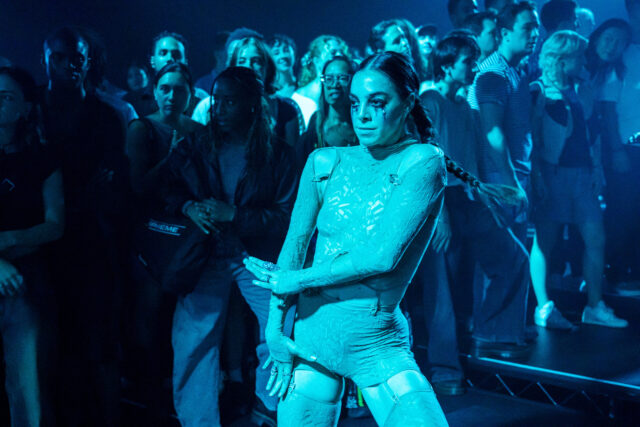
André De Shields makes the grandest of grand entrances as Old Deuteronomy in Cats: The Jellicle Ball (photo by Matthew Murphy)

CATS: “THE JELLICLE BALL”
Perelman Performing Arts Center (PAC NYC)
251 Fulton St.
Tuesday – Sunday through September 8, $68-$309
pacnyc.org

The Pride celebration of the summer and, hopefully, beyond is happening seven times a week at PAC NYC, where Zhailon Levingston and Bill Rauch’s electrifying reimagining of Andrew Lloyd Webber’s Cats — yes, that Cats — is running now through September 8, not quite forever, but not bad.

I have never before seen Cats, in any version — not the original 1982–2000 musical (which won seven Tonys and a Grammy), the 1998 film version, the 2016 Broadway revival, or the 2019 movie that not even Taylor Swift could save (and earned six Golden Raspberries). I haven’t read T. S. Eliot’s 1939 source book, Old Possum’s Book of Practical Cats, either. When I told two friends of mine, longtime Cats haters, that I was going to The Jellicle Ball, they looked at me like they’d rather watch paint dry. Which is unfortunate for them, because Cats: “The Jellicle Ball” is an absolute blast.

Rachel Hauck has transformed the John E. Zuccotti Theater into a fashionable immersive ball, with a central catwalk, the audience sitting on three sides, and cabaret tables along the runway. A DJ (Capital Kaos) finds a dusty copy of the Cats soundtrack and puts it on, a clever nod to the original. Munkustrap (Dudney Joseph Jr.), the master of ceremonies, keeps things moving at a fast pace. The crowd is encouraged to be loud, and they hoot and holler as a cast of nearly two dozen parade up and down and all around the space, looking fabulous in Qween Jean’s spectacular costumes, which range from fluffy and colorful to raw and raunchy, from playful and funny to sexy and scary, topped off by Nikiya Mathis’s outrageous hair and wigs. Adam Honoré sprays colored spotlights across the room and incorporates a disco ball, while sound designer Kai Harada turns up the volume. Brittany Bland’s projections take us from day to night with cool visuals and pay tribute to early BIPOC LGBTQIA+ heroes.

Arturo Lyons and Omari Wiles meld hip-hop and queer Ballroom culture into their vibrant choreography, with touches of traditional musical theater, since, of course, this is still Cats, following the same structure as the original and making very few tweaks to the story and lyrics; there are nods to Jennie Livingston’s 1990 documentary Paris Is Burning, the television series Pose and RuPaul’s Drag Race, The Wiz, and a dash of Hair in its throwback counterculture vibe.

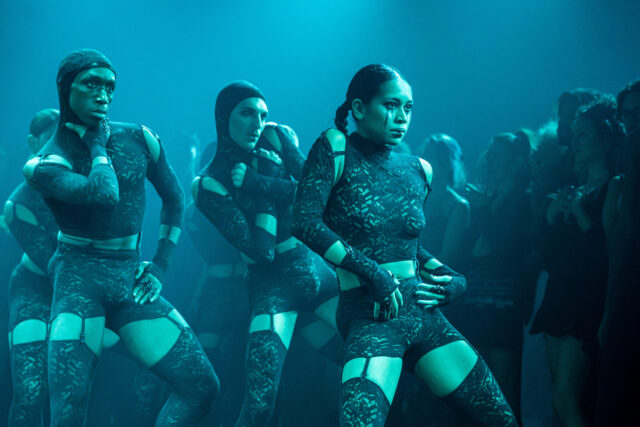
Cats: The Jellicle Ball is an intoxicating mélange of music and movement (photo by Matthew Murphy)

At the Jellicle Ball, dancers compete for trophies in such categories as Old Way vs. New Way, Voguing, Opulence, Hair Affair, and Butch Queen Realness. The preliminaries are judged by two people selected from the audience — and clearly chosen because of their wild outfits. (A few brought handheld fans, knowing just when to snap them open to match what was happening onstage.)

But it’s Old Deuteronomy (André De Shields) who will decide which furry feline will ascend to the Heaviside Layer. Among those making their case for top cat are Victoria (Baby), cat burglars Mungojerrie (Jonathan Burke) and Rumpleteazer (Dava Huesca), the curious Rum Tum Tugger (Sydney James Harcourt), virgin voguer Electra (Kendall Grayson Stroud), the mysterious Macavity (Antwayn Hopper), and housemother Jennyanydots (Xavier Reyes).

Emma Sofia stands out as Cassandra and Skimbleshanks, shaking the joint as an MTA conductor in “The Railway Cat.” Robert “Silk” Mason is in full glory mode as the conjurer Magical Mister Mistoffelees. Ballroom icon “Tempress” Chasity Moore brings heart and soul to Grizabella, the formerly glamorous gata who now lives off the street, delivering a powerful “Memory.” And Ballroom legend and Paris Is Burning emcee Junior LaBeija — the inspiration for Billy Porter’s Pose character, Pray Tell — gets duly honored as Gus the theater cat, carried out in a makeshift throne as he sings his eponymous song. LaBeija is one of numerous Trailblazers whose brief bios can be found on panels in the hall surrounding the theater, including Dorian Carey, Pepper LaBeija, Octavia St. Laurent, and Rauch.

But this is André De Shields’s world; we only live in it. The Tony, Obie, and Grammy winner (Hadestown, Ain’t Misbehavin’) makes the grandest of grand entrances, emerging from behind a glittering doorway and suddenly appearing before us in a plush purple suit and a lionlike cloud of silver, purple, and white hair, marking him as King of Pride. He floats slowly down the catwalk, basking in the tremendous adoration and adulation, then takes his royal seat at the end, a uniquely supreme being who is the ultimate judge of us all.

The music is performed by a crack eight-piece band: conductor Sujin Kim–Ramsey, Lindsay Noel Miller, and Eric Kang on keyboards, Justin Vance and Amy Griffiths on reeds, Andrew Zinsmeister on guitars, Calvin Jones on electric bass, and Clayton Craddock on drums, bringing funk and plenty of ’70s synth pop to the score, under William Waldrop’s direction.

Of course, this is still Cats, so not everything makes sense — what does “jellicle” even mean? — a few elements are repeated, and utter mayhem threatens at any second in this ferocious production, which is as unpredictable and entertaining as, well, cats.

[Mark Rifkin is a Brooklyn-born, Manhattan-based writer and editor; you can follow him on Substack here.]
HOW LONG BLUES

Whirling dervishes light up Little Island in Twyla Tharp’s How Long Blues (photo by Nina Westervelt)

HOW LONG BLUES
The Amph, Little Island
Pier 55, Hudson River Park at West Thirteenth St.
Wednesday – Sunday through June 23, $25
www.littleislandtickets.com
www.twylatharp.org

On opening night of Twyla Tharp’s How Long Blues at the 680-seat outdoor Amph on Little Island, a storm threatened. At one point, as rain began to fall, a dancer slipped on the stage, and project funder Barry Diller looked over at Tharp and wondered if they should stop the performance. Tharp shook her head, and the show went on, the weather adding a touch of magic and menace.

Little Island has hosted live music, dance, and storytelling the past several summers, but How Long Blues is the first work specifically commissioned for the sculpted oasis on the Hudson River, near the Whitney, kicking off a season of such pieces. The eighty-two-year-old Tharp incorporates her signature melding of contemporary movement and classical ballet into a rough-hewn narrative inspired by Albert Camus’s 1947 novel The Plague, a parable about fascism set against an epidemic. The book begins, “The unusual events described in this chronicle occurred in 194– at Oran. Everyone agreed that, considering their somewhat extraordinary character, they were out of place there.” How Long Blues might be a bumpy ride, but it feels like it belongs in the space, particularly as the wind swept through and the percussion was mistaken for thunder.

The sixty-minute premiere features two-time Tony winner Michael Cerveris (Fun Home, Assassins) as Nobel Prize–winning French philosopher and playwright Jean-Paul Sartre (Being and Nothingness, Existentialism and Humanism) and longtime ABT and Tharp dancer and choreographer John Selya as Camus (The Stranger, The Rebel); the two were close friends — Camus at one point was going to star in and/or direct Sartre’s play No Exit — until ideological differences over communism and freedom led to a public falling out. None of that is apparent in How Long Blues.

Cerveris spends most of the show walking around Santo Loquasto’s set with a copy of Le Figaro, smoking a pipe, wearing a headset, and watching the action, occasionally sitting on one of the audience benches. Selya, in a dapper suit, wanders back and forth across the stage, pursuing nearly every woman after one of his lovers jumps into the Hudson. Camus was a well-known philanderer who cheated on his wives; his second spouse, pianist and mathematician Francine Faure, was hospitalized with depression and attempted suicide.

How Long Blues features surprising props and set changes (photo by Nina Westervelt)

The score, by thirteen-time Grammy-winning singer-songwriter, guitarist, and producer T Bone Burnett and composer, musician, and violinist David Mansfield, who were both part of Bob Dylan’s Rolling Thunder Revue in the mid-’70s, is a curious thing. Much of it is prerecorded even though there is a seven-piece band (John Bailey on trumpet and fugelhorn, Justin Goldner on guitar, tenor banjo, and bass, Wayne Goodman on trombone, Mark Lopeman on sax and clarinet, Jay Rattman on saxophone, George Rush on bass and tuba, and Paul Wells on percussion) in addition to underutilized vocalist Andromeda Turre, all of whom are placed in two balconies at the west corners of the space. The song selections are also not particularly illuminating.

An unhoused man plays “My Way” on a trumpet. There’s an excerpt of the Sound of Feeling’s cover of Donovan’s “Hurdy Gurdy Man,” along with Mardi Gras Indian group the Wild Tchoupitoulas’s “Meet de Boys on the Battlefront” and “Brother John” and music by Jelly Roll Morton, Muddy Waters, Cab Calloway, and Count Basie. Cerveris eventually puts the headset to good use, delivering beautiful versions of the blues classic “St. James Infirmary” and Leonard Cohen’s ubiquitous “Hallelujah.”

Dancers Piper Dye, Jourdan Epstein, Oliver Greene-Cramer, Kyle Halford, Colin Heininger, Daisy Jacobson, Claude CJ Johnson, Pomme Koch, Skye Mattox, Nicole Ashley Morris, Hugo Pizano Orozco, Ryan Redmond, Victoria Sames, Frances Lorraine Samson, and Reed Tankersley bound about the stage in Loquasto’s ever-changing costumes as the choreography moves from the turn of the twentieth century to the turn of the twenty-first, from lavish, glittering parties and vaudevillian shtick to whirling dervishes and working-class drama at the docks. Props include a piano, a Sisyphus-like rock (Camus wrote The Myth of Sisyphus in 1942), a trio of doors, and a soccer ball (Camus loved European football and was a goalie in his younger days). Adding to the bizarreness is a group of cartoonish characters in oversized costumes with giant heads.

It might not be Pina Bausch, but Tharp’s How Long Blues is an entertaining start to Little Island’s summer of commissions, which continues with such presentations as Davóne Tines in Robeson, Henry Hoke’s Open Throat, Pam Tanowitz’s Day for Night, and Anthony Roth Costanzo in The Marriage of Figaro.

[Mark Rifkin is a Brooklyn-born, Manhattan-based writer and editor; you can follow him on Substack here.]