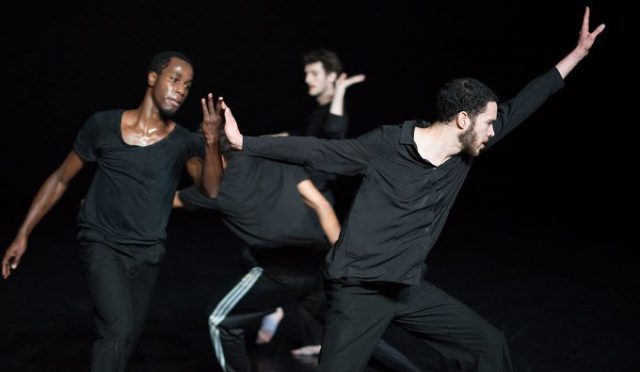
Four dancers play the roles of four musicians in Anne Teresa De Keersmaeker and Salva Sanchis’s revisiting of John Coltrane’s A Love Supreme (photo © Anne Van Aerschot)
New York Live Arts
219 West 19th St. between Seventh & Eighth Aves.
September 27-30, 7:30
212-924-0077
newyorklivearts.org
www.rosas.be/en
Bill T. Jones’s New York Live Arts strives to encompass more than just dance, a goal achieved with their stunning production of A Love Supreme, Belgian choreographer Anne Teresa De Keersmaeker and Spanish dancer and choreographer Salva Sanchis’s newly rewritten version of their 2005 evening-length piece, which continues at NYLA through September 30. Thirty minutes before the piece begins onstage in the theater, saxophonist Tony Jarvis and bassist Nathan Peck move about the waiting audience in the lobby space and head out into the street of passersby and onlookers as they perform excerpts from John Coltrane’s masterful, boundary-breaking 1965 album, the original recording of which serves as the soundtrack of De Keersmaeker and Sanchis’s collaboration. You don’t need a ticket to just hang out, get a drink, and watch Jarvis and Peck interact with each other in a way that only jazz allows, creating a spiritual conversation of dissonance and beauty. This prelude serves as an ingenious introduction to what follows inside the theater, as four male dancers embody the roles of the four main musicians on the record. The show begins in silence, with Thomas Vantuycom as saxophonist Coltrane, Jason Respilieux as bassist Jimmy Garrison, Bilal El Had (or Robin Haghi) as pianist McCoy Tyner, and José Paulo dos Santos as drummer Elvin Jones. They are all barefoot, dressed in black, with black tape dividing the black floor into a flurry of geometric patterns.
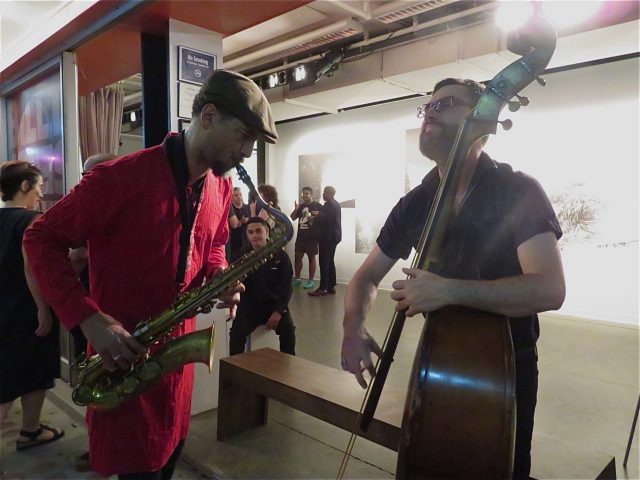
Tony Jarvis and Nathan Peck perform a Coltrane overture to get the audience in just the right mood for A Love Supreme (photo by twi-ny/mdr)
After several minutes, the music starts, the glorious four-part suite consisting of “Acknowledgement,” “Resolution,” “Pursuance,” and “Psalm,” which Coltrane performed only once live in its entirety. “You see, one thing about that music is that it showed you that we had reached a level where you could move the music around,” Tyner told NPR in 2012. “John had a very wonderful way of being flexible with the music, flexing it, stretching it. You know, we reflected that kind of thing. He gave us the freedom to do that.” That idea translates beautifully into De Keersmaeker and Sanchis’s choreography, in which the dancers follow the general progression of the “sheets of sound,” as Coltrane described it, ranging from solos to duets to trios to quartets but never just mimicking what is being played. When a musician takes a solo, that respective dancer improvises. Meanwhile, the other dancers stand aside and watch, just as jazz musicians do. All four performers are outstanding, with Vantuycom brilliant in the lead, swirling with his elongated arms, making angular gestures, and gliding across the floor as Coltrane soothes the soul.

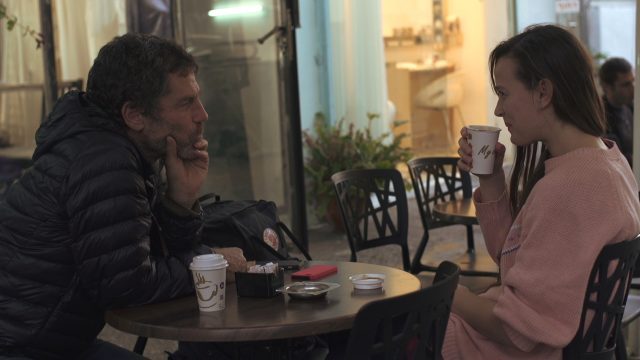
 If you didn’t know any better, you might think that Elvia Lund’s extraordinary Bobbi Jene was a fiction film. Danish director and cinematographer Lund, editor Adam Nielsen, and composer Uno Helmersson have employed narrative story techniques in crafting a bold and intimate tale about fear and desire, romance and ambition. But Bobbi Jene is actually a deeply personal documentary about a woman turning thirty and taking stock of her life. “I want to get to that place where I have no strength to hide anything,” Iowa native Bobbi Jene Smith says, and that is evident from the brief opening scene of Bobbi dancing naked and alone. When she was twenty-one, Bobbi moved to Israel to become a member of the world-renowned Batsheva Dance Company, led by choreographer Ohad Naharin, developer of the unique Gaga movement language. (I’ve seen her dance several times with Batsheva and have been touched and impressed by her abilities.) Now that she’s nearly thirty, Bobbi has decided to go back to America and create pieces herself, which she tells Naharin, with whom she had a relationship. “I love being in the company. I love dancing for you,” she says during their talk at a busy café. “I just feel it’s time for me to go make my own work.” Naharin carefully responds, “So it’s painful, but it’s probably also what you need.” Bobbi is not only leaving the troupe but her boyfriend, twenty-year-old company dancer Or Schraiber, who loves her but does not want to leave Tel Aviv. We see her struggling with her decision, trying to convince herself that she can both make a career in the States while also maintaining a long-distance relationship with Or. Once back in America, Bobbi concentrates on her durational solo piece A Study on Effort, a raw, intense work that combines power with vulnerability as she explores pleasure and pain. As she prepares to perform the piece at the Israeli Museum in Jerusalem, all the different parts of her life threaten to overwhelm her.