this week in dance

KINSTILLATORY MAPPINGS IN LIGHT AND DARK MATTER

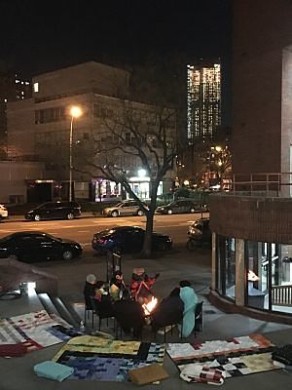
Emily Johnson is hosting free interdisciplinary fireside gathering on monthly Fridays outdoors at Abrons Arts Center

Emily Johnson is hosting free interdisciplinary fireside gathering on monthly Fridays outdoors at Abrons Arts Center

Abrons Arts Center
466 Grand St. at Pitt St.
April 13, May 25, June 8, and July 24, free, no RSVP necessary
212-598-0400
www.abronsartscenter.org
www.catalystdance.com

Nobody builds an artistic community quite the way Emily Johnson does in her interdisciplinary, immersive works. With her Catalyst company, Johnson, a native Alaskan of Yup’ik descent who is based in Minneapolis and New York, creates unique, multisensory experiences that bond the performers with the audience. For Shore, she led ticket holders on a walk from a public school playground to New York Live Arts, following the path of the old Minetta Creek. For Then a Cunning Voice and a Night We Spend Gazing at Stars, dozens of people came together on Randall’s Island from dusk to dawn, with art, dance, storytelling, cooking, eating, napping, and more. Her latest participatory presentation is Kinstillatory Mappings in Light and Dark Matter, taking place April 13, May 25, June 8, and July 24 from 7:00 to 10:00 in the outdoor amphitheater at Abrons Arts Center. On April 13, the celebratory fireside gathering will feature story and song offerings from Rick Chavolla, Tatyana Tenenbaum, and Georgia Lucas, a look at the stars, and dancing. Admission is free, and no RSVP is necessary. You can bring food, but sharing is up to you. The event will not be held in case of inclement weather. Prepare to be charmed by the effervescent Johnson, whose other works include Niicugni, The Thank-You Bar, Pamela, and Give Me a Story, Tell Me You Love Me.

FREE TICKET ALERT: A PRELUDE TO THE SHED

prelude-180403

A PRELUDE TO THE SHED
Tuesday, May 1, to Sunday, May 13, free with advance tickets
Tenth Ave. at West Thirty-First Sts. (entrance on West Thirty-First)
theshed.org

If you’ve wondered what that strangely curious building going up on West Thirtieth St. between Tenth & Eleventh Aves. is, we now know. It’s called the Shed, which bills itself as “the first arts center designed to commission, produce, and present all types of performing arts, visual arts, and popular culture.” The Shed, a 200,000-square-foot structure designed by Diller Scofidio + Renfro in collaboration with the Rockwell Group, will open next spring with intriguing, exciting projects by Steve McQueen and Quincy Jones; Gerhard Richter and Steve Reich; Anne Carson with Ben Whishaw and Renée Fleming; Trisha Donnelly; Agnes Denes; and others. “The original idea for the Shed was relatively simple: provide a place for artists working in all disciplines to make and present work for audiences from all walks of life,” Shed artistic director and CEO Alex Poots, formerly director of the Park Ave. Armory, said in a statement. “Our opening programs begin to show how these artists, art forms, and audiences can thrive together under one roof.” But before the Shed officially opens, it will be holding a preopening program, “A Prelude to the Shed,” in a flexible, transformable venue in an undeveloped lot at Tenth Ave. and West Thirty-First St., designed by architect Kunlé Adeyemi of NLÉ Works and conceptual artist Tino Sehgal. “‘A Prelude to the Shed’ is an exploration of architecture as an extension of human body, culture, and environment. Can architecture be more human?” Adeyemi explained in a statement. “This curiosity led us to reconfigure a steel shed into a comfortable interface to interact with people physically; inside and outside, in light and darkness, individually and collectively. Using simple technologies, we made the structure so that it can be moved and transformed by people, enabling its participation in different formats of art, education, events, and public life.”

(rendering courtesy of NLÉ Works)

“A Prelude to the Shed” takes place May 1-13 (rendering courtesy of NLÉ Works)

From May 1 to 13, visitors with advance free tickets can see live music and dance, panel discussions, art installations, and more. (There should be some walk-up availability as well.) Each session includes Sehgal’s continuous, immersive dance/sound piece This variation, which interacts with choreographer William Forsythe’s Pas de Deux Cent Douze, a reimagining of the central duet from his 1987 ballet In the Middle, Somewhat Elevated. On some nights, Reggie “Regg Roc” Gray will lead “D.R.E.A.M. Ring Dance Battles,” part of FlexNYC. Several nights will feature live solo concerts by ABRA, Arca, and Azealia Banks; on other nights there will be panel discussions organized by Bard professor Dorothea von Hantelmann with Shed senior program adviser Hans Ulrich Obrist and chief science and technology officer Kevin Slavin. Among the topics are “Transformative Topologies: Past, Present, and Future Functions of Art Institutions,” “Beyond the Mind/Body Division: Neuroscience, Technology, Spirituality,” “Agnes Denes: Animale, Rationale, Mortale,” and “A Global Dialogue That Is Not Globalization,” boasting such international thinkers as Manthia Diawara, Tim Morton, Avital Ronell, Barbara Browning, Moncell Durden, Nelson George, Frankie Decaiza Hutchinson, Akeel Bilgrami, Joy Connolly, Tim Ingold, Emily Segal, and Richard Sennett. And on May 5 and 12 at 11:30 am, Asad Raza, Jeff Dolven, and D. Graham Burnett’s “Schema for a School” experimental course for students will be open to the public. “Prelude” will also pay tribute to architect Cedric Price’s unrealized 1961 building “The Fun Palace” with an archival interactive display. We’re out of breath already, and this is only the preopening. So we’ll let von Hantelmann sum it all up: “Art institutions — museums, exhibitions, theaters, concert halls, festivals — have always been spaces in which a social structure becomes manifest. To find ritual forms that correspond to contemporary forms of life and to the social structures of the early twenty-first century, that is the aspiration to which this project is dedicated.”

MARTHA GRAHAM DANCE COMPANY: SACRED / PROFANE

Mosaic

Sidi Larbi Cherkaoui’s Mosaic will be part of Martha Graham season at New York City Center this week

New York City Center
130 West 56th St. between Sixth & Seventh Aves.
April 11 – 14, $35-$95
212-581-1212
www.nycitycenter.org
marthagraham.org

The Martha Graham Dance Company is presenting a wide range of works in three programs for their spring season at New York City Center. “Sacred/Profane” begins with a gala on April 11 at 7:00, consisting of the world premiere of Lucinda Childs’s Histoire, an expansion of a 1999 duet that is now for eight dancers, with music by Krzysztof Knittel (Histoire lll for harpsichord and tape) and Astor Piazzolla (Milonga en re for violin, piano, and double bass and Soledad for violin, bandoneon, piano, and double bass) and costumes by Karen Young; Lar Lubovitch’s The Legend of Ten, in honor of his company’s fiftieth anniversary, with music by Johannes Brahms (Quintet for Piano and Strings in F Minor, Opus 34, Movements I & IV) and costumes by L. Isaac with Naomi Luppescu; and Graham’s 1958 Embattled Garden, with music by Carlos Surinach, set design by Isamu Noguchi, and costumes by Graham. Program A, taking place April 12 & 14 at 8:00, features Childs’s Histoire and a trio of works that Graham choreographed and designed the costumes for: the lost 1933 solo Ekstasis, reimagined by Virginie Mécène, with original music by Lehman Engel that has been reimagined by Ramon Humet, 1984’s The Rite of Spring, with music by Igor Stravinsky, and 1935’s Panorama, which will be performed by local teens, set to music by Norman Lloyd. And Program A, on April 13 at 8:00, includes Sidi Larbi Cherkaoui’s Mosaic, with music by Felix Buxton and costumes by Young; Lubovitch’s The Legend of Ten; and Graham’s Embattled Garden and the 1936 antiwar piece Chronicle, the latter with music by Wallingford Riegger, set design by Noguchi, and costumes by Graham. The Mannes Orchestra will play live music for all the Graham classics. The company, which was formed in 1926, currently is made up of dancers So Young An, Alyssa Cebulski, PeiJu Chien-Pott, Leon Cobb, Alessio Crognale, Laurel Dalley Smith, Natasha M. Dimond-Walker, Abdiel Jacobsen, Lloyd Knight, Charlotte Landreau, Jacob Larsen, Lloyd Mayor, Ari Mayzick, Cara McManus, Marzia Memoli, Anne O’Donnell, Lorenzo Pagano, Ben Schultz, Anne Souder, Leslie Andrea Williams, and Xin Ying.

EVERYTHING IS IMAGINABLE

Jack Ferver

Jack Ferver collaborates with Reid Bartelme as well as James Whiteside, Lloyd Knight, and Garen Scribner in the world premiere of Everything Is Imaginable at New York Live Arts (photo by Jason Akira Somma)

New York Live Arts
219 West 19th St. between Seventh & Eighth Aves.
April 4-7, $15-$35, 8:00 (bonus 10:00 show on April 6)
212-924-0077
newyorklivearts.org
www.jackferver.org

A few weeks before the world premiere of Everything Is Imaginable, New York City treasure Jack Ferver tore his calf while preparing a piece for Reid Bartelme and Harriet Jung at the Guggenheim. But leave it to the Wisconsin-born actor, writer, dancer, choreographer, teacher, and director to incorporate the injury into the narrative of the two-act, seventy-minute show. As the audience enters the theater at New York Live Arts, the curtain is down, a rarity at the venue, upping the growing sense of anticipation that accompanies every Ferver work. The curtain soon opens on Jeremy Jacob’s playful set, consisting of four white cardboard columns with drawings of leaves on them, along with a central cardboard chandelier hovering at the top of a screen in the back. It immediately immerses the crowd into the wonders of Ferver’s imagination while exposing the artifice behind staged productions in general. The first act features four queer men in sheer, butt-revealing outfits dancing solos inspired by their childhood memories and one major role model: American Ballet Theater principal James Whiteside, in a short, glittering dress of silver sequins, pays tribute to Judy Garland, dancing to Garland’s version of Cole Porter’s “I Happen to Like New York”; Martha Graham principal dancer Lloyd Knight honors Graham, moving to a recording of the legendary choreographer speaking about dance; dancer and actor Garen Scribner slides across the stage in socks and does spins like his hero, champion skater Brian Boitano, to the sound of ice skates being sharpened and gliding across the ice; and longtime Ferver collaborator Bartelme, a former ballet dancer and current costume designer (as part of Reid and Harriet Design, who made the costumes for the show), wears a long orange mane and dances with horse movements, since his idol is My Little Pony. Each solo combines humor with beautiful movement, taking advantage of each dancer’s strengths while adding the charm and whimsy that are mainstays of Ferver’s choreography. The four star turns are followed by a solo about sunglasses and then an ensemble piece danced to “club music,” including a Martha Graham–esque sexualized orgy that is uproariously funny.

After a ten-minute intermission (with the curtains closed), the second act begins with Ferver (Chambre, Night Light Bright Light) by himself onstage, standing over a miniature version of the set from the first act, evoking Stonehenge from This Is Spinal Tap. In a sheer bodysuit recalling Michelle Pfeiffer’s garb as Catwoman in Batman Returns, the compact Ferver towers over the tiny columns and chandelier, emphasizing his power as a creator while also poking fun at it. Ferver talks about his calf injury, explaining how that limited his ability to dance — his doctor advised him not to move forward, which is not part of his vocabulary, literally or figuratively — and forced him to reimagine the work, and discusses his difficult childhood, friendless and bullied for his overt homosexuality; growing up gay is a regular theme in his oeuvre. As always, his stage persona is that of a devilish cherub, wild and wacky one moment, making the audience roll around their seats with laughter, and then deadly serious the next, raising disturbing elements from his life that may or may not be true, causing everyone to reconsider their reactions. He’s joined by Bartelme, who looks lovely in a fringe dress, and the two dance together to heartbreaking effect while Ferver, soldiering on despite his injury, goes on to describe his process of writing a memoir, which took place alone, terrified, in a strange house, in the dark. Ferver is no longer friendless or alone, as evidenced not only by the crowd response to the supremely personal show but by the long line of well-wishers who waited to hug and congratulate him for giving them yet another unique, meaningful, and vastly entertaining experience, shining a light on his life, and ours, as only he can.

ASCENSION: A LIFTING OF DR. MARTIN LUTHER KING’S LEGACY ON THE 50th ANNIVERSARY OF HIS ASSASSINATION

The fiftieth anniversary of the assassination of Dr. Martin Luther King Jr. will be honored at Harlem Gate on April 4

The fiftieth anniversary of the assassination of Dr. Martin Luther King Jr. will be honored at Harlem Gate on April 4

Who: Adepero Oduye, Amma Whatt, C. Kelly Wright, Kyle Marshall, Bertha Hope
What: An evening of live performances and tributes celebrating the legacy of Dr. Martin Luther King Jr.
Where: Harlem Stage Gatehouse, 150 Convent Ave. at West 135th St., 212-281-9240 ext. 19
When: Wednesday, April 4, free with RSVP, 7:30 & 8:45
Why: On April 4, 1968, Dr. Martin Luther King Jr. was assassinated at the Lorraine Motel in Memphis, Tennessee, altering the course of America’s future. Harlem Stage is honoring Dr. King’s legacy with a special program on April 4, 2018, the fiftieth anniversary of his murder. At 7:30 and 8:45, singer-songwriter Amma Whatt, actress, singer, and dancer C. Kelly Wright, dancer and choreographer Kyle Marshall (a solo piece set to Dr. King’s “On the Mountaintop” speech), actress, writer, and director Adepero Oduye (an excerpt from “The Drum Major Instinct”), and jazz pianist Bertha Hope will perform a tribute to MLK and Harlem, built around one of MLK’s most famous quotes, putting it into contemporary context: “Darkness cannot drive out darkness; only light can do that. Hate cannot drive out hate; only love can do that.”

JACK FERVER: EVERYTHING IS IMAGINABLE

Jack Ferver

Jack Ferver presents the world premiere of Everything Is Imaginable this week at New York Live Arts (photo by Jason Akira Somma)

New York Live Arts
219 West 19th St. between Seventh & Eighth Aves.
April 4-7, $15-$35, 8:00 (bonus 10:00 show on April 6)
212-924-0077
newyorklivearts.org
www.jackferver.org

Nothing is unimaginable in the fabulous world of Jack Ferver, the creator of such unique and unpredictable multidisciplinary works as Rumble Ghost, Two Alike, Chambre, Night Light Bright Light, and I Want You to Want Me. So the name of his latest piece, Everything Is Imaginable, debuting April 4-7 at New York Live Arts, makes perfect sense in his oeuvre. The Wisconsin-born actor, writer, dancer, choreographer, teacher, and director delves deep into his psyche and love of pop culture to tell compelling, tragicomic stories, teaming up with talented collaborators. In Everything Is Imaginable, Ferver has brought together five queer performers to explore gender, sexuality, love, and loss through personal tales as well as those of five other public figures while paying homage to Martha Graham.

Ferver will be joined by Graham principal dancer Lloyd Knight, American Ballet Theater principal James Whiteside, dancer and actor Garen Scribner (An American in Paris, Nederlands Dans Theater), and dancer and costume designer and Ferver regular Reid Bartelme (of Reid and Harriet Design), each of whom will get a solo that relates to their childhood as well as their role models. The scenic and sound design is by visual artist Jeremy Jacob. “The queer ‘I’ is a shattered ‘I,’” Ferver said in a statement. “The queer is not only told they are unnatural but that they have chosen to be so. The result of this shattering creates a slipperiness of self, an ability to coalesce into a performance without a center. This fragmentation, this relentless brokenness that continuously seeks stability and fails, is very much inside my work.” Ferver has a rabid fan base, so get your tickets now. And for a peek at what else he is been up to of late, check out JbDubs’ very NSFW “Duck Hunt” video, which was choreographed by Ferver and Whiteside and stars Ferver. (The April 5 performance of Everything Is Imaginable will be followed by a Stay Late Conversation with the performers.)

WHAT WILL WE BE LIKE WHEN WE GET THERE

Joanna Kotze’s What will we be like when we get there will make its world premiere March 28-31 at New York Live Arts (photo by Carolyn Silverman)

Joanna Kotze explores space, time, connection, collaboration, and communication in What will we be like when we get there at New York Live Arts (photo by Carolyn Silverman)

New York Live Arts
219 West 19th St. between Seventh & Eighth Aves.
March 28-31, $15-$25, 7:30
212-924-0077
newyorklivearts.org
www.joannakotze.com

It’s not exactly clear when Joanna Kotze’s What will we be like when we get there begins and ends — at a talkback moderated by Okwui Okpokwasili following the March 29 performance, one audience member said she wasn’t sure if the show was still going on. Such is the mystery, magic, madness, and mayhem of this world premiere, taking place at New York Live Arts through March 31. South Africa-born, Brooklyn-based dancer, choreographer, and teacher Kotze kicks off the evening by pointing out the exits, telling the audience to turn off their cell phones, and describing the origins of this collaboration with visual artist Jonathan Allen, sound designer, composer, and musician Ryan Seaton, and dancer and choreographer Netta Yerushalmy. However, Kotze’s speech starts hesitating as she drifts toward the floor, holding the microphone stand in awkward positions. Yerushalmy comes out and lies down on her side at the front of the stage, facing the back. Seaton pushes a heavy piano back and forth, perhaps a reference to Luis Buñuel and Salvador Dalí’s Un Chien Andalou. Allen lays orange gaffer’s tape from a ladder onto other objects as well as on the floor, creating new physical spaces in the air and on the ground. Seaton (Callers) plays electronic music from a laptop, then runs to a saxophone or grabs a clarinet and plays it. Allen (whose related paintings, “Knowing That Your House Is on Fire,” are on view in the lobby) gets continually knocked over by Yerushalmy (Paramodernities), who, after a long period hiding her face, finally reveals herself to the crowd but later teases it with potential nudity. Kotze jumps onto an empty chair in the audience and takes a breather on the steps. Allen collects nearly everything not bolted down — folding chairs, a cart, monitors, mechanical equipment — and moves it to the middle of the stage, as if a Wizard of Oz-like cyclone is scooping up whatever is in its path. For seventy-five minutes, with the house lights on, the four friends engage in a series of set pieces exploring connection and communication in a stormy world, incorporating large doses of absurdity and humor. Bessie winner Kotze (FIND YOURSELF HERE; It Happened It Had Happened It Is Happening It Will Happen) takes advantage of every part of the New York Live Arts Theater, immersing the audience in the vast unpredictability of life in the twenty-first century through an exhilarating controlled chaos. The quartet eventually stands together and bows, but a day later I’m still not sure it’s over, as Kotze alludes to in the title of this thrilling work.