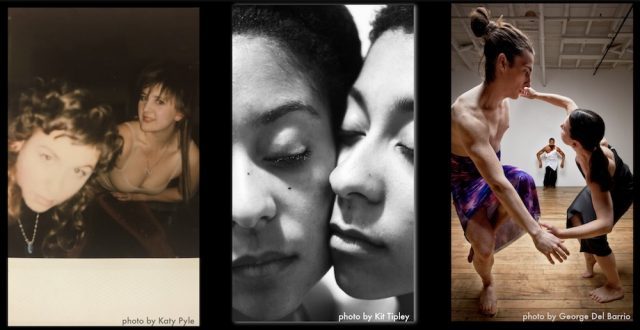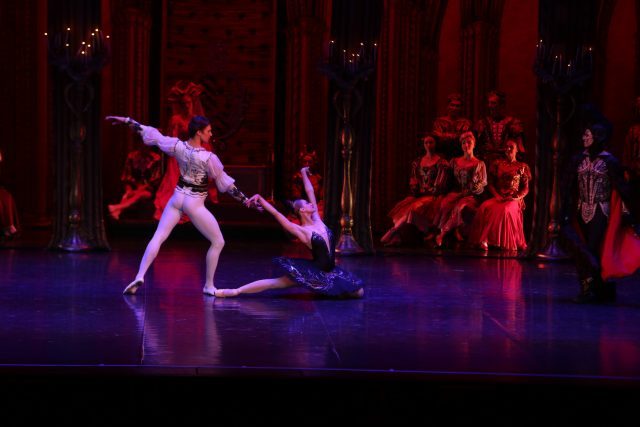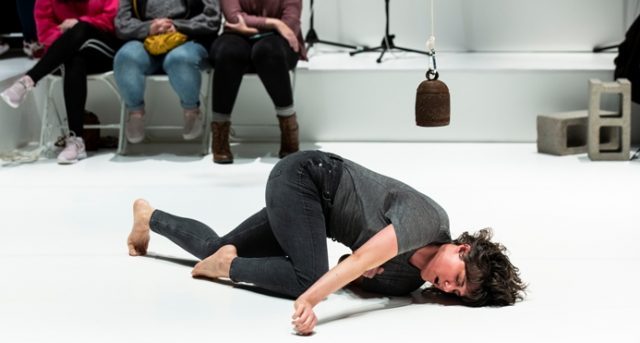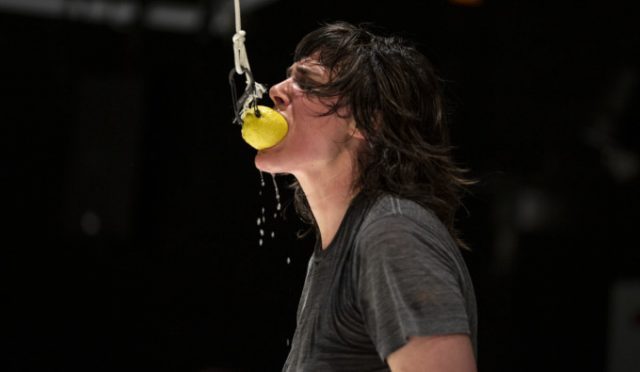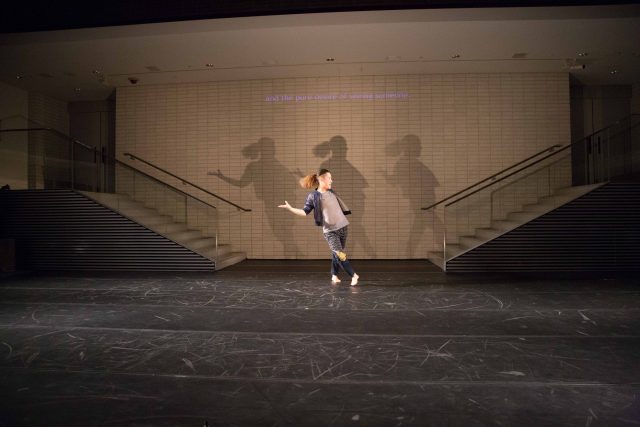
Faye Driscoll’s Thank You for Coming: Space concludes five-plus-year trilogy (photo by Maria Baranova)
LIVE ARTERY
New York Live Arts
219 West 19th St.
January 8-11, $15-$30
Festival continues through January 15 newyorklivearts.org fayedriscoll.com
“I think I have always been interested in performance as a ritual of expression, protest, transformation, and basically one gigantic act of mirroring with the performers and audience,” Guggenheim Fellow and Bessie Award-winning choreographer Faye Driscoll explained in a March 2014 twi-ny talk. “I don’t buy this idea that in order to be socially engaged you have to adapt to a certain way of being; I think we are all socially engaged whether we like it or not — or maybe whether we choose to deal with it or not. . . . I am trying through my own formal and aesthetic experiments to expand my perception of this interconnection, and maybe others will feel that or maybe they won’t.” Others have felt that interconnection through her trilogy that began with Thank You for Coming: Attendance in March 2014 at Danspace and was followed by Thank You for Coming: Play in November 2016 at the BAM Fisher.
Driscoll concluded the three-part piece in April 2019 at Montclair State University’s Peak Performances with Thank You for Coming: Space. If you didn’t make it to Jersey, you can catch the work January 8-11 as part of New York Live Arts’ annual Live Artery series, held in conjunction with the APAP conference. Thank You for Coming: Space explores presence and absence, death and grief, taking place in an intimate kinetic installation where it’s just Driscoll and the audience. You do not need to have seen the earlier works in order to join the potent and poignant community that Driscoll creates onstage. Live Artery continues through January 15 with such other shows as Kimberly Bartosik/Daela’s through the mirror of their eyes, Molly Lieber and Eleanor Smith’s Body Comes Apart, and Liana Conyers’s #ImFxckingFunny.
Sophia Petrides’s BREATHING WITH THE ROOM is part of New Ear Festival
Once upon a time, January was considered a relative artistic wasteland, as people suffered from a post-holidays letdown with a dearth of high-quality movies and Broadway shows opening up. But this century continues to fill that void with more and more cutting-edge, experimental, and offbeat music, dance, film, and theater at unique performance festivals around the city. You can catch cabaret at Pangea, opera at Prototype, dance at the 92nd St. Y and New York Live Arts, jazz at JazzFest, Irish theater at Origin’s 1st, avant-garde music and film at New Ear, and a little of everything at Under the Radar. Sadly, the last few years have seen the demise of COIL and American Realness. Below are only some of the highlights of this exciting time to try something that might be outside your comfort zone and take a chance on something new and different to kick off your 2020, especially with the majority of tickets going for about twenty-five bucks.
NEW EAR FESTIVAL
Fridman Gallery
287 Spring St. by Hudson St.
January 6–12, $20, 8:00 www.fridmangallery.com
Monday, January 6 CT::SWaM ExChange, with Ginny Benson, Jeremy Toussaint-Baptiste, Dani Dobkin, Bernd Klug, and a very special guest
Tuesday, January 7
Victoria Keddie exchanges transmissions from Copenhagen, improvised animations and sound by Theodore Darst and Kevin Carey, and a performance by Adelaide Damoah
Wednesday, January 8
Tariq “Black Thought” Trotter of the Roots, with Zachary Tye Richardson, Vuyo Sotashe, Onyx Violins, and Brother Paul Daniels II
Thursday, January 9 Model Home, new commission by Brandon Lopez with TAK Ensemble, and Sa’dia Rehman
Friday, January 10
Susie Ibarra and Dreamtime Ensemble, Allard van Hoorn, and the Dream Mapping Project
Saturday, January 11
Violist Joanna Mattrey, percussionist William Hooker’s quartet, and Sophia Petrides
Sunday, January 12
DeForrest Brown Jr., Muyassar Kurdi and MV Carbon, and SHYBOI
UNDER THE RADAR
Public Theater and other venues
425 Lafayette St. by Astor Pl.
January 6–19 publictheater.org
January 6, 10, 12, 20 Daniel J. Watts’ The Jam: Only Child, with Daniel J. Watts and DJ Duggz, Joe’s Pub, $35
January 8–19 The Shadow Whose Prey the Hunter Becomes, with Michael Chan, Simon Laherty, Sarah Mainwaring, and Scott Price, LuEsther Hall, Public Theater, $30
January 10–19 Selina Thompson: salt., with Rochelle Rose, Martinson Hall, Public Theater, $30
January 11–19 The Truth Has Changed, by Josh Fox & International WOW Company, Newman Theater, Public Theater, $30
January 11 & 17 Waterboy and the Mighty World by the HawtPlates, Shiva Theater, Public Theater, $25
London Assurance is part of Origin’s 1st Irish Festival (photo by Carol Rosegg)
ORIGIN’S 1st IRISH FESTIVAL
Multiple venues
January 7 – February 3 www.origintheatre.org
Through January 26 London Assurance, by Dion Boucicault, directed by Charlotte Moore, Irish Repertory Theatre, $50-$70
January 7–18 The 8th, written and directed by Seanie Sugrue, the Secret Theatre, $20
January 22 – February 2 The Scourge, by Michelle Dooley Mahon, directed by Ben Barnes, starring Michelle Dooley Mahon, Irish Repertory Theatre, $50
January 26 – February 1 Appropriate, by Sarah-Jane Scott, directed by Paul Meade, starring Sarah-Jane Scott, New York Irish Center, $26
January 27–28 Round Room: An Open Studio, by Honor Molloy, directed by Britt Berke, music by Susan McKeown, with Labhaoise Magee, Brenda Meaney, Rachel Pickup, Maeve Price, Zoe Watkins, and Aoife Williamson, the Alchemical Studios, $16
Molly Lieber and Eleanor Smith will present Body Comes Apart at New York Live Arts (photo by Maria Baranova)
LIVE ARTERY
New York Live Arts
219 West 19th St.
January 8-14 newyorklivearts.org
Saturday, January 11 Kathy Westwater: Rambler, Worlds Worlds a Part, $10, 2:00 Kimberly Bartosik/Daela: Through the Mirror of Their Eyes, 5:00
Saturday, January 11, 9:00
Sunday, January 12, 12 noon Molly Lieber and Eleanor Smith: Body Comes Apart, $15
January 12-14 Sean Dorsey: Boys in Trouble, $15
Monday, January 13 Yanira Castro/a canary torsi: Last Audience, free with RSVP, 4:0
James ‘Blood’ Ulmer will be at the Sultan Room on January 11
January 9, 12, 15–17 Blood Moon, by Ellen McLaughlin and composer Garrett Fisher, Baruch Performing Arts Center, $35-$75
January 11–17 Magdalene, chamber opera cocreated by performer Danielle Birrittella and director Zoe Aja Moore, with poetry by Marie Howe, HERE, $35-$75
January 10–11 Iron & Coal, rock opera by Jeremy Schonfeld, featuring Brooklyn Youth Chorus, Contemporaneous, MasterVoices, Rinde Eckert, and Daniel Rowan, Gerald W. Lynch Theater, $35-$75
January 14–15, 17–19 Ellen West, by poet Frank Bidart and composer Ricky Ian Gordon, Gelsey Kirkland Arts Center, $35-$75
January 15–18 Cion: Requiem of Ravel’s Boléro, by Gregory Maqoma, featuring Vuyani Dance Theatre, Joyce Theater, $10-$75
January 17–18 REV. 23, libretto by Cerise Lim Jacobs, composed by Julian Wachner, featuring Novus NY, Gerald W. Lynch Theater, $35-$75
Harkness Dance Center festival features Catherine Tharin, Kyle Marshall Choreography, and more
92Y HARKNESS DANCE CENTER ARTISTS IN RESIDENCE: ShAIRed SHOW AND MORE!
92nd St. Y
1395 Lexington Ave.
January 10-12, $15 in advance, $25 at the door www.92y.org
Friday, January 10 King by Kyle Marshall Choreography, through the mirror of their eyes by Kimberly Bartosik (work-in progress excerpt), Quarry by Ivy Baldwin Dance, Good Rhythm Wonderful Life by Kazunori Kumagai, noon
Sunday, January 12 Good Rhythm Wonderful Life by Kazunori Kumagai, 3:00 through the mirror of their eyes by Kimberly Bartosik (work-in progress excerpt), 4:0 Of you from here by Catherine Tharin, 4:45 Quarry by Ivy Baldwin Dance, 5:30 A.D. by Kyle Marshall Choreography, 6:15 DECADOSE (excerpts) by cullen+them, 7:15
Raquel Cion will perform Me and Mr. Jones: My Intimate Relationship with David Bowie at Pangea Winter Alt-Fest
WINTER ALT-FEST
Pangea NYC
178 Second Ave.
January 10–18 www.pangeanyc.com
Tuesday, January 7, 14, 21
Barbara Bleier & Austin Pendleton, Bits and Pieces, $20-$25 plus $20 food/beverage minimum, 7:00
Friday, January 10
Vicki Kristina Barcelona, the songs of Tom Waits, $15-$20 plus $20 food/beverage minimum, 7:00
Hannah Reimann: Both Sides Now: The Music of Joni Mitchell 1966 – 1974, $20-$25 plus $20 food/beverage minimum, 9:30
Thursday, January 16, 7:00, and Friday, January 17, 9:30
Raquel Cion: Me and Mr. Jones: My Intimate Relationship with David Bowie, $20-$25 plus $20 food/beverage minimum
Friday, January 17
Susanne Mack: Where I Belong, $20-$25 plus $20 food/beverage minimum, 7:00
El Museo del Barrio
1230 Fifth Ave. at 104th St.
Monday, January 6, free, 11:00 am – 3:00 pm
212-831-7272 www.elmuseo.org
El Museo del Barrio’s celebration of the Epiphany will make its way through East Harlem on Monday, paying tribute to the three kings who brought gifts of gold, frankincense, and myrrh to the manger. The forty-third annual event, titled “Nuestros Barrios Unidos: Celebrating Our Collective Strength,” will feature live music and dance by BombaYo, Los Pleneros de la 21, Annette Aguilar & the Stringbeans, Wabafu Garifuna Dance Theater, and others, large-size puppets, parrandas, floats, and live camels and more animals beginning at 11:00 at 106th St. near Park Ave., then heads north to 115th. At 1:00, the festivities move indoors at the museum, where there will be workshops for children beginning at 1:00, along with live performances by Teatro 220 and Annette Aguilar & the Stringbeans in El Museo’s El Teatro. This year’s king emeritus is poet and author Jesus “Papoleto” Melendez, and the kings are artist and photographer Hiram Maristany, former Telemundo senior anchor Jorge Ramos, and Board of Regents chancellor Dr. Betty A. Rosa, with madrinas Blanka Amezkua, Eileen Reyes-Arias, Nancy Mercado, Ana “Rokafella” Garcia, and Alicia Grullon and padrinos Marcel Agueros, Gabriel “Kwikstep” Dionisio, Gonzalo Mercado, Henry Obispo, and Luis Reyes. Admission to the galleries is free, so be sure to check out “An Emphasis on Resistance: 2019 CIFO Grants & Commissions Program Exhibition” and “Zilia Sánchez: Soy Isla (I Am an Island).”
Donald Byrd’s Greenwood looks at 1921 Tulsa Race Massacre (photo by Paul Kolnik)
ALVIN AILEY AMERICAN DANCE THEATER
New York City Center
130 West 56th St. between Sixth & Seventh Aves.
Through January 5, $29-$159
212-581-1212 www.alvinailey.org www.nycitycenter.org
Alvin Ailey American Dance Theater’s monthlong 2019–20 annual winter season at City Center is titled “Ailey Revealed,” offering a potpourri of works that celebrate the company’s past, present, and future. Every year I attend one of the “All New” programs, and the one I saw on December 20 was, pun intended, a revelation. The evening began with choreographer Donald Byrd’s fifth work for the company, Greenwood, a stirring interpretation of the 1921 Tulsa Race Massacre, which is also the starting point of the sensational HBO series Watchmen. In the late spring of 1921, there was some kind of incident between white elevator operator Sarah Page (danced here by Danica Paulos) and black shoeshiner Dick Rowland (Chalvar Monteiro), a pair of teenagers who might have known each other and even had a relationship. For still unknown reasons, she screamed and he was arrested, imprisoned, and nearly lynched. When the black community marched to the jail to protest, the white community, already uneasy at the success of black businesses in Tulsa’s Greenwood district, known as “Black Wall Street,” used the situation as an excuse to rampage through the district, kill hundreds of black citizens, and destroy millions of dollars’ worth of property.
Set to original compositions by Israeli ambient music composer Emmanuel Witzthum (joined on two pieces by British musician Craig Tattersall) as well as two southern black folk songs, Greenwood is a fierce and powerful thirty-five-minute work. The elevator scene is repeated slightly differently several times, as if in differing recollections and retellings, each followed by Monteiro trying to escape (running in place) as two black couples, Clifton Brown and Jacquelin Harris and Solomon Dumas and Ghrai DeVore-Stokes, react alongside them and Ku Klux Klan members wreak havoc. The three couples are in conventional 1920s attire, the men in suits, the women in brightly colored long dresses, while the Klan (Jeroboam Bozeman, Patrick Coker, Samantha Figgins, James Gilmer, Michael Jackson Jr., Yannick Lebrun, and Miranda Quinn) is dressed in silver outfits and masks. (The superb costumes are by Doris Black; Watchmen fans are likely to think of “Mirror Guy” from the cable show.) Throughout the piece, Courtney Celeste Spears, in more traditional African apparel, walks slowly around the stage, solemnly bearing witness to the tragedy. A long opening in the back serves as an entrance and exit, Jack Mehler’s lighting changing colors as smoke emerges, as if hell awaits. Byrd refers to his recent work as a kind of “theater of disruption”; Greenwood more than captures that philosophy.
Camille A. Brown’s City of Rain is a tribute to a lost friend (photo by Paul Kolnik)
Following intermission is a new production of Lar Lubovitch’s sensual 1990 duet Fandango. The seventeen-minute work is performed by Paulos and Brown to Ravel’s “Bolero,” both in black costumes. They longingly explore each other’s body, much of the time moving on the floor. It’s like a sweet palette cleanser after the brute force of Greenwood and a tender lead-in to the company premiere of Camille A. Brown’s City of Rain, a reimagined version of the Tony winner’s 2010 work about the loss of her friend Greg “Blyes” Boomer, who died of a paralyzing illness the previous year.
Set to Jonathan Melville Pratt’s “Two Way Dream” for strings, percussion, voice, synthesizers, and laptop, City of Rain features ten dancers (Jeroboam Bozeman, Patrick Coker, Solomon Dumas, Jacquelin Harris, Yannick Lebrun, Danica Paulos, Belén Indhira Pereyra, Miranda Quinn, Jessica Amber Pinkett, and Courtney Celeste Spears) moving in unison, rolling around on the floor, breaking off into smaller groups, and reaching toward the sky for seventeen minutes, in costumes by Mayte Natalio and with lighting by Burke Wilmore. Brown (The Groove to Nobody’s Business, The Evolution of a Secured Feminine) melds different styles in the emotionally gripping piece.
Aszure Barton’s BUSK is reimagined for Alvin Ailey (photo by Paul Kolnik)
The evening concludes in a big way with the company premiere of Aszure Barton’s 2009 BUSK, in which the daring Canadian-born choreographer explores what she calls the “multitasking [and] the wisdom of the body.” Updated for this presentation and staged by Jonathan Alsberry, BUSK, which is named for the Spanish word “buscar,” meaning “to look for, is performed by thirteen dancers dressed in dark monks’ robes with hoods, designed by Michelle Jank. Nicole Pearce’s lighting and set includes a small stoop and a disco ball. The spectacular piece is packed with stunning moments and punctuated with surprise and delight: The dancers occasionally make funny faces, sit in a center circle and bow their heads, and wave white-gloved hands. A soloist has fun with a hat. An impressive chest is bared. The score consists of eight wide-ranging songs, by Camille Saint-Saëns, Moondog, Daniel Belanger, and others, that add to the unpredictability of the twenty-minute work. Barton’s previous Ailey piece was 2013’s Lift. Let’s hope it’s not another six years before the next one.
The City Center season, which wishes a fond farewell to longtime dancer and associate artistic director Masazumi Chaya, who has been with the company since 1970, continues through January 5. There will be all-new programs on December 28, January 1, and January 4 (with a mix from the above as well as a new production of Judith Jamison’s Divining and/or the world premiere of Jamar Roberts’s Ode). In addition, “Ailey Classics” takes place December 28 and January 3, “3 Visionaries” on December 24, and the season finale on January 5.
Dana Davenport and Samita Sinha will present new work together for Gibney DoublePlus (photos by Maria Baranova and Yanissa Grand-Pierre)
The Theater at Gibney 280 Broadway
280 Broadway between Chambers & Reade Sts.
December 5-7, 12-14, 19-21, $15-$20, 8:00 gibneydance.org
Gibney’s annual DoublePlus program, in which established artists mentor pairs of emerging choreographers, kicks off December 5-7 with Pilipinx-American producer, administrator, contemporary performance manager, and Current Sessions founder Alexis Convento curating works by Korean and black American interdisciplinary artist Dana Davenport and composer and vocal artist Samita Sinha. Davenport will present the new movement piece Experiments for ~Relaxation~, while Sinha debuts Kaalo Jol (“Black Waters”), a duet with Sunny Jain on dhol on Thursday and guitarist Grey Mcmurray on Friday and Saturday. The December 6 show will be preceded at 7:00 by a free Living Gallery site-specific performance of Capital-D Dance by Brooklyn-based dancer, writer, and producer Tara Sheena. The series continues December 12-14 with Alexander Diaz’s Getting closer to Coral and Jennifer Harrison Newman’s topologies, curated by Charmaine Warren, and December 19-21 with Laurel Atwell’s We Wield and Hyung Seok Jeon’s Deep Out Agents, curated by Tei Blow.
“Tilted Arc” is the first of three movements in Elisa Monte Dance’s Emerged Nation at the Flea (photo by Tony Turner)
Flea Theater, the Sam
20 Thomas St. between Broadway & Church St.
November 21-24, $10-$25
212-352-3101 theflea.org www.elisamontedance.org
Elisa Monte Dance takes the emotional temperature of America in Emerged Nation, making its world premiere November 21-24 at the Flea. Choreographed by company artistic director Tiffany Rea-Fisher, the evening-length work explores issues of immigration, culture, and diversity in three movements; the piece is performed by Tracy Dunbar, Katherine Files, Jenny Hegarty Freeman, Daniela Funicello, Hannah Gross, Madelyn LaLonde, Ashley LaRosa, and Sai (Napat) Rodboon, with lighting by Michael Cole and a score by DJ Twelve45 and ambient chamber music composer Kevin Keller. Emerged Nation opens with “Tilted Arc,” which was commissioned by the DOT for the 2017 Summer Streets program and references Richard Serra’s controversial 1989 sculpture in Foley Square, followed by “Emerged Nation,” which examines black and Native American cultural assimilation in the States, and “Kinetic Kinship,” which delves into New York City’s reputation as a melting pot.
“Moving into Elisa Monte Dance’s thirty-ninth season, I wanted to reprise and expand my seminal work, ‘Tilted Arc,’ into an evening-length work. When I revisited this repertory piece, I felt that it left questions that needed to be answered about mine and so many others’ struggle to find a cultural place in America. This work takes the audience on my journey of self-exploration,” Rea-Fisher said in a statement. The November 23 performance will be followed by a talkback with Rea-Fisher, the composers, and other members of the cast and crew. And be on the lookout for the HP Reveal App that will enhance the experience.
BrandoCapote takes place in a Kyoto hotel that doubles as purgatory (photo by Miguel Aviles)
The Tank
312 West 36th St. between Eighth & Ninth Aves.
Tuesday – Sunday through November 24, $25 thetanknyc.org
In 1957, thirty-two-year-old writer and journalist Truman Capote was sent to Kyoto by the New Yorker to do a story on thirty-three-year-old actor Marlon Brando, who was in Japan making Sayonara, Joshua Logan’s movie based on James Michener’s novel about an air force pilot who falls in love with a Japanese dancer during the Korean War. Husband-and-wife team Reid and Sara Farrington use the resulting article, “The Duke in His Domain: Marlon Brando, on Location,” as the jumping-off point for the multimedia production BrandoCapote, continuing at the Tank through November 24. The seventy-minute show, set in the hotel where Capote is interviewing Brando, also incorporates elements of Capote’s 1965 nonfiction novel, In Cold Blood, an investigation into the senseless murder of the Clutter family in Kansas by Dick Hickock and Perry Smith, as well as the tragic circumstances surrounding Brando’s son Christian, daughter Cheyenne, and Cheyenne’s boyfriend, Drag Drollet.
As they have done in such previous dazzling works as The Passion Project,CasablancaBox,Gin & “It,” and A Christmas Carol, the Farringtons use film clips to propel the narrative, projected with pinpoint precision onto Japanese fans and umbrellas that the five-person cast open up and turn toward the audience. For example, a clip of Brando as Col. Kurtz in Apocalypse Now asking, “Are you an assassin?” is followed by Capote answering, “No no no, I’m a journalist!” The dialogue is a compelling, sometimes confusing patchwork, with some lines spoken live by the actors onstage — Rafael Jordan as Brando, Jennifer McClinton as Capote, Lynn R Guerra as Brando’s mother, Dodie, Laura K Nicoll as Cheyenne, and Cooper Howell as Christian — some from the film clips, and others prerecorded audio snippets (with Sara Farrington and Akiyo Komatsu delivering different vocal impressions of Capote), in which case it is sometimes lip-synced, causing a panoply of beguiling chaos. “He paused, seemed to listen, as though his statement had been tape-recorded and he were now playing it back,” Capote writes of Brando in the article.
Clips from Marlon Brando movies are projected onto such objects as umbrellas to propel the plot of multidisciplinary work at the Tank (photo by Miguel Aviles)
Dressed in colorful kimono designed by Andre Joyner and constructed by Kelvin Gordon-El, the actors move to intricate choreography by Nicoll based on Japanese noh, bunraku, and kabuki traditions that repeats continually throughout the show, as if the director is yelling “Cut!” and the scene is being done over. “Sorry, sorry. Lemme start over. I’m gonna get this right,” Brando says after re-creating a violent scene from A Streetcar Named Desire. There are also excerpts from On the Waterfront, Mutiny on the Bounty, Julius Caesar, Last Tango in Paris, The Missouri Breaks, Sayonara, The Godfather, and other Brando films, many of which deal with childhood and the relationship between parents and children. “The son becomes the father, and the father the son,” Brando as Kal-El says to his infant son in a clip from Superman. “You are all my children,” Brando as Dr. Moreau tells his hideous creations in The Island of Doctor Moreau. Meanwhile, Brando threatens to kill his father if he ever beats his mother, a wanna-be actress, again. And after being called a “sissy” by other kids, Capote says of the bullies, “Buttoned up, boring, faceless nobodies — the kind of son my mother always wanted.”
The set is continually destroyed and resurrrected in Reid and Sara Farrington’s BrandoCapote (photo by Miguel Aviles)
Chairs and tables are overturned, carried offstage, then brought back on as the characters fold up and then ritualistically unfurl long black-and-white or red obi sashes, placing them carefully across the floor. Someone calls out, “Let’s get back to the interview,” and a sound glitch takes the action back to Capote in the hotel, which doubles as purgatory. It all comes off like clockwork, which is fascinating to experience. It is also repetitive in an abstract way, which can be both titillating and aggravating. But it’s always stimulating, both aurally and visually. “I’m not an actor,” Brando says self-effacingly. “I’m a mimic. Everyone is. And I’m not successful.” However, BrandoCapote is, in part by not merely mimicking its two famous celebrities but taking their story to another level.