this week in dance

TO SAVE AND PROTECT: STORY TIME AT WEST PARK

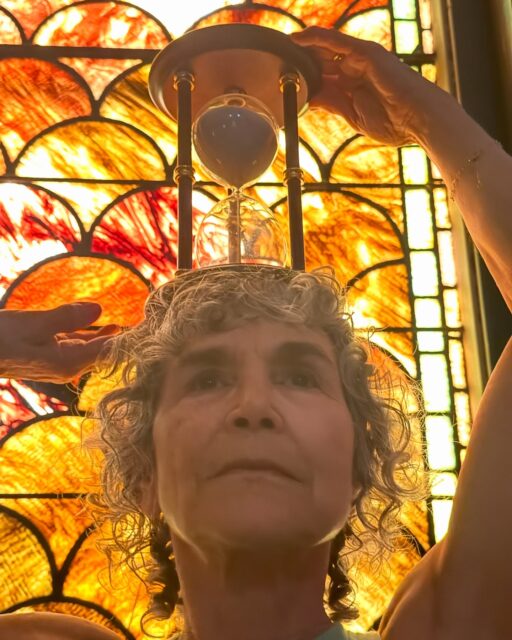
Jody Oberfelder will activate the endangered West Park Presbyterian Church with Story Time (photo courtesy Jody Oberfelder Projects)

STORY TIME
The Center at West Park
165 West Eighty-Sixth St. at Amsterdam Ave.
Friday, May 16, and Saturday, May 17, $24–$30, 7:30
www.centeratwestpark.org
www.jodyoberfelder.com

In June 2021, Jody Oberfelder Projects presented Amphitheater activating the endangered East River Park bandshell through live music and dance. At the time, Oberfelder noted that the piece “challenges the pending demolition of this fifty-acre park that transformed Lower Manhattan more than eighty years ago through inscribing the space with our movement inspired from human connections. We believe it is time to be happy again and reconnect with our community through our common joie de vivre, our passion for dance.” Despite a valiant battle that went to the courts, the amphitheater was torn down that December.

A New York–based director, dancer, choreographer, and filmmaker, Oberfelder is fighting for another worthy cause with her latest work, Story Time, which takes place throughout the Center at West Park in the landmarked West Park Presbyterian Church, which is also under threat of demolition. On March 8, hundreds of people gathered at a Love Our Landmarks: Save Park West rally to keep the wrecking ball away from the 135-year-old institution, with such special guests as actors Mark Ruffalo, Matthew Broderick, Laurence Fishburne, Julianna Margulies, and Fisher Stevens and local politicians Mark Levine, Brad Hoylman-Sigal, and Gale Brewer.

“It would be a tragedy if this landmarked building and thriving community arts hub were demolished — especially given that there is a viable plan to save it,” Manhattan borough president Mark Levine said at the protest. “We cannot allow this vital piece of our city’s history and culture to be lost. We must do everything in our power to protect it. I fully support the community-driven effort to preserve this unique and special place for New Yorkers. I call on the Landmarks Preservation Commission to take immediate action to save this gem. We will not give up the fight.”

Oberfelder, who has also staged works in an officers house on Governors Island, in the 6½ Ave. corridor in midtown Manhattan, in a garden pool at the Victoria and Albert Museum, in Green-Wood Cemetery, in a partially enclosed lot in Brisbane, and in a seventeenth-century baroque palace in Portugal, will be activating Park West on May 16 and 17 at 7:30, leading audience members from the sanctuary on foot to various nooks and crannies holding surprises before bringing myths and fairy tales to life as the audience sits in the historic pews.

The sets are designed by Juergen Riehm, Tine Kindermann, Johanna Maier, and Nick Cassway, with costumes by Katrin Schnabl, lighting by Connor Sale, music by Ellen Reid, Maurice Ravel, Žibuoklė Martinaitytė, Frank London, and, playing live, Tine Kindermann and Grace Bergere, and dramaturgy by Rebekah Morin. The piece was conceived, directed, and choreographed by Oberfelder in collaboration with the performers: Mariah Anton, Andi Farley-Shimota, Michael Greenberg, Nyah Malone, and Caleb Patterson.

“Across cultures and time, people have always gathered around stories — to make sense of the world, to find direction, to feel less alone,” Oberfelder said in a statement. “Dance is its own kind of storytelling: fleeting, wordless, yet full of meaning. There’s a Grimm tale that ends, ‘And the mouth of the person who last told this story is still warm.’ That warmth — that sense of something just passed on — is what I hope lingers. I want audiences to arrive with wonder, to follow the threads of their own journey, and perhaps leave seeing themselves as the hero in their own unfolding tale.”

She added via email, “How do we stand up when our country is pushing us down? How do we courageously live and give, redirect and inspire? Art is transformative. I’ve created a piece that I hope, with each turn of the page, addresses dark and light. How do we keep our humanity in this heroic journey? Especially right now, with everything coming at you faster than you can imagine. How do you summon your inner hero to survive?”

Tickets for the immersive, site-specific Story Time are $24–$30 to follow Oberfelder on her never-ending quest to bring unique, often interactive dances that ask all the right questions to unusual and thrilling locations across the globe, including right here in New York City.

And in this case, here’s hoping this fairy tale has a happy ending.

[Mark Rifkin is a Brooklyn-born, Manhattan-based writer and editor; you can follow him on Substack here.]
ANCESTRAL MEMORY AND RECLAMATION: BETWEEN WAVE AND WATER IN HUNTS POINT

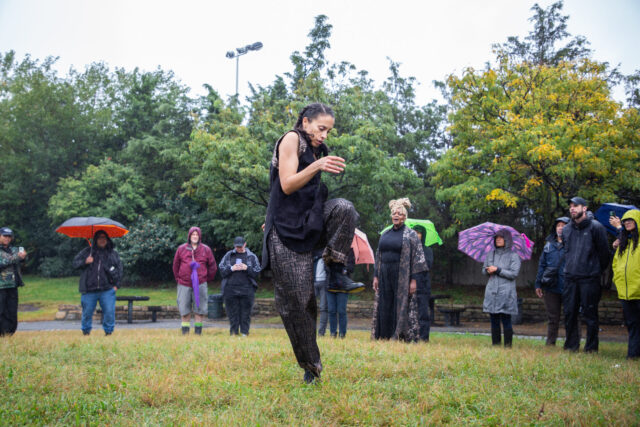
Alethea Pace will present between wave and water twice on May 10 (photo by Whitney Browne)

Who: Alethea Pace and dancers
What: Boogie Down Dance Series site-specific performances
Where: Joseph Rodman Drake Park and Enslaved People’s Burial Ground, Hunts Point
When: Saturday, May 10, $12.51-$44.52, 12:30 & 4:00
Why: The BAAD! (Bronx Academy of Arts and Dance) Boogie Down Dance Series continues May 10 with two site-specific performances by Bronx-based multidisciplinary artist Alethea Pace. Incorporating movement, music, and storytelling, between wave and water takes audiences on an immersive, interactive, participatory journey into the history of Joseph Rodman Drake Park and Enslaved People’s Burial Ground in Hunts Point, which was designated an individual landmark in December 2023; it contains two colonial-era cemeteries in an area where the Munsee-speaking Siwanoy people lived until being forced out in 1663 by English settlers.

Written and directed by Pace, the piece, which honors more than three dozen ancestors buried in the park, explores legacy and reclamation in the context of the modern world, with Ghost representing the present, Trickster the past, and Prophet the future; the music is by S T A R R busby with lyrics by Pace, who choreographed the work with the other performers, Maria Bauman, Imani Gaudin, Darvejon Jones, Alex LaSalle, Maleek Rae, Katrina Reid, and Indigo Sparks. The show, which runs between seventy-five and ninety minutes, includes walking a few blocks and getting on a short bus ride. Pace will also host her guided “Listening With: Hunts Point Walking Tours,” with specific dates and times to be announced.

“The articulation of memory, evoked through the act of moving, unearths an ever-evolving archive,” Pace explains on her website. “In collaboration, the participants and I investigate how our histories reside in our bodies, how our bodies shape and are shaped by the places they inhabit, and how bodies moving in nontraditional spaces inspire new ways of seeing.”

[Mark Rifkin is a Brooklyn-born, Manhattan-based writer and editor; you can follow him on Substack here.]
DISCOVERING JAPAN: CONCERT, PARADE, AND STREET FAIR CELEBRATION

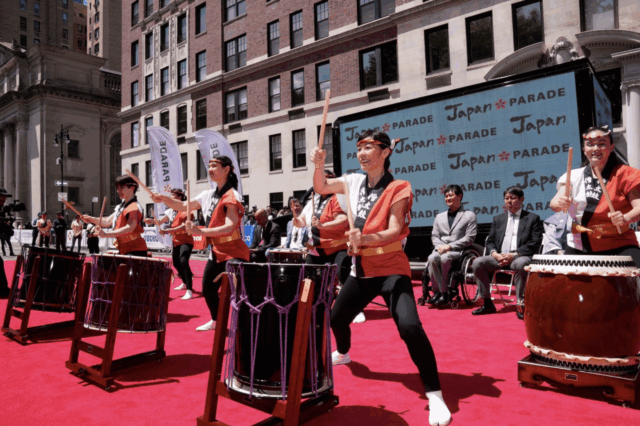
Japan Parade and Street Fair returns to NYC May 10 (photo courtesy Japan Parade)

Who: Masaharu Morimoto, Sayaka Yamamoto, Sandra Endo, the cast of ATTACK on TITAN: The Musical, Koji Sato, Soh Daiko, COBU, Taiko Masala Dojo, Harlem Japanese Gospel Choir, Japanese Folk Dance Institute of NY, Yosakoi Dance Project — 10tecomai / KAZANAMI, IKO Kyokushinkaikan, New York Kenshinkai, Anime NYC, Miyabi Koto Shamisen Ensemble, more
What: Japan Parade and Street Fair and Japan Night concert
Where: Parade: Central Park West between Sixty-Eighth & Eighty-First Sts.; concert: Edison Ballroom, 240 West Forty-Seventh St.
When: Concert: Friday, May 9, $81.88-$108.55, 5:30; parade and street fair: Saturday, May 10, free, 11:00 – 5:00
Why: The fourth annual Japan Parade and Street Fair takes place on May 10, celebrating the long friendship between the United States and Japan. Among the many participants in the parade, which kicks off at 1:00 at Central Park West and Eighty-First St. (the opening ceremonies are set for 12:30 at West Seventy-First St.), will be the cast of ATTACK on TITAN: The Musical, Hello Kitty, My Melody, Kuromi, taiko drummers, Japanese dance troupes, martial arts organizations, language schools, a gospel choir, singer-songwriter Sayaka Yamamoto, and members of Anime NYC. The grand marshal is Iron Chef restauranteur and author Masaharu Morimoto, the community leader is JAANY president Koji Sato, the honorary chairman is Ambassador Mikio Mori, and the emcee is television news correspondent Sandra Endo. In addition, there will be a street fair from 11:00 to 5:00 on West Seventy-Second St. between CPW and Columbus Ave., featuring food and drink, calligraphy, Yukata, origami, tourist and cultural information, a donation tent, prizes, and more.

“I am deeply honored to be appointed the grand marshal of this year’s Japan Parade in New York City,” Chef Morimoto said in a statement. “This role gives me a unique opportunity to celebrate and share the rich, dynamic culture of Japan with the heart of one of the world’s most vibrant cities.”

The parade will be preceded on May 9 by Japan Night at the Edison Ballroom in the Theater District, with performances by the cast of ATTACK on TITAN: The Musical, Miyabi Koto Shamisen Ensemble with Masayo Ishigure, and Sayaka Yamamoto, the former captain of NMB48, in addition to a sake tasting and a crafts presentation by ASP Group. The event will be hosted by NBC News correspondent Emilie Ikeda; tickets are $81.88-$108.55.

“The Japan Parade, a community-wide effort, represents the interwoven cultural and economic ties between Japan and New York, reflecting — and deepening — the strong alliance between Japan and the US,” Ambassador Mori added. “And right now, with the world in considerable need of unity, goodwill, and hope, Japan–US relations are more vital than ever, demonstrating what can be accomplished by working together towards common goals. So, by extension, the Japan Parade is also vital — the greater the celebration, the greater our cooperation!”

[Mark Rifkin is a Brooklyn-born, Manhattan-based writer and editor; you can follow him on Substack here.]
CHILDS, CHU, AND ASSAF: GIBNEY AT THE JOYCE

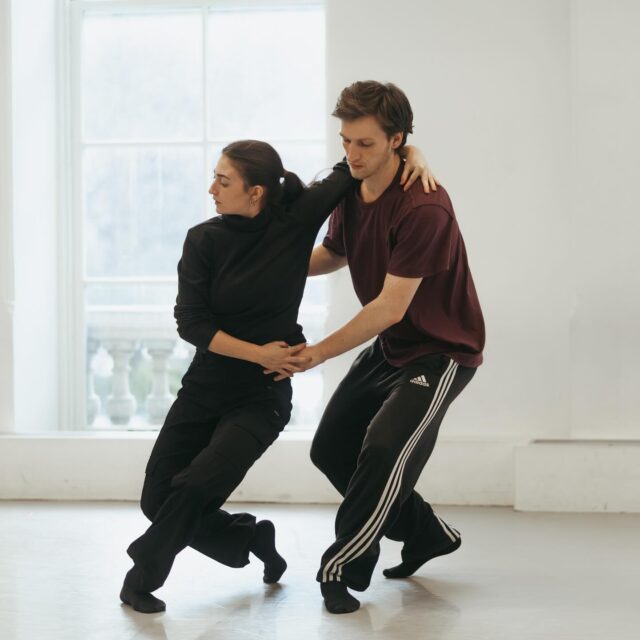
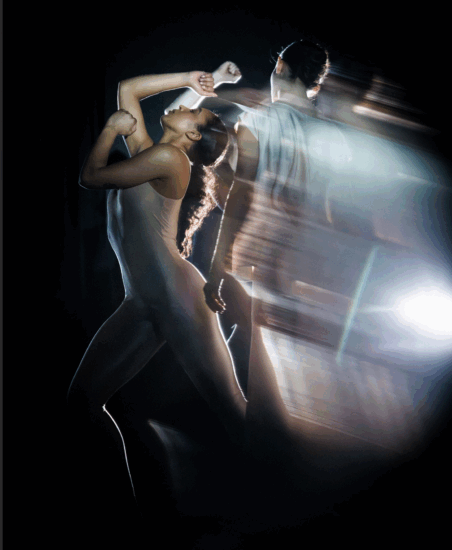
Gibney Company will be at the Joyce May 6–11 with three premieres (photo by Hannah Mayfield)

GIBNEY COMPANY
The Joyce Theater
175 Eighth Ave. at Nineteenth St.
May 6–11, $62-$82
www.joyce.org
gibneydance.org

“This season at The Joyce embodies what Gibney Company stands for — bringing together choreographers with distinct voices, movement languages, and artistic philosophies to shape a program that challenges, inspires, and moves us,” founding artistic director and CEO Gina Gibney said in a statement. “Lucinda Childs, Peter Chu, and Roy Assaf each bring a unique lens to dance, offering profoundly different yet equally compelling perspectives on how movement can communicate, resonate, and evolve.”

The New York–based dance and social justice troupe will be at the Joyce May 6–11, presenting three works. The evening begins with the US premiere of Roy Assaf’s A Couple, a fifteen-minute duet about relationships, set to music by Johannes Brahms performed by Glenn Gould and featuring “Perhaps you are a couple” text by Ariel Freedman; the pairings will be Graham Feeny and Zack Sommer, Madison Goodman and Lounes Landri, and Madi Tanguay and Andrew McShea.

The bill continues with two world premieres, first Peter Chu’s Echoes of Sole and Animal. The full company, consisting of Tiare Keeno, Jie-hung Connie Shiau, Feeny, Sommer, Goodman, Landri, Tanguay, and McShea, explore how sound shapes space, with movement inspired by animal Qi Gong and Taiji philosophies in search of human compassion and connection, with music and sound design by Djeff Houle in addition to immersive guitarist Ferdinand Kavall’s 2024 “Flageolets.” Chu also designed the costumes with Victoria Bek.

The program concludes with Lucinda Childs’s Three Dances (for prepared piano) John Cage, which takes Childs back to her Judson days, examining transdisciplinarity and formalism through structured repetition. The twenty-minute work, performed by all eight dancers, is set to recordings of Cage’s 1944–45 three-part piece played by Xenia Pestova and Pascal Meyer.

“Gibney Company is built on the idea that dance is a conversation — between artists, disciplines, traditions, and generations,” company director Gilbert T. Small II added. “This program brings together choreographers whose work is shaped by their histories, their influences, and the questions they explore through movement. We are honored to collaborate with such extraordinary artists whose work expands the boundaries of contemporary dance.”

Some shows are nearly sold out, so act fast to get tickets. The May 8 performance will be followed by a Curtain Chat with Childs and biophysicist and applied mathematician Dr. Michael Shelley, who participated together in the Open Interval residency combining dance and science.

[Mark Rifkin is a Brooklyn-born, Manhattan-based writer and editor; you can follow him on Substack here.]
TIME AND “TIME AGAIN”: TRISHA BROWN AT THE JOYCE

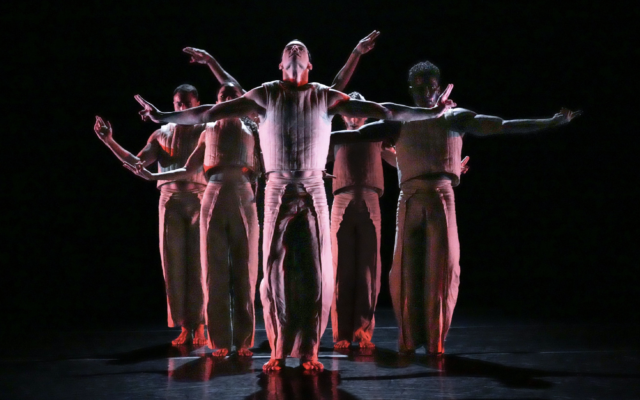
Opal Loop / Cloud Installation #722503 is part of Trisha Brown season at the Joyce (photo by Maria Baranova)

TRISHA BROWN DANCE COMPANY
The Joyce Theater
175 Eighth Ave. at Nineteenth St.
April 29 – May 4, $52-$72
www.joyce.org

For its 2025 season at the Joyce, Trisha Brown Dance Company looks back at its seminal Unstable Molecular Structure Cycle while also forging ahead into the future.

Running April 29 through May 4, the program features three dances, beginning with the world premiere of Time again, which explores the concept of change, repetition, chance, and familiarity. Choreographed by Lee Serle, who was mentored by Brown in 2010 through the Rolex Mentor and Protégé Initiative, the work features set and visual design by Mateo López, who was mentored by William Kentridge in 2012–13 in the Rolex program, lighting by Jennifer Tipton, and music by Australian sound artist Alisdair Macindoe. It will be performed by TBDC members Savannah Gaillard, Rochelle Jamila, Burr Johnson, Ashley Merker, Patrick Needham, Jennifer Payán, and Spencer James Weidie.

Following intermission, the company returns with two pieces from the Unstable Molecular Structure Cycle, which executive director Kirstin Kapustik calls “a series of works that embrace fluidity, unpredictability, and the beauty of constant change.” First up is 1980’s Opal Loop / Cloud Installation #722503, a collaboration with Japanese fog artist Fujiko Nakaya that invites the audience “to bring together images within themselves.” Merker, Needham, Payán, and Weidie perform to the sounds of water passing through high-pressure nozzles, with costumes by Judith Shea and lighting by Beverly Emmons.

The evening concludes with 1981’s Son of Gone Fishin’, which Brown called “a doozey. In it I reached the apogee of complexity in my work.” The full ensemble randomly selects sections of Robert Ashley’s score from his three-opera opus Atalanta, with costumes by Shea and lighting by Emmons evoking the original set design by Donald Judd.

To dive deeper, there will be a Curtain Chat following the April 30 performance.

[Mark Rifkin is a Brooklyn-born, Manhattan-based writer and editor; you can follow him on Substack here.]
THE VOICE OF A TEARDROP: ACTIVATING OTOBONG NKANGA’S CADENCE AT MoMA

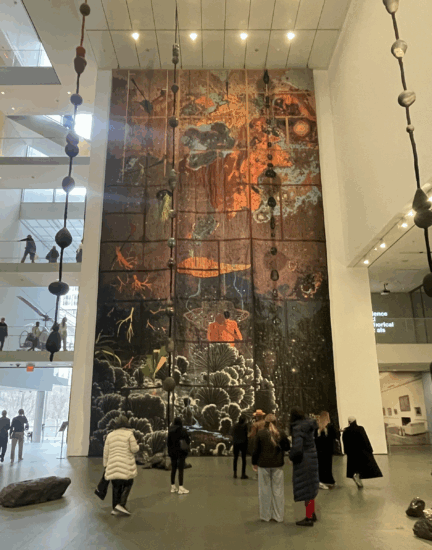
Artist Otobong Nkanga will be joined by six performers to activate Cadence installation on April 27 (photo by twi-ny/mdr)

Who: Otobong Nkanga and others
What: Installation activation
Where: Marron Family Atrium, MoMA, 11 West Fifty-Third St. between Fifth & Sixth Aves.
When: Sunday, April 27, free with museum admission, 10:30 am – 5:30 pm
Why: Describing her MoMA atrium commission Cadence, Nigeria-born, Belgium-based artist Otobong Nkanga notes, “Once I’d visited MoMA, I was interested in creating a tapestry work for the highest wall in the atrium, which would allow for a way of looking into the world from a different perspective. I wanted to create the notion of falling: a fall of things, a certain shift, a certain rhythm. The tapestry opens up to a more three-dimensional space, with sculptural pieces made of clay, smoked raku, and glass hanging from ropes and sitting on anthracite rocks, and a sound piece integrated in the sculpture that relates to the notion of teardrops, which is another kind of fall. . . . I wanted to make something that explores different rhythms of life. You might also feel that it’s a world that is beyond this one, like the universe somehow. It’s a mix of different worlds — from the underworld and the mining of minerals, to the surface and the soil, to the atmosphere and the heat of the sun, into outer space — all collapsing together in one place. That’s what creates the cadence of life. That’s what creates, actually, a world, because you cannot separate what is happening in the universe from what is happening underneath the soil in the core of the earth.”

On April 27 from 10:30 to 5:30, Nkanga and six other performers — Holland Andrews, Keishera, Muyassar Kurdi, Anaïs Maviel, Miss Olithea, and Samita Sinha, in costumes by Christian Joy — will activate the installation, incorporating sound and movement to interact with the piece. “What if a teardrop actually had a voice? What would it say? How would it say it? The work is really looking at that teardrop, and the emotions that go with it,” Nkanga says of the live performance, which is free with museum admission. Cadence is on view through July 27.

[Mark Rifkin is a Brooklyn-born, Manhattan-based writer and editor; you can follow him on Substack here.]

GRAHAM100: PSYCHODRAMAS AND MYTHOLOGY AT THE JOYCE

Martha Graham Dance Company will perform Baye & Asa’s Cortege and more in Joyce season (photo by Steven Pisano)

MARTHA GRAHAM DANCE COMPANY: DANCES OF THE MIND
Joyce Theater
175 Eighth Ave. at 19th St.
April 1-13, $62-$82
212-645-2904
www.joyce.org
marthagraham.org

What’s old is new again.

The Martha Graham Dance Company brings its ninety-ninth season to the Joyce for two weeks of classics, world premieres, and reimaginings of familiar pieces, in one case using — gasp! — AI.

From April 1 to 13, MGDC will present “Dances of the Mind,” three programs as part of its continuing GRAHAM100 celebration, preparing for its official centennial next year. Program A consists of Graham’s 1958 Clytemnestra Act II, with an original score by Halim El-Dabh and set by Isamu Noguchi; Baye & Asa’s Cortege, a world premiere about Charon the ferryman, inspired by Graham’s 1967 Cortege of Eagles, with music by Jack Grabow and costumes by Caleb Krieg; Xin Ying’s Letter to Nobody, based on Graham’s 1940 Letter to the World, this time honoring Graham and her legacy, incorporating generative media and AI technology, along with an Emily Dickinson poem (“I’m Nobody! Who are you? / Are you – Nobody – too? / Then there’s a pair of us!”), to craft a duet with Graham, Erick Hawkins, and Merce Cunningham; and Hofesh Shechter’s kinetic 2022 CAVE, with music by Âme and Shechter and costumes by Krieg.

Program B comprises Graham’s 1935 solo Frontier: American Perspective of the Plains, honoring the spirit of the pioneer woman, with a score by Louis Horst and set by Isamu Noguchi; two lost 1920s solos, Revolt and Immigrant, reimagined by Graham 2 director Virginie Mécène through extensive research; a new production of Agnes de Mille’s Rodeo, with Gabe Witcher’s bluegrass arrangement of Aaron Copland’s famous score, costumes by Oana Botez, and set by two-time Tony winner Beowulf Boritt; and Jamar Roberts’s 2024 We the People, which Roberts explains “is equal parts protest and lament, speculating on the ways in which America does not always live up to its promise,” with music by Rhiannon Giddens (arranged by Witcher) and costumes by Karen Young.

The third program brings together Graham’s 1943 Deaths and Entrances, made while Graham was contemplating faith and despair and inspired by the lives of Anne, Emily, and Charlotte Brontë, with music by Hunter Johnson, set by Arch Lauterer, and costumes by Oscar de la Renta; Graham’s 1947 Errand into the Maze, a duet based on the myth of Theseus and the Minotaur, with a score by Gian Carlo Menotti and set by Noguchi; and CAVE.

In addition, the April 1 gala features Clytemnestra Act II and Cortege, the April 5 University Partners Showcase highlights university and high school dancers performing works by Graham, Hawkins, José Limón, and others, the April 12 family matinee presents Graham’s 1935 call-to-action Panorama, Rodeo, and We the People, and there will be a Curtain Chat following the April 9 show.

Founded in 1926 in a tiny Carnegie Hall studio in midtown Manhattan, MGDC has an illustrious history involving a wide range of remarkable collaborators; the current troupe includes So Young An, Ane Arieta, Laurel Dalley Smith, Zachary Jeppsen-Toy, Meagan King, Lloyd Knight, Rayan Lecurieux-Durival, Antonio Leone, Devin Loh, Amanda Moreira, Ethan Palma, Jai Perez, Anne Souder, Matthew Spangler, Richard Villaverde, Leslie Andrea Williams, and Xin Ying.

[Mark Rifkin is a Brooklyn-born, Manhattan-based writer and editor; you can follow him on Substack here.]