this week in dance

TWI-NY AT TWENTY: ANNIVERSARY CELEBRATION

Who: Works by and/or featuring Moko Fukuyama, Joshua William Gelb, Gabrielle Hamilton, Jace, Elmore James, Jamal Josef, Katie Rose McLaughlin, Sara Mearns, Zaire Michel, Zalman Mlotek, Alicia Hall Moran, Patrick Page, Barbara Pollack, Seth David Radwell, Jamar Roberts, Tracy Sallows, Xavier F. Salomon, Janae Snyder-Stewart, Mfoniso Udofia, Anne Verhallen
What: This Week in New York twentieth anniversary celebration
Where: This Week in New York YouTube
When: Saturday, May 22, free with RSVP, 7:00 (available on demand through June 12)
Why: In April 2001, I found myself suddenly jobless when a relatively new Silicon Alley company that had made big promises took an unexpected hit. I took my meager two weeks’ severance pay and spent fourteen days wandering through New York City, going to museums, film festivals, parks, and tourist attractions. I compiled my experiences into an email I sent to about fifty friends, rating each of the things I had done. My sister’s husband enthusiastically demanded that I keep doing this, and This Week in New York was born.

Affectionately known as twi-ny (twhy-nee), it became a website in 2005 and soon was being read by tens of thousands of people around the globe. I covered a vast array of events – some fifteen thousand over the years – that required people to leave their homes and apartments and take advantage of everything the greatest city in the world had to offer. From the very start, I ventured into nooks and crannies to find the real New York, not just frequenting well-known venues but seeking out the weird and wild, the unusual and the strange.

For my tenth anniversary, we packed Fontana’s, a now-defunct club on the Lower East Side, and had live music, book readings, and a comics presentation. I had been considering something bigger for twenty when the pandemic lockdown hit and lasted longer than we all thought possible.

At first, I didn’t know what twi-ny’s future would be, with nowhere for anyone to go. But the arts community reacted quickly, as incredible dance, music, art, theater, opera, film, and hybrid offerings began appearing on numerous platforms; the innovation and ingenuity blew me away. The winners of twi-ny’s Pandemic Awards give you a good idea of the wide range of things I covered; you can check out part one here and part two here.

I devoured everything I could, from experimental dance-theater in a closet and interactive shows over the phone and through the mail to all-star Zoom reunion readings and an immersive, multisensory play that arrived at my door in a box. Many of them dealt with the fear, isolation, and loneliness that have been so pervasive during the Covid-19 crisis while also celebrating hope, beauty, and resilience. I’ve watched, reviewed, and previewed more than a thousand events created since March 2020, viewing them from the same computer where I work at my full-time job in children’s publishing.

Just as companies are deciding the future hybrid nature of employment, the arts community is wrestling with in-person and online presentations. As the lockdown ends and performance venues open their doors, some online productions will go away, but others are likely to continue, benefiting from a reach that now goes beyond their local area and stretches across the continents.

On May 22 at 7:00, “twi-ny at twenty,” produced and edited by Michael D. Drucker of Delusions International and coproduced by Ellen Scordato, twi-ny’s business manager and muse, honors some of the best events of the past fourteen months, including dance, theater, opera, art, music, and literature, all of which can be enjoyed for free from the friendly confines of your couch. There is no registration fee, and the party will be available online for several weeks. You can find more information here.

Please let me know what you think in the live chat, which I will be hosting throughout the premiere, and be sure to say hello to other twi-ny fans and share your own favorite virtual shows.

Thanks for coming along on this unpredictable twenty-year adventure; I can’t wait to see you all online and, soon, in real life. Here’s to the next twenty!

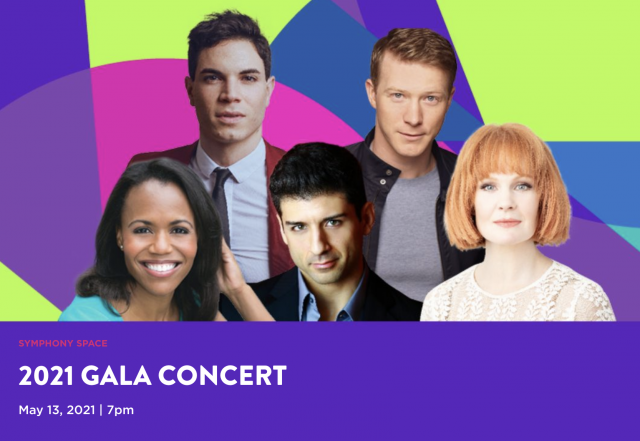
SYMPHONY SPACE 2021 GALA CONCERT

Who: Kate Baldwin, Roz Chast, Britney Coleman, Jane Curtin, Nikki Renée Daniels, Santino Fontana, Jason Gotay, Melora Hardin, Jane Kaczmarek, Jeff Kready, Colum McCann, Patricia Marx, Laura Osnes, George Saunders, Rashidra Scott, Nathaniel Stampley, Sally Wilfert, Meg Wolitzer, Tony Yazbeck, more
What: Virtual gala fundraiser
Where: Symphony Space Zoom
When: Thursday, May 13, $35, 7:00
Why: On January 7, 1978, conductor Allan Miller and playwright and director Isaiah Sheffer staged the free twelve-hour concert “Wall to Wall Bach” at an Upper West Side building on Broadway that was formerly the Astor Market, the Crystal Palace Skating Rink, and the Symphony Theatre. The event was such a success that they decided to start Symphony Space, an arts venue that for more than forty years has hosted music, storytelling, film, theater, readings, lectures, dance, and much more. The pandemic lockdown had closed the institution’s doors, but they will reopen for the 2021 annual gala fundraiser on May 13 in a hybrid livestream featuring an all-star lineup performing onstage at the Peter Jay Sharp Theater and sharing memories from home over Zoom. “When I got a text that the first rehearsal for the dance piece in the space had happened and gone well, it was thrilling — we had arrived at that long-awaited moment when artists were once again gracing our stages,” executive director Kathy Landau said in a statement. “Before the pandemic, every corner of our building pulsated with art and ideas, with people meeting in the hallways and the wings. The theater itself is almost its own character in the life of Symphony Space — and what makes it come alive is the community we have built in and around it. And while we had so much engaging virtual programming, the theater had been sitting almost entirely empty. For the gala, there was a lightbulb moment where we realized, ‘Wait, there’s a way to safely and responsibly and comfortably bring this energy back,’ for this event to be our first step before bringing audiences in. It had to be quintessential Symphony Space: to be multidisciplinary, to have that unique-to-this-one-evening, in-the-moment immediacy, to have that magical alchemy that occurs when artists come together at Symphony Space to create, collaborate, and celebrate.”

The evening of cocktails, concert, and conversation, produced and directed by Annette Jolles and Joel Fram, will feature performances by Kate Baldwin, Britney Coleman, Nikki Renée Daniels, Jason Gotay, Jeff Kready, Laura Osnes, Rashidra Scott, Nathaniel Stampley, Sally Wilfert, and Tony Yazbeck in addition to a new dance piece by Sara Brians (performed by Saki Masuda, Michelle Mercedes, and Devin L. Roberts) as well as appearances by Roz Chast, Jane Curtin, Nikki Renée Daniels, Santino Fontana, Melora Hardin, Jane Kaczmarek, Patricia Marx, Colum McCann, George Saunders, Meg Wolitzer, and others. The house band consists of conductor Fred Lassen on piano, John Romeri on flute, Keve Wilson on oboe, Nuno Antunes on clarinet, Eric Reed on horns, Nanci Belmont on bassoon, Laura Bontrager on cello, George Farmer on bass, and Clayton Craddock on drums. Tickets for the concert are $35 and go up to $1,000 to $40,000 for special breakout rooms and tables with guest artists and a Party in a Box.

La MaMa MOVES! DANCE FESTIVAL

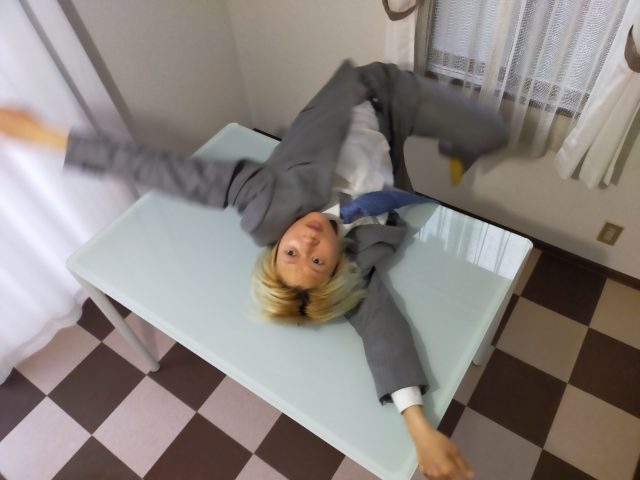
Mei Yamanaka will be part of Tiffany Mills Company presentation at 2021 La Mama Moves! Dance Festival

Who: Tiffany Mills Company; Hadar Ahuvia and Tatyana Tenenbaum; J. Bouey; Morgan Bullock, Gerald Casel, Daudi Fayar, BamBam Frost, and John Scott; Ricarrdo Valentine/Brother(hood) Dance!; Jasmine Hearn; Sugar Vendil; more
What: Digital and in-person dance festival
Where: La MaMa online and at Downtown Art/Alpha Omega
When: May 12–23, free – $25 (pay-what-you-can)
Why: The 2021 edition of La MaMa Moves! will be a hybrid dance festival, consisting of workshops, discussions, and performances streamed live from the Ellen Stewart Theatre and the Downstairs Theatre at its home at 66 East Fourth St. as well as held in front of a limited audience at Downtown Art/Alpha Omega at 19 East Third St. “Performing artists have always proven to be resilient and resourceful even during the most challenging times,” La MaMa Moves! curator Nicky Paraiso said in a statement. “Since the pandemic began last March, dance practitioners have been both taking time to reflect and going ahead in doing the creative work they are always doing. This past year has certainly been painful and frustrating, both mentally exhausting and physically debilitating. Dance artists have, however, continued to make work, and I believe that the artists participating in this season’s La MaMa Moves! Dance Festival are making work that is essential and true to this pivotal moment in time.”

The sixteenth annual festival kicks off May 12 with an intergenerational discussion in recognition of Asian American and Pacific Islander Heritage Month with Yoshiko Chuma, Sophia Gutchinov, Potri Ranka Manis, Paz Tanjuaquio, and Sugar Vendil, moderated by choreographer and writer Maura Nguyen Donohue. Tiffany Mills Company will offer a Zoom workshop for kids on May 13, Hadar Ahuvia and Tatyana Tenenbaum will perform Prayer of the Morning on May 13 and 15, J. Bouey will present untitled: an exploration of grief on May 14 and 16, and Morgan Bullock, Gerald Casel, Daudi Fayar, BamBam Frost, and John Scott will participate in a Virtual International Showcase on May 18. Tiffany Mills Company will give a sneak peek at the excerpts-in-process Home Project on May 20 and 22 (with Mills, Jordan Morley, Nikolas Owens, Emily Pope, and Mei Yamanaka), Ricarrdo Valentine/Brother(hood) Dance! shares All About Love about Black healing on May 21 and 23, and, on May 22 and 23 at 4:00, La MaMa moves to the nearby Downtown Art/Alpha Omega for outdoor performances of Jasmine Hearn’s Songs from Pleasure Memory and Vendil’s Test Sites. All events require advance RSVP and are either free or pay-what-you-can ($5-$25).

CRY 50th ANNIVERSARY

Who: Alvin Ailey American Dance Theater
What: Fiftieth anniversary performance of Cry
Where: Ailey All Access
When: Sunday, May 9, free, 3:00
Why: On May 4, 1971, at New York City Center, Alvin Ailey American Dance Theater premiered the sixteen-minute solo Cry, which Ailey choreographed on Judith Jamison as a birthday present for his mother, Lula Cooper. The piece, set to Alice Coltrane’s “Something about John Coltrane,” Laura Nyro’s “Been on a Train,” and the Voices of East Harlem’s “Right On Be Free,” has now been recorded for online viewing, featuring Jacqueline Green, and will make its debut as a Mother’s Day Matinee on May 9 at 3:00. “Exactly where the woman is going through the ballet’s three sections was never explained to me by Alvin,” Jamison writes in her autobiography, Dancing Spirit. “In my interpretation, she represented those women before her who came from the hardships of slavery, through the pain of losing loved ones, through overcoming extraordinary depressions and tribulations. Coming out of a world of pain and trouble, she has found her way — and triumphed.” The piece will be followed by a discussion between Green and Ailey dancer Constance Stamatiou about the work, which Ailey dedicated to “all Black women everywhere — especially our mothers.” The next day, AAADT will present the livestreamed panel “Celebrating Judith Jamison” on Jamison’s seventy-eighth birthday, with Jamison, Sarita Allen, Linda Denise Fisher Harrell, Renee Robinson, Linda Celeste Sims, Dwana Smallwood, Nasha Thomas, and Lisa Johnson-Willingham.

BLESSED UNREST: TOUCH

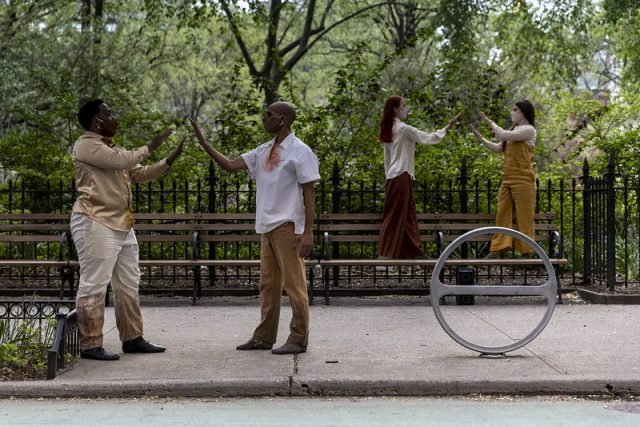
Touch takes place on the sidewalk, with Madison Square Park in the background (photo by Maria Baranova)

TOUCH
Blessed Unrest; NYC Open Culture Program
Saturday, May 8, 7:00, and Sunday, May 9, 3:00 & 5:00
Admission: free with RSVP (suggested donation $25)
East 26th Street (between 5th and Madison Avenue, NYC)
www.blessedunrest.org
www1.nyc.gov

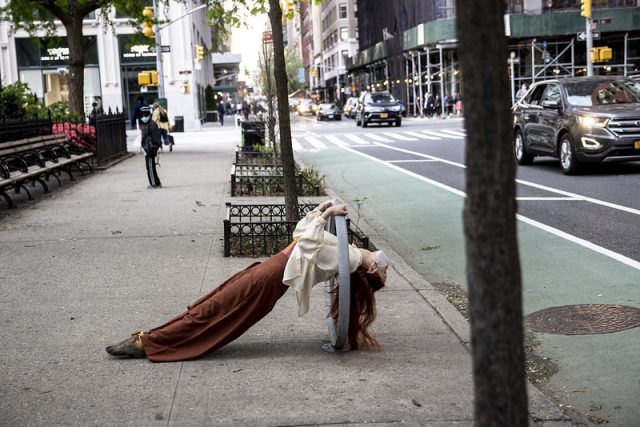
The Manhattan-based Blessed Unrest company explores our deep-seated need for physical and emotional connection in Touch, a dance-theater piece performed guerrilla-style just outside Madison Square Park. Part of the city’s Open Culture Program, the forty-five-minute work takes place on the sidewalk near the southwest corner of East Twenty-Sixth St. and Broadway, the park right behind them. Wearing masks, Michael Gene Jacobs, Tatyana Kot, Ariel Polanco, and Anna Wulfekuhle nimbly move across a long bench and interact with a lamppost, a circular bike rack, and a low railing around a tree as overlapping stories are broadcast from two small, portable speakers. The narratives, based on personal stories of isolation shared by the performers and edited and expanded by Keith Hamilton Cobb (American Moor) and Teddy Jefferson (One Inch Leather, The Insomniac), involve Oedipus, a horse, and a mysterious neighbor. The socially distanced audience, also wearing masks, stand or sit in the street, which is blocked off to vehicular traffic but not to pedestrians and bicyclists, who sometimes walk or pedal right through the performance, lending an unpredictable quality to the proceedings.

Performers make use of a bench, a bike rack, a lamppost, and more in site-specific Touch (photo by Maria Baranova)

“When we finished working on our 2015 show Body: Anatomies of Being, which was also built around personal testimonials from the performers, we felt strongly that the idea of touch hadn’t been explored fully in the final work,” director Jessica Burr (The Snow Queen, Eurydice’s Dream), who founded the company in 1999, said in a statement. “It seemed particularly fitting to revisit this subject now, as the months of detachment and related touch deprivation began to take a toll on all of us. When workshopping this piece remotely, each in our own isolated bubble, we spoke about research on mirror neurons and the emotional brain. That research suggests that our witnessing of the authentic corporeal experiences of others can stimulate the very same visceral response in our own brains, as though the experience were ours. It’s the forging of literal compassion through neural growth in our audiences.”

Touch, which features music composition, arrangement, and sound design by Adrian Bridges and costumes by Sohn Plenefisch, continues May 8 and 9; admission is free with RSVP. (There is a suggested donation of $25.) Be sure to also take a walk through Madison Square Park, where Maya Lin’s Ghost Forest, consisting of forty-nine bare trees representing impending environmental calamity, is on view through mid-November.

TRISHA BROWN DANCE COMPANY AT THE JOYCE

Who: Trisha Brown Dance Company
What: Digital program
Where: Joyce Theater online
When: April 29 – May 12, $25
Why: The pandemic lockdown might have shuttered theaters, but it has also stirred the creative instinct, particularly among dance companies, which quickly turned to streaming not only older productions but exciting new works developed over Zoom and other online platforms. This week it’s Trisha Brown’s turn, with an online spring season at the Joyce. Now in its sixth decade, the company looks back with 2002’s Geometry of Quiet, recorded at the Joyce in 2017; the intimate twenty-minute piece features music by Salvatore Sciarrino, white costumes by Christophe de Menil, and four dancers. The troupe then looks back and forward at the same time with new iterations of 1980’s semiautobiographical Locus Trio, set on a cubelike grid to an improvised score, and the 1978 short solo Watermotor, inspired by childhood memory and originally performed by Brown at the Public Theater, now danced by Marc Crousillat. The program concludes with “The Decoy Project,” a reimagining for video of 1979’s Glacial Decoy, an eleven-minute work for four dancers that Brown adapted for WNET and the company now approaches as a way to bring dancers back together again in the same physical space while reaching out to the local community. Tickets are $25 for the stream, which runs April 29 to May 12. The Joyce’s spring season continues with Limón Dance Company May 6-19, Stephen Petronio Company May 13-26, and Batsheva Dance Company May 27 – June 2.

SOCIAL! THE SOCIAL DISTANCE DANCE CLUB

Park Ave. Armory, Wade Thompson Drill Hall
643 Park Ave. at 67th St.
April 9-22, $45 ($35 standby tickets available)
212-933-5812
www.armoryonpark.org

Twister is the most physical of board games. The more people come into contact with one another on the plastic mat — which contains colored circles that participants must touch with one of their hands or feet depending on what the spinner tells them to do — the more fun it is to play and to watch. The same can be said for dancing, a social activity that brings people together in numerous ways. In a 2015 study, Bronwyn Tarr, Jacques Launay, Emma Cohen, and Robin Dunbar explained, “All human cultures perform and enjoy forms of music and dance in a group setting. Dancing involves people synchronizing their movements to a predictable, rhythmic beat (usually provided by music) and to each other. In this manner, dance is fundamentally cooperative in nature, and may have served the evolutionary function of encouraging social bonds, cooperation, and prosocial behaviors between group members. To date, empirical support for this social bonding hypothesis is based mainly on a link between synchrony (i.e. performing the same movement at the same time) and bonding.” In a twist on both Twister and dancing, the Park Ave. Armory commission Social! the social distance dance club incorporates people, colorful circles on the floor, and synchronous bonding in an immensely boisterous evening of interaction that features no touching whatsoever.

The armory was supposed to kick off its Social Distance Hall series with Bill T. Jones’s Afterwardsness, but several positive Covid tests in the company led to its postponement until May, after Party in the Bardo, a collaboration between Laurie Anderson and Jason Moran running May 5-9. Conceived by choreographer Steven Hoggett (The Curious Incident of the Dog in the Night-Time, Harry Potter and the Cursed Child), Tony-winning set designer and solo show specialist Christine Jones (American Idiot, Here We Are: Theatre for One), and multidisciplinary artist David Byrne (Talking Heads, American Utopia), Social! takes place in the fifty-five-thousand-square-foot Wade Thompson Drill, where nearly one hundred ticket holders spend fifty-five minutes moving and grooving in their own private circle.

Audience members must arrive about an hour before showtime to have a Covid-19 shallow-swab rapid response test. While waiting for the results — anyone who comes up positive will need to immediately leave the building with the rest of their party (and will be refunded the $45 ticket price) — groups of about twenty-four waited in different locations in the historic armory, where monitors displayed quotes about dancing from a March 2021 Financial Times article, “Covid will not squash our deep-seated need to dance,” by Will Coldwell, who references the above study in his piece, along with YouTube videos of men, women, and children from around the world dancing with joy. (For example, “Dance provides us with a universal language — one deeper and more emotional than words — that helps us to bond with other, often unfamiliar, people.”) Eventually we audience members were marched into the drill hall in formation, and each was sent to an assigned spotlight, spaced at twelve-to-fifteen-foot intervals. (The lighting design, which includes the projection of abstract shapes and a disco ball, is by Kevin Adams; the above videos are © DBOX.) In the center, on a slowly revolving raised platform, is DJ Mad Love (Tony nominee Karine Plantadit), who spins tunes on two computers (mixed by DJ Natasha Diggs) while Byrne’s disembodied voice guides us, suggesting specific movements and encouraging self-expression. (His instructions were done in conjunction with choreographer Yasmine Lee.)

To songs by D-Train, Daft Punk, James Brown, Benny Goodman, Olivia Newton-John, Fatback, Byrne, and others, the former Talking Heads leader prompts us through various scenarios (hands waving in the air, weaving through a subway car, balancing at the edge of your circle, swaying slowly, etc., although some of it is hard to hear amid the thumping beats) before leading up to the grand finale, a unified dance that we were advised to rehearse in advance via a video in which Byrne demonstrates the moves.

The drill hall is a judgment-free space; no one is going to laugh at your dancing, and you’re not going to laugh at anyone else’s. It’s a time to kick loose and let it all go, immerse yourself in a worry-free hour of nonstop exhilaration. It’s not always easy — several people in my vicinity had to take rests, and one woman spent much of the show sitting in her circle — but the more you are able to put into it, the more you will get out of it. (Coldwell explains, “As we now know so well, it’s far easier to start dancing than it is to stop.”) And when you are taken back to your seat, a small, relevant little gift is waiting for you, one last reminder that even if we can’t be together in a physical way — Twister might not be on the menu for a bit longer — we can now gather safely and bond, as long as we’re tested, masked, socially distanced, and ready to have a blast.