this week in dance

JEWELS: A BALLET IN THREE PARTS

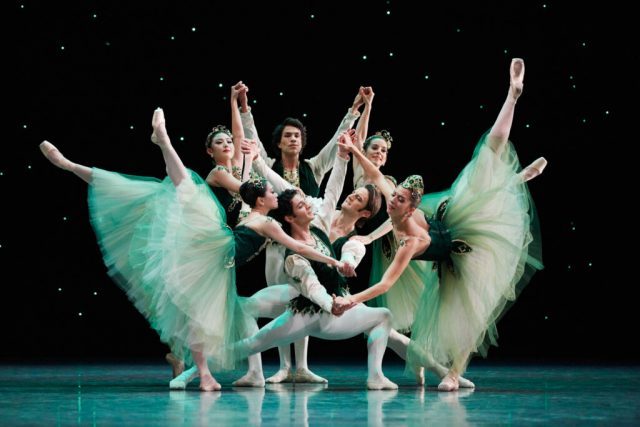
San Francisco Ballet presents a dazzling virtual production of Balanchine’s Emeralds (photo by Erik Tomasson)

JEWELS
SF Ballet online
Available on demand through April 21, $29
www.sfballet.org

You’re likely to let out a gasp when the curtain rises on San Francisco Ballet’s newly filmed production of George Balanchine’s Emeralds, the first section of the legendary choreographer’s three-part masterpiece, Jewels. I know I did. Onstage are a dozen dancers, the most I’ve seen at any one time together since the pandemic lockdown started. Then Gabriel Fauré’s score kicks in — consisting of extracts from Pelléas et Mélisande Suite, Op. 29 and incidental music to Shylock, Op. 57, conducted by Martin West — and principals Misa Kuranaga and Angelo Greco touch hands, leading to another gasp. I’ve watched a lot of dance pieces made during the current health crisis, but it’s mostly been solos or works outdoors, with no contact between performers. To see a full ensemble dance without restrictions for thirty glorious minutes is exhilarating, especially every lift, throw, and turn involving physical human connection. (Of course, SFB followed all Covid-19 protocols.)

The floor of the War Memorial Opera House reflects the dancers, who are wearing dark tops with necklaces, the women in green calf-length tulle skirts. A chandelier laden with faux emeralds hangs above, while stars dot the back wall, melding inside and outside. Balanchine considered Emeralds to be “an evocation of France — the France of elegance, comfort, dress, and perfume,” and that’s precisely what comes across in this glittering production, staged by the late Elyse Borne and Sandra Jennings, with additional decor by Susan Touhy and costumes by Karinska (re-created by Haydee Morales).

The camera slowly zooms in and out and pans right and left but always stays at orchestra level while concentrating on two couples, a trio, and a corps de ballet of ten women. The many stunning moments include a line of four women in attitude position, with three men on their knees, their right leg flat behind them, all holding hands; a gorgeous solo by Kuranaga; duets first with Kuranaga and Greco, then with Sasha Mukhamedov and Aaron Robison; and a concluding trio with Greco, Robison, and Esteban Hernandez, the three men left all alone at the end, their arms reaching out dramatically.

As the curtain descends, something strange and unexpected happens; applause can be heard, getting louder as the dancers take their bows. The work was filmed on January 28 without an audience, and there was no piped-in applause at intermediary points of beauty. It’s a bit unnerving, since we know that the seats are empty, though the show is well worthy of high praise.

Emeralds debuted at the New York City Ballet on April 13, 1967, followed by Rubies and Diamonds, a sparkling trilogy inspired by Claude Arpels’s designs for jeweler Van Cleef & Arpels. For both of the latter pieces, applause is heard as the curtain rises and throughout; the former was recorded February 2, 2016, the latter March 12, 2017, both at the War Memorial as well, giving the full program an added visual continuity, making it feel as if it is all occurring over the course of one evening. It also might explain why SFB decided not to add more camera angles to the 2021 performance; it would have been exciting to see closeups as well as views from the mezzanine, but it would not have matched the next two works.

The featured trio for Rubies are Mathilde Froustey, Pascal Moulat, and Wanting Zhao; the cast is dressed in tight red bejeweled tops with frills at the waist, the women with red hair accessories. Set to Stravinsky’s Capriccio for Piano and Orchestra, Rubies is passionate and exuberant; in one pas de deux, Froustey, wearing a flowery red tiara, and Moulat run, bounce, and spin around the floor. The focus is on the movement itself; there is no chandelier, and the stars on the backdrop are muted.

An homage to Marius Petipa, Diamonds is an opulent, luxurious climax, taking place in an icy blue world with two chandeliers and Tchaikovsky’s lovely Symphony No. 3 in D major, Op. 29, movements 2, 3, 4 & 5, conducted by Ming Luke. It begins with a glorious seven-minute scene with first twelve, then fourteen women, in glistening white tutus, followed by a pas de deux between De Sola and Tiit Helimets. In the finale, more than thirty dancers come together for a grand ball, intersecting and weaving among themselves with an infectious romanticism as the music builds to a thrilling crescendo.

And then, one last surprise; as the dancers take their bows, audience members rise to give a standing ovation, their heads partially blocking our view. It is an apt reminder that ballet — and theater, music, opera, et al. — is meant to be seen live and in person, in a crowd of people all there for one purpose, to share an experience that is happening right then and there, in real time. May it soon be so again.

(For more on SFB’s Jewels, you can stream a virtual discussion about “three composers, three styles, three moods” with De Sola, Helimets, Mukhamedov, and Molat here; there is also extensive background information available here.)
AFTERWARDSNESS

AFTERWARDSNESS
Park Ave. Armory
643 Park Ave. at Sixty-Seventh St.
May 19-26, $45 (limited tickets go on sale April 1)
www.armoryonpark.org

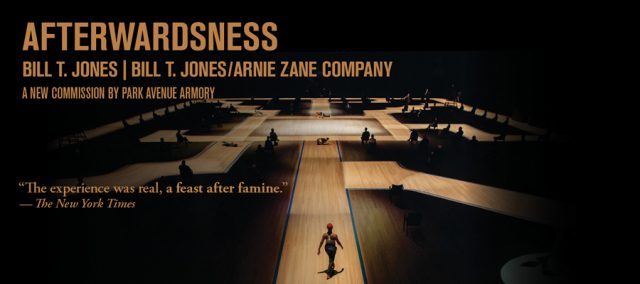
I’ve been tentative about the return of live, indoor music, dance, and theater, wondering how comfortable I would feel in an enclosed area with other audience members and onstage performers. Many of my colleagues who cover the arts are steadfastly against going to shows right now as things open up, while others have been having a ball going to the movies and eating inside. But when I received my invitation to see Afterwardsness at the Park Avenue Armory on March 24, I surprised myself with how much immediate glee I felt, how instantly exhilarated I was to finally, at last, see a show, in the same space with actual human beings. But my excitement was broken when it was announced that several members of the Bill T. Jones/Arnie Zane Company had tested positive for Covid-19 and the show, which had sold out quickly, had to be postponed. But now it’s back as part of the Armory’s Social Distance Hall season, running May 19 to 26; original ticket holders will get first dibs, with remaining tickets going on sale to the general public April 1. “Creating new, body-based work at a time when physical proximity is discouraged is no small feat,” Jones said in a statement. “However, as is often the case when artists are forced to push through limitations, this is when things get really good. Having the drill hall, this grand and glorious space to create and dance in, was quite liberating. The armory is a space like no other in New York City—and if it’s like no other in New York City, then it’s pretty unique in the world.”

The sixty-five minute show, named for Freud’s concept of “a mode of belated understanding or retroactive attribution of sexual or traumatic meaning to earlier events,” will take place in the fifty-five-thousand-square-foot Wade Thompson Drill Hall, where one hundred audience members will be seated in chairs nine to twelve feet apart in all directions as the action unfolds around them. The hall has been updated with air-refreshing methods that exceed CDC and ASHRAE standards; there will be onsite testing and strict masking and social distancing policies. The work explores the isolation felt during the pandemic as well as the impact of the George Floyd protests and BLM movement. The choreography is by Tony winner Jones, with a new vocal composition by Holland Andrews, whose Museum of Calm recently streamed through the Baryshnikov Arts Center. Musical director Pauline Kim Harris will perform the violin solo “8:46” in tribute to Floyd, and there will also be new compositions by company members Vinson Fraley Jr. and Chanel Howard as well as excerpts from Olivier Messaien’s 1941 chamber piece Quartet for the End of Time, written while he was a POW in a German prison. The lighting is by Brian H. Scott, with sound by Mark Grey. The inaugural program at the armory is now Social! The Social Distance Dance Club, a collaboration between Steven Hoggett, Christine Jones, and David Byrne that runs April 9-22 and gives each audience member their own spotlight in which to move to choreography by Yasmine Lee.

MUSEUM OF CALM — IN CONVERSATION: HOLLAND ANDREWS WITH MORGAN BASSICHIS

Vocalist, composer, and performance artist Holland Andrews will discuss Museum of Calm on March 24 (photo by Maria Baranova)

Who: Holland Andrews, Morgan Bassichis
What: Live discussion about streaming performance film
Where: Baryshnikov Arts Center Zoom
When: Wednesday, March 24, free with RSVP, 8:00 (film available through March 29)
Why: Baryshnikov Arts Center’s free digital spring season continues with Holland Andrews’s Museum of Calm, a sixteen-minute performance filmed by Tatyana Tenenbaum at BAC’s John Cage & Merce Cunningham Studio on West Thirty-Seventh St. “For me, a lot of what I had been focusing on was channeling all of my focus on my interior world,” Andrews, who previously recorded albums under the name Like a Villain, says in a video introduction. “And meditation, thinking a lot about tending to what was going on inside of my emotional world because, with everything from the external being cut off, this was all I had,” they add, bringing their hands to their chest. “So the idea of Museum of Calm is your own self being your Museum of Calm, whether or not you like it because, you know, what we were attached to in finding peace, in finding calm, had been taken away.”

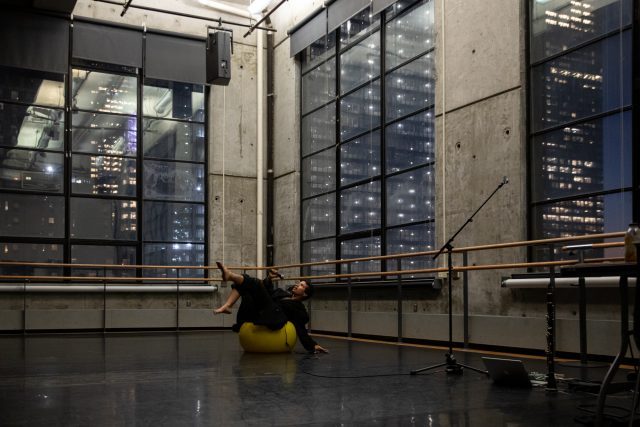
In the piece, a barefoot Andrews (Wordless, There You Are), whose recent Onè at Issue Project Room dealt with ancestral loss, family tragedy, and healing, incorporates a yellow ball — the kind generally used in physical therapy, but here it is more involved with psychological therapy as Andrews roams the empty studio, beautifully vocalizes words and melodies into a microphone (“I spent so much time feeling I was no good”; “How do I feel better?”), plays the clarinet, layers the different sounds into an audio palimpsest using foot pedals, and watches the sun set over the Hudson River. On March 24 at 8:00 — the day Afterwardsness, their collaboration with Bill T. Jones, was scheduled to premiere at the Park Avenue Armory but had to be postponed indefinitely because some members of the company contracted Covid even in their bubble — Andrews will take part in a live Zoom discussion and Q&A with performer and author Morgan Bassichis (The Odd Years, Nibbling the Hand That Feeds Me) about the BAC commission. The lovely and moving recording of Museum of Calm will be available on YouTube through March 29 at 5:00.

UNCHARTED TERRITORY: DANCERS IN ISOLATION

UNCHARTED TERRITORY: DANCERS IN ISOLATION
Eryc Taylor Dance
Sunday, March 21, pay-what-you-can, 6:00
Available on demand with live Q&As March 22-28
etd.nyc

New York City–based nonprofit Eryc Taylor Dance (ETD) looks back at a year in lockdown and celebrates its fifteenth anniversary with its first dance film, Uncharted Territory: Dancers in Isolation. The half-hour work premieres on YouTube on March 21 at 6:00, introduced by Robbie Fairchild, after which it will be available on demand March 22–28.

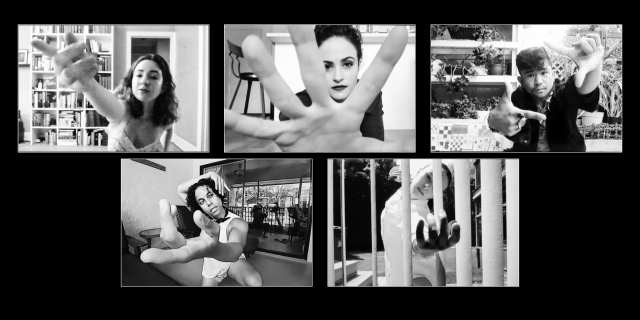
Conceived and developed over Zoom beginning last March, Uncharted Territory is divided into five segments, each featuring one dancer portraying a character, filming themselves indoors and/or outdoors, with an original score by Daniel Tobias. “My husband was one of the first to suffer a Covid-19 infection for three excruciating weeks in March, Tobias said in a statement. “He survived, but it scared me to death. When Eryc Taylor asked me to compose music for Uncharted Territory, there was already a tsunami of emotions heading his way. Each dancer’s story helped me process this tragic epic global pandemic, and I hope the music helped them as well.”

In “Movement One: Solitude,” set to Tobias’s acoustic guitar composition “Distancia,” Taylor Ennen is Spenser, a young woman in danger of unraveling, gliding through her family’s apartment in a short, loose-fitting dress as she grabs a bottle of wine, wriggles on a table under a Noguchi Akari lamp, and sits in a rocking chair; editor Benny Krown incorporates doubling, mirroring, and ghosting as Spenser wrestles with her mind.

In “Movement Two: In-Memoriam,” set to Tobias’s wind-chime “Bahay ni Lola Grandmother’s House,” AJ Guevara is Ivan, who is grieving for his grandmother, who died alone from the coronavirus. The piece begins with birds flying in a blue sky before following Ivan as he puts on his grandmother’s jewelry and starts a ritual fire in her backyard, near a handmade sign that reads, “Lola & Papa’s Nest: Where the Flock Gathers.” In “Movement Three: Meltdown,” Alex Tenreiro Theis is Dani, an attorney who has just lost her job, going from the kitchen to the bedroom as Tobias’s “Dark City” swirls around her, with quick cuts, backward and forward jumps, slow motion, and emotional thermal colors ultimately enveloping her.

Uncharted Territory: Dancers in Isolation was rehearsed over Zoom before being filmed on location by each performer (photo by Shannel Rest)

In “Movement Four: Manhunt,” set to Tobias’s “Path,” Chris Bell plays an anonymous, lonely man seeking a random sexual encounter in the woods by a muddy lake, by the side of a highway, and at a city bus stop. And finally, rehearsal director Nicole Baker is a nurse fighting paranoia and doubt in “Movement Five: Compulsion,” roaming from her bed to her car to a gravel driveway to an outdoor shower, trying to keep herself together as Tobias’s keyboard-based “Nurses Rhapsody” sweeps over a scene occasionally bathed in a blue tint.

Uncharted Territory: Dancers in Isolation was shot by each dancer in Queens, the West Village, Marshfield, Massachusetts, Brooklyn, and Grover Beach, California. ETD, whose previous works include Cycles, Into the Light, and The Missing, dedicate the new piece “to all artists who persevere, find their fire, and create during one of the most challenging times of our lives.”

In addition, there will be several events on Instragam Live (@eryctaylordance): a Q&A with Krown on March 22 at 6:00, a 5×5 interview with photographer Shannel Resto on March 23 at 6:00, and a Q&A with Baker on March 25 at 6:00.

VISION RESIDENCY: RAJA FEATHER KELLY

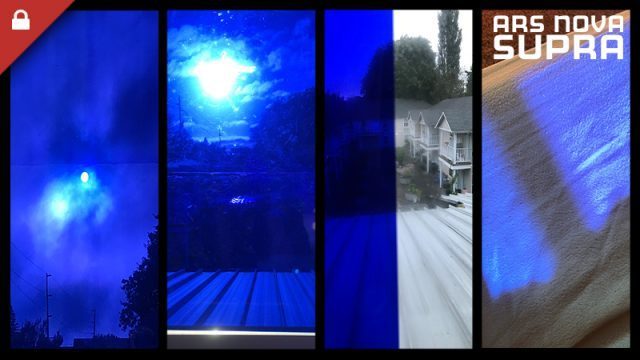
Tuçe Yasak’s Light Journals kicks off raja feather kelly’s Ars Nova Vision Residency

VISION RESIDENCY
Ars Nova
March 20 – April 9, $10 per show
arsnovanyc.com/SUPRA
thefeath3rtheory.com

It’s time to face facts: This is raja feather kelly’s world; we’re only living in it. Kelly is an Obie-winning choreographer, director, artistic director of the feath3r theory, and creative associate at Juilliard who has been involved with such productions as Young Jean Lee’s We’re Gonna Die at Second Stage, Electric Lucifer at the Kitchen, A Strange Loop and If Pretty Hurts Ugly Must Be a Muhfucka at Playwrights Horizons, Fireflies at the Atlantic, and Fairview at Soho Rep and TFANA. In December he premiered his solo performance installation Hysteria in the glassed-in lobby at New York Live Arts, for which he is also making the film Wednesday, a queer-fantasia reimagining of Dog Day Afternoon that he offered a sneak peek of at a wild watch party also in December. He will be bringing back Hysteria for encore performances April 8-10.

Kelly is now curating Ars Nova’s Vision Residency program, featuring presentations by four creators: Tuçe Yasak, Tislarm Bouie, L Morgan Lee, and Emily Wells, running March 20 to April 9. “There is no separation between who these people are as artists and who they are as people. Their work is indelible and one of a kind,” kelly said in a statement. The Ars Nova Supra events begin March 20 with Yasak’s virtual installation Light Journals, inspired by poetry by Rumi, followed March 25 by Bouie’s dance film on Black masculinity, THUG; a reading on April 8 of The Women, the working title of a play in progress, led by L Morgan Lee and kelly as Kirsten Childs, Dane Figueroa Edidi, Donnetta Lavinia Grays, Christine Toy Johnson, Bianca Leigh, Carmen LoBue, and Nia Witherspoon explore what it means to be a woman in today’s society; and, on April 9, kelly & Wells’s Artifact, a listening and viewing party previewing their work-in-progress Album and Opera. Tickets to each show are $10; a monthly subscription to Ars Nova’s Supra digital platform is $15. Kelly is one of seven 2020–21 Vision Residents; the others are Starr Busby, nicHi douglas, JJJJJerome Ellis, Jenny Koons, David Mendizábal, and Rona Siddiqui.

STEPHEN PETRONIO COMPANY: SPRING FORWARD

Who: Stephen Petronio Company
What: Virtual birthday party
Where: SPC Zoom
When: Saturday, March 20, free with RSVP, 5:00
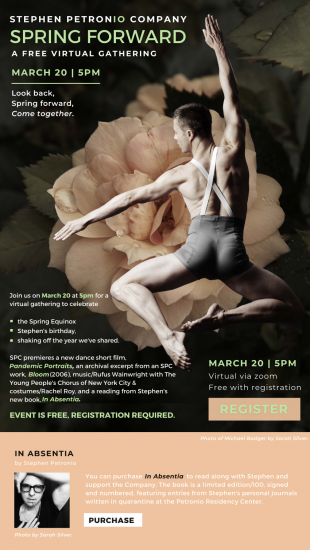
Why: In April 2013, Newark-born, New York City–based dancer and choreographer Stephen Petronio threw himself quite a New Orleans–style funeral at the Joyce for Like Lazarus Did (LLD 4/30). On March 20, he will rise up again for the spring equinox, celebrating his sixty-fifth birthday in style over Zoom. The virtual gathering will include an excerpt from SPC’s 2006 piece, Bloom, featuring music by Rufus Wainwright with the Young People’s Chorus of NYC; the world premiere of his latest short dance film, Pandemic Portraits (SPC previously presented #GimmeShelter last May and Are You Lonesome Tonight in July); and a reading and discussion of Petronio’s new book, In Absentia, consisting of personal journal entries about dealing with the current state of the world, written while Petronio was quarantining at the Petronio Residency Center in the Catskills. Signed and numbered copies of the limited edition book are available for $250. Petronio is a charming, effervescent character, so it’s always worth being in his company. Happy birthday!

OKLAHOMA! RE-IMAGINING A CLASSIC BROADWAY MUSICAL

Dancer Gabrielle Hamilton will be part of National Arts Club panel discussion on Oklahoma! (© Little Fang Photo)

Who: Daniel Fish, Ted Chapin, Rebecca Naomi Jones, Patrick Vaill, Gabrielle Hamilton, Foster Hirsch
What: Discussion of reworking of classic Broadway musical
Where: The National Arts Club Zoom
When: Monday, March 15, free with RSVP, 7:30
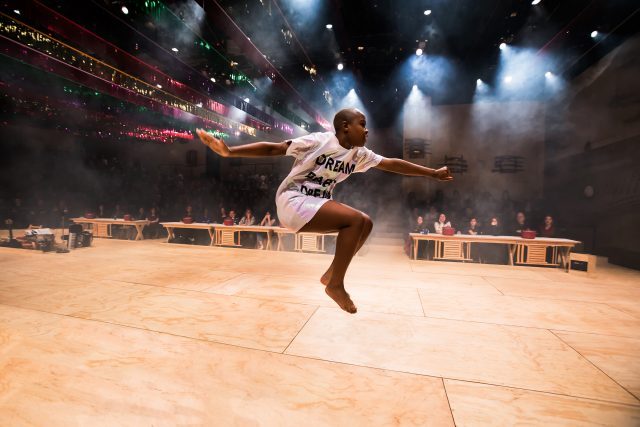
Why: In 2018, Daniel Fish presented his seventy-fifth-anniversary adaptation of Rodgers and Hammerstein’s beloved Oklahoma! The longtime downtowner reimagined the show with diverse casting, an intimate setting that included chili during intermission, significant tweaking of the score, and a controversial solo dance to replace Agnes de Mille’s dream ballet. In my review, I called the show, which started at St. Ann’s Warehouse before moving to Circle in the Square, an “extraordinary adaptation . . . Fish has created a masterful retelling of the 1943 original, immersing the audience in the optimism that came with the southern territory becoming a state in 1906 — but uncovering a deep layer of darkness in the rich farmland soil.”

On March 15 at 7:30, the National Arts Club is hosting the live Zoom panel discussion and Q&A “Oklahoma! Re-imagining a Classic Broadway Musical,” featuring the Tony-nominated Fish; Rodgers & Hammerstein president Ted Chapin (about halfway through the show, the woman next to me muttered, “How could Ted Chapin let this happen?”); Rebecca Naomi Jones, who played Laurey; Patrick Vaill, who portrayed Jud; Bessie winner Gabrielle Hamilton, who performed the dance that opens the second act; and moderator Foster Hirsch. (The show was nominated for eight Tonys, winning for Best Orchestrations [Daniel Kluger] and Best Revival of a Musical.) Registration is free, but donations will be accepted for the NAC Artist Fellows program.