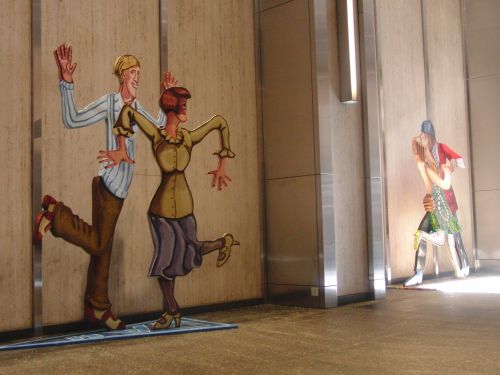
Nearly all Midtown galleries are closed Sundays and Mondays, but there’s a small outdoor venue that never closes and is always worth passing through. In the walkway between Fifth & Sixth Aves. and West 56th & 57th Sts., the Marlborough Gallery (40 West 57th St.) regularly displays sculptures from its collection. Right now is the best mix they’ve had in years, having recently added three colorful nine-foot-tall enamel-on-aluminum sculptures from Red Grooms’s late 2009 “Dancing” show in the gallery. Grooms’s whimsical nature is more than evident in “Swan Lake,” “Tango Dancers,” and “Charleston,” his monumental works adding color to the otherwise gray alley that also includes Nobu 57. The playfulness continues with Tom Otterness’s “Large Cocqui,” a cute oversized frog staring right at the viewer. Several years ago, Manolo Verdes’s queen series took over Bryant Park; “Reina Mariana” has made the trek uptown, holding court in the alley. And Fernando Botero’s “Rape of Europa” features the Phoenician princess lying atop Zeus the bull. In addition, vertical pieces by Beverly Pepper and Arnald Pomodoro stand tall.
Brennan Girard and Ryan Kelly, cofounders of the nonprofit, experimental Moving Theater, complete their stay as the first company-in-residence at the Park Avenue Armory with a multimedia performance in the historic building, designed by Charles Clinton in 1880 to house the Seventh Regiment of the National Guard, volunteer troops known as the Silk Stocking Regiment because of their ritzy members. The site-specific installation, which will take place in the armory’s fascinating period rooms, includes original music by Nathan Davis, Mario Diaz de León, and Du Yun and will be performed by Jonathan Drillet, Davon Rainey, Marlène Saldana, Jose Tena, Anthony Whitehurst, and ICE | International Contemporary Ensemble, incorporating dance, text, and video while commenting on the social and military history of the location and examining various aspects of the male identity. “This work maps our sense of loss at leaving a space we’ve worked in for such an extended period of time,” Gerard and Kelly explained in a statement. “Our attempts at capturing its complex history bring forth our own experience in this incredible building.”
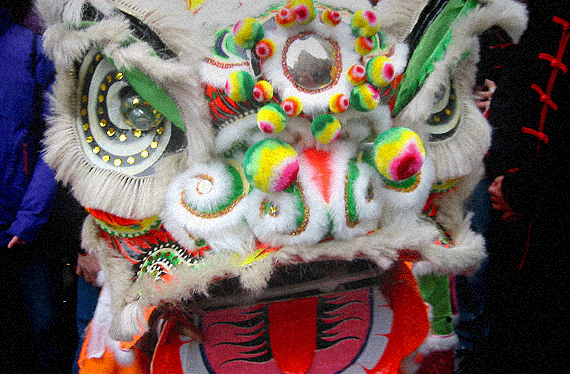
Chinatown Lunar New Year celebration goes into full swing this weekend (photo by twi-ny/mdr)
LUNAR NEW YEAR CELEBRATION
Museum of Chinese in America (and other locations)
211 Centre St. between Howard & Grand Sts.
Thursday – Monday, $7 (free Thursdays 11:00 am – 9:00 pm)
212-619-4785 www.mocanyc.org
The Museum of Chinese in America will be celebrating the Year of the Tiger, 4708, in its beautiful new space on Centre St., honoring the animal that represents courage and bravery. Tonight, Brooklyn-based Chinese Taiwanese American spoken-word artist Kelly Tsai will host an open-mic event dedicated to Valentine’s Day and the Lunar New Year, both of which occur on Sunday, two holidays bathed in beautiful red colors. For the next two Saturdays, MOCA is holding walking tours entitled “Prepare for the New Year in Chinatown.” The Lunar New Year Flower Festival takes place in Sara D. Roosevelt Park on February 12-13, featuring a bevy of cultural programs and traditional festivities, while on Sunday the annual New Year’s Day Firecracker Ceremony and Festival will light off an estimated 600,000 rounds in the park. On February 18, as part of the Free Fridays program at MOCA, the museum will be screening CHINESE ODYSSEY 2002 (Jeffrey Lau, 2002) at 6:30. If you’ve never been to Chinatown in Flushing, the fourteenth annual Lunar New Year Parade and Festival offers an excellent opportunity to check out that growing neighborhood, February 21 beginning at 11:00 am. And the weeklong partying comes to a close that same day with the eleventh annual Lunar New Year Parade and Festival starting in Little Italy at 11:30 am, with Lion Dancers going in and out of local stores and restaurants to bring good luck and prosperity in the coming year. Be sure to stop off for some dumplings, moon cakes, and other festive food, even if you’re not exactly sure what it is. Gung Hey Fat Choy!
The BodyCartography Project will go nuclear at P.S. 122
THE BODYCARTOGRAPHY PROJECT
Performance Space 122
150 First Ave. at Ninth St.
February 10-14, $20 www.ps122.org
Codirectors Otto Ramstad and Olive Bieringa examine the effects of nuclear power on the state of the human body in the New York premiere of 1/2 LIFE. Their BodyCartography Project, which “questions the space between the real materials of the body, the architecture, and the hyper real designed materials of video, light, sound and new technologies,” is joined by electronic music artist Zeena Parkins, artist and physicist Bryce Beverlin II, guest dancer Takemi Kitamura, and installation artist / performer / writer / set designer / costumer Emmett Ramstad in a multimedia look at survival through scientific research, data, and physics via dance, video, and music.
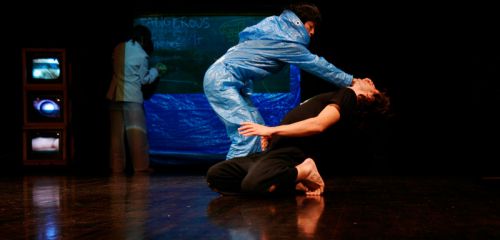
With a bumpy sheet of graying plastic “clouds” hanging from the ceiling, three survivors walk Butoh-slow across the stage, representing nuclear superpower America (Otto Ramstad), atomic bomb victim Japan (Kitamura), and nuclear-free New Zealand (Bieringa), showing that nobody is safe from nuclear winter. Twelve door-shaped light pieces of wood in the back soon come to life, erecting barriers for the three performers, welcoming them and shutting them out. After they put the boards away, the dancers behind them, representing critical mass, emerge and one by one circle each of the protagonists, as if infecting them with radiation. Ultimately, the trio find themselves in a Joseph Cornell-like box, erecting different poses as they are spun around and, in the end, one of them might have found a way out. The seventy-minute program ranges from the boring and mundane to the captivating and exciting; the beginning sequence goes on too long, and some of the solos, especially when Ramstad, Kitamura, and Bieringa keep falling to the floor, are repetitive and difficult to decipher. But the final third, involving the moving box and possible survival, is simply thrilling. The February 11 performance will include a Thursday Night Social, while the February 12 show will be followed by a Talkback with Clarinda Mac Low. Because of the snowstorm, tickets for opening night, February 10, were reduced to $10 and came with free beer for those intrepid folks who made their way despite the weather conditions.
Visual artist, dancer, choreographer, and opera director Trisha Brown is celebrating the fortieth anniversary of the Trisha Brown Dance Company with a series of lectures at Dance Theater Workshop as well as other special event in the city and beyond. Beginning with the Judson Dance Theater in the 1960s and then with TBDC starting in 1970, Brown developed a reputation for creating experimental dance pieces in alternative spaces, working with the likes of Robert Rauschenberg, Laurie Anderson, Lina Wertmuller, Terry Winters, and Kenjiro Okazaki. This year, the Nijinsky Award winner will be taking her company to the Netherlands, Greece, and France in addition to holding technique and repertory workshops and the lecture series. For the inaugural DTW event, on January 13 at 7:30, longtime dancers Diane Madden (now choreographic assistant) and Carolyn Lucas (rehearsal director) will discuss the TBDC creative process with moderator Wendy Perron, editor in chief of Dance magazine. Future lectures will include Madden, Julie Martin, and Trisha Brown herself on February 16 discussing the 1980 premiere of OPAL LOOP, which has been brought back for the 2009-2010 season; a March 22 lecture to be announced; Susan Rosenberg, Peter Eleey, and Guillaume Bernardi on April 11; and former TBDC dancers Eva Karczag, Lisa Kraus, Stacy Spence, Keith Thompson, Stephen Petronio, and Vicky Shick on May 23. The Trisha Brown Dance Company will also be performing early works at Dia:Beacon on February 13-14 and May 1 ($35) as part of its yearlong residency there.
Parsons Dance will update REMEMBER ME with the East Village Opera Company at the Joyce
REMEMBER ME AND MORE
Joyce Theater
175 Eighth Ave. at 19th St.
February 2-21, $10-$49
212-242-0800 www.joyce.org
Choreographer David Parsons and the East Village Opera Company bring an updated version of their collaboration, REMEMBER ME, back to New York City with a two-week stay at the Joyce. The multimedia show about a love triangle includes fourteen songs by the rock opera band, which rocks out to opera classics, with Tyler Ross and AnnMarie Milazzo performing live onstage; costumes are by PROJECT RUNWAY’s Austin Scarlett and lighting by Tony winner Howell Binkley. The stroboscopic solo CAUGHT, set to music by Robert Fripp, will be part of all programs. In addition, the season features family –friendly matinees on Saturdays and Sundays at 2:00 consisting of WOLFGANG, EBBEN, NASCIMENTO NOVO, HAND DANCE, CAUGHT, and SCRUTINY as well as a third program, on February 17-18, comprising WOLFGANG, BROTHERS, SWING SHIFT, KIND OF BLUE, CAUGHT, and IN THE END.
Kimberly Bartosik makes her DTW debut with the world premiere of THE MATERIALITY OF IMPERMANENCE
THE MATERIALITY OF IMPERMANENCE Dance Theater Workshop
219 West 19th St.
Wednesday, February 3, through Saturday, February 6, $15, 7:30
212-924-0077 www.dtw.org
www.daela.org
Evoking memory and the passage of time, Kimberly Bartosik / daela’s THE MATERIALITY OF IMPERMANENCE will have its world premiere this week at DTW’s Bessie Schönberg Theater, on a set dotted with LED lights designed by lighting expert Roderick Murray. The evening-length piece will be performed by Bartosik, Joanna Kotze, and Marc Mann, with music by Luke Fasano. The daela company “is dedicated to rigorous exploration of movement, sound and visual design towards the creation of performances in space-specific environments.” The February 3 show will be preceded by Coffee and Conversation at 6:30, while the February 5 performance will be followed by a discussion with the cast and crew.
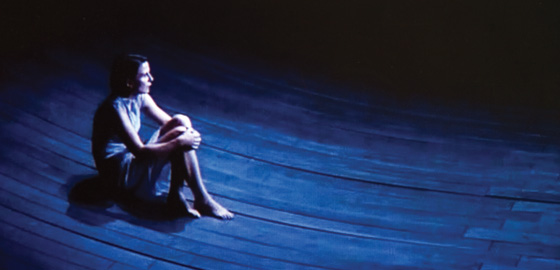
February 4 performance reviewed: The oxymoronically titled THE MATERIALITY OF IMPERMANENCE is an existential examination of home and the human psyche. As the audience enters the theater, lighting designer Roderick Murray and composer Luke Fasano are playing Scrabble in the middle of the stage. Once everyone is seated — including in rows to the right and left of the stage, creating a more intimate feel — choreographer and longtime Merce Cunningham dancer Kimberly Bartosik starts making her way downstairs backwards from the back of the crowd while reciting quotes that soon devolve into random word jumbles. Meanwhile, Marc Mann enters, swings a microphone that is dangling from the ceiling, and attempts to talk into it as it passes by, barely missing his head. Bartosik and Mann then spend the next forty-five minutes or so moving around a mazelike stage divided into compartments by LED lights that turn on and off on the floor, being careful to never step directly over them, as if they were walls. They make their way through the “rooms” with sudden, harsh movements, not light on their feet, as occasional snippets of music appear and disappear and they take off their clothes and then put them back on, over and over again. At one point they meet at center stage and maneuver into an erotic position as Bartosik feeds a torn piece of paper to Mann, once again incorporating words and language into the evening-length piece. Then the couple departs, taking seats in the audience as long-legged Joanna Kotze performs a striking dance, paying no attention to the barriers that constrained Bartosik and Mann.
An abstract, avant-garde work that encounters plenty of bumps along the way, THE MATERIALITY OF IMPERMANENCE, commissioned by DTW, is a curiously compelling piece of dance theater. It can go from cold and confusing to warming and inviting in a heartbeat, a visual representation of the word jumble, low-tech music, and mostly unintelligible dialogue that tease the audience. The words might not make sense, but Bartosik hides little else; both she and Mann disrobe several times, Murray (who is married to the choreographer) gives lighting cues from the stage, and Fasano walks around holding up small speakers and placing microphones on the floor that the dancers struggle to talk into.