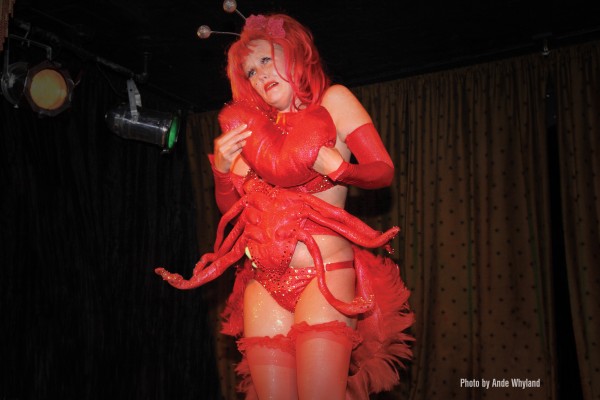
Bambi the Mermaid gets emotional in Beth B’s intimate and revealing documentary
EXPOSED (Beth B, 2013)
IFC Center
323 Sixth Ave. at West Third St.
Thursday, March 6, 7:45, and Monday, March 10, 12:45
Series runs March 5-13
212-924-7771
www.ifccenter.com
www.exposedmovie.com
 In Exposed, visual artist Beth B, who got her start in the 1970s underground scene in New York City, invites viewers into the inner world of burlesque, going behind the scenes with eight current performers who share intimate details about their lives and their shows. Beth B (Two Small Bodies, An Unlikely Terrorist), who wrote, directed, produced, edited (with Keith Reamer), and photographed (with Dan Karlok) the seventy-six-minute documentary, goes backstage at such New York venues as the Slipper Room, Le Poisson Rouge, the Cutting Room, Dixon Place, P.S. 122, Galapagos Art Space, and Coney Island’s Sideshows by the Seashore as burlesque performers discuss issues of gender, control, freedom, disabilities, power, nudity, femininity, personal and professional identity, and more. “What the world projects as normal, it’s just such an illusion, it’s such a fantasy,” Bunny Love says, “and I love that fantasy.” UK comedian and cabaret performer Mat Fraser, who was born with “flippers” for hands, explains, “If you can make them laugh and make a political point that fuels your outrage, all the better.” And Rose Wood adds, “I’ve tried to present my audience with an indelible picture of the body seen in another way, seen in a way that’s different than they see themselves. They have ideas of what’s normal — what a man does, what a woman does, what a heterosexual does, what a gay person does — and I try to present them with another way of seeing the body.” Among the other performers who share their stories are Tigger!, who uses burlesque as a kind of sexual political theater; Dirty Martini, who pays tribute to such early stars of the wordless art form as Dixie Evans and Vickie Lynn; Bambi the Mermaid, who produces Coney Island’s popular Burlesque at the Beach series; Julie Atlas Muz, who honors Pina Bausch in her performance art; and World Famous *BOB*, who points out, “I never lie to people. People would say, ‘Are you a man or a woman?’ And I would say yes. That quick wit was something that I learned from my drag family, that quick wit, that ability to turn anything that hurts you inside into something that’s funny.”
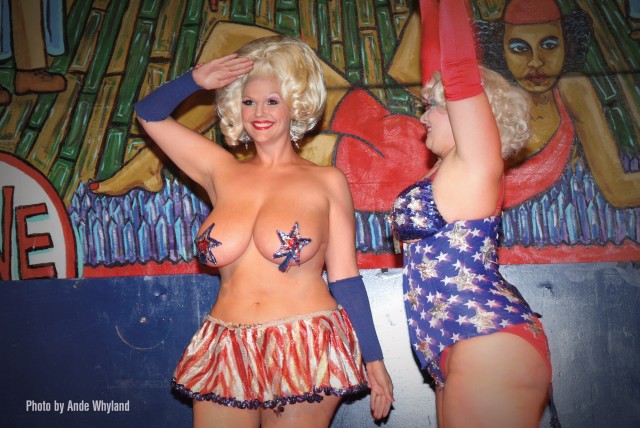
World Famous *BOB* takes on the Patriot Act and freedom in EXPOSED
But whereas previous documentaries about burlesque, like Leslie Zemeckis’s Behind the Burly Q, examine its history, Exposed delves into the very personal, individual stories that drive these performers’ desire to take the stage and reveal themselves. While some are clearly proud of who they are and what they do, others appear to still be working out deeply felt, raw and painful emotions and memories. The eight subjects hold nothing back in the film as they bare body and soul; many of the performances are extremely graphic, but it is often as freeing to watch the acts onstage as it appears to be for the performers to perform them. Exposed is running March 14-20 nightly at 9:30 at the IFC Center, with a sold-out sneak preview on March 13. Each screening will be accompanied by a live performance by at least one of the cast members, with World Famous *BOB* on March 14, Dirty Martini on March 15 & 17, Bunny Love and Tigger! on March 16, Mat Fraser and Julie Atlas Muz on March 18, and special guests TBA on March 19-20. (In addition, Fraser and Muz are starring in their own unique version of Beauty and the Beast at the Abrons Arts Center through March 30.)