this week in broadway

JAJA’S AFRICAN HAIR BRAIDING

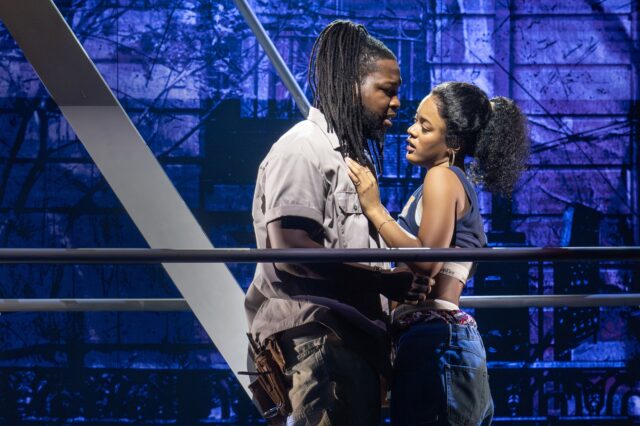
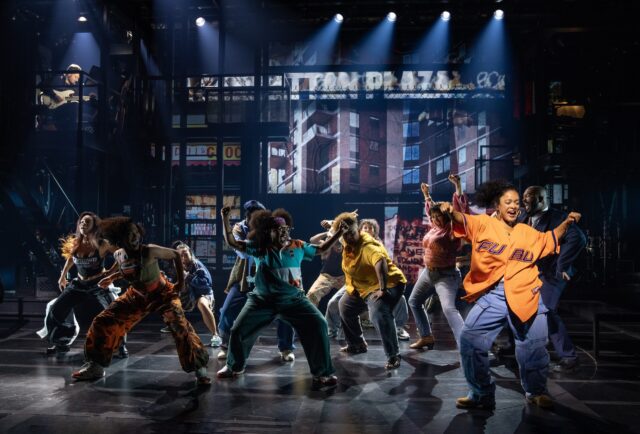
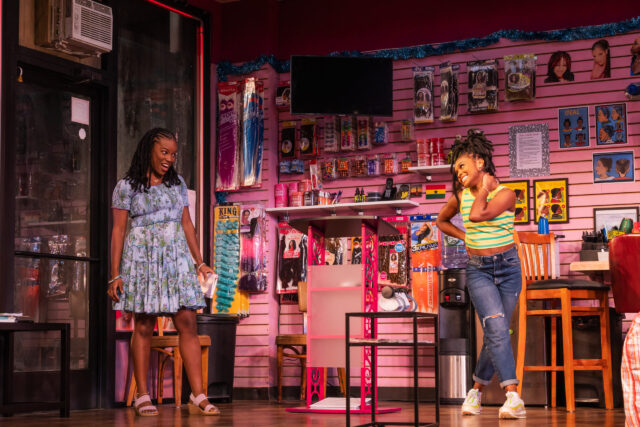
Marie (Dominique Thorne, right) receives an unexpected visitor in Jaja’s African Hair Braiding (photo © Matthew Murphy, 2023)

JAJA’S AFRICAN HAIR BRAIDING
Samuel J. Friedman Theatre
261 West Forty-Seventh St. between Broadway & Eighth Ave.
Tuesday – Sunday through November 19, $74-$205.50
www.manhattantheatreclub.com

“I feel like I moved in for the day,” Jennifer (Rachel Christopher) says in Jocelyn Bioh’s Broadway debut, Jaja’s African Hair Braiding. An aspiring journalist, Jennifer is a kind of doppelganger for the audience; she arrived just as Jaja’s hair salon on the corner of 125th St. and St. Nicholas Ave. in Harlem opened, asked for long micro braids, and has spent the entire morning and afternoon with Miriam (Brittany Adebumola), an optimistic stylist from Sierra Leone. It’s Jennifer’s first time in the shop, and she carefully watches from her chair to the side as people come and go and the stylists laugh, argue, gossip, and wonder what’s next for them. Just as Jennifer starts to feel part of this tight-knit community, so does the audience.

It’s an auspicious, and very hot, July day in 2019, and Senegalese owner Jaja (Somi Kakoma) is getting married that night. Her eighteen-year-old daughter, wannabe writer Marie (Dominique Thorne), is managing the shop and the stylists, who can be a handful: the Ghanaian Sista Bea (Zenzi Williams), a busybody who thinks she’s better than the others and is hoping to open her own salon; the Senegalese Aminata (Nana Mensah), who loves hanging around the shop, especially while she’s having issues with her husband; Miriam, a patient and agreeable young woman with a surprise secret; and the Nigerian Ndidi (Maechi Aharanwa), a fast, talented, fun-loving braider who the older Bea is jealous of.

Over the course of the day, a variety of customers come and go. The nasty and rude Vanessa (Lakisha May) complains about nearly everything, from the way the others look at her to the chair. Chrissy (Kalyne Coleman) is a cheerful young woman who wants to look like Beyoncé. Sheila (May) is a businesswoman who can’t stop talking on her phone. Laniece (Coleman) is a local DJ. And Michelle (Coleman) is a nervous mother who has made an appointment with Ndidi instead of her usual stylist, Bea, who is furious and feels betrayed.

Also stopping by are a series of men, including Franklin the Sock Man, Olu the Jewelry Man, and Eric the DVD Man, selling their wares, in addition to Aminata’s husband, James (all portrayed by Michael Oloyede).

Shortly after Jaja (Somi Kakoma) arrives, the narrative takes a sharp, unexpected turn, forcing everyone to face a hard dose of contemporary reality.

Jocelyn Bioh’s Jaja’s African Hair Braiding takes place in a Harlem salon (photo © Matthew Murphy, 2023)

In School Girls; Or, The African Mean Girls Play, Bioh, who has appeared in such plays as Suzan-Lori Parks’s In the Blood, Branden Jacobs-Jenkins’s Everybody and An Octoroon, and Jaclyn Backhaus’s Men on Boats, follows a group of young Ghanaian students seeking to be selected as a contestant for Miss Ghana, raising issues of jealousy, fairness, and colorism.

She expands on the concept of Black style in Jaja’s African Hair Braiding, celebrating individuality and woman entrepreneurship while also exploring immigration and the African diaspora in America. In a program note, Bioh explains, “To many people, they are just ‘hair braiding ladies,’ random women people pass by on the street, but to me, they are heroes, craftswomen and artists with beautiful, gifted and skilled hands.” Each character has her hopes and dreams, her fears and desires, that feel real, not cartoonish or pedagogic.

At the center is Marie, who, despite being the youngest, is both friend and mother to the other stylists while figuring out how she can afford to go to college and start up her own life. “You know, I really don’t wanna talk about ANY of this anymore, okay?! I don’t want to talk about school or my mother or her ‘connections’ or whatever you saw on the news!” she blurts out, succumbing to the pressure. “Trust me — this is already all I think about every single day. Every single second! For once, can I just have a day where I come here, do my work — in peace — and go home? Is that okay?!”

The show is lovingly directed by Obie winner Whitney White (soft, On Sugarland), balancing uproarious comedy and wit with sincerity and grace. The ensemble cast is outstanding, led by Thorne as Marie, who imbues her with an inner strength that is wise beyond her years yet existing on a knife’s edge. Adebumola is engaging as the warm and caring Miriam, Mensah is hilarious as Aminata, and Oloyede pulls off quite a feat in portraying all four male characters.

Dede Ayite nails the costumes, giving identity, dignity, and humor to each of the women. The effective lighting is by Jiyoun Chang, with lively sound and original music by Justin Ellington. David Zinn’s phenomenal set, a remarkably detailed salon that essentially puts the audience right in Jaja’s shop (and receives its own well-deserved applause), and Nikiya Mathis, who is responsible for the spectacular hair and wigs, are stars in themselves.

You won’t mind spending a lot more time in Jaja’s, moving in for a day or more.

[Mark Rifkin is a Brooklyn-born, Manhattan-based writer and editor; you can follow him on Substack here.]
THE SHARK IS BROKEN

Richard Dreyfuss (Alex Brightman), Robert Shaw (Ian Shaw), and Roy Scheider (Colin Donnell) find plenty of downtime in The Shark Is Broken (photo by Matthew Murphy)

THE SHARK IS BROKEN
Golden Theatre
252 West Forty-Fifth St. between Broadway & Eighth Aves.
Tuesday – Sunday through November 19, $58-$215.50
thesharkisbroken.com

The first two adult books I read were Ernest Hemingway’s The Old Man and the Sea and Herman Melville’s Moby-Dick, when I was in fourth grade. (I discovered only when I was in college that the latter was actually the Reader’s Digest Condensed version; I should have realized that by the opening sentence, which was “Call me Ish.”) A few years later, I devoured Peter Benchley’s Jaws, at least in part because the novel took place on Long Island, where I had spent most of my childhood. Not yet a teenager, I then saw the movie, which was actually filmed on Martha’s Vineyard, when it was released in the summer of 1975. It scared the hell out of me, and I loved every second of it.

I might not have loved every second of The Shark Is Broken, the Broadway play that goes behind the scenes of the making of the film, but I enjoyed enough of it to make it more than seaworthy.

English actor Ian Shaw was four years old when his father, Oscar-nominated actor, novelist, and playwright Robert Shaw (From Russia with Love, A Man for All Seasons) was on set alongside eventual two-time Oscar nominee Roy Scheider (The French Connection, All That Jazz) and soon-to-be Oscar winner Richard Dreyfuss (American Graffiti, The Goodbye Girl). Robert died in 1978 at the age of fifty-one, when Ian was only eight. In 2017, Ian read his father’s drinking diary, which, he explains in an online letter, he found “painful and very brave.” That was the impetus for The Shark Is Broken, which he cowrote with Joseph Nixon and premiered at the 2019 Edinburgh Fringe.

There is no curtain at the Golden Theatre, where the play opened August 21. Onstage is a cross-section of the Orca, the ramshackle lobster boat owned by salty shark hunter and WWII veteran Quint, Shaw’s character. Scheider (Colin Donnell) is playing new police chief Martin Brody, a former New York City cop who has moved to the supposedly much quieter beach community with his family. And Dreyfuss (Alex Brightman) is portraying oceanographer Matt Hooper, who has been brought in for his expert advice.

The three men sling testosterone around for ninety-five minutes as they wait for Bruce, the mechanical shark, to be repaired yet again; it keeps breaking down, giving the actors time to talk about their careers and for Shaw and Dreyfuss to lace into each other, with the cool and calm Scheider as referee.

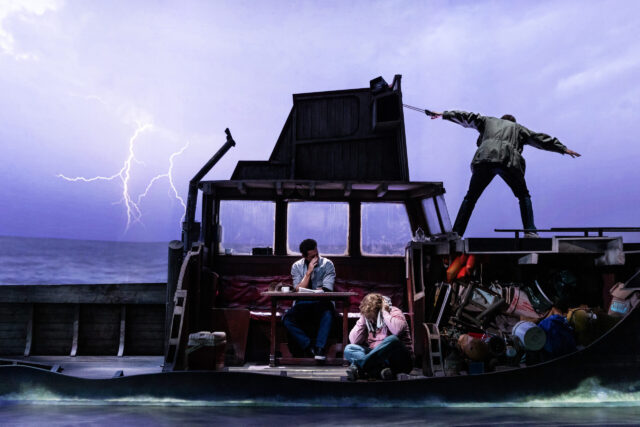
The Shark Is Broken goes behind the scenes of the making of Jaws, storms and all (photo by Matthew Murphy)

The neurotic, Jewish Dreyfuss, who is from Queens, declares, “What a god-almighty fucking waste of time! This whole thing is a disaster.” New Jersey native Scheider, who spends most of the downtime reading the newspaper and catching rays, closely following the Nixon-Watergate story, says, “Well . . . it’s not the time it takes to take the take that takes the time. . . . It’s the time it takes between the takes that takes the time to take the take.” Dreyfuss responds, “How much time did that take you?”

Complaining about the way Steven Spielberg is directing the film, shooting on the ocean and constantly making changes to the script, Dreyfuss argues, “Jews should stay away from water. Nothing good ever happened to any Jew on the water.” Scheider asks, “Didn’t Jesus walk on water?” Dreyfuss concludes, “Yeah! Look what happened to him!”

Meanwhile, Shaw preys on Dreyfuss’s lack of worldly knowledge. “You’re a philistine, boy!” he declares. When Dreyfuss admits he has never heard of Damon Runyon, saying “You can’t expect me to know everything,” Shaw barks back, “I think our mistake is expecting you to know anything.” A few minutes later, Dreyfuss asks, “What, you think I’m an idiot?” to which Shaw replies, “I presume that’s a rhetorical question.”

The interplay among the three is like the scar scene in the film, when the three men show off their scars and share other intimacies, including discussing their relationships with their fathers, ultimately bonding if not exactly becoming best buds. Shaw has hidden bottles all over the boat, Scheider can’t get enough of the blazing sun, and Dreyfuss is a young, highly ambitious nervous wreck. Certain that he was a failure in American Graffiti and that his lead role in The Apprenticeship of Duddy Kravitz will not get him the respect he craves, Dreyfuss yearns to do Shakespeare and Pinter, just like the grizzled Shaw has done, all the while both seeking Shaw’s approval and desperately wanting to best him.

The structure of the play, directed with a loose hand by Guy Masterson (Morecambe, One Flew Over the Cuckoo’s Nest), is as rickety as the Orca; the narrative centers around the most poignant moment in the film, Quint’s speech about having survived the July 1945 sinking of the USS Indianapolis, the ship that delivered components for Little Boy, the atomic bomb dropped on Hiroshima. But the scene doesn’t involve Bruce at all, so it is never quite clear why they are waiting around for the mechanical shark to be fixed before proceeding with the shooting. Jaws is essentially a character study constructed around greed, from the Amity mayor’s refusal to close the beaches as the great white attacks continue during the profitable July 4 weekend to humans’ belief that they have any power at all over the natural world. The Shark Is Broken is a vastly entertaining character study as well, but there’s not a whole lot more meat on its bones. In the play, Dreyfuss asks, “What do you think it’s about?”; he’s referring to the movie, but the same can be said of the show.

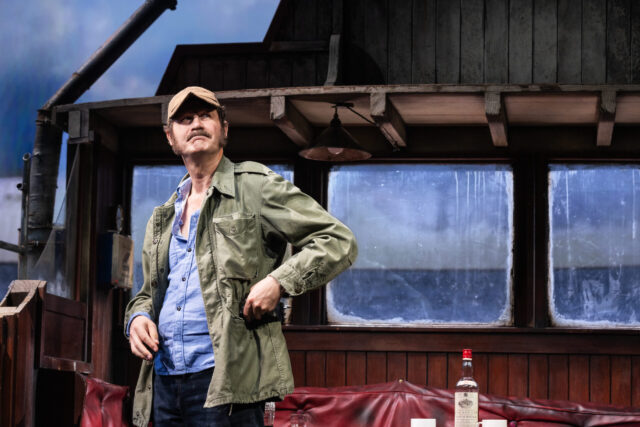
Ian Shaw cowrote and stars as his father, Robert Shaw, in The Shark Is Broken (photo by Matthew Murphy)

In addition, the dialogue is filled with bons mots that wink at what happened after the film; some of them are funny, but others are too obvious. “One thing’s for certain — if there is a sequel, I will not be in it,” Scheider says; he was back for Jaws 2. Reading the paper, Scheider remarks, “Christ! There will never be a more immoral president than Tricky Dicky,” a cheap laugh no matter what you think of 45. And when the three men talk about their families, Scheider asks Shaw about his children (the English actor had ten with three wives), “Do any of yours want to be actors?” Shaw replies, “Christ, I hope not! It’s a shrivelling profession, isn’t it?,” a sly reference to Ian.

Duncan Henderson’s set and costumes put the audience right on board the cutaway Orca, surrounded by Nina Dunn’s effective projections of the sea and storms, enhanced by Jon Clark’s lighting and Adam Cork’s sound and interstitial music.

Donnell (Anything Goes, Love’s Labour’s Lost) is steadfast and hunky as Scheider, who is a calming influence among the three actors. Brightman (Beetlejuice, School of Rock) is uncanny as Dreyfuss, looking and sounding so much like him that you will sometimes forget it isn’t Dreyfuss himself. And in his Broadway debut, Ian Shaw (War Horse, Common) pays wonderful tribute to his father, capturing his essence in every word and move while depicting his virtues and his flaws.

“There is no folly of the beast of the earth which is not infinitely outdone by the madness of men,” Ishmael says in Moby-Dick. It’s a line that also relates to a trio of actors portraying three very different men, each with his own unique form of madness, hunting a mechanical shark in a make-believe Hollywood movie.

[Mark Rifkin is a Brooklyn-born, Manhattan-based writer and editor; you can follow him on Substack here.]
HERE LIES LOVE

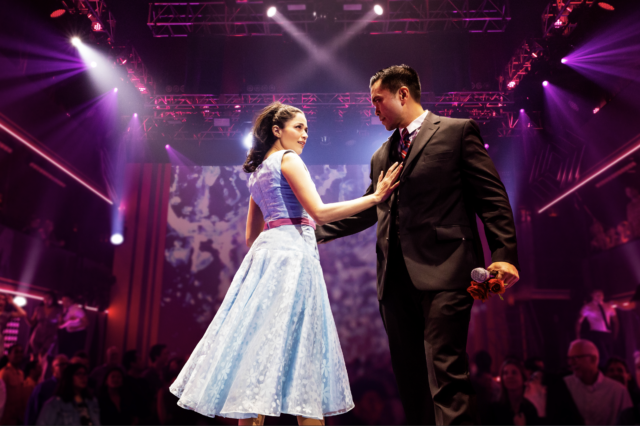
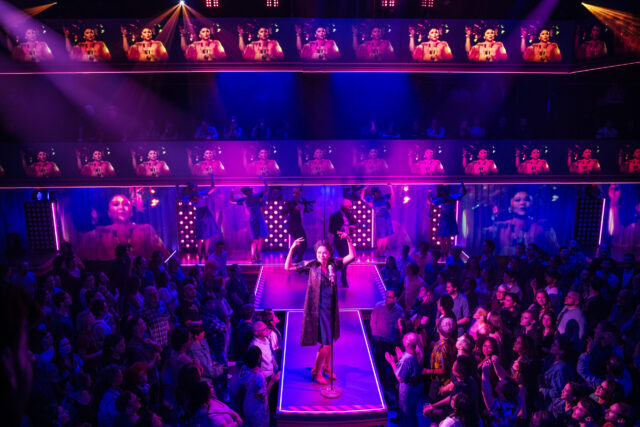
Imelda (Arielle Jacobs) and Ferdinand Marcos (Jose Llana) dance their way to power in Here Lies Love (photo by Billy Bustamante, Matthew Murphy, and Evan Zimmerman)

HERE LIES LOVE
Broadway Theatre
1681 Broadway at 53rd St.
Tuesday – Sunday through September 3, $49 – $299
herelieslovebroadway.com

“Why don’t you love me?” Imelda Marcos (Arielle Jacobs) asks in Here Lies Love, the fast-paced extravaganza thrilling audiences at the reconfigured Broadway Theatre. Obviously, she hasn’t been paying attention, too obsessed with greed, corruption, and power.

Here Lies Love started out as a 2010 concept album about Marcos by former Talking Heads leader David Byrne and musician and DJ Fatboy Slim, featuring Tori Amos, Steve Earle, Martha Wainwright, Natalie Merchant, Florence Welch, Cyndi Lauper, Nellie McKay, and others. The full-on show opened at the Public’s LuEsther Hall in 2013, when I called it “a spectacular, must-see event, an immersive, endlessly creative theatrical experience.” It’s still all that and more.

Set designer David Korins has ripped out most of the seats in the theater, so hundreds of people gather on the floor, where large rectangular platforms (nearly four feet high) are pushed around by stagehands while other crew members guide the audience like airplane safety ground handlers so revelers don’t get smushed. There are a few mezzanine rows on two sides of the theater; at one end there are two dozen rows of more traditional balcony seating, while at the other is the main stage. In the center of the room is a giant disco ball, evoking Marcos’s New York City penthouse, where she had one installed over a dance floor, and Studio 54, where she liked to party with celebrities.

Throughout the ninety-minute show, Peter Nigrini projects archival news footage, sociopolitical information, images of Johanna Poethig, Vicente Clemente, and Presco Tabios’s 1986 Lakas Samabayanan (“People’s Power”) mural, and live action, documenting Imelda’s determined rise from a poor childhood by winning a local beauty contest and moving to Manila, meeting and falling in love with the ambitious Ferdinand Marcos (Jose Llana), a military veteran and lawyer with major political aspirations.

Soon she’s swept into a life of position and wealth, although her public statements seem touchingly ingenuous. “The most important things are love and beauty. / It doesn’t matter if you’re rich or poor. / To prosper and to fly — / a basic human right. / The feeling in your heart that you’re secure,” she sings in the opening title number. “Is it a sin to love too much? Is it a sin to care? / I do it all for you. / How can it be unfair?” Most of the lyrics are taken directly from interviews, films, and public statements made by the characters; “here lies love,” for example, is the phrase Imelda wants engraved on her tombstone.

The Marcoses’ rise to power is being challenged by reformer Ninoy Aquino (Conrad Ricamora), a provincial mayor and governor who briefly dated Imelda before becoming a senator who correctly predicted what she and Ferdinand would do to the Philippines. “Out ev’ry night in New York and Paris / Champagne and dancing — while back here at home / People barely surviving — they’re living in shanties! / Our country’s in trouble — but the party goes on!” he declares, earning himself the top spot on their long list of enemies.

Here Lies Love follows the story of Imelda Marcos (Arielle Jacobs) through music and dance (photo by Billy Bustamante, Matthew Murphy, and Evan Zimmerman)

Another sad observer of Imelda’s transformation into an egotistical despot is her childhood friend Estrella Cumpas (Melody Butiu), who in some ways represents both the audience and the people of the Philippines. Once wealth and power come her way, Imelda quickly dumps Estrella. In one of the most touching scenes in the show, Estrella watches Imelda on her wedding day, but she is kept on the other side of a gate. Estrella is intent on standing by her friend as long as she can, explaining, “I know that you are in there somewhere / Letters get misplaced in the mail / Guess that there was some confusion / Amidst those throngs and swells / Did you see me outside? / Did you see me wave? / When you passed in your car / Ah, well, that’s okay — / How she looked when she passed by / How she looked when she passed by.” But Imelda has moved on, trying to erase her poverty-stricken past from her official story.

In 1965, Ferdinand became the tenth president of the Philippines, and for more than twenty years he ruled with an iron fist, having his rivals jailed and murdered, cheating on Imelda, silencing the media, establishing martial law, and lying to the populace as he grew ridiculously rich.

Shortly after the wedding, a press attaché (Jeigh Madjus) announces, “And the whole world can see / They’re our Jackie and John . . . What a picture they make / I’m so proud for us all.” But that’s not at all the way things turned out.

Tony-winning director Alex Timbers (Bloody Bloody Andrew Jackson, Moulin Rouge!) infuses Here Lies Love with nonstop energy spreading across the theater; while the central action follows Ferdinand, Imelda, and Ninoy, the ensemble moves and grooves to Olivier nominee Annie-B Parson’s electric choreography on podiums in the balcony, as if featured dancers in a nightclub. A ladder is occasionally wheeled to the balcony so the main characters can interact with the audience there.

The staging works on multiple levels, but, most important, it helps attendees experience some of what the Filipino people felt during the Marcoses’ ascent. At first, the crowd on the floor is sucked into Ferdinand’s populist campaign, cheering, shaking hands with him and Imelda, and eagerly posing with them for photos and videos. But soon after, they are at an Aquino rally, joining in the rage against the Marcoses’ rampant corruption.

Justin Townsend’s lighting is flashy and bold, splashing flickering colors everywhere. Clint Ramos’s colorful costumes are inspired by such traditional Filipino styles as the terno and the barong. M. L. Dogg and Cody Spencer’s pumping sound shakes the house, led by a fast-talking DJ (Moses Villarama) who keeps the party going even after the show is over. Music director J. Oconer Navarro guides the band across tender ballads and splashy disco and pop, with Joe Cruz on guitar, Derek Nievergelt on bass, and Jacqueline Acevedo, Gustavo Di Dalva, Brandon Ilaw, Paula Winter, and Yuri Yamashita on percussion.

Broadway’s first all-Filipino cast has Llana (The King and I, The 25th Annual Putnam Country Spelling Bee), Ricamora (The King and I, Soft Power), and Butiu (Doctor Zhivago, South Pacific) reprising their roles from the Public Theater production, and all three embody their characters with skill and confidence; Butiu is particularly touching as the friend left behind, essentially representing all the people the Marcoses steamrolled. Jacobs (In the Heights, Between the Lines) is almost too likable as Imelda, although you run out of sympathy for the woman known as the Iron Butterfly by the end. Jasmine Forsberg (Broadway Bounty Hunter, A Grand Night for Singing) is Maria Luisa and Imelda’s inner voice.

Through August 13, Tony winner Lea Salonga (Miss Saigon, Once on This Island) brings down the house as Aurora Aquino, Ninoy’s mother, singing the heartfelt “Just Ask the Flowers” dressed in all black, surrounded by black umbrellas. Kristina Doucette plays Ninoy’s wife, Cory; Timothy Matthew Flores is their son.

Oscar, Grammy, and Tony winner Byrne (Joan of Arc: Into the Fire, American Utopia) and Grammy winner Fatboy Slim (“Praise You,” “The Rockafeller Skank”) have ingeniously transformed the story of despicable despots into a cautionary tale and all-out dance celebration — and with only one mention of shoes.

Ferdinand died in 1986 at the age of seventy-two; Imelda, who concluded a nine-year run in the Philippine House of Representatives in 2019, is still alive, now ninety-four, and their son Bongbong, aka Ferdinand Marcos Jr., was elected president of the country in a landslide in 2022.

“Don’t let them look down on us,” Imelda calls out in “Please Don’t.” It seems she has little to worry about.

[Mark Rifkin is a Brooklyn-born, Manhattan-based writer and editor; you can follow him on Substack here.]
HARLEM WEEK: A GREAT DAY IN HARLEM AND MORE

Who: Uptown Dance Academy, the Gospel Caravan, IMPACT Repertory Theatre, Mama Foundation’s Sing Harlem! Choir, Bishop Hezekiah Walker & Choir, Ray Chew & the Harlem Music Festival All-Star Band featuring Nona Hendryx, more
What: Annual Harlem Week celebration
Where: U.S. Grant National Memorial Park, West 122nd St. at Riverside Dr.
When: Sunday, August 13, free, noon – 7:00 pm (festival runs August 9-16)
Why: One of the centerpieces of Harlem Week is “A Great Day in Harlem,” which takes place Sunday, August 13, as part of this annual summer festival. There will be an international village with booths selling food, clothing, jewelry, and more, as well as live music and dance divided into “Artz, Rootz & Rhythm,” “The Gospel Caravan,” “The Fashion Flava Fashion Show,” and “The Concert Under the Stars.” Among the performers are the Uptown Dance Academy, the Gospel Caravan, IMPACT Repertory Theatre, the Sing Harlem! Choir, and Bishop Hezekiah Walker & Choir. In addition, Ray Chew & the Harlem Music Festival All-Star Band, featuring Nona Hendryx, will perform a tribute to the one and only Tina Turner, who died in May at the age of eighty-three; Harry Belafonte, Tony Bennett, Miriam Makeba, and Tito Puente will also be honored.

The theme of the forty-ninth annual Harlem Week is “Be the Change: Hope. Joy. Love.”; it runs August 9-16 with such other free events as the panel discussion “Climate & Environmental Justice in Harlem: Storms, Heat & Wildfires,” A Harlem SummerStage concert, Senior Citizens Day, the Uptown Night Market, the Percy Sutton Harlem 5K Run & Walk & Children’s Run, “Choose Healthy Life Service of Renewal and Healing,” Great Jazz on the Great Hill in Central Park with Wycliffe Gordon and Bobby Sanabria, Imagenation Outdoor Film Festival screenings of Beat Street with DJ Spivey and Max Roach: The Drum Also Waltzes, a Youth Conference & Hackathon, Economic Development Day, an Arts & Culture Broadway Summit, Harlem on My Mind Conversations, a Jobs & Career Fair, and more. “We continue to build a stronger, more united Harlem, radiating hope, joy, and love throughout our beloved city,” Harlem Week chairman Lloyd Williams said in a statement.

[Mark Rifkin is a Brooklyn-born, Manhattan-based writer and editor; you can follow him on Substack here.]
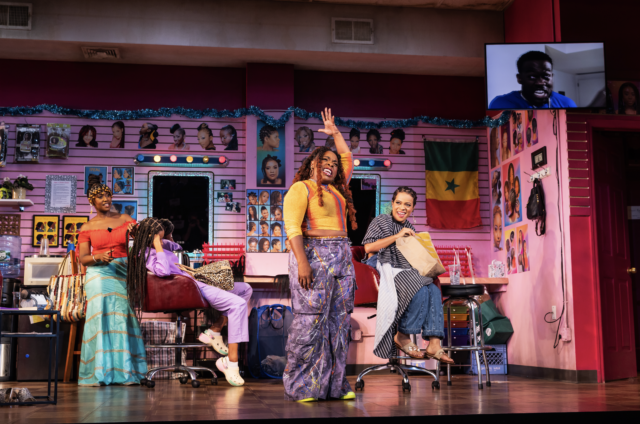
THE COTTAGE

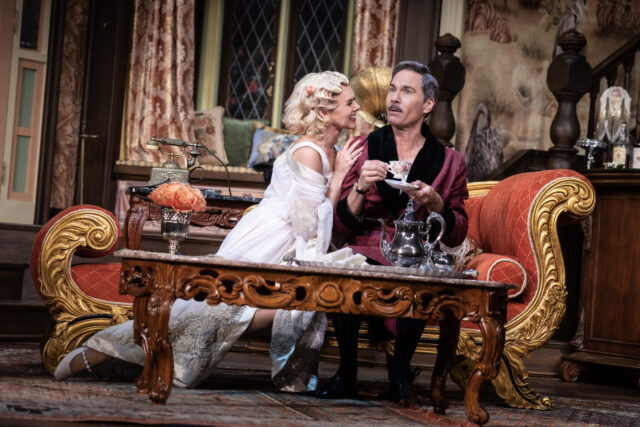
Sylvia (Laura Bell Bundy) and Beau (Eric McCormack) discuss their future in The Cottage (photo by Joan Marcus)

THE COTTAGE
Hayes Theater
240 West Forty-Fourth St. between Broadway & Eighth Ave.
Tuesday – Sunday through October 29, $109-$169
thecottageonbroadway.com

“Why do I have a sense of impending disaster?” a character asks early in Tom Stoppard’s 1981 farce, On the Razzle. “One false move and we could have a farce on our hands.”

The best farces build comedy around impending disasters, usually involving class and romance, from Noël Coward’s Present Laughter and Oscar Wilde’s The Importance of Being Earnest to Michael Frayn’s Noises Off and Molière’s The Miser. But the less-successful farces are hampered by too many false moves.

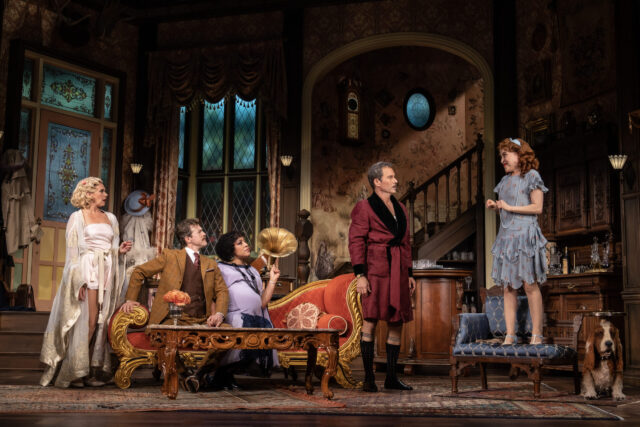
Sandy Rustin’s 2014 drawing room comedy of manners, The Cottage, which opened July 24 at the Hayes Theater on Broadway, starts off well enough. As the audience enters the space, the stage is covered by a screen depicting the image of a colorful, idyllic cottage covered in plants and flowers — as well as several pairs of animals engaged in overt sexual behavior; a bra dangles from a tree branch, hinting at what is going on inside. The screen is then raised to reveal Paul Tate dePoo III’s wonderful set, which deservedly gets its own applause. The large room is filled with elegant furniture, sculptures, books, paintings, a bar, a globe, a gramophone, and seemingly endless knickknacks.

It’s June 1923, and Beau (Eric McCormack) is at his family’s cottage in the English countryside, in the midst of his annual tryst with Sylvia (Laura Bell Bundy), which has been going on for seven years. Sylvia is ready to take their relationship to the next level, but Beau is apprehensive.

An all-star cast cannot save the Broadway debut of The Cottage (photo by Joan Marcus)

“I wish you were my husband,” she says.

“If I were your husband you would despise me just as you despise Clarke and you would spend your evenings wishing to make love to him and not me,” Beau replies, referring to his brother, Clarke (Alex Moffat), who is married to Sylvia. “Romance, my dear, is for fairy tales. This is not a romance. This is sex,” Beau adds. “Un-wifely sex.”

Beau is none-too-thrilled when Sylvia announces that she has sent telegrams to both Clarke and Marjorie (Lilli Cooper), Beau’s wife, revealing the affair. Clarke and Marjorie soon arrive separately with secrets of their own, followed by Dierdre (Dana Steingold), a whirling dervish who is in love with Beau and is worried that her husband, Richard (Nehal Joshi), will find out where she is and kill him — but not before they all have some fun. “I didn’t expect a party. Will there be games?” Dierdre declares. The fun and games take a drastic downturn in the far-less-effective second act.

Subtitled “A Romantic and (Not Quite) Murderous Comedy of Manners,” The Cottage could be renamed The Farce That Goes Wrong. The all–North American cast (McCormack is Canadian) speaks in overly dramatic British accents. Many of the props offer surprise jokes that quickly become repetitive, while others are just plain head scratchers — antlers, I’m talking about you.

The play, gleefully helmed by the Tony-winning, Emmy-nominated Jason Alexander (Seinfeld, Jerome Robbins’ Broadway) in his directorial debut, does have its fair share of amusing exchanges, particularly in the first act, and there were two genuinely funny moments that appeared to be spontaneous, one involving a shoe, the other a bunch of grapes, resulting in the actors trying their best to hold back their own laughter and failing wonderfully. Unfortunately, there was not nearly enough of that.

Sydney Maresca’s costumes are appropriately genteel, from Clarke’s tweed suit to Sylvia’s white negligee to Beau’s smoking jacket. Justin Ellington’s sound design is overwhelmed by the actors speaking way too loud, which often impacts the believability of the plot; numerous times, characters have discussions they don’t want others to hear, but it’s hard to believe that a person knocking at the front door can’t hear what two people are saying as they shout right on the other side.

The cast is all in, but the lack of subtlety drags the show down; it might have worked better as a ninety-minute one-act instead of two hours with intermission. The actors, particularly Saturday Night Live veteran Moffat and Steingold (Beetlejuice, Avenue Q), display a talent for physical comedy, but a gaggle of gags feels tossed in purely for giggles, not organic to the story. A stage farce needs to be clever and witty first, without the pratfalls, in order to capture the audience; otherwise, as with The Cottage, you end up with an overlong episode of a mediocre sitcom or SNL skit.

[Mark Rifkin is a Brooklyn-born, Manhattan-based writer and editor; you can follow him on Substack here.]
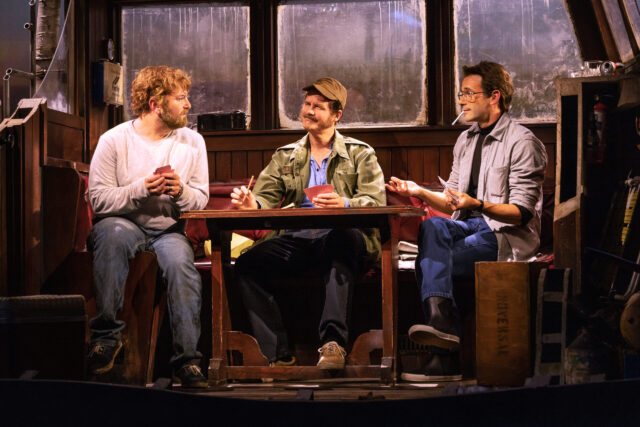
JUKEBOX HEROES, TAKE TWO: ONCE UPON A ONE MORE TIME / ROCK AND ROLL MAN

Six fairy-tale characters reimagine their future in Once Upon a One More Time (photo by Matthew Murphy)

ONCE UPON A ONE MORE TIME
Marquis Theatre
210 West Forty-Sixth St. between Seventh & Eighth Aves.
Tuesday – Saturday through September 3, $59.75-$319.50
onemoretimemusical.com

In May, I wrote about a pair of jukebox musicals, the extremely disappointing A Beautiful Noise: The Neil Diamond Musical, which unsurprisingly received no Tony nominations, and the absolutely delightful & Juliet, which earned nine nods but unfortunately took home none. The former was a disjointed look at the life and career of the Brooklyn-born megastar, while the latter was a clever follow-up to Shakespeare’s Romeo and Juliet in which his wife, Anne Hathaway, decides to pen a sequel in which Juliet survives and, leaving behind the dead Romeo, heads to Paris to start a new life, set to existing tunes written or cowritten by Swedish producer Max Martin for the Backstreet Boys, Robyn, Demi Lovato, Bon Jovi, Katy Perry, *NSYNC, Justin Timberlake, Britney Spears, and others.

Last week I encountered a similar situation when I saw two new musicals, one an unsatisfying biographical chronicle, the other a surprisingly clever reimagining of a fairy-tale world using nothing but songs by Spears, the Princess of Pop, who has sold nearly 150 million records but has won more Golden Raspberries (3) than Grammys (1).

At the Marquis Theatre, Once Upon a One More Time is a load of fun despite a fairly ludicrous setup: After generations of following the rules enforced by the Narrator (Adam Godley), who makes sure to keep every female character in her place from story to story, Cinderella (Briga Heelan), Snow White (Aisha Jackson), Rapunzel (Gabrielle Beckford), Sleeping Beauty (Ashley Chiu), Princess Pea (Morgan Whitley), and Little Mermaid (Lauren Zakrin) start to realize there might be something else out there for them after the O.F.G. — the Original Fairy Godmother (Brooke Dillman) — gives Cin a copy of Betty Friedan’s 1963 game-changer, The Feminine Mystique, which helped usher in second-wave feminism. And they explore their situations through such Spears hits as “Lucky,” “Toxic,” “Womanizer,” “Oops! . . . I Did It Again,” and “. . . Baby One More Time.”

Prince Charming (Justin Guarini) turns out to be quite the dog in Britney Spears musical (photo by Matthew Murphy)

Cinderella is the first to consider that she might have a choice in her future, which upsets the Narrator. “Yes. Listen, I’ve been doing this a long time. And believe me, if I change so much as an intonation, the children go full Rumpelstiltskin,” he tells her. “They want things the same, every time. The narrative is very clear. We’re not here to make fairy tales, we’re here to follow them. Don’t overthink it. Oh, and don’t furrow your brow! We want you delivering lines, not wearing them. There. Better. Happy ever after.”

When Snow notices that Cin appears to be a bit off, she says, “Hey, you seem ‘stuck.’ Doc gives me pills for when I get like that.” Cinderella turns her down, then points out that Snow White’s latest needlepoint, “Happy ever after,” is filled with typos. Snow replies, “Huh. I guess neither of us knows what happy ever after’s supposed to look like. . . . All right, I gotta go get chased through the woods by a terrifying man in pitch blackness.”

When Cin discovers that her Prince Charming (Justin Guarini) is also Snow’s Faithful, the misogyny that is baked into traditional fairy tales rises to the surface and begins to turn things upside down and inside out. Not only do the young women — including Belle (Liv Battista), Goldilocks (Amy Hillner Larsen), and Red (Justice Moore) — start reevaluating the state of their being, but Prince Erudite (Ryan Steele) and Clumsy (Nathan Levy) wonder if they can explore their potential relationship as well. Meanwhile, Cinderella’s Stepmother (Jennifer Simard) and her two stepsisters, Belinda (Ryann Redmond) and Betany (Tess Soltau), lie in wait, willing to play by the rules in order to land Prince Charming or even Prince Brawny (Joshua Daniel Johnson), Mischievous (Kevin Trinio Perdido), Gregarious (Mikey Ruiz), Suave (Josh Tolle), or Affable (Stephen Scott Wormley).

Cinderella (Briga Heelan) discovers a whole new world in a book by Betty Friedan (photo by Matthew Murphy)

If you took Six, & Juliet, Into the Woods, Head Over Heels, Wicked, and Bad Cinderella and put them into a blender, you would come up with something like Once Upon a One More Time. Not all of it works; at two and a half hours with intermission, it is repetitive, and the last fifteen minutes or so should be chopped off, as it basically explains to us what we’ve already seen. The whole Betty Friedan element is still puzzling to me — I understand why they chose that book, but the whole idea of making it a key part of the plot and (sort of) getting away with it is mind-boggling to me — as are the Narrator’s threats to send rule breakers to a place called Story’s End.

Jon Hartmere’s (bare, The Upside) book is otherwise witty and clever, no doubt helped by five-time Tony nominee David Leveaux serving as creative consultant. The crack ten-piece band keeps Spears’s songs down to earth, avoiding haughty orchestrations, although several ballads threaten to go over the top. In their first Broadway show, directors and choreographers Keone and Mari Madrid (Beyond Babel,The Karate Kid) cut loose with ecstatic Spears-inspired dance numbers performed by an exuberant cast.

Anna Fleischle’s appealing set features trees and the facades of houses raised and lowered, an elegant staircase, a multilevel platform laden with stage lighting, a balcony, windowlike screens in the back, and a giant quill in a bubble hanging from the ceiling, daring anyone to grab it and rewrite the fairy tales. Sven Ortel’s projections range from the night sky to scary woods to magic castles, with fanciful lighting and plenty of glowing spots by Kenneth Posner and raucous sound by Andrew Keister.

Many of Loren Elstein’s costumes are based on outfits Spears wore in videos and concerts, with wigs by Nikiya Mathis that further our immersion into all things Britney, as if each fairy-tale character represents a separate part of her history. In her Broadway debut, Heelan is absolutely delightful as Cinderella, a stand-in for anyone ready to burst out with their own story. Jackson (Paradise Square, Waitress) is lovely as Cin’s best friend, Guarini (American Idiot, Wicked) has a field day as the self-absorbed, selfish prince who gets to belt out “Oops! . . . I Did It Again,” and two-time Tony nominee Godley (The Lehman Trilogy, Anything Goes) is just right as the Narrator, who is terrified of change. But two-time Tony nominee Simard (Company, Mean Girls), as she so often does, steals the show as the evil stepmother who always has a plan up her corset.

Once Upon a One More Time bites off more than it can chew, but it’s no poison apple it’s nibbling on but is instead shiny, fresh, and crisp, even if it’s occasionally sour.

While the show is not about Spears’s controversial life — it arrives on Broadway less than two years after Spears was freed from her father’s conservatorship — there are fairy-tale aspects to her early career, followed by bittersweet personal and professional entanglements that titillated the public and impacted her reputation. Once Upon a One More Time helps reestablish that original image.

Leo Mintz (Joe Pantoliano) and Alan Freed (Constantine Maroulis) come up with a plan to spread the gospel of rock and roll in musical (photo © Joan Marcus 2023)

ROCK & ROLL MAN
New World Stages
340 West 50th St. between Eighth & Ninth Aves.
Wednesday – Monday through September 1, $90-$164
rockandrollmanthemusical.com
www.newworldstages.com

When my mother was a teenager in the mid-1950s, she would sneak out of her apartment and catch rock and roll shows at the Brooklyn Paramount, seeing all the greats, the originators of the art form. I grew up with that music, treasuring two small boxes of 45s that contained many of the best singles ever recorded, by Little Richard, Chuck Berry, Jerry Lee Lewis, the Moonglows, the Coasters, the Platters, the Drifters, and others.

All of those artists and more are featured in Rock & Roll Man, a new musical about legendary DJ Alan Freed (Constantine Maroulis) that is making its New York premiere at New World Stages. It opens at the Paramount with Freed’s 1958 Holiday Rock and Roll Extravaganza, kicking off with my favorite song from that era, “Sh-Boom” by the Bronx-based Chords: “Life could be a dream / If I could take you up in paradise up above / If you would tell me I’m the only one that you love / Life could be a dream, sweetheart.” Unfortunately, after a promising beginning, the rest of the show proves not to be a dream of paradise.

The goofy premise is that on the last night of his life, January 20, 1965, amid Beatlemania and the Vietnam War, the Pennsylvania-born Freed is dreaming that he is being tried in an imaginary Court of Public Opinion by Judge Mental (Eric B. Turner) in the trial of The World versus Alan Freed; with the help of his lawyer, Little Richard (Rodrick Covington), Freed must defend his legacy against relentless prosecutor J. Edgar Hoover (Bob Ari), who has charged him with “the destruction of the American way of life by inventing the genre of music which you named rock and roll,” claiming that Freed is a “fraud . . . a modern day snake oil salesman who concocted this foul form of music solely for the purpose of self-promotion and illicit profit . . . then foisted it on our unsuspecting youth, manipulating them into a world of juvenile delinquency, alcohol, narcotics, and . . . SEX!!!!!”

Through flashbacks, Freed returns to Cleveland, where he got his start in radio, teaming up with Record Rendezvous owner and station advertiser Leo Mintz (Joe Pantoliano) to bring rock and roll to the younger generation. Freed immediately draws an integrated audience, with Black and white teenagers listening to his Moondog Show, hanging out at the record store, and going to concerts hosted by Freed and featuring such acts as LaVern Baker (Valisia LeKae).

Constantine Maroulis stars as controversial deejay Alan Freed in Rock & Roll Man (photo © Joan Marcus 2023)

Freed hits the big time when he moves to New York City and WINS, teaming up with Roulette Records owner and Birdland cofounder Morris Levy (Pantoliano), who allegedly associated with the Mafia. When a district attorney asks him, “Is it true you associate with known mobsters like Vinnie the Chin Gigante and other members of the Gambino crime family?,” he replies, “Look, I grew up in New York City. I know a lot of different people, including a few of the gentlemen you just mentioned. I also know Cardinal Spellman. That don’t make me a Catholic. And by the way, the cardinal loves me. He’s a real mensch.”

Freed and Levy present Little Richard, Frankie Lymon (Jamonté) and the Teenagers, Buddy Holly (Andy Christopher), Chuck Berry (Matthew S. Morgan), Jerry Lee Lewis (Dominique Scott), Bo Diddley (Eric B. Turner), and other breakthrough favorites, fighting off the trend of Caucasian crooners like Pat Boone (Christopher) “sucking the soul [right out of Little Richard’s] songs . . . bleaching ’em lily white,” with the original artists not seeing a penny in royalties when they’re played on the radio or on TV. Introducing Boone’s hot new song “Ain’t That a Shame” — first recorded by Fats Domino, who wrote it with Dave Bartholomew — on American Bandstand, host Dick Clark (Scott) calls himself “one of the good guys playing good clean American rock and roll for all you good clean American teenagers.”

But white performers and producers weren’t the only ones on the take; as Freed keeps growing more successful, FBI chief Hoover comes after him, accusing him of not only corrupting children but of accepting payola, setting up a final showdown.

By including new songs alongside classic oldies, Rock & Roll Man sets itself up with a major problem: Gary Kupper’s (Freckleface Strawberry, Consumer Behavior) original music and lyrics are vastly overshadowed by “Sixty Minute Man,” “Rocket 88,” “Lucille,” “See See Rider,” and “Smoke Gets in Your Eyes.” Covington and LeKae rip it up as Little Richard and LaVern Baker, respectively, with strong support from Turner as a singer in multiple groups, far outshining Morgan as Berry and Scott as Jerry Lee. The show might have benefited from a more wide-ranging book from Kupper, Larry Marshak, and Rose Caiola, adding much-needed attention to Freed’s family life; there are perfunctory appearances by his daughter Alana (Anna Hertel) and his wife Jackie (Autumn Guzzardi) — which was not the name of any of his three wives. Notably, one of the producers is Colleen Freed, who is married to Alan’s son Lance from his first marriage.

Rodrick Covington rips it up as Little Richard in Alan Freed biomusical (photo © Joan Marcus 2023)

Director Randal Myler (It Ain’t Nothin’ But the Blues, Hank Williams: Lost Highway), music supervisor and arranger Dave Keyes (with Kupper), and choreographer Stephanie Klemons only lift the show out of first gear when the classic songs are performed, with Keyes on synth, George Naha on guitar, Lee Nadel on bass, Mark Ivan Gross Sr. on reeds, and Rocky Bryant on drums and percussion.

Tim Mackabee’s two-level set morphs from record store to nightclub to radio station to concert stage. Leon Dobkowski’s costumes capture the feel of the era, enhanced by Kelley Jordan’s fab wigs. The projections are by Christopher Ash, with lighting by Matthew Richards and Aja M. Jackson and sound by Ed Chapman.

Tony nominee Maroulis (Rock of Ages, Jekyll & Hyde) has a charm to him but is not given enough character depth, falling short of Tim McIntire’s more energetic portrayal of Freed in Floyd Mutrux’s 1978 film, American Hot Wax. Emmy winner Pantoliano (Great Kills, Frankie and Johnny in the Claire de Lune) seems more at home as Levy than Mintz, and he sings, too. Ari (Bells Are Ringing, Picasso at the Lapin Agile) is like a grizzly bear onstage as several villainous figures.

There’s no need to sneak out of your apartment to see Rock & Roll Man. If you need to hear “Tutti Frutti,” “Maybellene,” “Great Balls of Fire,” “Yakety Yak,” and “Why Do Fools Fall in Love” — and you do — you can always come over to my place and listen to the original pressings on my Victrola.

GREY HOUSE

Max (Tatiana Maslany, second from right) meets a creepy family in Grey House (photo by MurphyMade, 2023)

GREY HOUSE
Lyceum Theatre
149 West 45ht St. between Sixth & Seventh Aves.
Tuesday – Sunday through July 30, $74-$278
greyhousebroadway.com

When I was a kid, I was obsessed with 1970s horror movies set in houses. I couldn’t get enough of Bad Ronald, The Little Girl Who Lives Down the Lane, Don’t Be Afraid of the Dark, Burnt Offerings, The Legend of Hell House, and the scariest of them all, the “Amelia” section of Trilogy of Terror, in which Karen Black portrays a woman who is terrorized by a Zuni doll. I saw all of them on television, with commercials, but they still terrified me.

I got the same chills watching Levi Holloway’s thrilling Grey House, live and in person on Broadway.

It’s a classic setup: A young couple, Max (Tatiana Maslany, but I saw understudy Claire Karpen) and Henry (Paul Sparks), crash their car during a snowstorm and seek refuge in a strange house in the woods. The creepy, creaky, cluttered structure is run by Raleigh (Laurie Metcalf), “mama” to five children, each of whom has their own proclivities: Marlow (Sophia Anne Caruso), Bernie (Millicent Simmonds), A1656 (Alyssa Emily Marvin), Squirrel (Colby Kipnes), and the Boy (Eamon Patrick O’Connell). They wear gothic dressing gowns and pajamas, speak in mysteries, and occasionally break out into ritualistic songs.

“It’s a call coming from your house / She’s yelling from the window frame / You want to ignore it but there’s nothing else / No one, no one, no one, no one left to play,” A1656 sings early on. It’s a 2018 tune by Mountain Man, “Stella,” that references horror-movie tropes.

The kids scatter when they hear a knock at the door; Max enters the living room and picks up the phone, but the cord has been cut. Henry sits on a couch, worrying about his ankle, which might be broken. “I’ve seen this. All this. I’ve seen this movie,” he says. “What happens?” Max asks. “We don’t make it,” Henry replies. For added effect, there’s a ghoulish doll leaning against a small television on the floor.

Max (Tatiana Maslany) and Henry (Paul Sparks) find themselves trapped in a cabin in the woods in Grey House (photo by MurphyMade, 2023)

When she meets the children, Max tells them, “You don’t need to be afraid.” Marlow responds, “Neither do you,” as she pulls a knife on Max.

To help him heal, the kids offer Henry “the Nectar of Dead Men,” which Raleigh explains is one of the types of moonshine they make and sell.

Impressed by the children’s general efficiency, Max tells Raleigh, “Your daughters are very independent.” Raleigh answers, “They are willful creatures.” They soon show just how willful they can be.

Over the course of one hundred intermissionless minutes, the wind howls. Blood drips. The lights go off and then on again. A devilish glow and smoke seep out of the basement. Characters suddenly appear and disappear. A rocking chair rocks. A game called Show and Hell involves a demonic chalk circle. What’s in the refrigerator changes every time it’s opened. The entire house lets out ghastly groans as if it might collapse at any moment. An old woman (Cyndi Coyne) sings. Every move anyone makes is filled with possibility: trepidation, fear, dread, conjuring, and, perhaps, care and love. Even when you think something bad is coming, you’ll still jump in your seat when it happens.

Successful and original scary plays are extremely rare on Broadway; there have been plenty of frightful musicals — Little Shop of Horrors, Sweeney Todd, The Phantom of the Opera, Wicked, Young Frankenstein — but at their heart they are often romances filled with dark humor.

Grey House contains references to numerous horror classics (photo by MurphyMade, 2023)

Grey House is pure, unadulterated horror. Two-time Tony-winning director Joe Mantello (The Humans, The Boys in the Band) masterfully maintains a constant state of foreboding as the plot unfolds. Like most 1970s horror movies, not everything makes sense; several loose knots are left untied, but more than enough answers are supplied. Holloway and Mantello also expertly sprinkle references to such other frightening classics as Rosemary’s Baby, The Shining, The Texas Chainsaw Massacre, The Beguiled, Misery (a great book and film but failed play, starring Metcalf), and Ju-On.

Scott Pask’s set is a character unto itself, stuffed to the gills with endless objects and secrets; the rafters seem to be closing in on everyone, ready to collapse at the next drop of blood. Rudy Mance’s costumes capture the feel of people trapped in a cabin in the woods, while Natasha Katz’s lighting and Tom Gibbons’s sound honor the genre well.

The cast is exceptional, their perfomances perfectly modulated to prey on the audience’s fears, led by two-time Tony winner Metcalf (Three Tall Women, A Doll’s House, Part 2), who plays Raleigh with just the right amount of perplexity. Karpen (Sylvia, Into the Woods) and Emmy nominee Sparks (At Home at the Zoo, The Killer) are terrific as the couple who have no idea what they have gotten themselves into, their lives changed forever by one harrowing event.

Caruso, who at twenty-one has already excelled in such shows as Lazarus, Beetlejuice, The Nether, and Blackbird, all of which contain some level of terror, is again outstanding as a girl who knows much more than she is letting on, playing Marlow with a cool and eerie self-confidence.

While I can imagine watching Grey House on television on a snowy Saturday night, the place to catch it now is on Broadway; it is scheduled to occupy the Lyceum Theatre through September 3.

[Mark Rifkin is a Brooklyn-born, Manhattan-based writer; you can follow him on Substack here. Ed. note: Grey House closed early, on July 30.]