this week in broadway

THE GIN GAME

(photo by Joan Marcus)

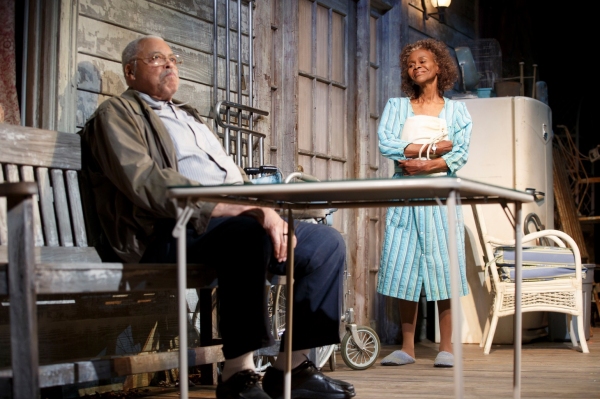
James Earl Jones and Cicely Tyson reunite onstage in lovely Broadway revival of THE GIN GAME (photo by Joan Marcus)

Golden Theatre
252 West 45th St. between Broadway & Eighth Ave.
Tuesday – Sunday through January 10, $57 – $141
thegingamebroadway.com

Life is like a game of cards in D. L. Coburn’s Pulitzer Prize-winning The Gin Game, back at its original Broadway home, the Golden Theatre, in a lovely revival starring James Earl Jones and Cicely Tyson. But it’s also a whole lot more complicated than that. Weller Martin (Jones) and Fonsia Dorsey (Tyson) have both recently moved into a nursing home to live out their final years. “Is there something wrong with you — if you don’t mind my asking,” Fonsia says. “Oh my, I should say so,” Weller replies. “I have one of the most advanced cases of old age in the history of medical science. The mortality rate’s incredible.” Over numerous games of gin on the ramshackle back porch, Weller, who fancies himself a card sharp, and Fonsia, who claims to not have played in a long time, slowly and carefully reveal details about their lives and their families, none of whom come to visit them. They are two old, lonely people brought together by circumstance; as they play gin, the other residents are inside, taking advantage of more of what the nursing home has to offer. “I don’t understand all this ‘entertainment,’” Weller says. “I’m talking about this constant need to entertain us. Sometimes I get the idea that they feel like if they don’t have a choir up there, or if they don’t have a goddamn magician up there doing tricks or something, then we’re all going to drop dead right in front of their eyes. En masse.” Weller is a big, blustery man whose cynicism and deep-seated anger seep into his card playing, especially when he continues losing games to the God-fearing, slim, and demure Fonsia, who doesn’t take kindly to his language. “You know, I never heard my father say a curse word in his life,” she explains, to which Weller responds, “Obviously you never played gin with him.”
(photo by Joan Marcus)

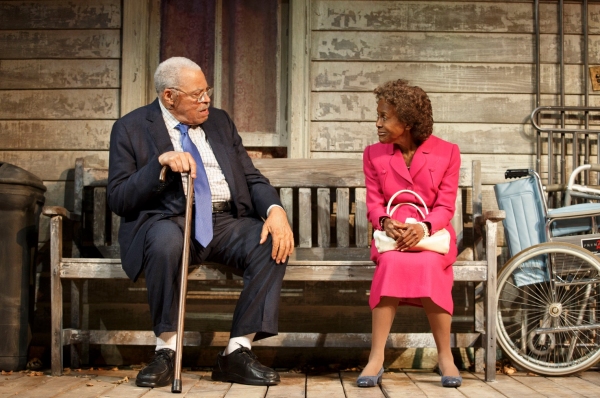
Weller Martin (James Earl Jones) and Fonsia Dorsey (Cicely Tyson) play cards as a metaphor for life in THE GIN GAME (photo by Joan Marcus)

Coburn’s first play, The Gin Game sums up the whole of two people’s lives in clever, if at times sentimental and overly metaphorical, ways, while avoiding any easy, pat answers. At one point, Weller is not willing to accept that Fonsia’s success is just beginner’s luck. “I didn’t realize there was that much strategy to it,” she says. “There most certainly is. Anyone who tells you that gin is nothing but luck doesn’t know what the game is all about,” he says, referring to life as well. Riccardo Hernandez’s set is littered with broken-down sinks and refrigerators, old walkers and wheelchairs, but Weller and Fonsia are not ready for the garbage heap quite yet. Director Leonard Foglia (On Golden Pond, Master Class) sure-handedly makes a play that is mostly made up of games of cards mesmerizing and exciting, letting his stars do their stuff. (To see the cheat sheet Coburn created so the performers can keep track of the games, go here.) The two actors, who first worked together on Broadway nearly fifty years ago, in Roscoe Lee Browne’s 1966 show A Hand Is on the Gate, are sensational. The eighty-four-year-old Jones (You Can’t Take It with You, Gore Vidal’s The Best Man), who has won two Tonys, three Emmys, a Grammy, and a lifetime achievement Oscar, adds a complex sadness to Weller’s pomposity, his deep, mellifluous voice raising and lowering like a choreographed dance, while the ninety-year-old Tyson (The Trip to Bountiful, Sounder), who has won a Tony and three Emmys along with an Oscar nomination, is utterly charming and delightful as Fonsia, who turns out to be much stronger than she first appears. Both characters, despite their age, do some growing up during the course of the two-hour play, which has been previously performed by such pairs as Hume Cronyn and Jessica Tandy, E. G. Marshall and Maureen Stapleton, and Charles Durning and Julie Harris and won Tonys in 1977 for Best Play and in 1997 for Best Revival. (There is also a 2003 television adaptation starring Dick Van Dyke and Mary Tyler Moore.) The night I saw the show, both Jones and Tyson each had a moment when they accidentally dropped something. As they bent down to pick the items up, you could feel a tension build in the audience, wondering whether the actors would be able to do so without a problem. We should have had no such fears; it appears that there’s almost nothing this dynamic duo can’t accomplish.
SPRING AWAKENING

(photo © 2015 Joan Marcus)

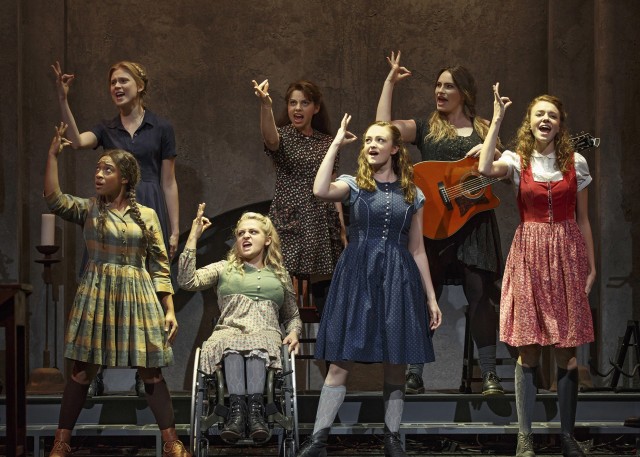
Revival of SPRING AWAKENING combines deaf and hearing actors in ingenious ways (photo © 2015 Joan Marcus)

Brooks Atkinson Theatre
256 West 47th St. between Broadway & Eighth Ave.
Tuesday – Sunday through January 24, $49-$149
877-250-2929
www.springawakeningthemusical.com
www.deafwest.org

America would be in much better shape if every member of Congress went to see Deaf West Theatre’s thrilling revival of Duncan Sheik and Steven Sater’s Spring Awakening. The musical, which won eight Tony Awards in its initial 2006 Broadway run, deals with homosexuality, guns, teen pregnancy, child abuse, suicide, premarital sex, disabilities, masturbation, education, religion, the arts, and more. At its heart, it’s a story about the eternal generation gap, focusing on the miscommunication between adults and children, which is as critical today as it was in 1891, when German author Frank Wedekind wrote the original play on which it’s based. But this time around, director Michael Arden and choreographer Spencer Liff have made the mediocre songs and Shakespeare-does-YA story secondary to a spectacular staging that will take your breath away over and over again. Arden has paired each deaf member of the cast with a hearing actor to speak or sing their lines; both performers use sign language as well, their bodies moving in a very different, very beautiful kind of dance. Sometimes the dual performers are on opposite sides of the stage, and sometimes they follow each other around, as if linked together by an invisible chain. Lines that are not vocalized or signed are projected onto a blackboard or the back wall; cues for the deaf actors consist of physical touches from their hearing doppelganger, musical vibrations, multicolored lighting, offstage closed-captioned monitors, and the use of props, such as the opening of a letter. It all works as seamlessly as in the most heavily choreographed musical, so much so you’re likely to not even realize there’s not much actual dancing in the show, which is somewhat different from Deaf West’s previous Broadway production, 2003’s Big River.

(photo © 2015 Joan Marcus)

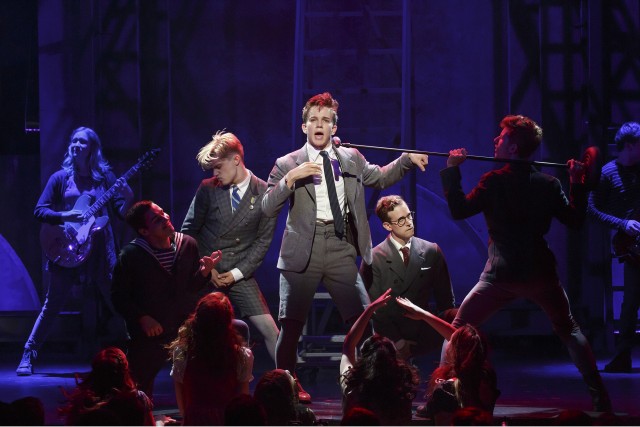
Melchior Gabor (Austin P. McKenzie) finds himself in the midst of big trouble in SPRING AWAKENING revival (photo © 2015 Joan Marcus)

The show takes place in 1891 Germany, a time when deaf people were discriminated against and sign language was banned in classrooms. Sandra Mae Frank stars as Wendla Bergmann, an adolescent girl who asks her mother, Frau Bergmann (Camryn Manheim), how babies are made. Frau Bergmann’s fear of telling her daughter the truth sets everything in motion, as parents and teachers battle their children and students, the lack of communication between the young and old serving as the major theme of the play. The bright and charming Melchior Gabor (Austin P. McKenzie) challenges his teacher, Herr Sonnenstich (Patrick Page), over the concept of “critical commentary on textual conjecture,” Moritz Stiefel (Daniel D. Durant) has sexual dreams he doesn’t understand, the geeky Georg (Alex Wyse) has the hots for his piano teacher, and the girls don’t want what happened to the bruised and battered Ilse (Krysta Rodriguez) to happen to Martha (Treshelle Edmond) and cause her to run away too. “When I have children, I’ll let them be free. And they’ll grow strong and tall,” Anna — portrayed by Ali Stroker, the first wheelchair-bound actor to ever play a part on Broadway, even more impressive because it’s a role that doesn’t call for it — says, to which Thea (Amelia Hensley) responds, “Free? But how will we know what to do if our parents don’t tell us?” Only Frau Gabor (Marlee Matlin), Melchior’s mother, is willing to give the kids the freedom to grow. “Surely, you boys are now of an age to decide for yourselves what is good for you and what is not,” she tells her son and Moritz. But Melchior makes their dire situation clear when leading everyone in the showstopper, “Totally Fucked,” declaring, “There’s a moment you know you’re fucked / Not an inch more room to self-destruct.”

The set is like an industrial warehouse, with several metal staircases leading to a second level where the adults often look down on the children, watching them in shame and embarrassment. The impeccable casting features Emmy winner Manheim, who studied sign language in college and used the skill on The Practice; Oscar winner Matlin (Children of a Lesser God), the grand dame of deaf actors, in her Broadway debut; and Page (Casa Valentina, Cyrano de Bergerac), whose deep, booming voice echoes throughout the Brooks Atkinson Theatre, reminding everyone of the power, and bombastic nature, of vocalized speech. As the show opens, Frank, a short brunette, looks into a glassless mirror; on the other side is Katie Boeck, a tall blonde with a guitar, who will follow Frank around for the rest of the show as they portray Wendla as a team, Boeck supplying the voice of the character while also playing music. Their relationship is a beauty to behold, as if every one of us, whether we’re deaf or hearing, has two parts that form our own whole. In a later scene, a deaf actor’s voice partner becomes more than just a talking, singing shadow, making for an unforgettable, magical moment that is what live theater is all about. Wedekind’s stories work amazingly well with music; in addition to Spring Awakening, German composer Alban Berg turned his Lulu plays, Earth Spirit and Pandora’s Box, into the opera Lulu, which is being performed at the Met in November and December in a new production directed by South African multimedia artist William Kentridge. So now, how do we get Congress to see Spring Awakening?

OLD TIMES

(photo by Joan Marcus)

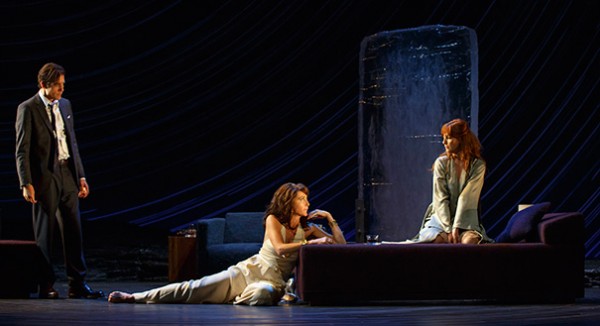
Clive Own, Eve Best, and Kelly Reilly delve into the mysterious past in Roundabout revival of Harold Pinter’s OLD TIMES (photo by Joan Marcus)

American Airlines Theatre
227 West 42nd St. between Broadway & Eighth Ave.
Tuesday – Sunday through November 29, $67-$137
212-719-1300
www.roundabouttheatre.org

As the Roundabout’s Broadway revival of Harold Pinter’s Old Times opens, Deeley (Clive Owen) is man-spread on a fashionably modern chair, Kate (Kelly Reilly) lies on a matching couch, and Anna (Eve Best) stands between them, facing a large, rectangular block of ice, her back to the audience at the American Airlines Theatre. It looks as if something happened the night before, something no one wants to remember. “Dark,” Kate says to Deeley. Indeed, Old Times is dark. And this being Pinter, don’t expect there to be much light shed on exactly what might have happened the night before, or at all, during this seventy-minute journey into a never-defined past or present. Early on, Kate confesses to Deeley, her husband, that Anna was her best and only friend, that they once lived together, but she also admits, “I hardly remember her. I’ve almost forgotten her.” Meanwhile, Anna raves about the two women’s relationship in great detail, with verve and excitement, but she adds, “There are some things one remembers even though they may never have happened. There are things I remember which may never have happened but as I recall them so they take place.” They all discuss having seen Carol Reed’s IRA noir masterpiece, Odd Man Out, and at one time or another in the play, each of the characters becomes the “odd man out” as the other two bond by telling old stories, singing American classics, or debating a possible previous meeting. “Some people throw a stone into a river to see if the water’s too cold for jumping,” Anna says, continuing, “others, a few others, will always wait for the ripples before they will jump.” There are plenty of ripples in Old Times, which has a backdrop of ever-widening concentric circles that evoke the ripples in a lake, or the rays of a pitiless sun. Christine Jones’s (American Idiot, The Green Bird) set also features black clumps of dried lava (“I live on a volcanic island,” Anna says), a sharp counterpoint to the huge block of ice and the mural of rippling water or blazing sun, echoing the characters’ ability to go from hot to cold and back again in an instant.

(photo by Joan Marcus)

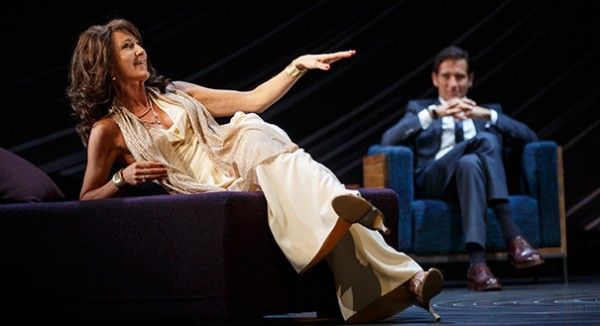
The sexy Anna (Eve Best) shares her memories in OLD TIMES (photo by Joan Marcus)

It’s been forty-four years since Old Times was last seen on Broadway, in its Great White Way debut with Robert Shaw, Rosemary Harris, and Mary Ure, and the Roundabout previously revived it in 1984 with Anthony Hopkins, Jane Alexander, and Marsha Mason. It is considered one of Pinter’s middle-period memory plays, which also include 1974’s No Man’s Land and 1978’s Betrayal, each of which has been revived on Broadway the last two years, the former a huge hit, the latter a major disappointment. Douglas Hodge, who has appeared in and directed many of Pinter’s works over the past two decades, makes his Broadway directorial debut here with a sure hand, keeping things appropriately mystifying, obscure, and utterly compelling, although the strobe lights and the onetime rotation of the stage seem unnecessary. Owen (A Day in the Death of Joe Egg, Closer) and Reilly (After Miss Julie, Russian Dolls) make strong impressions in their Broadway bows, he giving Deeley more than a little smarm, she imbuing Kate with an uncomforting yet sublime mystery, but Best, who was nominated for a Tony in 2008 for her performance as Ruth in Pinter’s The Homecoming, is an absolute whirlwind, dominating the stage in her gorgeous, sexy white pantsuit, making confident declarations with a commanding physicality. She mesmerizes even with a casual swipe of the floor with her bare foot. There are various theories exploring what Old Times is really about; perhaps Kate and Anna are two parts of the same person, or maybe one of the women has killed the other, or maybe they’re all dead, lingering in a kind of way station. Pinter never said, so we’ll never be sure. But we do know that there may be no one better at evoking the prismatic nature of time and memory and the brilliant refractions of human relationships than the iconoclastic British playwright.

BROADWAY WEEK SUMMER 2015

(photo by Joan Marcus)

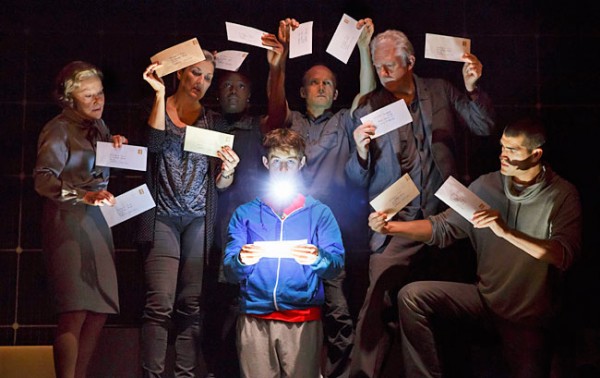
THE CURIOUS INCIDENT OF THE DOG IN THE NIGHT-TIME is among nearly two dozen Broadway shows offering half-price tickets September 7-20 (photo by Joan Marcus)

Multiple venues
September 7-20, buy one ticket, get one free
www.nycgo.com/broadwayweek

Tickets are now on sale for the summer edition of Broadway Week, which runs September 7-20 and offers theater lovers a chance to see new and long-running shows for half-price as well as have an opportunity to pay a $20 fee to upgrade to better seats. Twenty-two shows are participating, but they’re already starting to sell out, with the most popular selections being Aladdin, Fun Home, and The Lion King. Among the other choices are The Curious Incident of the Dog in the Night-Time, An American in Paris, Hand to God, Hedwig and the Angry Inch, The King and I, A Gentleman’s Guide to Love and Murder, Kinky Boots, Something Rotten!, the rebooted Les Misérables, Matilda the Musical, Spring Awakening, and such longtime mainstays as Wicked, Jersey Boys, Chicago, and The Phantom of the Opera. You can look all you want, but the two-for-one list still does not include The Book of Mormon, unfortunately.

BROADWAY IN BRYANT PARK

Broadway in Bryant Park features a sneak peek at George Takei musical on August 6

Broadway in Bryant Park features a sneak peek at George Takei musical on August 6

Bryant Park
40th to 42nd Sts. between Fifth & Sixth Aves.
Thursday, August 6, free, 12:30
Series continues Thursdays through August 13
www.bryantpark.org

The annual summer Broadway in Bryant Park series features performances Thursday afternoons at 12:30 from several current and upcoming Broadway musicals, and August 6 has a real treat in store, a sneak peek at Allegiance, which tells the story of George Takei’s childhood, spent in part in a Japanese internment camp in California; the show begins previews on October 6 and stars Lea Salonga, Telly Leung, and social media sensation Takei. Also on the August 6 bill is the Tony-winning hit A Gentleman’s Guide to Love and Murder, the new Amazing Grace, the Shakespeare spoof Something Rotten!, and the off-Broadway revival of Ruthless! The series concludes August 13 with selections from Once Upon a Mattress, The King and I, Dames at Sea, Spring Awakening, and Mrs. Smith’s Broadway Cat-Tacular!

AMAZING GRACE

(photo by Joan Marcus)

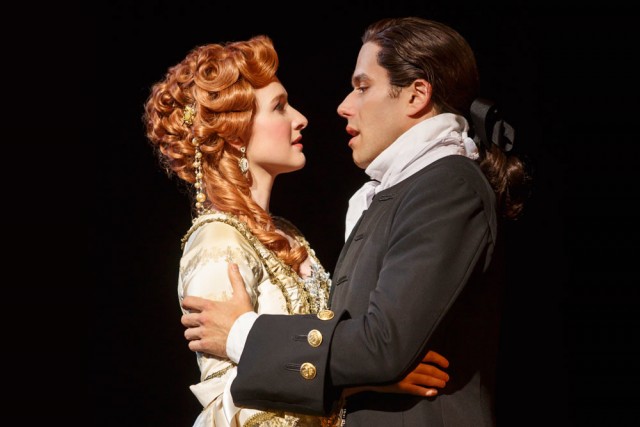
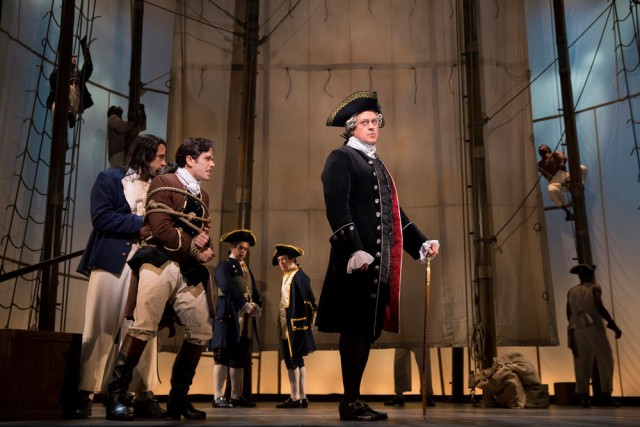
Mary (Erin Mackey) and John (Josh Young) try to find love in turbulent times in new Broadway musical (photo by Joan Marcus)

Nederlander Theatre
208 West 41st St. between Seventh & Eighth Aves.
Tuesday – Sunday through December 20, $65-$139
877-250-2929
amazinggracemusical.com

As the new Broadway musical Amazing Grace opens, a man (Tony winner Chuck Cooper) stands at the side of the stage and announces, “There are moments when the waves of history converge. When the transformation of one man can change the world,” declaring, “It is a story that must be told.” There may indeed be a fascinating tale behind John Newton, the writer of the title song, a beloved Protestant hymn, but this is not necessarily it. Tony nominee Josh Young (Jesus Christ Superstar, Evita) stars as Newton, the ne’er-do-well son of the regal Captain Newton (Tony nominee Tom Hewitt), an important businessman and slave trader in the port town of Chatham, England. John has just returned from a stint on the high seas, where he meets up on the docks with Mary Catlett (Erin Mackey), his “dearest friend in the world,” and is chastised by his father, who takes away his son’s mariner’s license and demands he return to England, the family business of slaving, and his studies. Against his father’s orders, John runs a slave auction that turns disastrous when abolitionists intercede, leading to bloodshed and an escape. It doesn’t take long for John to find himself at odds with everyone else as Mary starts meeting secretly with the abolitionists, the dandy Major Gray (Chris Hoch) begins wooing Mary, and his father demands that he find the missing slave. John then sets off on a dangerous journey that only gets worse because of his haughty attitude and love of the drink, heading toward rock bottom at full speed.

(photo by Joan Marcus)

John Newton (Josh Young) battles with his father (Tom Hewitt) in AMAZING GRACE (photo by Joan Marcus)

The Playbill points out that Amazing Grace is Christopher Smith’s “first work of professional writing,” and it shows as the musical continues, bogged down by clichés and obvious plot twists. Smith, who wrote the music and lyrics and cowrote the book with Arthur Giron (Moving Bodies, A Dream of Wealth), strives to take us deep into the heart and soul of John Newton, exploring the travails that resulted in his composing one of the most famous songs ever written, but it turns out that Newton’s story is not nearly as compelling as the song itself. The cast is terrific — Hewitt (The Rocky Horror Show, Another Medea) and Cooper (The Life, Memphis), as the Newtons’ slave and John’s closest friend, are particularly impressive, and Mackey (Chaplin, Wicked) is in fine voice. But director Gabriel Barre (Summer of ’42, The Wild Party) never finds a consistent rhythm as the production attempts to navigate racism and white privilege but cannot escape mundane sentimentality and political correctness, especially in a banal finale. Part of the problem is that slavery is a one-sided conflict, and it is difficult to have sympathy for Newton even as he is being redeemed. The producers tried hard to avoid major religious overtones, given the title song’s association with the concept of redemption, and they achieve that in the first act, but the second act turns out to be far more preachy, complete with religious implications. Still, Amazing Grace, which has been in the works for eighteen years, has its moments, concluding with a sing-along of the complete eighteenth-century hymn that continues to have such an emotional impact, sung recently by President Obama at the funeral for shooting victim Rev. Clementa Pinckney in Charleston, South Carolina.

THE 2015 TONY AWARDS

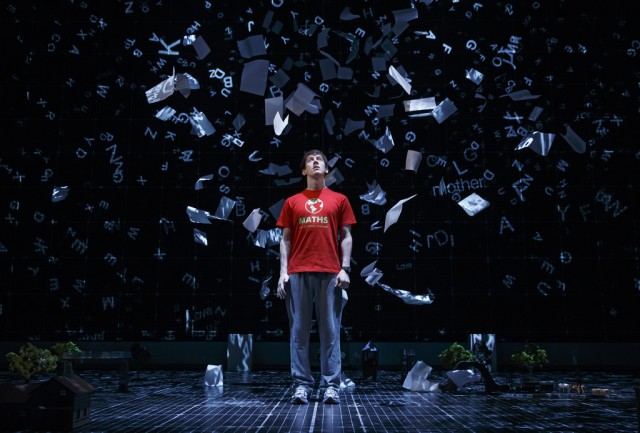
CURIOUS INCIDENT is nominated for six Tony Awards (photo by Joan Marcus)

CURIOUS INCIDENT is nominated for six Tony Awards (photo by Joan Marcus)

Radio City Music Hall
1260 Sixth Ave. at 50th St.
Sunday, June 7, red carpet 5:30, show 8:00
www.tonyawards.com
www.radiocity.com

The 2014-15 Broadway season was a strong one, breaking records for both gross and attendance. Quality was up as well as quantity, with a bevy of musicals and plays worthy of high praise indeed. The Tonys will be handed out on Sunday night at Radio City, and below are my predictions for who will take home the prize, named after actress, director, and producer Antoinette Perry, the cofounder of the American Theatre Wing. In addition, you can read my review of every nominated show (save for one) here.

BEST PLAY
The Curious Incident of the Dog in the Night-Time
Disgraced
Hand to God
Wolf Hall Parts One & Two
What Should Win: The Curious Incident of the Dog in the Night-Time, an utterly dazzling theatrical experience (by the way, was there really no room for Airline Highway in this category?)
What Will Win: The Curious Incident of the Dog in the Night-Time, a treat for the eyes, ears, and brain

BEST MUSICAL
An American in Paris
Fun Home
Something Rotten!
The Visit
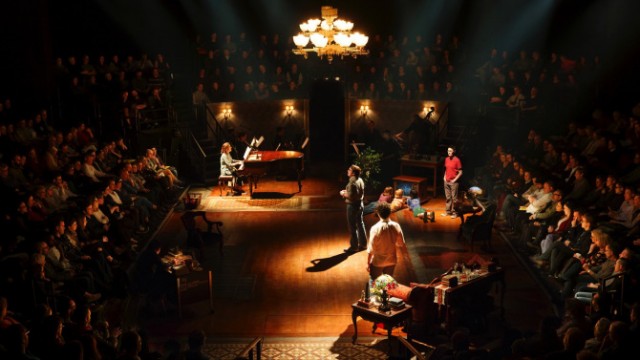
What Should Win: Fun Home, because there’s nothing else quite like it
What Will Win: Something Rotten!, because it’s a clever Shakespearean musical that rewards the audience’s love of theater

BEST REVIVAL OF A PLAY
The Elephant Man
Skylight
This Is Our Youth
You Can’t Take It with You
What Should Win: This Is Our Youth, a powerful drama that not enough voters will remember (and hey, what about It’s Only a Play?)
What Will Win: You Can’t Take It with You, because it has aged so surprisingly well

BEST REVIVAL OF A MUSICAL
The King and I
On the Town
On the Twentieth Century
What Should Win: On the Twentieth Century, for its sheer glee and love of life
What Will Win: The King and I, because it’s The King and I

FUN HOME made a wildly successful move from the Public to Circle in the Square (photo by Joan Marcus)

FUN HOME made a wildly successful move from the Public to Circle in the Square (photo by Joan Marcus)

BEST ORIGINAL SCORE (MUSIC AND/OR LYRICS) WRITTEN FOR THE THEATRE
Fun Home, music by Jeanine Tesori, lyrics by Lisa Kron
The Last Ship, music and lyrics by Sting
Something Rotten!, music and lyrics by Wayne Kirkpatrick and Karey Kirkpatrick
The Visit, music by John Kander, lyrics by Fred Ebb
What Should Win: Fun Home, because of its originality and daring
What Will Win: Something Rotten!, because it’s a celebration of all things Broadway

BEST PERFORMANCE BY AN ACTOR IN A LEADING ROLE IN A PLAY
Steven Boyer, Hand to God
Bradley Cooper, The Elephant Man
Ben Miles, Wolf Hall Parts One & Two
Bill Nighy, Skylight
Alex Sharp, The Curious Incident of the Dog in the Night-Time
Who Should Win: Sharp, who boggles the mind as a boy on the autism spectrum, although Boyer is outrageous as a puppet-obsessed boy on the edge
Who Will Win: Sharp, in a very strong category where all are deserving

BEST PERFORMANCE BY AN ACTRESS IN A LEADING ROLE IN A PLAY
Geneva Carr, Hand to God
Helen Mirren, The Audience
Elisabeth Moss, The Heidi Chronicles
Carey Mulligan, Skylight
Ruth Wilson, Constellations
Who Should Win: Mulligan, who is sensational as a single woman coming to terms with her life
Who Will Win: Mirren, because she’s royalty on both sides of the pond

BEST PERFORMANCE BY AN ACTOR IN A LEADING ROLE IN A MUSICAL
Michael Cerveris, Fun Home
Robert Fairchild, An American in Paris
Brian d’Arcy James, Something Rotten!
Ken Watanabe, The King and I
Tony Yazbeck, On the Town
Who Should Win: Cerveris, who gives a complex, nuanced performance as a closeted husband and father
Who Will Win: Fairchild, who brings balletic elegance to Broadway while paying homage to Gene Kelly

BEST PERFORMANCE BY AN ACTRESS IN A LEADING ROLE IN A MUSICAL
Kristin Chenoweth, On the Twentieth Century
Leanne Cope, An American in Paris
Beth Malone, Fun Home
Kelli O’Hara, The King and I
Chita Rivera, The Visit
Who Should Win: Chenoweth, who is an unstoppable force of nature
Who Will Win: Chenoweth, because there’s just no stopping her

BEST PERFORMANCE BY AN ACTOR IN A FEATURED ROLE IN A PLAY
Matthew Beard, Skylight
K. Todd Freeman, Airline Highway
Richard McCabe, The Audience
Alessandro Nivola, The Elephant Man
Nathaniel Parker, Wolf Hall Parts One & Two
Micah Stock, It’s Only a Play
Who Should Win: Parker, for his novel, downright friendly interpretation of King Henry VIII, although Freeman and McCabe are exceptional as well
Who Will Win: Freeman, who is beguiling as transgender Sissy Na Na

BEST PERFORMANCE BY AN ACTRESS IN A FEATURED ROLE IN A PLAY
Annaleigh Ashford, You Can’t Take It with You
Patricia Clarkson, The Elephant Man
Lydia Leonard, Wolf Hall Parts One & Two
Sarah Stiles, Hand to God
Julie White, Airline Highway
Who Should Win: White, for her poignant portrayal of a brave woman struggling to get by day by day
Who Will Win: Clarkson, for her poignant portrayal of the brave woman who looks into John Merrick’s soul

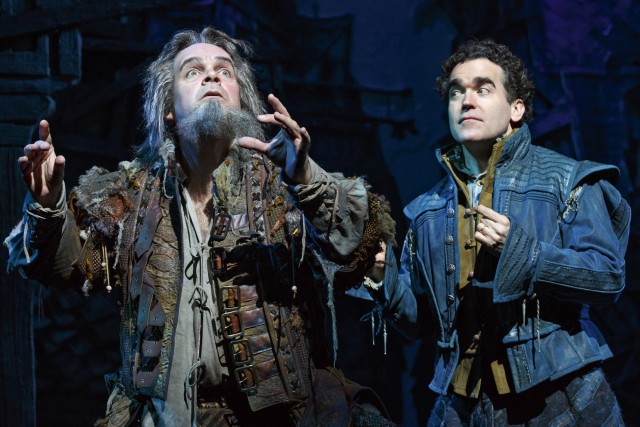
Brad Oscar tries to predict the Tony future for him and Brian d’Arcy James in SOMETHING ROTTEN! (photo by Joan Marcus)

Brad Oscar tries to predict the Tony future for him and Brian d’Arcy James in SOMETHING ROTTEN! (photo by Joan Marcus)

BEST PERFORMANCE BY AN ACTOR IN A FEATURED ROLE IN A MUSICAL
Christian Borle, Something Rotten!
Andy Karl, On the Twentieth Century
Brad Oscar, Something Rotten!
Brandon Uranowitz, An American in Paris
Max von Essen, An American in Paris
Who Should Win: Oscar, for joyfully going way over the top as the other Nostradamus
Who Will Win: Karl, who has quickly become a Broadway favorite

BEST PERFORMANCE BY AN ACTRESS IN A FEATURED ROLE IN A MUSICAL
Victoria Clark, Gigi
Judy Kuhn, Fun Home
Sydney Lucas, Fun Home
Ruthie Ann Miles, The King and I
Emily Skeggs, Fun Home
Who Should Win: Lucas, for her marvelous turn as the youngest Alison Bechdel
Who Will Win: Lucas, who has a charming presence beyond her years

BEST DIRECTION OF A PLAY
Stephen Daldry, Skylight
Marianne Elliott, The Curious Incident of the Dog in the Night-Time
Scott Ellis, You Can’t Take It with You
Jeremy Herrin, Wolf Hall Parts One & Two
Moritz von Stuelpnagel, Hand to God
Who Should Win: Elliott, for the wildly inventive and constantly awe-inspiring Curious Incident
Who Will Win: Elliott, the mastermind behind an unforgettable production

BEST DIRECTION OF A MUSICAL
Sam Gold, Fun Home
Casey Nicholaw, Something Rotten!
John Rando, On the Town
Bartlett Sher, The King and I
Christopher Wheeldon, An American in Paris
Who Should Win: Gold, for reinventing Fun Home on its move from the Public to Broadway
Who Will Win: Sher, for his third straight beloved Rodgers & Hammerstein revival at Lincoln Center

BEST CHOREOGRAPHY
Joshua Bergasse, On the Town
Christopher Gattelli, The King and I
Scott Graham and Steven Hoggett, The Curious Incident of the Dog in the Night-Time
Casey Nicholaw, Something Rotten!
Christopher Wheeldon, An American in Paris
Who Should Win: Wheeldon, who has brought ballet back to Broadway
Who Will Win: Wheeldon, for his ingenuity and craftsmanship