this week in broadway

OH, HELLO

(photo by Joan Marcus)

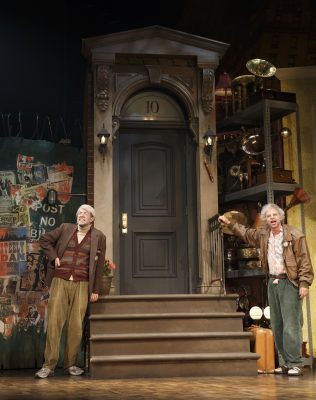
George St. Geegland (John Mulaney) and Gil Faizon (Nick Kroll) make their Broadway debut in OH, HELLO (photo by Joan Marcus)

Lyceum Theatre
149 West 45th St. between Sixth & Seventh Aves.
Tuesday – Sunday through January 22, $59- $159
ohhellobroadway.com

It’s no mean feat to turn brief comedy sketches into feature-length productions; just ask Saturday Night Live, which has produced such critical flops as It’s Pat, A Night at the Roxbury, Superstar, The Ladies Man, and MacGruber. Yet somehow, Upright Citizens Brigade regular Nick Kroll and former SNL writer John Mulaney, who started performing as opinionated aging showbiz hangers-on Gil Faizon and George St. Geegland, respectively, in the East Village club Rififi in 2005 and later at the Cherry Lane Theatre and on the Comedy Central series Kroll Show from January 2013 to March 2015, have transformed their absurdist two-minute bits into the Broadway smash Oh, Hello, an uproarious send-up of celebrity culture and the Great White Way itself. The goofy, sloppy Faizon and the eccentric, possible serial killer St. Geegland, the hosts of the cable access show Too Much Tuna, have finally reached the big time, making it to Broadway with a play about themselves, a pair of old Upper West Side vaudeville types whose rent is suddenly going up from $75 to thousands a month. Desperate to keep their longtime abode, Faizon, who still hurts from losing a CBS announcing gig decades before, and St. Geegland, the author of the seminal works Next Stop, Ronkonkoma and Rifkin’s Dilemma, try to score a gig on NY1, as if that will make everything right. Amid self-deprecating riffs and a deep, abiding love for the music of Steely Dan, the two old guys manage to put on quite a show.

(photo by Joan Marcus)

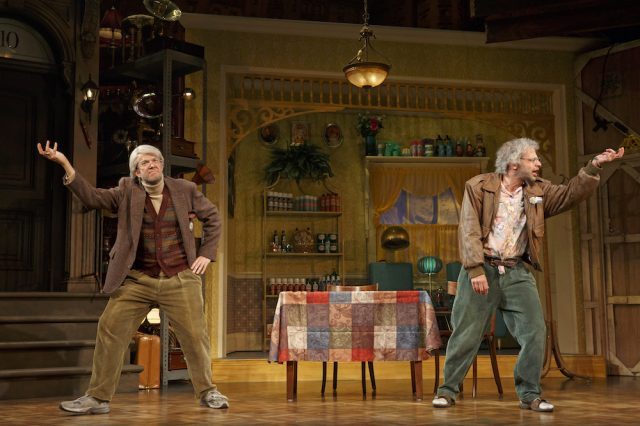
Septuagenarian Upper West Side pranksters prepare for entrance of F. Murray Abraham in OH, HELLO (photo by Joan Marcus)

Oh, Hello, named after the two men’s trademark greeting, is a clever and inventive one hundred nonstop minutes of hilarity, as fellow Georgetown grads Mulaney and Kroll — who were inspired to create the characters after seeing a pair of elderly men, attached at the hip, both purchasing a copy of Alan Alda’s autobiography Never Have Your Dog Stuffed, at the Strand — try to crack each other up as much as the audience, particularly in their offbeat, offhanded pronunciations of various words and phrases that just make no sense. Scott Pask’s ramshackle set matches Faizon and St. Geegland’s dishevelment to a T, made up of leftover detritus from other shows, including family photos from an August Wilson play. Inside references abound, some that you will get, and some that you won’t, but little does that matter. There are even jokes about Alda, Bobby Cannavale, Aziz Ansari, and Griffin Dunne — Griffin Dunne? — but it turns out that each of those actors have made surprise guest appearances on the prank show Too Much Tuna. (We got John Oliver the night we went, and the Last Week Tonight host couldn’t stop laughing, which was infectious.) Kroll and Mulaney never miss a chance at a visual gag or a ridiculous pun, from the bit of shirt peeking through Faizon’s zipper, to both of them ripping unseen tech intern Ruvi Nandan, to John Slattery and Jon Hamm supposedly serving as their understudies. Two-time Tony nominee Alex Timbers, who has directed such elaborate productions as Here Lies Love, Rocky, and Peter and the Starcatcher in addition to Bloody Bloody Andrew Jackson, goes with the flow, relishing all of the shabby DIY madness. And yes, there is definitely too much tuna. It genuinely doesn’t matter whether you like Mulaney or Kroll individually or whether you were a fan of Kroll Show; everyone is welcome to say Oh, Hello.

HEISENBERG

(photo © Joan Marcus 2016)

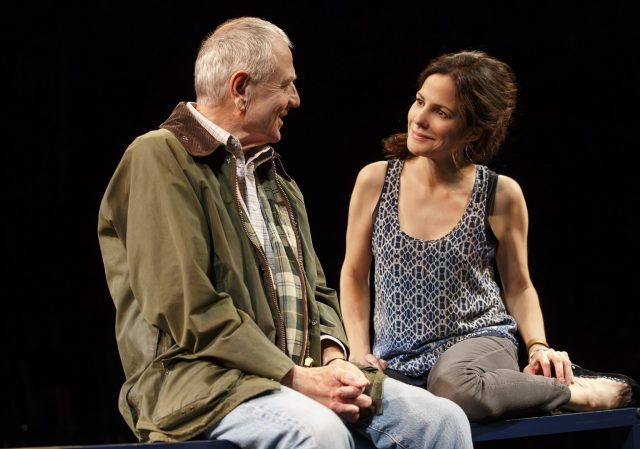
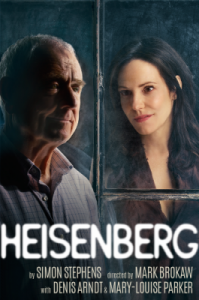
Butcher Alex Priest (Denis Arndt) and quirky Georgie Burns (Mary-Louise Parker) meet in a London tube station in HEISENBERG (photo © Joan Marcus 2016)

Manhattan Theatre Club at the Samuel J. Friedman Theatre
261 West 47th St. between Broadway & Eighth Aves.
Tuesday – Sunday through December 11, $70-$150
heisenbergbroadway.com
www.manhattantheatreclub.com

Simon Stephens’s Heisenberg, which transferred to Broadway last month shortly after his extraordinary The Curious Incident of the Dog in the Night-Time ended a two-year run at the Ethel Barrymore, might reference the quantum theory uncertainty principle that proves the impossibility of precisely measuring position and momentum at the same time, but there’s no uncertainty that the British playwright is an exceptional storyteller bursting with both position and momentum. Stephens’s Tony-winning adaptation of Mark Haddon’s children’s book was turned into a multimedia marvel by Marianne Elliott. Heisenberg explores some of the same territory, the nature of establishing connections and communication between people, but could not otherwise be more different; it’s a spare, minimal tale directed with a graceful simplicity by Mark Brokaw (The Lyons, After Miss Julie). Mary-Louise Parker and Denis Arndt are magnetic as Georgie Burns and Alex Priest, respectively, two loners who meet one afternoon in a London tube station. Georgie is a forty-two-year-old fast-talking American with a tenuous grasp on the truth, while Alex is a seventy-five-year-old Irish butcher who just wants to be left alone. As the play opens, she kisses the back of his neck, mistaking him for someone else, then starts babbling to him. “Why are you talking to me?” he asks sternly. “I’m sorry. I’m really weird. I know. You don’t need to tell me. I’ll go,” she replies. But she can’t leave; she is drawn to him, sharing intimate details of her life that might or might not be true. When she shows up at his shop five days later, tracking him down through Google, he coldly declares, “My privacy has been violated.” She responds, “‘Violated’ is a bit strong. ‘Violated’ is a bit hyperbolic.” “Nice word,” he says. “Thank you. Ha. ‘Nice word.’ Patronizing fucker,” she answers. As these two extremely particular and rather odd strangers get to know each other, they attempt to fill in the missing parts of their lives.

heisenberg-2

The awe-inspiring technology behind Curious Incident is completely absent in Heisenberg, a streamlined production that relies on basic, almost workshoplike elements. Mark Wendland’s (Next to Normal, The Merchant of Venice) sparse stage features two chairs and two tables that the actors occasionally move around as the scenes change; there is a riser of seats behind the stage, placing the characters in the middle of the audience. Despite the show’s title, Stephens’s script does not delve deeply into physics, although at one point Georgie explains, “If you watch something closely enough you realize you have no possible way of telling where it’s going or how fast it’s getting there. Did you know that? That’s actually the truth. That’s actually scientifically been proven as the truth. By scientists. They all got together and they completely agreed on that. If you pay attention to where it’s going or how fast it’s moving, you stop watching it properly.” Those words also apply to how one can experience theater, including this Manhattan Theatre Club production. There’s no need to pay special attention to where this charming two-actor character sketch is going, or how fast it will get there; just watch it properly, immersed in the moment and the flow, in the lightning-quick pace and dizzying spectacle of Parker’s (Proof, Weeds) splendidly quirky performance or the subtle, sly, sublimely powerful work of Oregon Shakespeare Festival veteran Arndt (The Ballad of Soapy Smith, Basic Instinct) as he almost imperceptibly builds the quietly heartbreaking figure of Alex. “You need to follow it. The melody,” Alex tells Georgie when teaching her how to listen to a Bach sonata. “Try to predict what will happen to it next. It will completely take you by surprise.” The same can be said for this beautifully constructed show.

HOLIDAY INN: THE NEW IRVING BERLIN MUSICAL

HOLIDAY INN (photo by Joan Marcus, 2016)

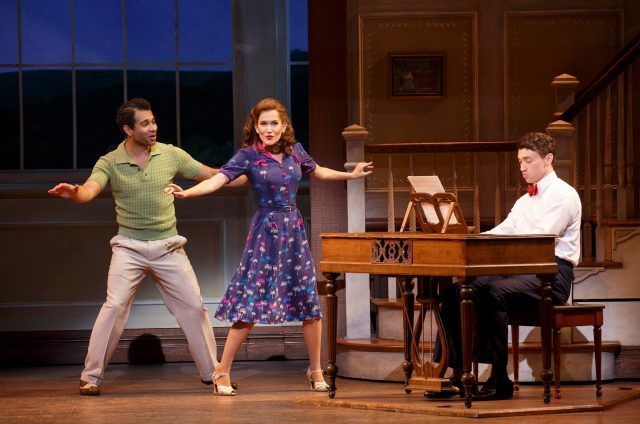
Corbin Bleu, Lora Lee Gayer, and Bryce Pinkham star in Broadway debut of HOLIDAY INN (photo by Joan Marcus, 2016)

Studio 54
254 West 54th St. between Seventh & Eighth Aves.
Tuesday – Sunday through January 15, $47-$167
212-719-1300
www.roundabouttheatre.org

Sitting in the lobby in any of several theater district Holiday Inn hotels, watching people come and go, is likely to be more pleasurable than sitting in Studio 54, watching the Roundabout production of the Goodspeed musical Holiday Inn. Mark Sandrich’s 1942 movie was nominated for Best Original Score and Best Original Story, but music director-conductor Andy Einhorn and orchestrator Larry Blank sap all of the charm and rhythm from Irving Berlin’s songs, while director Gordon Greenberg and Chad Hodge’s book makes all the wrong changes to the plot, aside from wisely dropping the infamous “Abraham” minstrel scene. Singer-composer Jim Hardy (Bryce Pinkham), dancer Ted Hanover (Corbin Bleu), and chanteuse Lila Dixon (Megan Sikora) are a moderately successful song-and-dance team seeking their big break. Immediately after Jim proposes to Linda, he proposes that they give up show business and move to the farm he just bought in Midville, Connecticut; their manager, Danny (Lee Wilkof), then scores the trio a major gig in Chicago. Jim is heartbroken when Lila says she’d rather go out on the road with Ted. “But Lila, we promised each other that when the gigs dried up we’d get out of show business and live a normal life,” Jim implores. “I’ve always wanted to be normal. After I’m famous,” Lila replies. Jim sticks to his guns, deciding to go to the farm, where he will wait for Lila to join him after she and Ted finish their shows. Arriving at his new home, Jim meets the downtrodden Linda Mason (Lora Lee Gayer), the previous owner of her family’s farm who had defaulted on the mortgage, allowing Jim to buy it.

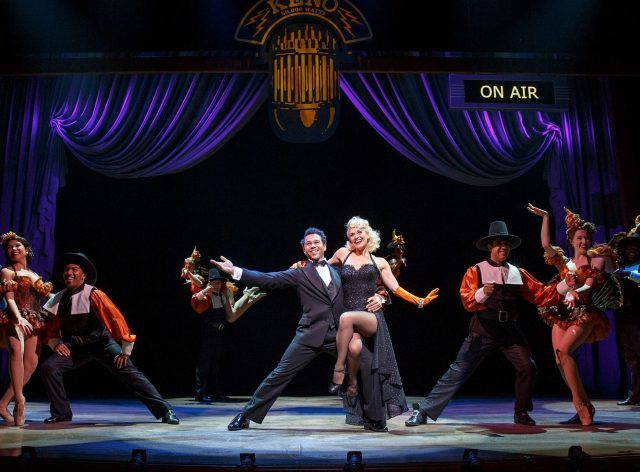
HOLIDAY INN gobble-gobbles its way to Studio 54 (photo by Joan Marcus, 2016)

HOLIDAY INN gobble-gobbles its way to Studio 54 (photo by Joan Marcus, 2016)

It takes about three seconds to figure exactly where the story is going, and lo and behold, that is precisely where it ends up. The songs, which were taken from the film as well as other sources, are staged by Greenberg (Guys and Dolls, Working) and choreographer Denis Jones (Honeymoon in Vegas, Pieces of My Heart: The Bert Berns Story) in either overly silly or melodramatic ways, zapping the spirit from “White Christmas,” “Blue Skies,” “Steppin’ Out with My Baby,” “Heat Wave,” “Cheek to Cheek,” and “Easter Parade,” while the costumes, by Alejo Vietti (Beautiful: The Carol King Musical, Allegiance), are either too mundane or too over-the-top. Pinkham (A Gentleman’s Guide to Love & Murder, The Heidi Chronicles) and Gayer (Doctor Zhivago, Follies) are pleasant enough in the roles performed in the film by Bing Crosby and Marjorie Reynolds, respectively, but Bleu (High School Musical, Godspell) doesn’t have enough vocal range or pizzazz as Ted, played in the film by Fred Astaire, and Sikora (Under My Skin, Curtains) is miscast in the Virginia Dale part; it’s as if she is in a different show. And Megan Lawrence (The Pajama Game, Urinetown) just plain tries too hard in the thankless role of Louise, who has been added for comic relief but quickly grows tedious, as does Morgan Gao as Charlie Winslow, a ten-year-old Midville banker. (Don’t ask.) Aside from a couple of funny Connecticut jokes, this Holiday Inn is not a place where anyone should stay.

TICKET ALERT: BROADWAY WEEK SUMMER 2016

(photo by Matthew Murphy, 2015)

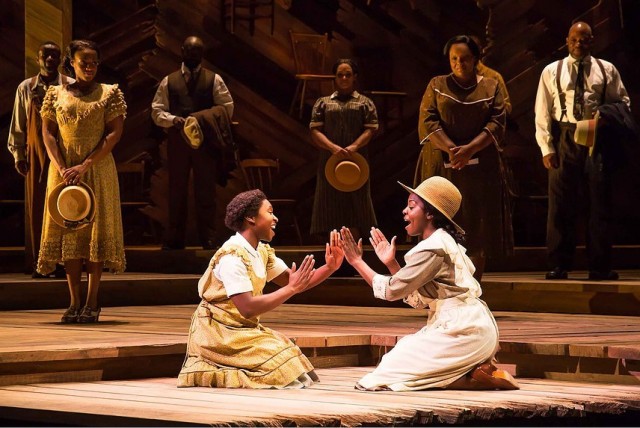
THE COLOR PURPLE is one of nineteen shows participating in this summer’s two-for one Broadway Week deal (photo by Matthew Murphy, 2015)

Multiple venues on Broadway
September 5-18, buy one ticket, get one free
Tickets on sale August 18 at 10:30 am
www.nycgo.com/broadwayweek

Tickets go on sale August 18 at 10:30 am for the summer edition of Broadway Week, which runs September 5-18 and offers theater lovers a chance to see new and long-running shows for half-price. Nineteen shows are participating, but tickets will go fast, so don’t hesitate or you’ll lose out on your chance to get two-for-one seats for such musicals as Aladdin, The Lion King, Beautiful, Cats, Chicago, Paramour, Jersey Boys, Kinky Boots, On Your Feet, The Phantom of the Opera, School of Rock, Wicked, and the new Holiday Inn. We highly recommend An American in Paris, The Color Purple, Fiddler on the Roof, Matilda, and Something Rotten! In addition, squeezing in among all those musicals is one play, the outstanding Tony-winning drama The Humans.

PARAMOUR

(photo by David Gordon)

Atherton brothers Andrew and Kevin perform spectacular aerial feats in PARAMOUR (photo by David Gordon)

Lyric Theatre
214 West 43rd St. between Broadway & Eighth Ave.
Thursday – Tuesday through February 19, $55-$139
www.cirquedusoleil.com
www.lyricbroadway.com

For more than thirty years, the Canada-based Cirque du Soleil has been wowing audiences with its unique reinvention of the circus, concentrating on stupendous feats of acrobatics with live music and an all-human cast. For its Broadway debut, however, it has bitten off more than it can chew with Paramour, running at the Lyric Theatre through February 19. Instead of concentrating on what the troupe does best, director and conceiver Philippe Decouflé and creative guide and creative director Jean-François Bouchard decided to frame the thrilling acrobatics within the confines of traditional musical theater, obscuring both in the process. Jeremy Kushner is the ersatz ringmaster as AJ Golden, a famous film director — don’t call them movies! — who thinks he has found his next superstar (and personal and professional muse) in local ingénue Indigo (Ruby Lewis) during the Golden Age of Hollywood. But standing in between them is Indigo’s partner, pianist and composer Joey (Ryan Vona), who is in love with her. As success comes to Indigo, she must make difficult decisions that will forever change her life and career.

Jeremy Kushner is film director and ersatz circus ringleader in PARAMOUR (photo by Richard Termine)

Jeremy Kushner is film director and ersatz circus ringleader AJ Golden in Cirque du Soleil’s PARAMOUR (photo by Richard Termine)

The book is as standard as they come, as are the music (by Guy Dubuc and Marc Lessard) and lyrics (by co-composer Andreas Carlsson). As expected, the show looks terrific, with ecstatic sets by Philippe Guillotel, glittering costumes by Daphné Mauger, and choreography by Raffaello D’Andrea, but what’s wrong with Paramour can be summarized by one set piece that focuses on the central love triangle. A trio of aerialists, dressed in the same colors as AJ, Indigo, and Joey, beautifully reenact their troublesome situation, avatars performing remarkable feats in the air, but then AJ, Indigo, and Joey start singing a song that essentially retells everything we have just seen, as if the audience can’t be trusted to understand what the flying dance was all about. Indeed, the acrobatics usually occur in the background, forming no bond with the main story, as if they are two separate entities. Even when they do come together, as in a Calamity Jane scene involving a teeterboard, we are left scratching our heads, wondering why. The performers, who include artistic gymnasts Tom Ammirati, Martin Charrat, and Amber Fulljames, aerial strap artists Andrew and Kevin Atherton, trampolinist Lee Brearley, dancer Yanelis Brooks, martial artist Sam Charlton, contortionist Myriam Deraiche, juggler Kyle Driggs, Chinese pole and Cyr wheel specialist Jeremias Faganel, and clown Nate Cooper (who wanders through the audience before the show starts), exhibit extraordinary talent, but director West Hyler (the Big Apple Circus, Jersey Boys) puts too little of it front and center. It all feels too gimmicky; in fact, in front of each theatergoer, Velcroed to a seat, is a menu of merchandise that you can order and have delivered right there as you sit. That might work in Vegas, but it’s far too cheesy for Broadway.

SHUFFLE ALONG

(photo © Julieta Cervantes)

Savion Glover’s choreography powers SHUFFLE ALONG (photo © Julieta Cervantes)

SHUFFLE ALONG, OR THE MAKING OF THE MUSICAL SENSATION OF 1921 AND ALL THAT FOLLOWED
Music Box Theatre
239 West 45th St. between Broadway & Eighth Aves.
Tuesday – Sunday through October 9, $69 – $169
shufflealongbroadway.com

Shuffle Along, or, the Making of the Musical Sensation of 1921 and All That Followed has some of the best music and dancing you’ll find on Broadway right now. Unfortunately, it doesn’t have the book to support it. The show tells the story of the historic 1921 production of Shuffle Along, a landmark musical featuring music by Eubie Blake, lyrics by Noble Sissle, and book by vaudevillians F. E. Miller and Aubrey Lyles; Blake played the piano onstage (there was no orchestra pit at the 63rd Street Music Hall), while Sissle starred as detective Jack Penrose, Miller was mayoral candidate Steve Jenkins, and Lyles was candidate Sam Peck. The 1921 cast also included Lottie Gee as Jessie Williams, Gertrude Saunders as Ruth Little (later replaced by Florence Mills), and Adelaide Hall as a Jazz Jasmine in the large ensemble. George C. Wolfe (Jelly’s Last Jam, Bring in ’da Noise, Bring in ’da Funk) wrote the book for and directs the new show, which went through significant revisions during previews — at one point it was clocking in at more than three hours (the final version is two hours and forty minutes), and six-time Tony winner Audra McDonald (The Gershwins’ Porgy and Bess, Lady Day at Emerson’s Bar & Grill), who plays Gee, had to take time off for illness. (It was later revealed that she is pregnant and will be going on maternity leave July 24, when Carolina Chocolate Drops singer Rhiannon Giddens will take over her role.)

(photo © Julieta Cervantes)

Eubie Blake (Brandon Victor Dixon) plays piano for Lottie Gee (Audra McDonald) in SHUFFLE ALONG (photo © Julieta Cervantes)

Savion Glover’s choreography is energetic and exhilarating while incorporating multiple genres, as are Ann Roth’s dazzling period costumes. But the relating of the behind-the-scenes efforts of a group of black men and women trying to storm Broadway is trite and clichéd, dragging down the rest of the show. Brandon Victor Dixon (The Color Purple, Motown: The Musical) and Joshua Henry (Violet, The Scottsboro Boys) are fine as Blake and Sissle, respectively, but Brian Stokes Mitchell (Man of La Mancha, Kiss Me, Kate) as Miller tries his best with dry lines, and Billy Porter (Kinky Boots, Miss Saigon is miscast as Lyles. Brooks Ashmanskas (Something Rotten, Fame Becomes Me) is fun as all the white men. It all makes for way too bumpy a ride, despite such songs as “Broadway Blues,” “Affectionate Dan,” “Honeysuckle Time,” “Love Will Find a Way,” “You Got to Git the Gittin’ While the Gittin’s Good,” and “(I’m Just) Wild About Harry,” with rousing orchestrations and arrangements by Daryl Waters (After Midnight, Memphis). The Playbill comes with a bonus re-creation of the original program (and some extra information) from when the show opened May 23, 1921, at the 63rd Street Music Hall. Shuffle Along wants to be both historic and historical, instead losing its focus as it gamely attempts to meld substance with style.

AMERICAN PSYCHO

(photo © Jeremy Daniel)

AMERICAN PSYCHO will close after only eighty-one Broadway performances (photo © Jeremy Daniel)

Gerald Schoenfeld Theatre
236 West 45th St. between Broadway & Eighth Aves.
Through June 5, $69-$148
americanpsychothemusical.com

The musical version of Bret Easton Ellis’s popular but controversial 1991 novel, American Psycho, which was also made into a popular but controversial 2000 film, has posted an early closing notice on Broadway, ending its short run at the Gerald Schoenfeld Theatre on June 5 after a mere eighty-one performances. So what went wrong with the show, a sold-out smash in London? The Broadway production looks great; the set, designed by the always innovative Es Devlin (Machinal, Chimerica), is often breathtaking and thrilling, with blinding whites everywhere, gorgeous minimalist furniture, and ultracool lighting by Justin Townsend (The Humans, The Other Place), pulsating with fast-moving projections by Finn Ross (The Curious Incident of the Dog in the Night). When a plexiglass front comes down, the stage turns into Dexter’s dream kill room, as New York City investment banker and ahead-of-his-time metrosexual Patrick Bateman (Benjamin Walker) uses a number of techniques to dispose of people standing in his way. But director Rupert Goold (King Charles III, Enron), Walker (Bloody Bloody Andrew Jackson, Cat on a Hot Tin Roof), book writer Roberto Aguirre-Sacasa (Based on a Totally True Story), and composer and lyricist Duncan Sheik (Spring Awakening) can’t quite decide whether American Psycho is a tongue-in-cheek satire of 1980s Wall Street, a black comedy about greed and desire, or a psychological exploration of obsession and violence. Much like Martin Scorsese’s overrated The Wolf of Wall Street, which also takes place during the Reagan era, American Psycho is filled with characters you either strongly dislike or just don’t care about, people you don’t want to spend even a few hours with on Broadway (including Alice Ripley as Mrs. Bateman, Drew Moerlein as Paul Owen, Theo Stockman as Timothy Price, and Heléne Yorke as Evelyn). Meanwhile, the music shifts between hits of the time by such bands as Tears for Fears, Phil Collins, the Human League, and New Order alternating with Sheik’s new songs (“Selling Out,” “Cards,” “I Am Back”) that don’t stand up in comparison. There were significant changes made for American audiences, including adding, deleting, and shifting around numbers, which might not have been the best idea. The show, which garnered a mere two Tony nods (Best Scenic Design and Best Lighting Design of a Musical) but a hefty eight nominations from both the Drama Desk and the Outer Critics Circle, closes with an $8.8 million loss, something that would probably send Bateman looking for yet more people to take out his anger on.