this week in broadway

PRESENT LAUGHTER

(photo by Joan Marcus)

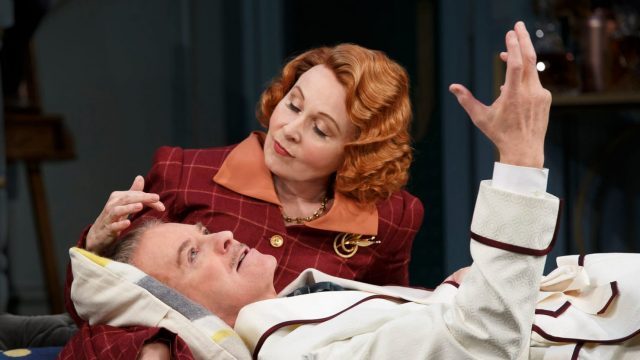
Liz (Kate Burton) comforts ex-husband and master thespian Garry Essendine (Kevin Kline) in Broadway revival of Present Laughter (photo by Joan Marcus)

St. James Theatre
246 West 44th St. between Broadway & Eighth Aves.
Tuesday – Sunday through July 2, $59 – $199
laughteronbroadway.com

In the latest Broadway revival of Noël Coward’s WWII-era comedy Present Laughter, two-time Tony winner and Oscar recipient Kevin Kline gets to put his stamp on Garry Essendine, one of the great characters of twentieth-century British theater, and he does so with devilishly wicked delight. He ferociously devours the scenery, following in the footsteps of such previous ferocious scenery devourers as Albert Finney, George C. Scott, Peter O’Toole, Frank Langella, Ian McKellen, Clifton Webb, and the original Essendine, Coward, who based the role on himself; other characters and incidents were inspired by real people and events as well, lending the show an intimate charm with plenty of knowing winks and nods. Essendine is a master thespian preparing for a tour of Africa, but not in peace and quiet — his apartment becomes a carnival of friends, colleagues, staff, lovers, and an oddball stranger. Late one morning, upon learning that Daphne Stillington (Tedra Millan), a young woman he apparently brought home the night before, is in the guest room, Essendine complains to his longtime assistant and confidante, Monica Reed (Kristine Nielsen), “Why didn’t you tell her to dress quietly like a mouse and go home? You know perfectly well it’s agony here in the morning with everybody banging about.” Also turning his impressive London flat (designed by David Zinn) into Victoria Station over the course of the play are Essendine’s ex-wife, Liz (Kate Burton); his manager, Morris Dixon (Reg Rogers); his producer, Henry Lyppiatt (Peter Francis James); Henry’s hot-to-trot wife, Joanna (Cobie Smulders); Daphne’s mother, Lady Saltburn (Sandra Shipley); would-be playwright Roland Maule (Bhavesh Patel); and Essendine’s irrepressible, good-natured valet, Fred (Matt Bittner), and rather strange housekeeper, Miss Erikson (Ellen Harvey). Essendine has built a kind of extended family around himself, one that he might not be able to hold together as things start falling apart, in classically British ways.

(photo by Joan Marcus)

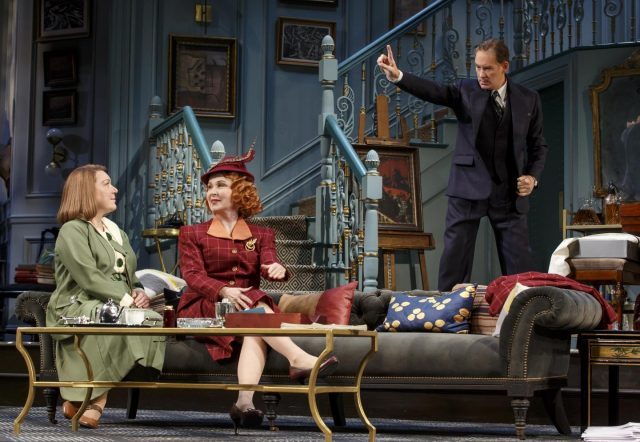
Garry Essendine (Kevin Kline) makes a point in semiautobiographical Noël Coward play (photo by Joan Marcus)

Kline (The Pirates of Penzance, On the Twentieth Century) is masterful as Essendine, his every gesture and utterance beautifully overplayed to the hilt, as if the character can’t tell the difference between the stage and real life, always acting, be it Shakespeare or vaudeville. Kline shows a flair for slapstick comedy reminiscent of Monty Python’s John Cleese — Kline won his Oscar for his supporting role in A Fish Called Wanda, which was written by Cleese and starred fellow Python Michael Palin — whether he’s falling down stairs or trying not to be seduced. The women in the show, which takes its name from a line from the Bard’s Twelfth Night — “Present mirth hath present laughter” — are terrific, led by the stalwart Burton, who played Daphne in Scott’s 1982 production; her Liz is not about to take any garbage from Garry while getting a kick out of all the crazy shenanigans going on around him. The always excellent Nielsen (Betty’s Summer Vacation, Vanya and Sonia and Masha and Spike) turns Monica into a den mother with a wry sense of humor about her boss’s philandering, and Harvey (How to Succeed in Business without Really Trying, Mary Poppins) is nearly unrecognizable as the dour Miss Erikson, who is not the most caring of housekeepers. Smulders (How I Met Your Mother; Love, Loss, and What I Wore), in her Broadway debut, is sexy and elegant as the manipulative Joanna, while Millan, in her Broadway debut, follows up her success in The Wolves with another strong performance as the overexcited, high-pitched Daphne, determined to get what she wants. The men, however, do not fare as well; Bittner has fun with Fred, but James (Stuff Happens, Hamlet with Kline) and Rogers (Holiday, Privacy) can’t keep up with Kline, looking lost at times, and Patel (War Horse, Indian Ink) is so over the top as Roland that he seems to be in the wrong play. But director Moritz von Stuelpnagel (Hand to God, Important Hats of the Twentieth Century) is able to keep reeling it in whenever it threatens to go a little bit off track, with the help of Kline, who has such an impressive command of the stage and the character that there’s never a doubt that you will presently be laughing; even the way he checks his hair several times in a mirror almost as an aside is an absolute treat, capturing the essence of Garry, and Kevin, with just a few scant motions.

GROUNDHOG DAY THE MUSICAL

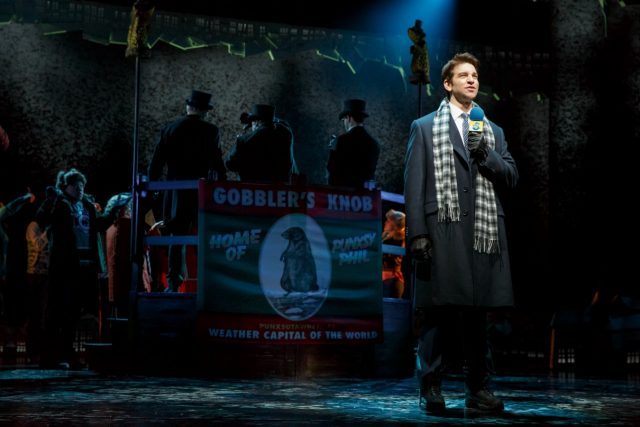
Phil Connors (Andy Karl) is trapped in Punxsutawney, PA, forced to relive Groundhog Day over and over again (photo by Joan Marcus)

Phil Connors (Andy Karl) is trapped in Punxsutawney, PA, forced to relive Groundhog Day over and over again (photo by Joan Marcus)

August Wilson Theatre
245 West 52nd St. between Broadway & Eighth Ave.
Tuesday – Sunday through January 7, $79.50 – $169
www.groundhogdaymusical.com

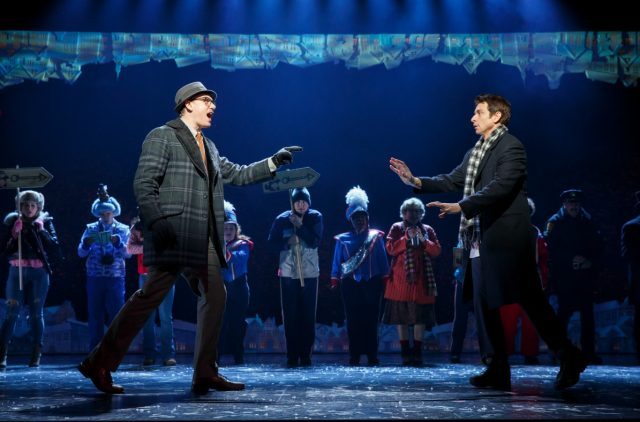
“Hoping for an early spring? Well, tomorrow is Groundhog Day, and the good folks in Punxsutawney are already gathering in a snowy field waiting for the dawn. Why? Because they’re morons,” meteorologist Phil Connors (Andy Karl) declares at the beginning of Groundhog Day, the fabulous musical adaptation of the popular 1993 comedy. The arrogant, condescending, misogynistic Connors, who hosts the television program Good Weather with Phil Connors — “Thanks for watching,” he patronizingly says whenever recognized by a gushing fan — has been sent to cover the annual Groundhog Day celebration in Punxsutawney, Pennsylvania, with excited associate producer Rita (Barrett Doss) and quiet cameraman Larry (Vishal Vaidya), but he doesn’t care one iota about whether the rodent sees its shadow or whether there will be six more weeks of winter. “Small towns, tiny minds / Big mouths, small ideas / Shallow talk, deep snow / Cold fronts, big rears,” he sings about the local populace and eager tourists who have flooded the community, many who have come in costume to celebrate the aptly named Phil the groundhog. “There’s nothing more depressing than small town USA / And small don’t come much smaller than Punxsutawney on Groundhog Day,” he adds. Connors might care only about himself, unwilling to find the charm that is the core of America, but he’s about to get one very unusual comeuppance because of his snarky, superior attitude. Every morning, he wakes up to discover that it is still Groundhog Day — he is stuck in a loop in which he keeps meeting such corny, down-home characters as the Chubby Man (Michael Fatica), bed-and-breakfast owner Mrs. Lancaster (Heather Ayers), groundhog fans Mr. and Mrs. Cleveland, nerdy marching band sweethearts Fred and Debbie (Gerard Canonico and Katy Geraghty), the bumbling sheriff (Sean Montgomery), and high school acquaintance and insurance salesman Ned Ryerson (John Sanders), who all annoy him no end, especially when they want to talk about the weather. He’s trapped in a nightmare of his own making, perhaps incapable of figuring a way out.

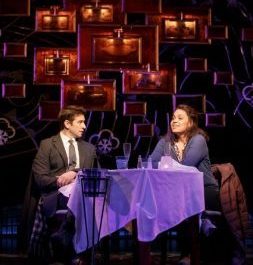
Phil Connors (Andy Karl) and Rita (Barrett Doss) pause for a special moment in smash Broadway musical (photo by Joan Marcus)

Phil Connors (Andy Karl) and Rita (Barrett Doss) pause for a special moment in smash Broadway musical (photo by Joan Marcus)

Three-time Tony nominee Karl (On the Twentieth Century, Rocky) is a phenomenon as Connors, a role immortalized by Bill Murray in the film; he is bursting with an infectious charisma and bewitching energy that envelops the audience from the very start and never lets go; it’s an unforgettable, bravura, career-making performance by a rising star. He even has fun showing off the brace he has to wear after having torn his ACL during previews. But he’s helped tremendously by an outstanding book that really understands the heart and soul of the film, which is not a shock, as the book is written by Danny Rubin, who cowrote the movie with director Harold Ramis. Thus, the characters and the plot come first, with plenty of spoken dialogue leading into the superb music and lyrics by Australian comedian, musician, writer, director, and actor Tim Minchin, who also wrote the music and lyrics for Matilda the Musical, earning him a Tony nomination for Best Original Score. (He also played crazed rock star Atticus Fetch on Californication.) The songs flow seamlessly into the story, with some brilliant surprises. Rebecca Faulkenberry (Spider-Man: Turn Off the Dark, Rock of Ages) brings down the house as Nancy Taylor, a conquest of Phil’s who opens the second act with “Playing Nancy,” lamenting her fate both as the character and the actress playing the character. “Well, here I am again the pretty but naive one / the perky breasted, giggly, one-night-stand / Is it my destiny to be a brief diversion / just a detour on the journey of some man?” she asks, wanting to be more than she is. Later, Sanders (Matilda, Peter and the Starcatcher) delivers the beautiful ballad “Night Will Come,” about life’s inevitabilities.

(photo by Joan Marcus)

Meteorologist Phil Connors (Andy Karl) can’t stop bumping into insurance salesman Ned Ryerson (John Sanders) in Groundhog Day (photo by Joan Marcus)

Minchin and Rubin don’t sugarcoat anything, instead focusing on the bittersweet nature of human existence. Tony-winning director Matthew Warchus (Matilda, God of Carnage) never allows the show to get boring, despite so much repetition, while Peter Darling and Ellen Kane’s playful choreography weaves its way through Rob Howell’s fast-changing sets amid Christopher Nightingale’s smart orchestrations. (Howell also designed the fun costumes.) And during “Hope,” magician Paul Kieve (Ghost, Matilda) adds some very cool illusions as Phil contemplates the end. There’s a reason the Old Vic production garnered eight Olivier nominations (winning Best Actor and Best Director) and the Broadway version is up for seven Tonys (Best Musical, Best Book, Best Actor, Best Direction, Best Original Score, Best Choreography, and Best Scenic Design): The cast and crew are just that good, from top to bottom, led by Karl, all coming together to create a show to remember, one that, yes, audiences are likely to want to see over and over again and one that, despite its British roots, is profoundly American.

WAR PAINT

(photo by Joan Marcus)

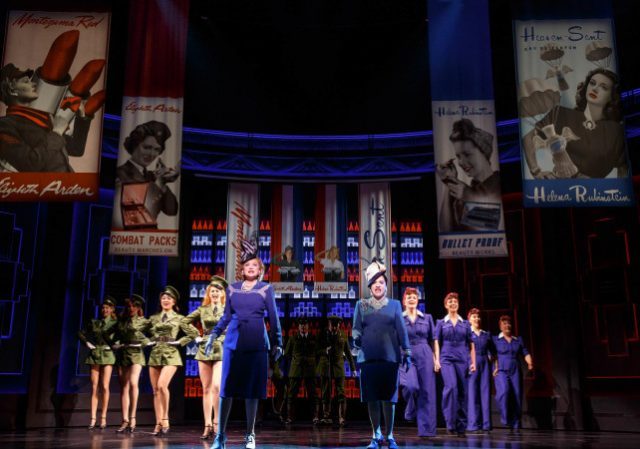
Elizabeth Arden (Christine Ebersole) and Helena Rubinstein (Patti LuPone) battle it out during the war effort in War Paint (photo by Joan Marcus)

Nederlander Theatre
208 West 41st St. between Seventh & Eighth Aves.
Tuesday – Sunday through September 3, $65-$179
877-250-2929
www.warpaintmusical.com

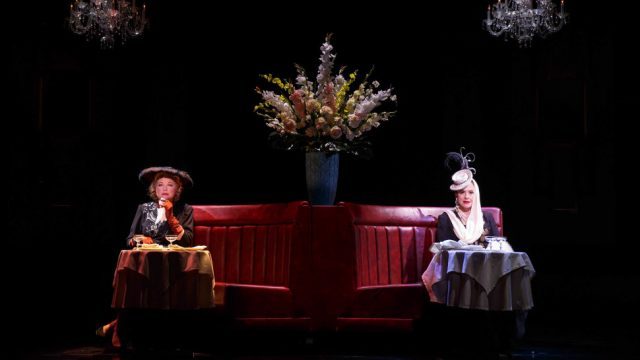
War Paint is everything it should be and more. Inspired by Lindy Woodhead’s 2004 book and Ann Carol Grossman and Arnie Reisman’s 2009 documentary, The Powder & the Glory, this knockout Broadway musical pits not only fashion doyenne Helena Rubinstein against Elizabeth Arden but Tony-winning divas Patti LuPone, as the former, against Christine Ebersole, as the latter. And everyone wins, especially the audience. Rubinstein (1872-1965) and Arden (1878-1966) were fierce rivals in the cosmetics industry, bringing a new conception of feminine beauty to America while also breaking barriers for women entrepreneurs. The show, which takes place between the late 1930s and the early 1960s, focuses on how sharply different each was from the other, although they both sought the same things: power in a man’s world, as a woman. Rubinstein was a tough, gruff Jewish immigrant from a Polish shtetl, while the blonde Arden hailed from an impoverished Canadian farm. While Rubinstein made such proclamations as “There are no ugly women; only lazy ones,” Arden made such demure statements as “Remember, girls! Every woman has a God-given right to loveliness!” In the show, they battle over new products, secret ingredients, location, Senate investigations, and even sales managers; at one point, Elizabeth’s husband, Tommy Lewis (John Dossett), feeling neglected, jumps ship to work with Helena, so Helena’s right-hand man, Harry Fleming (Douglas Sills), is quickly snatched up by Elizabeth. David Korins’s darkly bold changing sets include a wall of glowing cosmetic bottles, a movable red door representing Arden’s lush salon, portraits of Rubenstein done by famous artists, and a restaurant where both women dine and where they reveal many of their fears. Catherine Zuber’s costumes are exuberant, as are David Brian Brown’s wigs and Angelina Avallone’s makeup, while Christopher Gattelli’s choreography has ravishing moments of razzle-dazzle; all of those elements come together for a terrific number about Helena and Elizabeth’s involvement in the war effort (“Necessity Is the Mother of Invention”) as well as such other fun songs as “Behind the Red Door” and “Back on Top,” featuring the talented ensemble, who all play multiple roles, including such standouts as Mary Ernster as the Society Doyenne, Joanna Glushak as Magda, Barbara Marineau as the Grand Dame, Angel Reda as the Heiress, Mary Claire King as Miss Beam, and Erik Liberman as Charles Revson.

(photo by Joan Marcus)

Elizabeth Arden (Christine Ebersole) and Helena Rubinstein (Patti LuPone) pause for a rare quiet moment in their lavish yet complex lives (photo by Joan Marcus)

The book, by Doug Wright (I Am My Own Wife, Hands on a Hardbody), does an excellent job of condensing the story into a fast-paced two and a half hours, giving equal time to each side of the conflict. The music, by Scott Frankel, and lyrics, by Michael Korie, who previously collaborated on such shows as Far from Heaven, Doll, and Happiness and teamed up with Wright on Grey Gardens, are fanciful and exhilarating, propelling the story while allowing the stars to shine, and shine they do; LuPone (Gypsy, Evita), Ebersole (Grey Gardens, 42nd Street), Dossett (Gypsy, Giant), and Sills (The Scarlet Pimpernel, Little Shop of Horrors) are the fiercest foursome on Broadway today, chewing up the colorful scenery and spitting it out with verve and style, although the show, of course, belongs to the women. Early on, Harry suggests to Helena, “Perhaps this time you’ll drop by the Red Door and introduce yourself? Maybe even make nice?” to which Helena responds, “The Ford should meet the Studebaker? The Macy’s should take tea with the Gimbel’s?” In real life, Helena Rubinstein and Elizabeth Arden actually never met; thank goodness this show brings them together for posterity.

SIX DEGREES OF SEPARATION

(photo © Joan Marcus 2017)

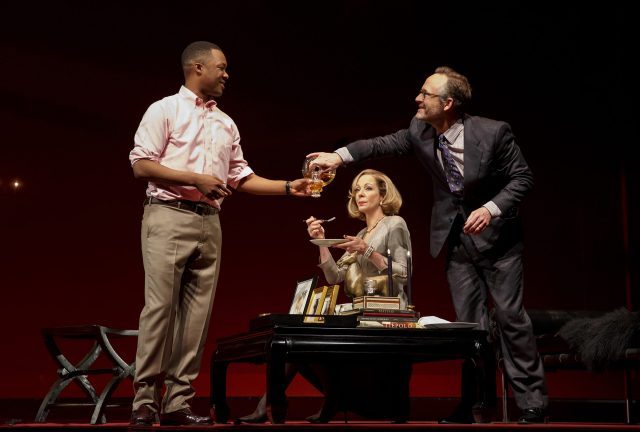
Paul (Corey Hawkins) charms Ouisa (Allison Janney) and Flan (John Benjamin Hickey) in Broadway revival of Six Degrees of Separation (photo © Joan Marcus 2017)

Barrymore Theatre
243 West 47th St. between Broadway & Eighth Ave.
Tuesday – Sunday through July 16, $49 – $149
sixdegreesbroadway.com

In 1983, David Hampton talked his way into several apartments owned by wealthy New Yorkers, claiming to be the son of Sidney Poitier. Award-winning playwright and screenwriter John Guare heard the story from friends of his, Inger McCabe Elliott and Osborn Elliott, who were among those who took in Hampton, and turned the true tale first into a 1990 play, which premiered at the Mitzi E. Newhouse at Lincoln Center and moved upstairs to the Vivian Beaumont for its Broadway debut, and then a 1993 film, directed by Fred Schepisi. It is now having its first Broadway revival, and it’s as sharp and delightful as ever, skewering white liberal guilt, societal racism, and the child-rearing of the wealthy with glee and wit to spare. Six Degrees of Separation is set in an elegant Fifth Avenue apartment, where private art dealer Flan (John Benjamin Hickey) and his chi-chi wife, Ouisa (Allison Janney), have just gone through a traumatic experience. They relate in flashback, often addressing the audience directly, precisely what happened to shake them up so much. Flan and Ouisa, who are both in their forties, were enjoying an evening with their friend Geoffrey (Michael Siberry), a wealthy South African businessman whom they plan to wine and dine into an art investment deal. When asked why he stays in South Africa, where apartheid is still in effect, Geoffrey, who employs seventy thousand black workers in one of his mines, explains, “One has to stay there to educate the black workers, and we’ll know we’ve been successful when they kill us.” When Geoffrey asks Flan and Ouisa to visit him in South Africa, she opines, “But we’d visit you and sit in your gorgeous house planning trips into the townships demanding to see the poorest of the poor. ‘Are you sure they’re the worst off? I mean, we’ve come all this way. We don’t want to see people just mildly victimized by apartheid. We demand shock.’ It doesn’t seem right sitting on the East Side talking about revolution.” Their evening is interrupted when the doorman (Tony Carlin) brings in a young man who bleeding from a recent attack in Central Park. Paul (Corey Hawkins) claims to be friends with Ouisa and Flan’s children (they have two kids at Harvard and one at Groton) as well as being the son of famed actor Poitier. The three white people see this as an excellent opportunity to help a black man, so they take him in, getting particularly excited when Paul promises that they can appear in the movie version of Cats, which his father is directing. But later that night they find out a whole lot more about Paul that is not quite so comforting.

(photo © Joan Marcus 2017)

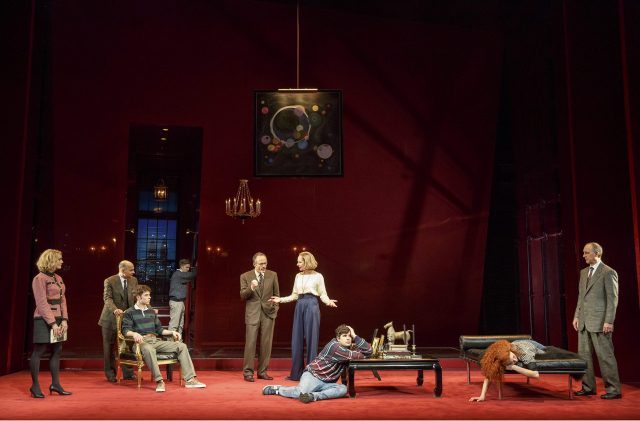
John Guare revival is set in a luxurious Fifth Avenue living room (photo © Joan Marcus 2017)

Guare (The House of Blue Leaves, Atlantic City) does an expert job exploring the racial divide, one that hasn’t changed all that much in America since 1990. “I never knew I was black in that racist way till I was sixteen and came back here,” Paul explains about his return to the States after being raised in Switzerland. Although Guare didn’t come up with the Poitier reference — that was done by the real Hampton — it allows the playwright to subtly pontificate on the boundary-breaking actor so beloved by black and white audiences. “Your father means a great deal in South Africa,” Geoffrey points out, while Dr. Fine (Ned Eisenberg), who treated Paul at the hospital, calls Poitier “a matinee idol of my youth. Somebody who had really forged ahead and made new paths for blacks just by the strength of his own talent.” Also getting involved are Flan and Ouisa’s friends Kitty (Lisa Emery) and Larkin (Michael Countryman) and several of the adults’ less-than-happy children, including Woody (Keenan Jolliff), Doug (Cody Kostro), Tess (Colby Minifie), and Ben (Ned Riseley), who have some terse words to share with their parents. “There are two sides to every story,” Dr. Fine tells his son, Doug, a theme that also relates to the painting Flan and Ouisa have hanging in their living room, a two-sided Kandinsky described thusly by Guare: “One side is geometric and somber. The other side is wild and vivid.” There are plenty of both sides in the play.

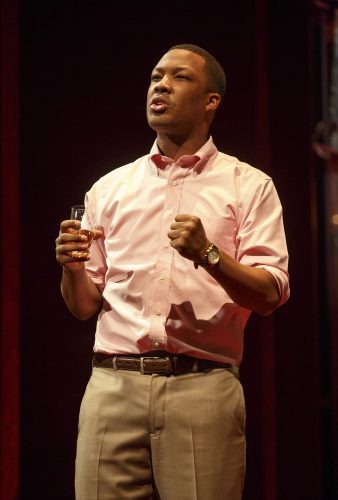
Corey Hawkins takes on role previously played by James McDaniel, Courtney B. Vance, and Will Smith (photo © Joan Marcus 2017)

Corey Hawkins takes on role previously played by James McDaniel, Courtney B. Vance, and Will Smith (photo © Joan Marcus 2017)

Seven-time Emmy winner and two-time Tony nominee Janney (The West Wing, A View from the Bridge) and Tony winner and Emmy nominee Hickey (The Normal Heart, The Big C) portray the quintessential East Side couple — previously played onstage by John Cunningham and Stockard Channing and on film by Channing and Donald Sutherland — with grace and skill, masterfully blending humor and irony. Hawkins (Hurt Village, 24: Legacy) is a worthy successor to previous Paul portrayers James McDaniel off Broadway, Courtney B. Vance on Broadway, and Will Smith on film; he keeps the audience guessing just as he does the gullible characters. The show is smoothly directed by Obie winner Trip Cullman (Significant Other, Punk Rock), moving back and forth between the past and the present, although the red scrim in the back of Mark Wendland’s set is confusing. “I read somewhere that everybody on this planet is separated by only six other people,” Ouisa says. “Six degrees of separation. Between us and everybody else on this planet. The President of the United States. A gondolier in Venice. Fill in the names. I find that A) tremendously comforting that we’re so close and B) like Chinese water torture that we’re so close. Because you have to find the right six people to make the connection.” This revival of Six Degrees of Separation, continuing at the Ethel Barrymore Theatre through July 16, makes quite a connection itself.

INDECENT

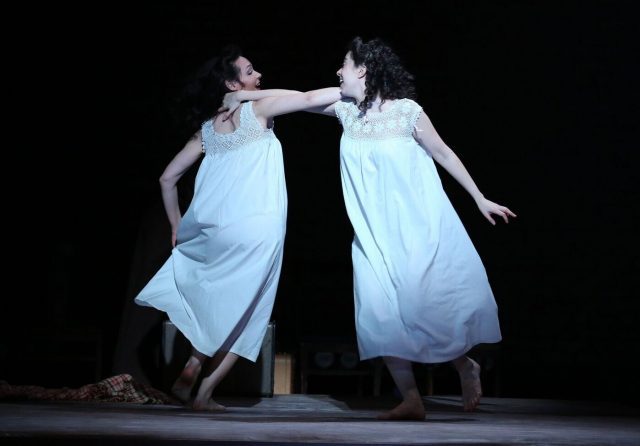
INDECENT takes audiences behind the scenes of controversial drama THE GOD OF VENGEANCE (photo by Carol Rosegg)

Indecent takes audiences behind the scenes of controversial drama GOD OF VENGEANCE (photo by Carol Rosegg)

Cort Theatre
138 West 48th St. between Sixth & Seventh Aves.
Tuesday – Sunday through August 6, $39 – $129
indecentbroadway.com

In late 1922, Sholem Asch’s controversial 1907 Yiddish play, God of Vengeance, premiered in an English-language version at the Provincetown Playhouse in the Village. On February 19, 1923, it moved uptown to the Apollo Theatre on Broadway. On March 5, the cast and producer were indicted on obscenity charges. (The play closed on April 14.) Ninety-three years later, on April 27, 2016, Paula Vogel and Rebecca Taichman’s Indecent, about the making of God of Vengeance, opened at the Vineyard Theatre by Union Square Park. The following April, it moved uptown to the Cort Theatre on Broadway. On May 3, the show received three Tony nominations, including Best Play (Vogel, in her Broadway debut) and Best Director (Taichman). How times have changed. I was moved by Indecent when I saw it at the Vineyard last June. However, since then, I caught the New Yiddish Rep revival of God of Vengeance, and the new U.S. administration has clamped down on immigration while anti-Semitism is on the rise around the world. Those aspects have led me to fall in love with the Broadway version, which is bigger and better at the Cort. Richard Topol again stars as Lemml, an immigrant who is so taken with Asch’s (Max Gordon Moore) play that he becomes the stage manager for the show as it travels through Eastern Europe and ultimately to New York City; he also serves as the narrator, addressing the audience directly as he shares his memories — although he cannot remember how it all ends. (The audience, however, is unlikely to forget the elegiac, haunting conclusion.) In the play within a play, Yankl (Tom Nelis), a devout Jewish man, is running a brothel in his basement in order to be able to afford a better life for his daughter, Rifkele (Adina Verson), as well as a new Torah, which he hopes will protect her virtue. Much to his chagrin, however, Rifkele falls in love with Menke (Katrina Lenk), one of the prostitutes. Nelis is also Rudolph Schildkraut, the famous Austrian actor who headlined and directed the show. The famous lesbian kiss from God of Vengeance, one of the most romantic moments I have ever seen onstage, is handled beautifully by Pulitzer Prize winner Vogel (How I Learned to Drive, The Baltimore Waltz) and Taichman (How to Transcend a Happy Marriage, Familiar), as is the entire production.

 (photo by Carol Rosegg)

Menke (Katrina Lenk) and Rifkele (Adina Verson) share a beautiful moment in Indecent (photo by Carol Rosegg)

As you enter the theater, the cast is already seated in a row of chairs at the back of the stage. There is a slightly raised platform in the center, where most of the action takes place. (The dark, ominous stage design is by Riccardo Hernandez.) Most of the dialogue is in English, with Tal Yarden’s projections explaining what language is actually being spoken. The play features several surreal elements, including the dispensation of sand from the characters’ sleeves, a clever use of suitcases, and sudden breakouts into joyous klezmer songs and Jewish folk dances during which a trio of musicians (clarinetist Matt Darriau, violinist Lisa Gutkin — who gets a bonus surprise — and accordionist Aaron Halva) gets involved. The choreography, which ranges from playful to portentous, is by David Dorfman; Christopher Akerlind’s stunning lighting is virtually a character unto itself. Much of the excellent cast is the same from the Vineyard, with standout performances by Topol (The Merchant of Venice, The Normal Heart), who is both observer and participant, and the sultry, sexy Lenk (Once, The Band’s Visit), who can set the hearts of men and women aflutter. The exhaustively researched Indecent, which was inspired by Taichman and Rebecca Rugg’s 2000 The People vs. The God of Vengeance at Yale, raises questions of freedom of speech, immigration, the suppression of art, homosexuality, and faith, as well as the power of theater itself. With all that’s going on in the world today, the play also serves as a warning that this could all happen again if we’re not careful.

HELLO, DOLLY!

(photo by Julieta Cervantes)

Bette Midler eats up the spotlight in Hello, Dolly! Broadway revival (photo by Julieta Cervantes)

Shubert Theatre
225 West 44th St. between Broadway & Eighth Aves.
Wednesday – Sunday through January 14, $59-$229
hellodollyonbroadway.com

The new production of Hello, Dolly!, which is breaking house records at the Shubert Theatre, is everything that is wrong with Broadway. The fourth revival of the hit musical that debuted on the Great White Way in 1964 is, more than ever, a star vehicle with more than its share of glitz and glamour masking an old-fashioned story that is mediocre at best and downright embarrassing at worst. Grammy, Tony, and Emmy winner Bette Midler, who has also been nominated for two Oscars, has taken over a role she was seemingly born to play, a part most identified with Carol Channing but also portrayed by such other prominent leading ladies as Ginger Rogers, Martha Raye, Betty Grable, Pearl Bailey, Phyllis Diller, and Ethel Merman onstage and by Barbra Streisand in Gene Kelly’s 1969 film. Now seventy-one (Channing was forty-three when she originated the role), Midler has charm and energy to spare, if not quite the pipes and the moves; her every utterance and shuffle are met with wild cheers of delight from the worshipful audience. And Midler plays off the crowd to the hilt, posturing and preening for maximum effect even as we hope she manages to avoid the long, narrow opening to the unseen pit orchestra below. The show, directed by four-time Tony winner Jerry Zaks (Guys and Dolls, Lend Me a Tenor) and choreographed by Warren Carlyle (After Midnight) — Gower Champion was responsible for both in 1964 — is chock-full of razzle-dazzle, including fabulously colorful costumes by Santo Loquasto, who also designed the sets, which range from the glamorous Harmonia Gardens Restaurant to the homey Vandergelder’s Hay and Feed shop in Yonkers.

(photo by Julieta Cervantes)

Minnie Fay (Beanie Feldstein), Barnaby Tucker (Taylor Trensch), Irene Molloy (Kate Baldwin), and Cornelius Hackl (Gavin Creel) have an unusual night on the town in Hello, Dolly! (photo by Julieta Cervantes)

But this version is really more of a cabaret-circus variety show than a fully fledged Broadway musical; Michael Stewart’s book, based on Thornton Wilder’s The Matchmaker, boasts a silly narrative that is not exactly a boost to the fight for women’s equality, and Jerry Herman’s music and lyrics are rather dilapidated all these years later. Midler stars as Dolly Gallagher Levi, a widowed matchmaker trying to convince fussy, sort-of-wealthy widower Horace Vandergelder (David Hyde-Pierce) to let his whiny niece, Ermengarde (Melanie Moore), marry starving artist Ambrose Kemper (Will Burton) while also laying a trap to get Horace for herself while introducing him to young and beautiful milliner Irene Molloy (Kate Baldwin) and the very odd Ernestina Money (Jennifer Simard). Heading off to New York City for a parade, Horace leaves his two clerks, Cornelius Hackl (Gavin Creel) and Barnaby Tucker (Taylor Trensch), in charge of the store, but they decide it’s time for them to get away as well, sneaking off to New York, where Cornelius falls for Irene and Barnaby takes a liking to Minnie Fay (Beanie Feldstein), Irene’s assistant.

(photo by Julieta Cervantes)

Bette Midler and David Hyde-Pierce search for chemistry in Hello, Dolly! (photo by Julieta Cervantes)

In the big city, much zaniness ensues, from run-of-the-mill slapstick comedy (Cornelius and Barnaby hiding from Horace in Irene’s shop) to a long, cringeworthy scene in Harmonia Gardens that plays off the rich vs. poor theme with a series of unfunny sight gags. And “The Waiters’ Gallop,” in which the talented ensemble gets caught up in ever-more-precarious situations, boasts creative props and terrific costumes, but it’s a real showstopper in both senses of the word; not only does the crowd go gaga over it, clapping again and again and again, but it brings the narrative to a screeching halt. It’s merely an excuse for everyone to show off, and show off they do, even though it has little to do with the story. It certainly doesn’t help that there’s zero chemistry between any of the potential love matches, particularly, and most egregiously, Dolly and Horace; at times it’s like Midler (I’ll Eat You Last) and Hyde-Pierce (Vanya and Sonia and Masha and Spike), who does his fair share of flaunting, are in two different shows. Through it all, though, there’s Bette, who never really inhabits the role but plays herself playing the character while basking in the unending attention, the love bursting forth from the audience at her every knowing smirk; the Shubert practically explodes when she emerges in her glittering red dress for the title song, but it’s Bette who’s being celebrated, not Dolly. For many, that appears to be more than enough. And that’s really too bad, because by then, the parade had already passed by. (Donna Murphy will play Dolly on Tuesday nights beginning June 13 and for select performances through the run of the show; it should be intriguing to see how it holds up when the Divine Miss M is not front and center.)

OSLO

(photo by T. Charles Erickson)

Mona Juul (Jennifer Ehle) and Terje Rød-Larsen (Jefferson Mays) try not to get their signals crossed in Oslo (photo by T. Charles Erickson)

Vivian Beaumont Theater at Lincoln Center Theater
150 West 65th St. between Broadway & Amsterdam Ave.
Tuesday – Saturday through June 18, $87-$147
212-362-7600
www.lct.org

In 1993, unbeknownst to the rest of the world, a Norwegian couple reached out to Israel and the Palestine Liberation Organization in an effort to foster peace in the Middle East. The clandestine back-channel talks, which led to the historic and controversial Oslo Accords, are dramatized in J. T. Rogers’s gripping play, Oslo, which has seamlessly moved from Lincoln Center’s downstairs Mitzi E. Newhouse Theater to its Broadway venue, the Vivian Beaumont. The always excellent Jefferson Mays stars as sociologist Terje Rød-Larsen, the head of the Fafo Institute for Applied Sciences, who sees such events as the tearing down of the Berlin Wall as an opportunity to facilitate the peace process between violent enemies Israel and the PLO. “My God, if Leningrad can revert to St. Petersburg, anything is possible,” he says. “Are you seriously suggesting Rabin talk peace with the man the Israelis call Hitler in his lair?” Norwegian foreign minister Johan Jorgen Holst (T. Ryder Smith) asks in disbelief. “Johan Jorgen, you don’t make peace with the people you have dinner parties with. You make peace with the people who bomb your markets and blow up your buses,” Larsen answers. Larsen is joined by his wife, Mona Juul (Jennifer Ehle), who occasionally addresses the audience directly, as a sort of narrator. “To clarify: Johan Jorgen is married to Marianne [Henny Russell], who works for Terje, who is married to me, who, as of tomorrow, works for Johan Jorgen. In Norway we take nepotism to an entirely new level,” she says with a smile. Larsen and Juul believe that by using “gradualism,” they can bring Israel and the PLO to the table, even though Israeli law makes it illegal for an Israeli official to speak with a member of the PLO.

Food serves as a key feature in negotiations between Israel and the PLO in OSLO (photo by T. Charles Erickson)

Food and drink play key roles in negotiations between Israel and the PLO in Oslo (photo by T. Charles Erickson)

“This new model — my model — is rooted not in the organizational but in the personal, a process of negotiation allowing the most implacable of adversaries to focus on a single issue of contention, resolve it, then move on to the next single issue, as they gradually build a bond of trust,” Larsen explains. Secretly arriving in Norway are PLO finance minister Ahmed Qurie (Anthony Azizi), aka Abu Ala; official PLO liaison Hassan Asfour (Dariush Kashani), an avowed communist with an intense distrust of Jews; and Haifa economics professors Yair Hirschfeld (Daniel Oreskes) and Ron Pundak (Daniel Jenkins), who have been chosen by Israeli deputy foreign minister Yossi Beilin (Adam Dannheisser) to represent Israel in an unofficial capacity. Larsen and Juul put their plan into action, attempting to inject a positive attitude into the proceedings in order to get the negotiators talking. They are assisted by housekeeper Toril Grandal (Russell), who makes a mean plate of waffles, and her husband, groundsman Finn Grandal (Smith). Soon, despite their massive differences, Abu Al, Hirschfeld, Asfour, and Pundak are making progress, but without official acknowledgment from Israeli foreign minister Shimon Peres (Oreskes) and prime minister Yitzhak Rabin, the talks threaten to fall apart, until wildly unpredictable Israeli foreign ministry director-general Uri Savir (Michael Aronov) shows up.

Sociopolitical playwright Rogers (Madagascar, The Overwhelming) was introduced by director Bartlett Sher to the real Larsen and Juul following a performance of their previous Lincoln Center Theater collaboration, Blood and Gifts (which also starred Mays and Aronov), about diplomacy during the Soviet war in Afghanistan. Thus, Oslo is based on firsthand research, although Rogers points out, “To be clear, it is my version of this history.” Michael Yeargan’s set features a large backdrop with double doors through which the four negotiators often disappear; the audience is not privy to what is going on behind. In addition, huge images of Middle East violence are projected onto the wall. Together, the size of the wall and the videos make Larsen and Juul often appear small, which was the couple’s intention, as they saw themselves as mere facilitators, minor players in this major undertaking. Tony winner Mays (A Gentleman’s Guide to Murder, I Am My Own Wife) is outstanding as Larsen, balancing fear and excitement as he puts himself out on a limb in trying to accomplish the seemingly impossible. Tony winner Ehle (The Coast of Utopia, The Real Thing) excels as his equal partner in this dangerous venture, the unseen backbone ostensibly serving as an amiable hostess and direct liaison to the audience. Despite its nearly three-hour length, the play flies by, with Tony winner Sher (South Pacific, The Light in the Piazza) keeping things moving at a smooth police-procedural-like pace. Rogers’s script melds the comic and the surreal, the serious and the wacky in translating this most unlikely of scenarios into an utterly gripping yet tenderly intimate tale. Of course, nearly a quarter-century later, peace is still a pipe dream in the Middle East, and the theory of gradualism has not exactly taken hold in international diplomacy. But for a fascinating moment in time, two Norwegians offered more than a glimmer of hope, something the world can use a whole lot more of.