this week in broadway

BE MORE CHILL

(photo by Maria Baranova)

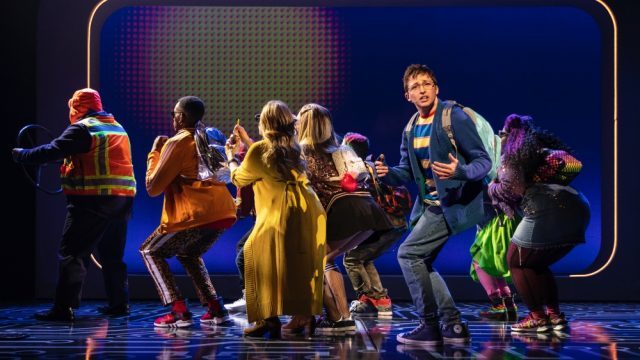
Jeremy Heere (Will Roland) takes a pill to make him more popular in Be More Chill (photo by Maria Baranova)

Lyceum Theatre
149 West 45th St. between Sixth & Seventh Aves.
Tuesday – Sunday through March 29, $49- $199
bemorechillmusical.com

While I sat mouth agape at the jaw-dropping inanity that is Be More Chill on Broadway, I looked around at the teenage girls sitting all around me. I was genuinely envious of the sheer glee they were experiencing, their eyes transfixed in front of them, their mouths singing along with every one of the songs. I am not the target audience of this runaway juggernaut, this little show that could, which is breaking attendance records at the Lyceum Theatre. (However, in another part of my life, I work in children’s books, for a company that has published several books by Ned Vizzini, whose 2004 YA novel is the basis for the musical, so I’m no mere disinterested curmudgeon.) That said, the production is a disaster. The cast is energetic, but director Stephen Brackett’s pacing is woefully inconsistent, Joe Tracz’s book is flagrantly flawed, Joe Iconis’s music and lyrics are wholly drab and forgettable, and Chase Brock’s choreography is slipshod and clumsy. The climax is so feeble I wanted to hide my head in embarrassment for everyone onstage. But none of that matters with this review-proof phenomenon, which is like a musical version of Saved by the Bell, with Screech in the lead.

(photo by Maria Baranova)

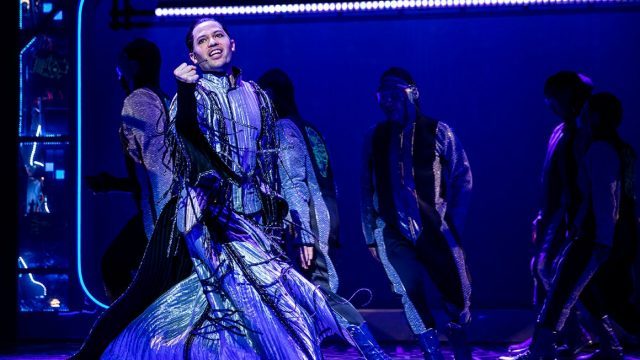
Jason Tam stars as the SQUIP in Broadway transfer of Be More Chill (photo by Maria Baranova)

As has been well documented, Be More Chill failed to make much of an impact when it premiered at the Two River Theater in Red Bank, New Jersey, in 2015, but the cast recording became a surprise hit, resulting in a sold-out run at the Signature Theatre last year and the Broadway transfer, with much of the cast intact since its beginning. The plot follows the trajectory of high school student Jeremy Heere (Will Roland), who is lured by bad boy Rich Guranski (Gerard Canonico) into taking a pill known as the SQUIP (which stands for “super quantum unit intel processor” and is personified by the devilishly handsome Jason Tam) in order to make him more confident, popular, and cool. Upon the SQUIP’s commands, Jeremy starts ignoring his best friend, the nerdy Michael Mell (George Salazar), and hanging out with stylish mean girls Chloe Valentine (Katlyn Carlson) and Brooke Lohst (Lauren Marcus) to make his crush, Christine Canigula (Stephanie Hsu), jealous, while she flirts with class superstar Jake Dillinger (Britton Smith) as they all participate in the school play, A Midsummer Nightmare (about Zombies). Jeremy also has to deal with his sad, lonely father (Jason “SweetTooth” Williams), who spends most of his days at home in his underwear and bathrobe. As the pill takes hold, Jeremy sacrifices his personal identity and true self – and everything around him falls apart.

(photo by Maria Baranova)

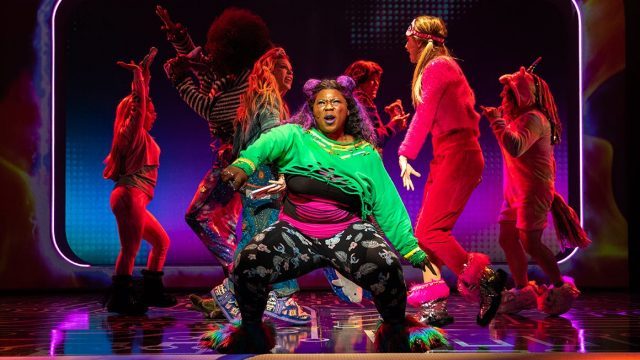
Tiffany Mann nearly blows the roof off the Lyceum Theatre as Jenna Nolan in Be More Chill (photo by Maria Baranova)

The musical hits many current hot-button teen issues, including sexual orientation, depression, bullying, suicidal thoughts, divorced parents, drug and alcohol abuse, sex, and more, but none of them is examined in any realistic way, instead becoming clichés and caricatures. Beowulf Boritt’s glam, ever-changing set is amusing, Bobby Frederick Tilley’s costumes are fun (especially at the Halloween party, with Jeremy going as one of the hive-minded Borg), and Tiffany Mann blasts it into hyperspace as Jenna Nolan, but the rest of the show is a major drag. Sadly, Vizzini killed himself in 2013 at the age of thirty-two; in addition, “Jeremy” is the title character in the 1992 Pearl Jam song inspired by the real-life suicide of a high school student. Unfortunately, a magic pill was not able to save them; nor can anything save this show, despite its breakout popularity. And popularity, particularly in high school, can be a double-edged sword.

WHAT THE CONSTITUTION MEANS TO ME

(photo by Joan Marcus)

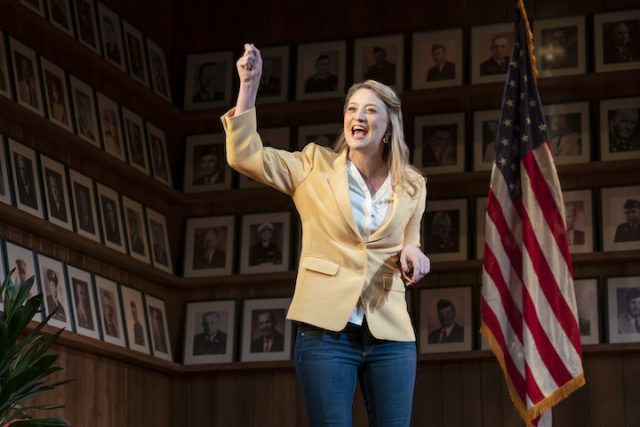
Heidi Schreck examines the US Constitution in Broadway transfer of hit play (photo by Joan Marcus)

Helen Hayes Theater
240 West 44th St. between Broadway & Eighth Ave.
Tuesday – Sunday through July 24, $49-$169
constitutionbroadway.com

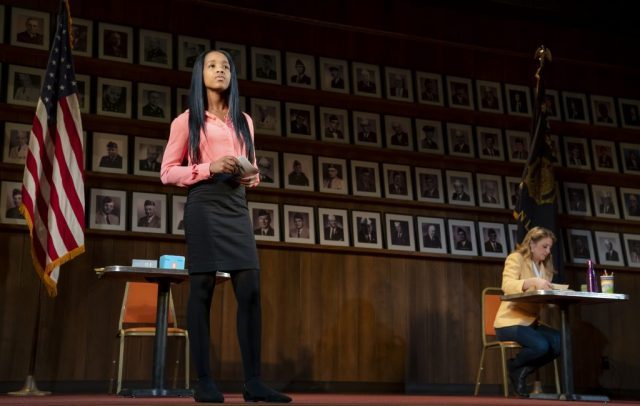
The first time I saw Heidi Schreck’s What the Constitution Means to Me, during its run last year at New York Theatre Workshop, it was the day that the Judiciary Committee had voted to advance the nomination of Brett Kavanaugh for Supreme Court Justice to the Senate floor. A somber atmosphere hung over the crowd, which was acknowledged by Schreck, who persevered with hope and humor. The show has now made a wholly successful transfer from the 199-seat NYTW to Broadway, where it is packing them into Second Stage’s 597-seat Helen Hayes Theater. And when I saw it there earlier this month, the foreboding cloud of doom and gloom was gone, replaced by an innate faith that America was going to be okay, as Schreck and the audience were in better spirits, often downright giddy, even as Schreck’s tale goes to dark, intimate places, all the while maintaining a steady focus on exactly “what the Constitution means to me” when “me” is a woman — or anyone except a white man.

In the mid-1980s, Schreck, living in the “abortion-free zone” of Wenatchee, Washington, earned money for college by participating in debates in American Legion Halls about the Constitution. The hundred-minute show re-creates some of those debates, focusing on the Ninth and Fourteenth Amendments, as Brooklyn-based actress, playwright, and television writer Schreck (Grand Concourse, The Consultant) shifts back and forth between her younger self and the woman she is today, able to intelligently face her demons and the mistakes she made, as well as celebrate the triumphs. She is supported by Mike Iveson (The Sound & the Fury, Plenty) as an American Legion Hall moderator and either Thursday Williams or Rosdley Ciprian, high school students who challenge her in a live debate. Rachel Hauck’s set remains intact, consisting of a few chairs and small tables, a central podium, and three sides of a wall displaying more than a hundred framed photographs of legionnaires, uniformly white men in caps. “This hall is not — it’s not a naturalistic representation,” Schreck says. “I got my friend Rachel to help me reconstruct it from my dreams, so I guess it’s like one of those crime victim drawings.” Obie-winning director Oliver Butler (The Amateurs, The Open House) doesn’t make any major changes for the Broadway transfer.

Thursday Williams debates Heidi Schreck in (photo by Joan Marcus)

Thursday Williams debates Heidi Schreck in What the Constitution Means to Me (photo by Joan Marcus)

Since I first saw the show at NYTW, there continues to be threats to the Constitution, which Schreck emphasizes “is a living document. That is what is so beautiful about it. It is a living, warmblooded, steamy document.” Using historical facts and personal anecdotes, Schreck connects to the audience while exploring the ramifications of the numerous interpretations of specific rights and liberties, taking on the white patriarchy and honoring the empowerment of women in the country while also delving into hot-button issues. Discussing Clause Four of the Fourteenth Amendment, she explains, “This is the most miraculous clause in our entire Constitution. It says that we all must be treated equally, that we cannot be discriminated against on the basis of race, sex, gender, sexual orientation, religion, ability, or immigration status. It actually uses the word ‘person,’ not ‘citizen.’ Which means that if you are an undocumented immigrant, you must be given all the protections of Clause Three, the due process clause. You cannot be locked up without a fair trial. You cannot have anything — or anyone — seized from you.” Schreck’s innate happiness in talking about the Constitution is infectious; she was so filled with glee that at one point, crossing the stage over to Iveson, she nearly fell onto him; the two of them broke out in laughter, as did the audience. It was one of several spontaneous moments in the show — which is scripted but includes significant room for improvisation — that will have you leaving the theater with a smile on your face even as you worry about how the Constitution is under attack on a nearly daily basis.

AIN’T TOO PROUD — THE LIFE AND TIMES OF THE TEMPTATIONS

(photo by Matthew Murphy)

The story of the Temptations comes to Broadway in jukebox musical (photo by Matthew Murphy)

Imperial Theatre
249 West 45th St. between Broadway & Eighth Ave.
Tuesday – Sunday through November 24, $49-$189
www.ainttooproudmusical.com

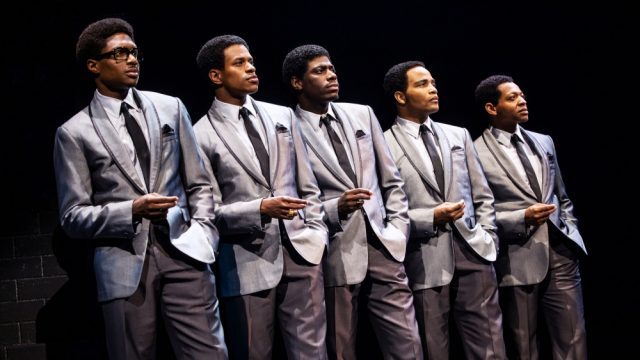
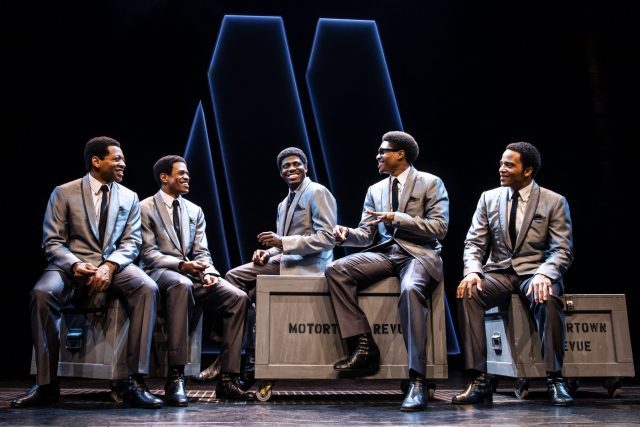
Ain’t Too Proud — The Life and Times of the Temptations purports to tell the story behind the famed R&B group that recorded many of Motown’s most popular and successful songs. But director Des McAnuff, a veteran of such other Broadway jukebox bio-musicals as the misbegotten Summer: The Donna Summer Musical and the runaway hit Jersey Boys (as well as Jesus Christ Superstar and The Who’s Tommy), and book writer Dominique Morisseau, a rising playwright who has written the Detroit Trilogy (Detroit ’67, Skeleton Crew, Paradise Blue), never approach cloud nine in this standard show that goes by the numbers. The story is based on the memoir of Temptations founder Otis Williams (Derrick Baskin), who narrates the chronological tale, from his childhood to the present day. After serving a stint in prison, he is determined to go straight, making his way in the music world.

He puts together a talented group of singers he initially calls Otis Williams and the Distants, then the Elgins, and finally, following an “accidental” meeting with Berry Gordy (Jahi Kearse) in a men’s room, the Temptations: Williams, the deep-voiced Melvin Franklin (Jawan M. Jackson), band choreographer Paul Williams (James Harkness), and up-and-coming superstars Eddie Kendricks (Jeremy Pope) and David Ruffin (Ephraim Sykes). Gordy teams them first with songwriter Smokey Robinson (Christian Thompson) and later Norman Whitfield (Jarvis B. Manning Jr.) as they eventually tear up the charts. But success also brings a clash of egos, drugs and alcohol, womanizing, domestic abuse, and the inability to maintain family relationships because of the constant touring, resulting in a revolving door of Temptations except for Otis, who remains throughout.

(photo by Matthew Murphy)

The Temptations are ready to take the music world by storm in Ain’t Too Proud (photo by Matthew Murphy)

Sergio Trujillo’s choreography captures the Temptations’ skillful movements, with Sykes eliciting shrieks of excitement from the audience for his spectacular moves, and Harold Wheeler’s orchestrations do justice to the Motown originals, from “My Girl,” “The Way You Do the Things You Do,” and “Papa Was a Rolling Stone” to “Just My Imagination (Running Away with Me),” “Ball of Confusion (That’s What the World Is Today),” and “I Can’t Get Next to You,” although some are condensed for time or broken up in the narrative. There are also hits from the Supremes, the Cadillacs, the Five Satins, and others that sometimes feel out of place as McAnuff and Morisseau try to provide musical context. The main group’s backup vocals are excellent, but the lead singers often fall short; it’s impossible to expect that the Broadway actors will reach the heights achieved by, for example, Kendricks and Ruffin, but several songs suffer for it. The story addresses the civil rights movement and the dire socioeconomic situation in Detroit in a bumpy manner, almost as if an afterthought, and the projections by Peter Nigrini are often repetitive and hard to figure out as they are shown on Robert Brill’s ever-changing set, which boasts a conveyor belt to help props and characters enter and exit.

Baskin (Memphis, The 25th Annual Putnam County Spelling Bee) is amiable and warm as Otis, a charming, principled man who chooses fame over family — Baskin is so comfortable in the role that he sweetly replied a few times to a woman in the audience who called out like she was at a church service — with a superb Rashidra Scott (Beautiful, Sister Act) as his wife, Josephine, and Shawn Bowers as his son, Lamont. Jackson (Motown: The Musical) is lovable as Franklin, a big man whose impossibly deep voice resonates through the theater and rattles in your bones. Also in the cast are Saint Aubyn and E. Clayton Cornelious as replacement Temptations Dennis Edwards and Richard Street, respectively; Nasia Thomas as Motown star Tammi Terrell, Florence Ballard of the Supremes, and Franklin’s stern mother; Joshua Morgan as the Temptations’ longtime manager, the white and Jewish Shelly Berger; Candice Marie Woods as Diana Ross; and Taylor Symone Jackson as Mary Wilson and Otis’s first manager. Paul Tazewell’s costumes and Charles G. LaPointe’s hair and wig design are right-on. Ain’t Too Proud looks and sounds good, but it fails to dig deep enough under the surface of one of R&B’s most beloved and seminal groups.

OKLAHOMA!

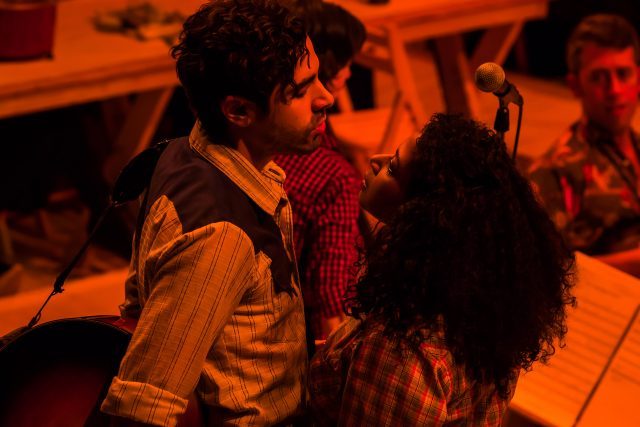
(© Little Fang Photo)

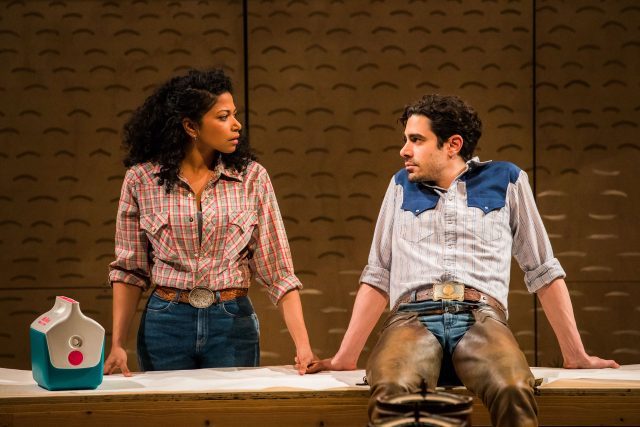
People might say Laurey Williams (Rebecca Naomi Jones) and Curly McLain (Damon Daunno) are in love in Oklahoma! (© Little Fang Photo)

Circle in the Square Theatre
1633 Broadway at 50th St.
Tuesday – Sunday through September 1, $69.50 – $169.50
oklahomabroadway.com

Daniel Fish’s extraordinary adaptation of Rodgers and Hammerstein’s Pulitzer Prize–winning Oklahoma! has come sweepin’ down on Broadway following a much-lauded sold-out run at St. Ann’s Warehouse in Brooklyn, opening last night at Circle in the Square. It’s the best of a recent influx of tweaked golden age musicals that update their take on misogyny and inequality between men and women, including My Fair Lady, Carousel, and Kiss Me, Kate. Fish has created a masterful retelling of the 1943 original, immersing the audience in the optimism that came with the southern territory becoming a state in 1906 — but uncovering a deep layer of darkness in the rich farmland soil. The theater has been turned into a communal hoedown, with some audience members sitting at long wooden tables on the stage opposite the characters; on the tables are red crockpots as if everyone is about to have a picnic — and indeed, at intermission, the audience lines up for a bowl of vegetarian chili and cornbread. Laura Jellinek’s stage is otherwise bare, with a pit at one end where the small band performs, a mural of a prairie landscape at the other, and many well-stocked gun racks on the walls surrounding the audience, threatening violence at any moment. The house lights are on for much of the show, except for two key times when lighting designer Scott Zielinski switches them off, bathing the theater in near-total pitch-blackness, only the red Exit signs visible. The lights above the stage shine through colorful bunting running across the ceiling, signaling a celebration, but it is a muted one, as Fish has a lot to say about the American dream amid all of this hopefulness in a still-young country.

(© Little Fang Photo)

Daniel Fish delivers a dark Oklahoma! at Circle in the Square (© Little Fang Photo)

A box social is coming up, in which the men of the town bid on “hamper” meals made by the women, followed by a square dance. Goofy cowboy Curly McLain (Damon Daunno) wants to go with the serious Laurey Williams (Rebecca Naomi Jones), a beauty considered the catch of the community, but she has already agreed to attend the dance with the creepy Jud Fry (Patrick Vaill), a hired hand working on her Aunt Eller’s (Mary Testa) farm; resembling Theon Greyjoy from Game of Thrones, he is an intense man who looks as if he’s going to explode at any second and do some very bad things. Meanwhile, the clueless Will Parker (James Davis) is courting the free-spirited Ado Annie (Ali Stroker), who has developed the hots for traveling peddler Ali Hakim (Will Brill), who doesn’t know what he’s getting into. The hoi polloi also includes federal marshal Cord Elam (Anthony Cason); Ado Annie’s father, judge Andrew Carnes (Mitch Tebo); Gertie Cummings (Mallory Portnoy), who is attracted to Curly and has a ridiculous laugh; and Mike (Will Mann), a big guy who spends a lot of time watching the proceedings.

Much of Agnes de Mille’s original choreography has been cut, as John Heginbotham has created new movement for several scenes, most importantly the second set opener, in which Gabrielle Hamilton performs a long, powerful modern-dance solo to a screeching instrumental medley. Wearing a white shirt that says, “Dream Baby Dream,” referencing a song by glam punk duo Suicide (and covered by Bruce Springsteen), she furiously runs, jumps, and twirls across the stage, stopping often to make direct eye contact with people in the audience, almost accusingly, raising issues of gender and race as she questions the promise of equal opportunity in America, her deep breaths echoing through the space.

(© Little Fang Photo)

Gabrielle Hamilton opens the second act with a thrilling solo about the American dream (© Little Fang Photo)

Fish (White Noise, The Source), well respected for his experimental works, primarily sticks to Oscar Hammerstein II’s book, although the ending is significantly altered to comment on the current state of one critical debate in the nation. Richard Rodgers’s score is gorgeously played by a country bluegrass band, expertly orchestrated by Daniel Kluger, with conductor and music director Nathan Koci on accordion and drums, Joe Brent on mandolin and electric guitar, Brett Parnell on pedal steel guitar, Hilary Hawke on banjo, Sarah Goldfeather on violin, Leah Coloff on cello, and Eleonore Oppenheim on bass. Joshua Thorson’s projections are not necessary, part of a trend of shows using large-scale live imagery that is all Ivo van Hove’s fault. Drew Lovey’s sound works well, particularly during the two scenes that take place in darkness.

But Fish doesn’t leave out the exhilarating joy that is Oklahoma!, which was based on the 1931 play Green Grow the Lilacs by Lynn Riggs, debuted on Broadway in 1943, won two Oscars for Fred Zinnemann’s 1955 film, and has previously been revived on the Great White Way in 1979 and 2002. Songs such as “Oh, What a Beautiful Morning,” “The Surrey with the Fringe on Top,” and “People Will Say We’re in Love” don’t sound old-fashioned in the least, and Stroker (Spring Awakening, Glee), rolling around in her wheelchair with an infectious glee, blasts out “I Can’t Say No,” taking ownership of her decisions as a sexually aware woman. Daunno (The Lucky Ones, Hadestown) and Jones (Significant Other, Big Love) excel in a battle of wills, while Vaill (Macbeth, Peter Pan) is chilling in a role previously played by Howard Da Silva, Shuler Hensley, and Rod Steiger. The ever-reliable Testa (Wicked, Queen of the Mist) holds down the fort as the sensible Aunt Eller. Don’t be scared off by the doom and gloom; Fish will still have you leaving the theater with magical music filling your head, even as you reconsider certain elements of a familiar story and how it relates to America in 2019.

HARPER LEE’S TO KILL A MOCKINGBIRD

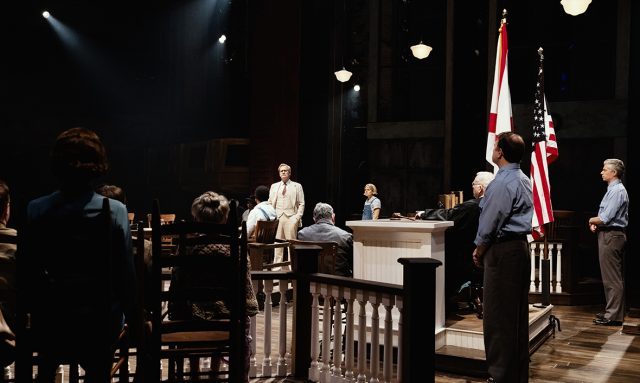
(photo by Julieta Cervantes)

Atticus Finch (Jeff Daniels) addresses the court in Aaron Sorkin’s Broadway adaptation of Harper Lee’s To Kill a Mockingbird (photo by Julieta Cervantes)

Shubert Theatre
225 West 44th St. between Broadway & Eighth Aves.
Tuesday – Sunday through November 3, $89-$199
tokillamockingbirdbroadway.com

About a dozen years ago, friends of mine had a baby they named Atticus, after the lawyer in Harper Lee’s Pulitzer Prize–winning 1960 novel, To Kill a Mockingbird; Gregory Peck won his only Oscar for portraying the highly principled Atticus Finch in Robert Mulligan’s 1962 film. If my friends had seen Aaron Sorkin’s Broadway adaptation of Lee’s book before giving birth, they may have chosen a different name. Following a legal dispute with the estate, which claimed that Oscar and Emmy winner Sorkin — who has written such plays as A Few Good Men and The Farnsworth Invention, such films as Moneyball and The Social Network, and such series as The West Wing and The Newsroom, — had broken their contract by making too many changes to Lee’s original story, the play opened at the Shubert Theatre after an undisclosed settlement to mixed reviews, some celebrating Sorkin’s version, others vilifying it as a disgrace. I find myself somewhere in between; directed by Bartlett Sher, the production is outstanding, but too many of Sorkin’s alterations scream out, too patently obvious and political-minded.

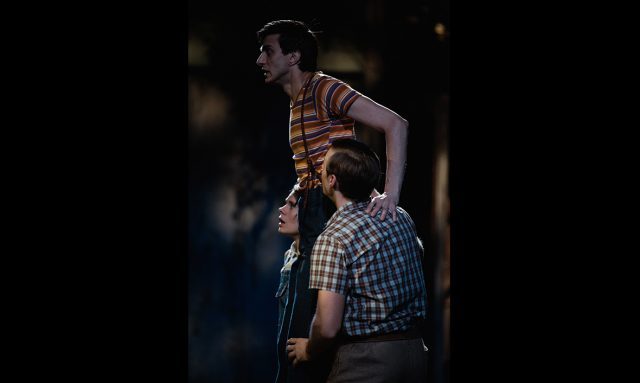
(photo by Julieta Cervantes)

Dill (Gideon Glick) is lifted up by Scout (Celia Keenan-Bolger) and Jem (Will Pullen) in To Kill a Mockingbird (photo by Julieta Cervantes)

Set in sweltering Maycomb, Alabama (inspired by Lee’s hometown of Monroeville), in 1934, the poignant story about racial injustice is narrated by Atticus’s young daughter, Scout, played by forty-one-year-old actress Celia Keenan-Bolger, retelling what happened when a black man named Tom Robinson (Gbenga Akinnagbe) is accused of raping a white woman, Mayella Ewell (Erin Wilhelmi), and is defended by the widowed Atticus Finch (Jeff Daniels). Scout spends the summer hanging out with her older brother, Jem (Will Pullen), and new neighbor Dill (Gideon Glick), goofing around, traipsing too close to the house where local weirdo Arthur “Boo” Radley (Danny Wolohan) resides, and watching the trial. The white townspeople are furious that Atticus is helping a black man, and they make sure to let him know it, threatening Finch and his family with violence. But Atticus is determined not to give up, believing that he has enough evidence on his side to convince the all-white jury of Tom’s innocence. But racism rules all in Maycomb.

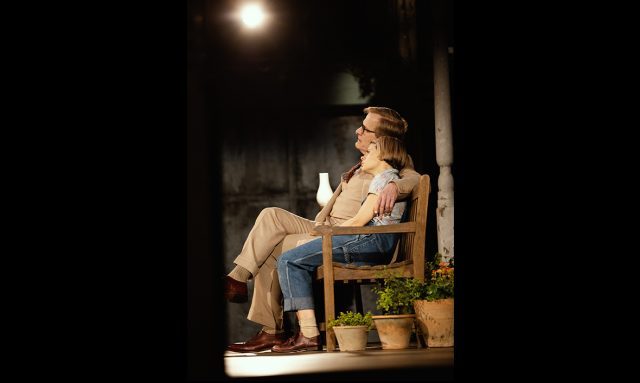
(photo by Julieta Cervantes)

Atticus (Jeff Daniels) and daughter Scout (Celia Keenan-Bolger) take a break on the front porch in Aaron Sorkin adaptation of classic novel (photo by Julieta Cervantes)

Sorkin makes some critical adjustments to Lee’s novel and the film, focusing on different aspects and characters. Judge Taylor (the ever-reliable Dakin Matthews) becomes more involved in the trial, castigating prosecutor Horace Gilmer (Stark Sands) and such witnesses as Bob Ewell (Frederick Weller), Mayella’s father, for ignoring protocol. The Finches’ maid, Calpurnia (LaTanya Richardson Jackson), speaks with a decidedly twenty-first-century attitude, intent on getting Atticus woke. Atticus also is a modern-day figure, beset by a political correctness that makes him want to see the best in all people, even men who don white hoods in the middle of the night and lie on the stand. His determination to reserve judgment of those who so obviously deserve it feels oddly reminiscent of President Trump’s declaration that there are good people on both sides of the Charlottesville conflict, although nothing else about Atticus is Trumpian.

Miriam Beuther has crafted a homey southern set, complete with musicians on either side of the stage for added atmosphere, with Kimberly Grigsby on pump organ and Allen Tedder on guitar, playing original music by Adam Guettel. Two-time Tony nominee and Emmy and Obie winner Daniels (Blackbird, God of Carnage) is both tender and stalwart as Atticus, an understanding man who has too much faith in humankind, while three-time Tony nominee Keenan-Bolger (The Glass Menagerie, The 25th Annual Putnam County Spelling Bee) is terrific as the adventurous and curious Scout, a young girl wise beyond her years, without being overly precocious. The cast also features Danny McCarthy as Sheriff Heck Tate, Wolohan as Mr. Cunningham, Phyllis Somerville as Mrs. Henry Dubose, and Neal Huff as the mysterious Link Deas. Sorkin’s version of Lee’s classic Bildungsroman is not your mother’s To Kill a Mockingbird, nor your grandmother’s. It is built around the continuing legacy of America’s greatest shame, from the seventeenth century to now, when it’s sadly still relevant, even if it’s been fiddled with far too much and there are unlikely to be a glut of babies named Atticus in the near future.

KISS ME, KATE

(photo by Joan Marcus 2019)

Kelli O’Hara and Will Chase star as a divorced couple making a musical version of The Taming of the Shrew in Kiss Me, Kate (photo by Joan Marcus 2019)

Studio 54
254 West 54th St.
Through June 30, $59-$352
212-719-1300
www.roundabouttheatre.org

The #MeToo makeover of golden age Broadway musicals continues with Roundabout’s Kiss Me, Kate, which opened March 14 at Studio 54. In the last year, major or minor changes have been made to My Fair Lady, Carousel, and Oklahoma! in order to deal with their troublesome presentations of sexism, misogyny, domestic violence, and gender inequality. Tony nominee Amanda Green (Hands on a Hardbody, Bring It On), who tweaked Roundabout’s 2015 revival of On the 20th Century, now does the same with Kiss Me, Kate, implementing small fixes that most audience members won’t notice in director Scott Ellis’s exuberant adaptation of one of Cole Porter’s most beloved shows, which in 1949 won the first-ever Tony for Best Musical and in 2000 won for Best Revival of a Musical. The book by Sam and Bella Spewack (Boy Meets Girl, My Favorite Wife), inspired by the real-life relationship of legendary actors Alfred Lunt and Lynn Fontanne during their 1935 revival of William Shakespeare’s The Taming of the Shrew at the Guild Theatre (now known as the August Wilson), also won a 1949 Tony.

The tale is set in the summer of 1948, as a company prepares for opening night of a musical version of Shrew at Baltimore’s Ford Theatre, hoping for an eventual Broadway run. The show is produced and directed by Fred Graham (Will Chase), who also plays Petruchio, opposite his ex-wife, movie star Lilli Vanessi (Kelli O’Hara), who is returning to the stage as Katharine (Kate), the character who supposedly needs taming. The backstage shenanigans mimic Shakespeare’s plot with an extra dollop of Hollywood screwball comedy as Petruchio woos Kate for her father’s (Mel Johnson Jr., who also plays stage manager Harry Trevor) money despite her resistance, for she wants no part of any man, while Fred and Lilli become enmeshed in a battle of the sexes over fame, fortune, and love. Fred is fooling around with the sweet but not-so-innocent ingénue Lois Lane (Stephanie Styles), who is dating Bill Calhoun (Corbin Bleu), a cad with a $10,000 gambling debt he has surreptitiously signed over to Fred. In the musical within the musical, Lois is Bianca, Kate’s younger sister, who has a trio of suitors, Gremio (Will Burton), Hortensio (Rick Faugno), and Lucentio, the last played by Bill. Lilli has just gotten engaged to General Harrison Howell (Terence Archie), a rigid military man who is not as devoted to his fiancée as he is to his country or other women. Meanwhile, Fred is being closely watched by two gangsters (John Pankow and Lance Coadie Williams) who are sticking around to collect their boss’s ten grand and who even take roles in the show to make sure Fred doesn’t go anywhere.

(photo by Joan Marcus 2019)

“Too Darn Hot” is a highlight of Roundabout revival of Kiss Me, Kate (photo by Joan Marcus 2019)

Ellis’s revival takes a while to get going, building too slowly. It isn’t until the second act opener, the sizzling “Too Darn Hot,” led by James T. Lane as Paul, Fred’s assistant, that the show starts hitting its mark. The chemistry between Tony nominee Chase (The Mystery of Edwin Drood, Nashville) and Tony winner O’Hara (The King and I, South Pacific) is just not there at the beginning; Fred is too unsympathetic, and Lilli is not shrewish enough, especially as compared to Petruchio and Kate. You just don’t want them to fall back in love. In her Broadway debut, Styles (Kingdom Come, Roman Holiday) is a delight as Lois/Bianca, and Pankow (Twelve Angry Men, The Iceman Cometh) and Williams (Sweat, Bootycandy) have fun as the gangsters, although “Brush Up Your Shakespeare” goes on too long. Paul Gemignani’s orchestrations of such Porter tunes as “Another Op’nin’, Another Show,” “Wunderbar,” “Why Can’t You Behave,” and “Where Is the Life That Late I Led?,” performed by a band positioned in the audience boxes on either side of the stage, go from syrupy to extravagant, with O’Hara cutting it loose with her operatic voice and making Lilli’s point exceedingly clear in “I Hate Men” (“I hate men. / Though roosters they, I will not play the hen. / If you espouse an older man through girlish optimism, / He’ll always stay at home at night and make no criticism, / Though you may call it love the doctors called it / Rheumatism. / Oh, I hate men.”).

The choreography by Tony winner Warren Carlyle (After Midnight; Hello, Dolly!) is highlighted by “Too Darn Hot,” which includes tap and lots of heat, and “Tom, Dick or Harry,” as Gremio, Hortensio, and Lucentio make their case to Bianca through dazzling moves. David Rockwell’s sets change to a choreography all their own. But even as Lilli strikes back at Fred, literally and figuratively, her ultimate choice does not feel as liberating as one might wish. “Come, come you wasp; i’ faith, you are too angry,” Petruchio tells Kate, who replies, “If I be waspish, best beware my sting.” Eight-time Tony nominee Ellis’s (Curtains, 1776) Shrew lacks the necessary sting, but it does have bite.

THE PROM / THE CAKE

(photo by Deen van Meer)

Broadway stars Dee Dee Allen (Beth Leavel) and Barry Glickman (Brooks Ashmanskas) find a common cause after their Eleanor Roosevelt musical gets panned in The Prom (photo by Deen van Meer)

THE PROM
Longacre Theatre
220 West 48th St. between Broadway & Eighth Ave.
Tuesday – Sunday through October 20, $49-$169
212-239-6200
theprommusical.com

In 2012, Colorado baker Jack Phillips refused to make a wedding cake for a gay couple because of his religious beliefs, leading to a Supreme Court case and a battle with the Colorado Civil Rights Commission. In 2010, a Mississippi high school canceled its prom after being sued for barring a lesbian student from attending with her girlfriend. These two ripped-from-the-headlines situations have inspired a pair of shows currently running in the city that deal with issues of faith, prejudice, and LGBTQ rights in very different ways, both sparked by the struggle of gay couples to celebrate happy milestone events just like straight culture does. They also both explore the possibility of changing people’s minds, asking for tolerance of the intolerant. In The Prom, a musical comedy at the Longacre, the setup is theatrical: Great White Way veterans Dee Dee Allen (Beth Leavel) and Barry Glickman (Brooks Ashmanskas) are looking for a quick way to rebound from their instant flop Eleanor! — The Eleanor Roosevelt Musical by finding a cause they can support to get them some positive press attention. “People need to know it’s possible to change the world, whether you are a homely middle-aged first lady or a Broadway star,” Dee Dee, who played Eleanor, says. Barry adds, “The moment I first stepped into FDR’s shoes, and by shoes I mean wheelchair, I had an epiphany. I realized there is no difference between the president of the United States and a celebrity. We both have power. The power to change the world.”

They are joined by lesser-known minor actors Trent Oliver (Christopher Sieber) and Angie (Angie Schworer) and producer Sheldon Saperstein (Josh Lamon) and decide their best opportunity is to head to Edgewater, Indiana, where high school student Emma (Caitlin Kinnunen) is being harassed by the other students because Mrs. Greene (Courtenay Collins), the head of the PTA, has canceled the prom since Emma was going to go with another girl. Little does Mrs. Greene know that Emma is dating her daughter, Alyssa (Isabelle McCalla), who is understandably terrified of coming out to her mother. As this self-centered crackpot Justice League demands equal rights (“We’re all lesbians!”), Dee Dee unexpectedly falls for the soft-hearted, clear-sighted principal, Mr. Hawkins (Michael Potts), who takes the case to the state attorney’s office. He’s also none too happy when he begins thinking that the city folk might be in it only for the publicity, not the cause.

(photo by Deen van Meer)

Angie (Angie Schworer) gets a leg up speaking with gay teen Emma Greene (Caitlin Kinnunen) (photo by Deen van Meer)

Directed and choreographed by Tony winner Casey Nicholaw (The Book of Mormon, Something Rotten!), The Prom features a book by Bob Martin and Chad Beguelin, with music by Matthew Sklar and lyrics by Beguielin, who have a blast skewering not only the concept of narcissistic celebrities but musical theater itself. It’s loaded with inside jokes; for example, when Barry says to Angie, “I thought you were in Chicago,” she replies, “I just quit. Twenty years in the chorus and they still wouldn’t let me play Roxie Hart.” Schworer played Go to Hell Kitty for three years in a tour of Chicago while also understudying the Hart role. At nearly two and a half hours, The Prom is too long and overly repetitive, and it’s pretty easy to see where it’s going as it uses a sledgehammer to bring home its sociological perspective.

(photo by Deen van Meer)

Dee Dee Allen (Beth Leavel) seeks good publicity in Indiana fighting for an inclusive prom (photo by Deen van Meer)

Before leaving for Indiana, the five New Yorkers sing, “We’re gonna teach them to be more P.C. / the minute our group arrives. That’s right! Those / fist pumping / Bible thumping / Spam eating / cousin humping / cow tipping / shoulder slumping / tea bagging / Jesus jumping / losers and their inbred wives / They’ll learn compassion / and better fashion / once we at last start changing lives!” Mrs. Greene sticks to her guns, declaring, “You and your friends know nothing about us, about our town, about our people. And yet, you feel justified in telling us what to do.” It’s the privileged elitists against the deplorables, each side proclaiming that the other is the villain. The show inadvertently shoots itself in the foot by having a multiracial, color-blind cast at the school; if the town is so bigoted against gays and lesbians, it’s unlikely to be so accepting of blacks, Latinx, and Asians, so the homosexual fear/hatred feels like a plot device, which it is. Of course, the producers would have taken a different kind of hit if they had indeed hired only white actors to portray the children and adults of Edgewater. The Prom can be wacky and poignant, but it also can be preachy and predictable, whether to liberal theatergoers from the blue states or conservative tourists from red states. Nobody loses!

(photo © Joan Marcus, 2019)

Della (Debra Jo Rupp) is a sweet baker who opts not to make a cake for a gay wedding in MTC production at City Center (photo © Joan Marcus, 2019)

THE CAKE
Manhattan Theatre Club
MTC at New York City Center – Stage I
Tuesday – Sunday through March 31, $89
212-581-1212
thecakeplay.com

Meanwhile, Bekah Brunstetter’s The Cake, which opened this week at Manhattan Theatre Club’s Stage I at City Center, takes place in a small, tight-knit community in North Carolina, where the delightful Della (Debra Jo Rupp) runs a bakery specializing in extraordinary cakes for special occasions. Della, who is scheduled to be a contestant on The Great American Baking Show, is visited by Jen (Genevieve Angelson), the daughter of her late best friend, who has come to tell her that she is getting married and wants her to make the cake for the special event. But when Della finds out that Jen’s fiancée is Macy (Marinda Anderson), a black gluten-free Brooklynite, she changes her mind and claims that she is too busy to bake for her. While Macy is furious, Jen wants to give Della the benefit of the doubt.

When it seems that Della might be rethinking her decision (which is based on sexual orientation, not race, as Bella notes, “I don’t see color”), her husband, Tim (Dan Daily), demands that she not bake the cake because of their religion. “We know we can’t pick and choose the Bible, honey,” he explains. “That’s when the edges start to blur. Fabric starts to fray. We can be sad for her, though. We can love her, still.” Later, he says, “It’s — it’s just not natural.” Della responds, “Well, neither is confectioner’s sugar!” Tim: “You’re not making that cake.” Della: “I’ll make it if I want to.” Tim: “What’s that?” Della: “Nothing.” Tim and Della are quite a couple; she bakes delicious items that go in people’s mouths, while he, a plumber, fixes problems involving what comes out the other end.

(photo © Joan Marcus, 2019)

Baker Della (Debra Jo Rupp) and plumber Tim (Dan Daily) discuss sex and religion in The Cake (photo © Joan Marcus, 2019)

Much like the Broadway elitists want to change the mind of Edgewater, Indiana, Macy feels that Jen can help Della avoid making the wrong choice. “You could change her,” Macy says. “Della? No thank you,” Jen replies. Macy: “But if you don’t push her to change, then they never will. “Jen: “They?” Macy: “All of them.” . . . Jen: All I ask is that you just try and be respectful of the people down here.” Macy: “I don’t respect these people.” Jen: “But I’m one of them.” Macy: “No you’re not.” Brunstetter, a writer and producer on the first three seasons of This Is Us who identifies as a straight white woman, was raised in a conservative North Carolina household; she loves and respects her family even though she disagrees with them on many social issues, and The Cake might her attempt to convince theatergoers who are not fond of bigots and homophobes to have more compassion and empathy for these down-home plain folk.

(photo © Joan Marcus, 2019)

Della (Debra Jo Rupp) is happy for Jen (Genevieve Angelson) and Macy (Marinda Anderson) despite her religious beliefs in Bekah Brunstetter play (photo © Joan Marcus, 2019)

But it’s not that easy; no matter how cute and adorable Della is — and she’s portrayed wonderfully by Rupp, the mother on That ’70s Show and Linda on This Is Us; in fact, all four actors are terrific — it’s a lot for Brunstetter to ask of the audience. At the beginning of the play, which is engagingly directed by three-time Tony nominee Lynne Meadow (The Assembled Parties, The Tale of the Allergist’s Wife) and boasts an attractive set by John Lee Beatty that consists of ever-shifting ingredients, Della says, “See, what you have to do is really, truly follow the directions. That’s what people don’t understand.” She’s talking not only about baking but about her religion, following kitchen directions like she follows the Bible. Della also occasionally speaks with a disembodied voice from The Great American Baking Show, booming down from above as if God himself, judging if she’s worthy of being on the program. Each of the characters gets at least a little bit woke about something, resulting in a story that has tasty icing but too much fluff. “Ambivalence is just as evil as violence,” Macy argues after Della says she is not a political person, as if that excuses her from addressing the hot-button topics of the day. It’s also an excuse for Brunstetter to try to get us to accept her own family’s insensitivity to certain types of people. But being tolerant of the intolerant is not going to change things the way they need to be changed.