this week in broadway

PARADE

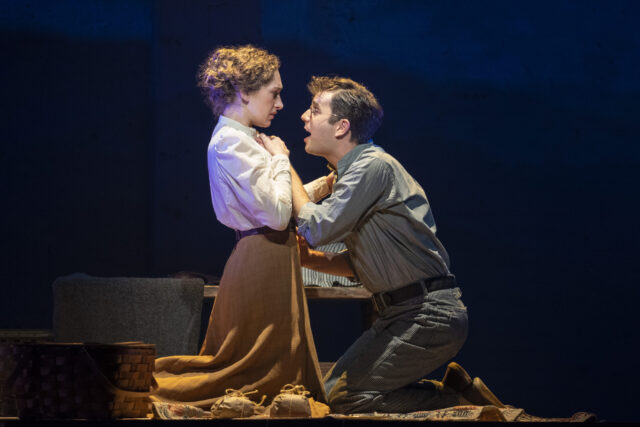
Lucille (Micaela Diamond) and Leo Frank (Ben Platt) fight for justice in Parade (photo by Joan Marcus)

PARADE
Bernard B. Jacobs Theatre
242 West 45th St. between Broadway & Eighth Ave.
Tuesday – Sunday through August 6, $84-$288
paradebroadway.com

At intermission of the first Broadway revival of Parade, based on a true story of anti-Semitism, racism, and a terrible miscarriage of justice, several colleagues and I asked the same question: “Why is this a musical?” We found out in the far superior second act.

The show, directed by Harold Prince, with music and lyrics by Jason Robert Brown and a book by Oscar and Pulitzer Prize winner Alfred Uhry (Driving Miss Daisy), debuted at the Vivian Beaumont in 1998, running for thirty-nine previews and eighty-four regular performances, earning nine Tony nominations and winning for Best Book and Best Original Score. It is now playing at the Bernard B. Jacobs Theatre, in a version directed by Tony winner Michael Arden that transferred from Encores! at City Center and uses the 2007 Donmar Warehouse production, which included a few different songs from the original.

Parade begins with a prologue set in Marietta, Georgia, in 1862, as a young Confederate soldier (Charlie Webb) sings goodbye to his love and prepares to fight “for these old hills behind me / these old red hills of home. . . . in the land where honor lives and breathes.” The action then shifts to Atlanta in 1913, where the soldier (Howard McGillin), who lost a leg in the Civil War, is determined to help the South rise again, “honor” be damned.

It’s Confederate Memorial Day, and Lucille Frank (Micaela Diamond) wants to go on a picnic with her husband, Leo (Ben Platt), but he instead decides to go to work at the National Pencil Company, her father’s factory where Leo is superintendent. Thirteen-year-old Mary Phagan (Erin Rose Doyle) arrives to collect her pay and is later found murdered in the basement. The police arrest Leo for the crime, but he doesn’t take them very seriously, since he is innocent — but when power-hungry district attorney Hugh Dorsey (Paul Alexander Nolan) starts building a strong case against him, constructed on a series of lies, Leo suddenly faces reality as Lucille seeks to uncover the truth and reveal the conspiracy to railroad her husband.

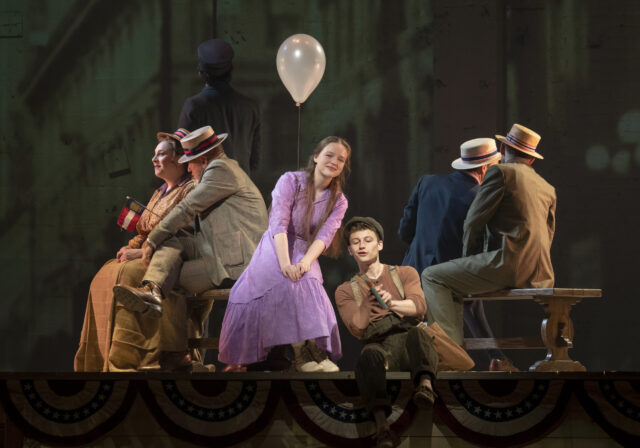
Mary Phagan (Erin Rose Doyle) enjoys one final moment of life with Frankie Epps (Jake Pedersen) in based-on-fact musical (photo by Joan Marcus)

Among those participating in the frame-up led by Dorsey are National Pencil night watchman Newt Lee (Eddie Cooper), janitor Jim Conley (Alex Joseph Grayson), and Frank family maid Minnie McKnight (Danielle Lee Greaves), all of whom are Black and manipulated because of the color of their skin; Governor Jack Slaton (Sean Allan Krill), who is more concerned with his upcoming reelection campaign than the fate of one perhaps innocent man; Mary’s friend Frankie Epps (Jake Pedersen), who wants to see the murderer “burn in the ragin’ fires of hell forevermore”; right-wing newspaper editor and publisher Tom Watson (Manoel Felciano), who calls out, “Who’s gonna stop the Jew from killin’? Who’s gonna swing that hammer?”; Judge Roan (McGillin), who’d rather be fishing than in court; and Britt Craig (Jay Armstrong Johnson), an ambitious reporter who declares, “Take this superstitious city / Add one little Jew from Brooklyn / Plus a college education and a mousy little wife / And big news! Real big news! / That poor sucker saved my life!” Mary’s distraught mother (Kelli Barrett) is the only one considering forgiveness.

The focus of the show shifts dramatically after intermission, during which Leo remains onstage, in his jail cell, contemplating his fate; while the first act was all over the place, squeezing in too much information alongside oversized production numbers, the second act zeroes in on the touching relationship between Lucille and Leo as they desperately try to prove his innocence. It’s a beautiful, romantic love story, highlighted by a prison picnic Lucille brings to Leo in which she first chastises him for not accepting her assistance. “Do it alone, Leo — do it all by yourself. / You’re the only one who matters after all. / Do it alone, Leo — why should it bother me? / I’m just good for standing in the shadows / And staring at the walls, Leo,” she sings. Later they duet on “This Is Not Over Yet,” as Leo proclaims, “Hail the resurrection of / the south’s least fav’rite son! / It means I made a vow for better! / Two is better than one! / It means the journey ahead might get shorter. / I might reach the end of my rope! / But suddenly, loud as a mortar, there is hope!”

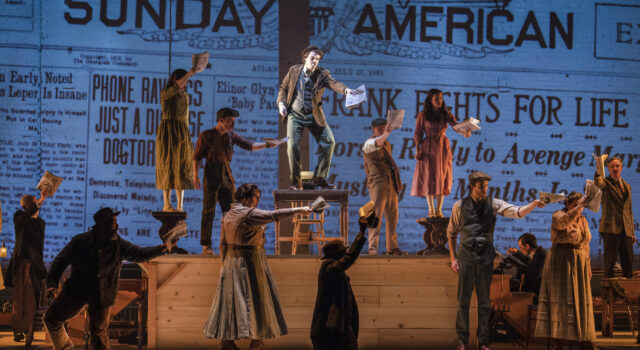
Parade features archival projections throughout (photo by Joan Marcus)

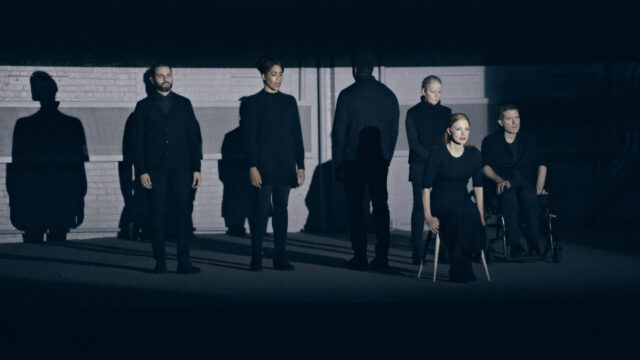
Dane Laffrey’s set is centered by a large wooden platform on which most of the action takes place, evoking a gallows as well as a coffin. There are scattered chairs and pews on either side, where many of the characters sit when they’re not in the scene, which can get confusing, especially for actors who play multiple roles. Susan Hilferty’s period costumes put us right in the 1910s, while Sven Ortel’s projections feature archival photographs of the real people and locations involved in the story, along with newspaper articles and a memorial plaque, a constant, and effective, reminder that this really happened — along with a final shot providing one last shock. Lauren Yalango-Grant and Christopher Cree Grant’s choreography thankfully calms down in the second half. Heather Gilbert’s lighting and Jon Weston’s sound maintains the dark mood surrounding the events. Music director and conductor Tom Murray handles three-time Tony winner Brown’s (The Last Five Years, Mr. Saturday Night) compelling score with a rousing touch, while director Michael Arden (Spring Awakening, Once on This Island) ably navigates through Uhry’s (Driving Miss Daisy, The Last Night of Ballyhoo) busy book. (Notably, Atlanta native Uhry’s great-uncle owned the National Pencil Company at the time of the killing.)

Tony winner Platt (Dear Evan Hansen, The Book of Mormon) and Diamond (The Cher Show, A Play Is a Poem) are wonderful together, portraying a Jewish couple in the Deep South facing bigotry; Platt captures Leo’s unrealistic belief that justice will triumph in the end, while Diamond embodies Lucille’s growth as she confronts what is happening in her beloved hometown. Grayson (Into the Woods, Girl from the North Country) brings down the house with “Feel the Rain Fall,” although, in 2023, it teeters on the edge of appropriation. Courtnee Carter (Once on This Island, Sing Street) as Angela and Douglas Lyons (Chicken & Biscuits, Beautiful) as Riley provide necessary perspective in their duet, “A Rumblin’ and a Rollin’,” in which they assert, “I can tell you this, as a matter of fact, / that the local hotels wouldn’t be so packed / if a little black girl had gotten attacked.” Also providing strong support are Cooper (Assassins, The Cradle Will Rock), Tony nominee Krill (Jagged Little Pill, Honeymoon in Vegas), and Greaves (Hairspray, Rent).

The final projection as the musical ends is a potent reminder that this country still has a long way to go when it comes to entrenched racism, misogyny, and anti-Semitism, in states such as Georgia and too many others that appear determined to continue a legacy of bigotry and hatred, although there is hope with such political stalwarts as Georgia senator Raphael Warnock, the reverend who tells us, before the show starts, to silence our cellphones but, implicitly, not our voices.

BAD CINDERELLA

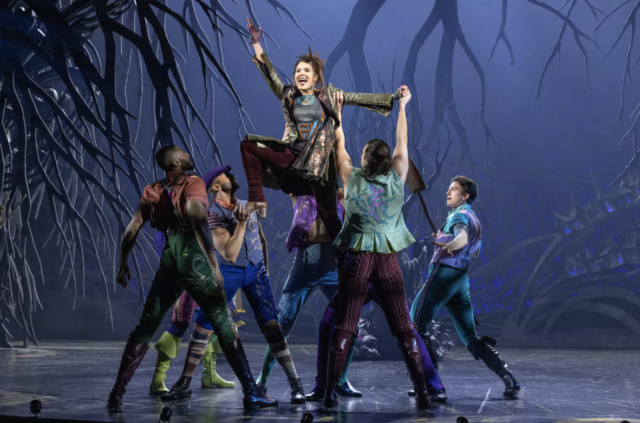
Bad Cinderella (Linedy Genao) rises up in Andrew Lloyd Webber Broadway musical (photo by Matthew Murphy and Evan Zimmerman)

BAD CINDERELLA
Imperial Theatre
249 West 45th St. between Broadway & Eighth Ave.
Tuesday – Sunday through June 4, $48-$298
badcinderellabroadway.com

At last Friday night’s performance of Bad Cinderella at the Imperial, a boisterous trio of big men sat behind us, their belly laughs and rousing cheers shaking our row throughout the first act. During intermission, I turned to my friend and said, “I want to watch what they’re watching.”

Indeed, what show were they watching?

I am not going to jump on the bandwagon and take advantage of the American retitling of Andrew Lloyd Webber’s Cinderella, which has added the word Bad, but it’s hard not to. I found the two-and-a-half-hour musical more insulting and embarrassing than downright bad; I knew we were in trouble when my musical-loving friend wasn’t giving even perfunctory applause after songs. “You’ve ruined theater for me forever,” she told me outside at intermission, as if it was my fault for taking her. “I might never see another show.”

Bad Cinderella is everything you’ve heard and worse.

Lloyd Webber, whose composer son Nick tragically died from gastric cancer on March 25 at the age of forty-three, has some fierce competition in the alt-fairy-tale Broadway musical realm. Stephen Schwartz and Winnie Holzman’s Wicked has been packing them in on the Great White Way since 2003. The recent limited-run revival of Stephen Sondheim’s Into the Woods was spectacular. And musical minions are still kvelling over Douglas Carter Beane’s 2013 family-friendly adaptation of Rodgers + Hammerstein’s more traditional Cinderella.

Bad Cinderella is ostensibly about being proud of one’s personal identity and defying the populist adherence to conventional ideas of beauty and success. But in its attempts to be clever, unpredictable, and, dare I say, woke, it steps all over itself, fumbling its themes and confusing its basic principles.

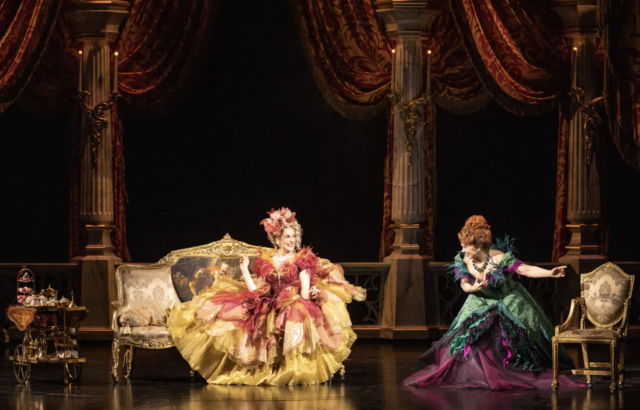
The Queen (Grace McLean) and the Stepmother (Carolee Carmello) do battle in Bad Cinderella (photo by Matthew Murphy and Evan Zimmerman)

The show opens with the innocuous “Buns ’n’ Roses / Beauty Is Our Duty,” in which random characters at the Belleville Market revel in their hotness amid garish sexual innuendo. “Hot buns! Check out my hot buns!” the hunky baker declares. “True, there are not buns / Equal to mine.”

Various townspeople blast out, “Our town Belleville is a place so picturesque, / Makes every other town jealous. / So exquisite, every other seems grotesque. . . . Every single citizen’s a cut and chiseled god, / Beauty is our duty. / Everyone among us has a ripped and rockin’ bod. . . . We’re quite shallow, / We’re obsessed with how we look. / It’s quite OK if you’re dumb here. / Every lawn is manicured / As well as every hand.”

“Wrinkles are not tolerated, torsos must be tanned. / Acne is a misdemeanor, / Cellulite is banned. . . . So what if we’re a bit snooty” is about as sophisticated as Tony winner David Zippel’s lyrics gets.

The book, by Oscar winner Emerald Fennell and adapted by playwright Alexis Scheer for the Broadway run, is a “hot mess,” which is what the townspeople call Cinderella. Cinderella is ripe for interpretation; the Brothers Grimm and Rodgers & Hammerstein are only two of thousands who have told a similar tale going back two millennia. The most famous version was written in 1697 by Charles Perrault, the basis for the 1950 animated film by Walt Disney, a rags-to-riches story of magic, abuse, discrimination, misogyny, and outmoded ideals of what makes a person attractive and desired.

Director Laurence Connor and choreographer JoAnn M. Hunter hit a brick wall just a few minutes in, after the unveiling of a statue in honor of the missing Prince Charming (Cameron Loyal) reveals that Cinderella (Linedy Genao) has defaced it with a graffiti-esque banner declaring, “Beauty Sucks.” The townspeople call her a “psychopath” who “should be arrested,” but a moment later the hunky men are lifting her up as if she’s a hero, not a villain, and she proudly proclaims, “I’m a loner, I’m a freak, a rebel. . . . a girl from the gutter, unpleasant peasant, no one, a nutter, unwelcome present.”

Cinderella is badly mistreated by her stepmother (Carolee Carmello) and two gorgeous but hollow and dimwitted stepsisters, Adele (Sami Gayle) and Marie (Morgan Higgins). Her only friend is Prince Sebastian (Jordan Dobson), now heir to the throne, a shy young man with no kingly aspirations who the women in the town deride, complaining, “What a disappointment is this prince! / Look at him! My heart can’t help but wince! / He’s not the type on which girls set their sights.”

It doesn’t help that Sebastian is handsome, even in his militaristic outfit, even if he is dour, unhappy to be thrust into the limelight, while Cinderella, in her long black leather jacket, tight-fitting shirt, and maroon pants, is not only cool but hot, at least to the audience if not to the vain citizens of Belleville. “I’m the opposite of ev’rthing you are!” she sings. So why, about halfway through the show, does she go to Godmother (Christina Acosta Robinson), a nasty plastic surgeon, wanting her to transform her into a beauty, to be just like everyone else so the prince will choose her for his bride at the ball?

“The damsel wants to save the prince in distress. How very modern
of you,” Godmother says, but there’s nothing modern about it. No longer a fairy, Godmother doesn’t work magic, so her assertion that Cinderella’s makeover will last only until midnight is absurd, as is Sebastian’s inability to recognize Cinderella at the dance.

Bad Cinderella is laden with huge plot holes and incongruities galore; while there’s no need to stick close to any of the familiar versions, it feels like Connor (Les Misérables, School of Rock), Lloyd Webber (Jesus Christ Superstar, Cats, The Phantom of the Opera), Fennell (Promising Young Woman, Killing Eve), Scheer (Our Dear Dead Drug Lord, Laughs in Spanish), and Zippel (City of Angels, The Woman in White) choose the least reasonable turn at each crossroad as they teeter back and forth between old-fashioned values and contemporary mores.

Gabriela Tylesova’s sets, dominated by the forest’s ominous tree branches, serve their purpose, although her costumes leave something to be desired, specifically, men’s shirts, as several male dancers are bare-chested every step of the way. Luc Verschueren’s hair and wigs are fun, Bruno Poet’s lights are bright, and Gareth Owen’s sound is loud. The title song might stick with you for a while, but you’ll try hard to get it out of your head; the British show earned a Grammy nomination for Best Musical Theater Album, naming Andrew, Nick, and Greg Wells as producers.

Carmello (Scandalous, Lestat) and McLean (Cyrano, Natasha, Pierre & the Great Comet of 1812) go too far over the top, especially in what should have been a classic duet in which they battle each other (“I Know You”). Dobson (Hadestown, West Side Story) lacks style and energy as Sebastian but is still likable, while Genao (On Your Feet, Dear Evan Hansen) fares well as Cinderella despite the inconsistencies built into the character.

Ultimately, Bad Cinderella is unable to figure out what story it wants to tell and who its audience is. The creative team should talk to those three men sitting behind me, even if they did quiet down significantly in the second act.

PICTURES FROM HOME

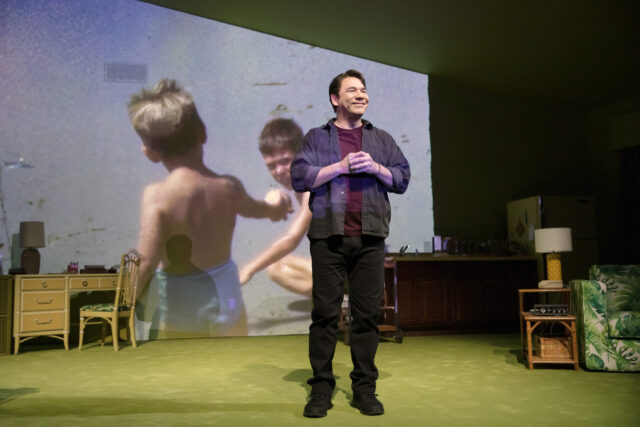
Danny Burstein plays real-life photographer Larry Sultan in Pictures from Home on Broadway (photo by Julieta Cervantes)

PICTURES FROM HOME
Studio 54
254 West 54th St. between Seventh & Eighth Aves.
Tuesday – Sunday through April 30, $65-$312
212-719-1300
picturesfromhomebroadway.com

Even an all-star cast and an award-winning director can’t prevent Sharr White’s Pictures from Home from feeling like you’re watching people you don’t know show you their home movies and vacation photos; you can only care so much. The play, continuing at Studio 54 through April 30, has its share of touching and funny moments, but it’s primarily a bumpy, inconsistent trip through strangers’ family albums.

The show is adapted from photographer Larry Sultan’s 1992 book of the same name, the result of an eight-year project in which Larry (Danny Burstein) took pictures of his parents, Jean (Zoё Wanamaker) and Irving (Nathan Lane), primarily at their home in the San Fernando Valley. Larry lives in the Bay Area with his pregnant wife and child but spends many weekends visiting his mother and father to take photos, most of which are posed.

The three characters are aware of the audience’s existence, occasionally addressing them directly. The play begins with Larry explaining that he is a distinguished professor of photography at California College of the Arts in San Francisco and that “this project will become one of my hallmark achievements — I know that’s not a modest thing to say. Regardless, this isn’t about me, it’s about them.” Irv interjects, “Larry may say it’s about us, but trust me. It’s about him.”

Larry admits, “My wife, Kelly, and I joke that no matter how much respect I get in the outside world, stepping inside these walls is my Kryptonite. I turn to mush when I try to get the shots I’m looking for.”

After finding a dusty box in his parents’ garage filled with hundreds of reels of Super-8 film, “thirty years of folktales,” Larry decides to start photographing Irv, who is not in favor of the project and hates nearly all the pictures his son takes of him, and Jean, who is not so upset but doesn’t quite understand why Larry is making such a fuss.

Larry (Danny Burstein) documents his parents’ (Zoё Wanamaker and Nathan Lane) life in Pictures from Home (photo by Julieta Cervantes)

Asking the unseen projectionist to play a clip from one of the reels, Larry tells us, “You can’t watch this movie without getting the impression of, of . . . a family living in a small apartment in Brooklyn projecting its dreams onto film emulsion.” He adds, “Knowing the disparity between the actual circumstances of the movie versus the hopes you nurtured when you made the movie . . . can’t you then imagine the possibility that a home movie could be more than, as you call it . . . ‘a record of actual events?’” (The projections are by Ben Pearcy at 59 Productions.)

Irv doesn’t want the memories to be treated like some kind of psych evaluation, so he answers, “What I’m saying is, why am I not allowed to just have my home movies?” Larry responds, “I’m not saying you’re not! But did you ever think that my examining them is perhaps my way of getting to know . . . a different version of you?” Irv declares, “Larry, I think you know me perfectly well. And if you’d like, I’ll introduce you to a version of your mother.”

It’s a very funny exchange, but it’s an argument that runs throughout the play repeatedly, offering little that is new. Irv is a realist who did whatever he had to in order to support his family, from working in clothing stores to becoming an executive for Schick razors. Jean raised the kids and, later in life, began a successful career as a Realtor, which the retired Irv considers a hobby.

We don’t learn much about Larry’s siblings, or his wife and kids; it’s like they are an afterthought, not that important as Larry instead digs into his parents’ lives, whether they want him to or not. He tells his bewildered father, “What I’m doing, Dad? Is looking for the, the . . . life beyond the frame.” He wants to preserve them, particularly as they get older, but he appears to be sacrificing his own present to accomplish that.

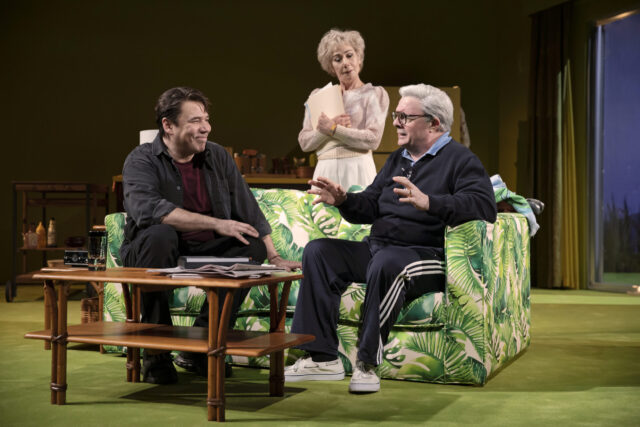
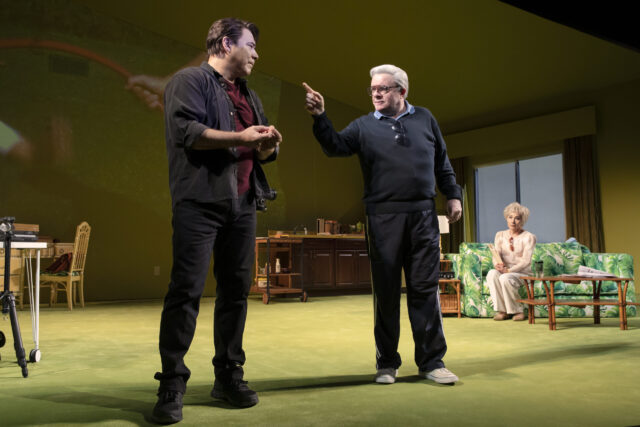
Michael Yeargan’s set is a comfy, relatively spare California living room, with a flowery couch, a desk, and glass doors leading to a backyard where Irv gardens and barbecues. The space is cantilevered, with the back wall painted an ugly green. I initially thought that it was done that way for effect, a metaphor for their off-tilt, colorless life. (I can already hear Irv saying, “I don’t think that’s a metaphor,” which he barks at Larry early on.)

Irving (Nathan Lane) gives his son (Danny Burstein) another talking-to as his wife (Zoё Wanamaker) watches (photo by Julieta Cervantes)

But it turns out that it very much matches Irv and Jean’s actual home, which is not a candidate for House Beautiful; it’s more like my great-aunt Sylvia’s old Florida place from that same era. All the photos and videos are taken from Larry’s collection; they are of the real Irv and Jean, not Lane and Wanamaker, which is both good and bad. While it’s exciting to see the actual pictures, several of which are warmly Rockwellian, it also forces us to compare how much the actors do or don’t look like the people they are portraying, Lane in his white wig, Wanamaker in a poufy hairdo. Burstein, in an obviously fake ill-fitting wig, looks more like Jerry O’Connell than Larry.

Thus, it is hard to lose yourself in the production, as the artifice stands out. Complaining about one of the photos of him, Irv tells his son, “The picture shows how strained and artificial the situation was that you set up.” The play cannot escape that same feeling.

Three-time Tony winner Lane (It’s Only a Play, Angels in America) plays, well, Nathan Lane, using his trademark boisterous bravado. When he shouts at Jean, “I can’t interject? I’m just doing a little interjecting!,” we see Lane, not Irv. Four-time Tony nominee and two-time Olivier winner Wanamaker (Loot, Awake and Sing!) is underused, usually kept in the background except when they are discussing a photo of Jean in the garage. And Tony winner Burstein (Talley’s Folly, Fiddler on the Roof) is ever likable, but his character is severely underdeveloped, leaving too many holes about his life away from his parents. It’s also hard to believe he’s playing their son, as Lane and Wanamaker are only eight and fifteen years older than Burstein, respectively.

White (The Other Place, The True, The Affair) and Sher (My Fair Lady, Oslo) can’t get past the general stagnation of an audience watching actors look at photos on a wall. You keep wanting the show to go somewhere, to offer more than one man’s attempt to ensure his parents live forever, at least on film. Instead, it’s too slight, 105 minutes of studying a family album I had only mild interest in.

THE COLLABORATION

Andy Warhol (Paul Bettany) and Jean-Michel Basquiat (Jeremy Pope) collaborate in new Broadway play (photo by Jeremy Daniel)

THE COLLABORATION
Samuel J. Friedman Theatre
261 West Forty-Seventh St. between Broadway & Eighth Ave.
Tuesday – Sunday through February 11, 474-$318
www.manhattantheatreclub.com

In the fall of 1985, gallerist Tony Shafrazi and art dealer Bruno Bischofberger presented “Warhol Basquiat: Paintings” on Mercer St., an exhibition of works made in tandem by Pop Art maestro Andy Warhol, looking to restore himself to relevance, and rising street-art superstar Jean-Michel Basquiat, who wanted to reach the next level of fame and fortune. The story of this unusual alliance is told in Anthony McCarten’s boldly titled The Collaboration, extended through February 11 at Manhattan Theatre Club’s Samuel J. Friedman Theatre.

While Basquiat and Warhol’s teaming up might have been a lightning strike of an idea in the art world, it’s more than a bit presumptuous to declare that it was the collaboration; if you didn’t know what the play was about, the title wouldn’t make you first think of this unexpected partnership. That aside, it was a fascinating moment in art history, and just as the collaboration was not wholly successful, so goes The Collaboration on Broadway.

In September 1985, Vivian Raynor wrote about the exhibit in the New York Times, “It’s a version of the Oedipus story: Warhol, one of Pop’s pops, paints, say, General Electric’s logo, a New York Post headline, or his own image of dentures; his twenty-five-year-old protege adds to or subtracts from it with his more or less expressionistic imagery. The sixteen results — all ‘Untitleds,’ of course — are large, bright, messy, full of private jokes, and inconclusive.” The same can be said of the play itself.

Alternatively, artist Keith Haring wrote in “Painting the Third Man” in 1988, “Jean-Michel and Andy achieved a healthy balance. Jean respected Andy’s philosophy and was in awe of his accomplishments and mastery of color and images. Andy was amazed by the ease with which Jean composed and constructed his paintings and was constantly surprised by the never-ending flow of new ideas. Each one inspired the other to outdo the next. The collaborations were seemingly effortless. It was a physical conversation happening in paint instead of words. . . . For me, the paintings which resulted from this collaboration are the perfect testimony to the depth and importance of their friendship. The quality of the painting mirrors the quality of the relationship. The sense of humor which permeates all of the works recalls the laughter which surrounded them while they were being made.”

Meanwhile, poet, songwriter, and playwright Ishmael Reed offered little love for Warhol in his recent show, The Slave Who Loved Caviar, feeling that Warhol treated Basquiat like a mascot; Reed wrote, “As Basquiat, the Radiant Child of the downtown art scene of the 1980s, was sacrificed to sustain the dying career of a fading Super Star, Antonius was sacrificed so that Hadrian would recover from a mysterious illness.”

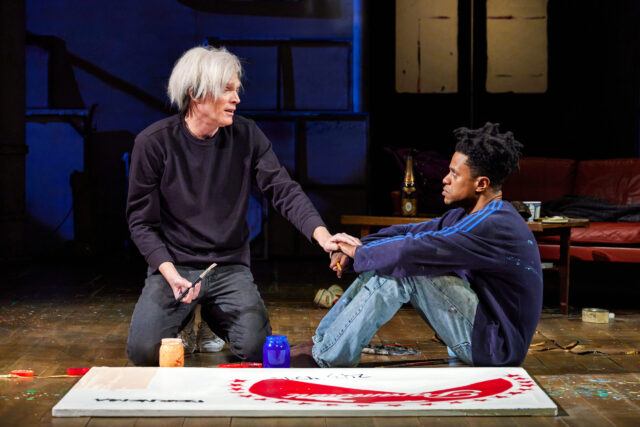
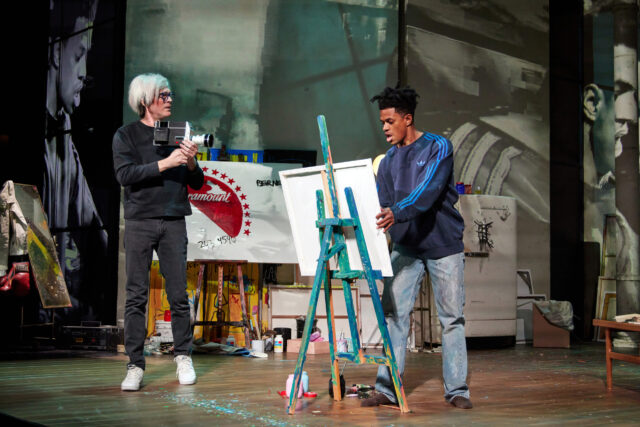
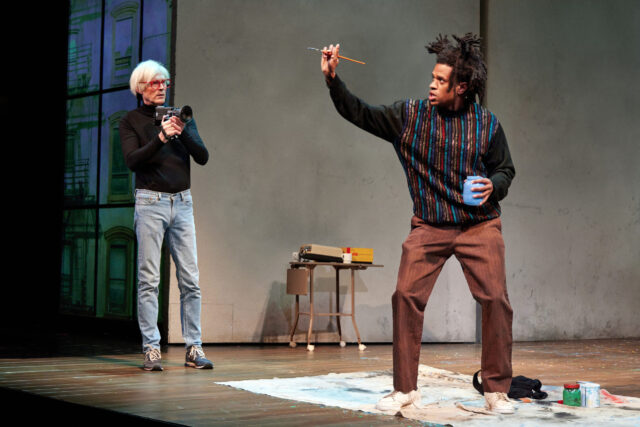
Andy Warhol (Paul Bettany) films Jean-Michel Basquiat (Jeremy Pope) in The Collaboration (photo by Jeremy Daniel)

Part of McCarten’s Worship Trilogy, which also includes The Two Popes and Wednesday at Warren’s, Friday at Bill’s, The Collaboration takes place alternately in Bischofberger’s (Erik Jensen) Manhattan gallery, Warhol’s (Paul Bettany) studio near Union Square, and Basquiat’s (Jeremy Pope) loft apartment and studio on Great Jones St. At first both artists are hesitant to work together; being shown Basquiat’s paintings for the first time by Bischofberger, Warhol, referring to them as “art therapy things,” says, “They’re so . . . busy. Is it too much? Or am I getting old? And so much anger. All these skulls and gravestones everywhere. I thought I was bleak. And all these words and symbols, what’s it all mean? What’s he trying to say? Bruno? Do you know? And why do they have to be so ugly? Did he tell you? Does he talk about that? They’re so ugly and angry and yeah, well, they’re kinda violent. I’d be careful; he’s really in trouble, I think.”

Basquiat is also unsure of the potential partnership, telling Bischofberger, “I’m better than Andy. I don’t need this. . . . And how come he doesn’t paint anymore, you know? Just mechanically reproduces all these prints? There’s no soul. I’m Dizzy Gillespie, blowing a riff, he’s one of those pianos that plays all by itself. The same tune. Over and over. You seen those things? Pink, pink plonk, pinkety pinkety pink.”

Bischofberger, who represents both artists, promises Warhol, “It will be the greatest exhibition ever in the history of art.” Warhol says, “Please don’t exaggerate.” The dealer boasts, “Warhol versus Basquiat.” The Pop maestro wonders, “Oh, versus? Gee, you make it sound so macho, like a contest. I don’t know. I thought you said it would be a collaboration?” Bischofberger answers, “Painters are like boxers; both smear their blood on the canvas.” The promotional posters for the exhibition — which eventually will become more famous than the actual works (one of the original posters hangs in my apartment) — feature Warhol and Basquiat wearing boxing gloves, ready to do battle.

But soon the soft-spoken Warhol, who hadn’t picked up a paintbrush in more than twenty years but has amassed a fortune through his silkscreens, photography, films, and business savvy, is creating canvases with Basquiat, who is far more spontaneous and unpredictable, taking drugs, sleeping around (Krysta Rodriguez plays Maya, a fictionalized version of Basquiat’s girlfriend Suzanne Mallouk), and keeping his cash in the refrigerator.

Once the playwright finally gets Andy and Jean putting paint to canvas, their debates about the purpose of art sound a bit sanctimonious. No one knows what their conversation was really like: Within three years, they would both be dead, Basquiat in 1987 at the age of twenty-seven, Warhol in 1988 at the age of fifty-eight.

Directed by Kwame Kwei-Armah (Things of Dry Hours, One Night in Miami), The Collaboration works best when Warhol and Basquiat get down to brass tacks, exploring what they might do together, each suspicious of the other’s motives and abilities. In roles previously played by David Bowie and Jeffrey Wright, respectively, in Julian Schnabel’s 1996 film, Basquiat (Dennis Hopper was Bischofberger), Bettany (Love and Understanding, WandaVision) and Tony nominee Pope (Choir Boy, Ain’t Too Proud) are phenomenal. Pope embodies Basquiat’s untethered energy, his lust for life, and his social conscience, particularly when learning that his friend, graffiti artist Michael Stewart, is in the hospital after an altercation with the police. Bettany not only looks great in Warhol’s trademark white fright wig and black turtleneck and sneakers (the wigs are by Karicean “Karen” Dick and Carol Robinson, with sets and costumes by Anna Fleischle) but captures his awkward, strange public persona.

Rodriguez (Into the Woods, Seared) does what she can as the underwritten Maya, an amalgamation that stretches the truth of Basquiat’s relationships with women, and Jensen (Disgraced, How to Be a Rock Critic) provides a solid middle ground to highlight the disparity between his two artists.

Andy Warhol (Paul Bettany) watches Jean-Michel Basquiat (Jeremy Pope) paint in The Collaboration (photo by Jeremy Daniel)

The narrative takes a sharp turn beginning at intermission, when large monitors just outside both sides of the stage show footage of Bettany’s Warhol and Pope’s Basquiat collaborating, painting on transparent glass, mimicking the style Warhol uses when filming Basquiat on his 16mm spring-wound Bolex movie camera. As they did prior to the beginning of the show, DJ theoretic spins thumping 1980s music from a booth on the stage as the prerecorded film plays.

During the second act, Kwei-Armah and McCarten, who has written such fact-based films as The Theory of Everything, Darkest Hour, and Bohemian Rhapsody and the book for the current Neil Diamond musical A Beautiful Noise, become obsessed with Warhol’s live footage of Basquiat (the projections are by Duncan McLean), so it’s hard to know where to look. (Oh, what Ivo van Hove has wrought.) A notoriously private person despite his fondness for late-night celebrity-studded parties, Warhol wants to capture the real Basquiat on film, but Basquiat doesn’t want to be seen as a commodity. This dichotomy further emphasizes the difference, and psychological distance, between Basquiat and Warhol, whose shows are still blockbusters today. (For example, Basquiat’s biographical “King Pleasure” in Chelsea last year and the Whitney’s 2018-19 “Andy Warhol — From A to Be and Back Again.”

None of Warhol’s footage exists today, so we don’t know what really happened, but what McCarten and Kwei-Armah depict grows more confusing and annoying by the second. We also don’t see enough of the artists’ collaboration itself, but that output is not considered among either one’s most well regarded works. Alas, the same can be said of the creators of the play. But as Warhol explains to Basquiat, “I don’t think there’s going to be a revolution, but if there is it will be televised, with commercial breaks, cause it’s all about brands now. Even us, we’re not painters, we’re brands. Jean. We’re brands. Well, you’re almost a giant brand, and after this exhibition with me you will be too. Then just watch the language change, Jean.”

The Collaboration concludes on the same note as Eduardo Kobra’s large-scale 2018 mural in Chelsea above the Empire Diner, a reimagined Mount Rushmore with the faces of Andy Warhol, Frida Kahlo, Keith Haring, and Jean-Michel Basquiat, all of whom remain brands to this day.

BETWEEN RIVERSIDE AND CRAZY

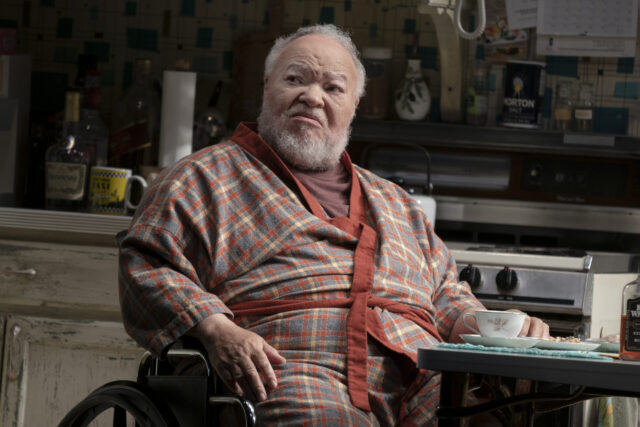
Stephen McKinley Henderson is unforgettable as Pops in Stephen Adly Guirgis’s Between Riverside and Crazy (photo by Joan Marcus 2022)

BETWEEN RIVERSIDE AND CRAZY
Hayes Theater
240 West 44th St. between Broadway & Eighth Ave.
Tuesday – Sunday through February 19, $68-$210 (live simulcast $68)
2st.com/shows

At the 2015 Drama Desk Awards, I had the option of being seated in the audience with the cast and crew of any nominated show; without hesitation, I chose Stephen Adly Guirgis’s searing dark comedy Between Riverside and Crazy. The Atlantic Theater production had three nominations: Best Play, Outstanding Actor in a Play for the amazing Stephen McKinley Henderson, and Outstanding Director of a Play for legendary actor, teacher, and director Austin Pendleton. The show, which had just won the Pulitzer Prize for Drama, was up against such staunch competition as The Curious Incident of the Dog in the Night-Time, Airline Highway, and Let the Right One In; among those competing for Best Musical were An American in Paris, Hamilton, and Something Rotten!

As the evening progressed, Pendleton slumped lower and lower into his chair as he, Henderson, and Guirgis failed to take home a trophy, losing each time to Curious Incident (Simon Stephens for Best Play, Alex Sharp for actor, and Marianne Elliott for director). In January 2015, Between Riverside and Crazy received an encore run at Second Stage’s Tony Kiser Theater, with nearly the full original cast. Last month, the show opened at Second Stage’s Hayes Theater on Broadway, where it has been extended through February 19. It still packs the same punch it did almost nine years ago at the Atlantic.

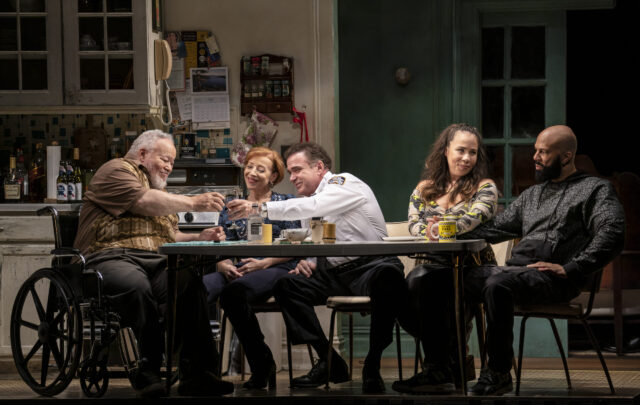
The extended family of Between Riverside and Crazy makes a toast (photo by Joan Marcus 2022)

The 130-minute show (with intermission) unfolds in a cramped rent-controlled apartment and rooftop on Riverside Drive (the rotating set is by Walt Spangler), where the recently widowed Walter “Pops” Washington (Henderson) lives with a motley crew of younger folks, including his ne’er-do-well son, Junior (Common), who is on parole; Junior’s scantily clad girlfriend, Lulu (Rosal Colón); and Oswaldo (Victor Almanzar), a tough-talking young man in recovery who Pops has taken in. All three call Walter either Pop, Pops, or Dad, even though he’s hardly the loving, nurturing type. Pops spends most of his time in the kitchen, eating pie, taking swigs of alcohol, and sitting in his wife’s wheelchair, pontificating on life.

His daily reflections don’t exactly reflect popular psychology. As Oswaldo discusses his health and why he no longer eats Ring Dings and baloney, which he ate because he didn’t feel safe or cared for by his parents, Oswaldo tells Pops, “I’m not trying to get all up in your business, but maybe that’s also the reason you always be eating pie — because of, like, you got emotionalisms — ya know?” Pops replies, “Emotionalisms.” Oswaldo continues, “I know — it sounded funny at first to me too — but emotionalisms is real, and pie — don’t take this wrong, but they say pie is like poison.” To which Pops concludes, “Pie ain’t like poison, Oswaldo — pie is like pie!”

A retired cop facing eviction, Pops is in a major fight with the city and the NYPD, demanding more cash in compensation for his shooting by a white rookie officer eight years earlier. One night his former partner, Det. Audrey O’Connor (Guirgis regular Elizabeth Canavan), and her fiancée, Lieutenant Caro (originally played by Michael Rispoli, though I saw understudy J. Anthony Crane, who was excellent; the role has now been taken over by Gary Perez), come over for dinner. They try to convince him to take the deal, as time is running out, but Pops stands by his principles while also understanding Caro’s motive in urging him to sign off. “An honorable man can’t be bought off,” he previously explained to Junior. “An honorable man doesn’t just settle a lawsuit ‘No Fault’ and lend his silence to hypocrisy and racism and the grievous violation of all our civil rights.”

Pops changes some of his views on life — and death — after a visit from the new church lady (Maria-Christina Oliveras) ends up sending him to the hospital.

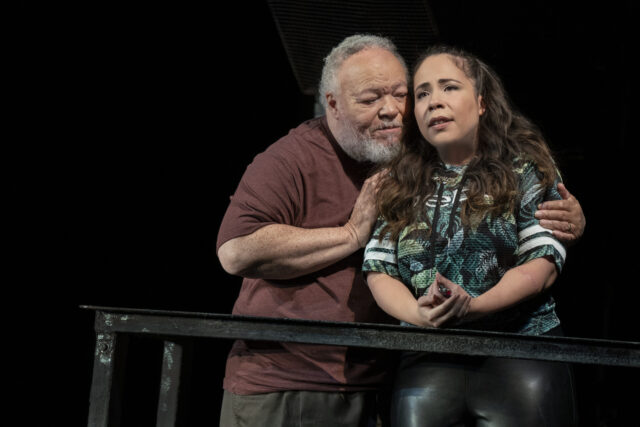
Pops (Stephen McKinley Henderson) and Lulu (Rosal Colón) share a moment in powerful New York play (photo by Joan Marcus 2022)

I called Between Riverside and Crazy one of the best plays of 2014, and currently it’s the best nonrevival on Broadway. (The best new musical on Broadway, Kimberly Akimbo, also got its start at the Atlantic.) Seventy-three-year-old Tony nominee Henderson (A Raisin in the Sun, Guirgis’s The Last Days of Judas Iscariot), a longtime staple in the work of August Wilson, is unforgettable as Pops, a character who’s hard not to love even as you learn some questionable things about him. Henderson has an endearingly round face, gentle eyes, and an infectious smile that makes you want to call him Pops too. The play is very much about fathers and sons: Pops’ relationship with Junior, Oswaldo’s troubles with his dad, and Pops’ feelings about his own father. Even Det. O’Connor tells Pops, “You’re like my father.”

The set includes a rooftop veranda where Henderson gets even closer to his adoring audience. The rest of the cast is terrific under Pendleton’s (Gidion’s Knot, Orson’s Shadow) expert direction. Guirgis (Our Lady of 121st Street, Jesus Hopped the “A” Train), who grew up on Riverside Drive, writes gritty, believable dialogue and creates hard-hitting situations that are quintessentially New York, mixing comedy and tragedy with subtle, and not-so-subtle, narrative shifts.

If I were going to the 2023 Tony Awards and had the choice of which show to sit with, I just might choose Between Riverside and Crazy again. In the meantime, get yourselves to the Hayes and become part of this beautiful extended family.

KIMBERLY AKIMBO

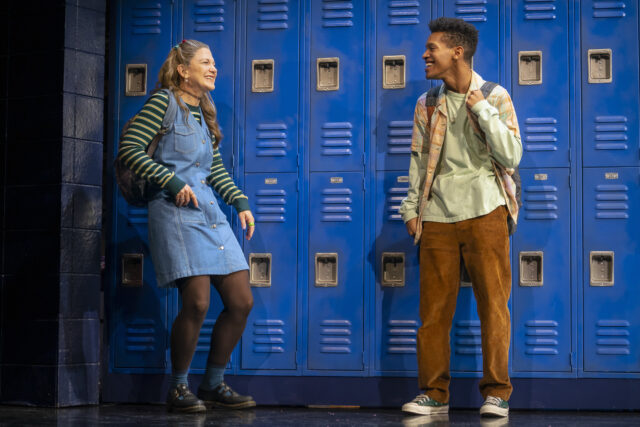
Kimberly (Victoria Clark) and Seth (Justin Cooley) become good friends in Kimberly Akimbo (photo © Joan Marcus)

KIMBERLY AKIMBO
Booth Theatre
222 West 45th St. between Broadway & Eighth Ave.
Tuesday – Sunday through March 26, $84 – $419
kimberlyakimbothemusical.com

Broadway shows about death and dying tend to be serious affairs. Plays such as The Shadow Box, Marvin’s Room, Angels in America, ’night, Mother, and Whose Life Is It Anyway? are not lighthearted comedies; Wit is not exactly a laugh riot. (By the way, those six works have four Pulitzers between them.) But right now, Mike Birbiglia is facing his own mortality every night in his hilarious one-man show The Old Man & the Pool, at the Vivian Beaumont, while Kimberly Akimbo, an unusual, life-affirming musical about a high school girl with a terminal illness, is delighting audiences at the Booth.

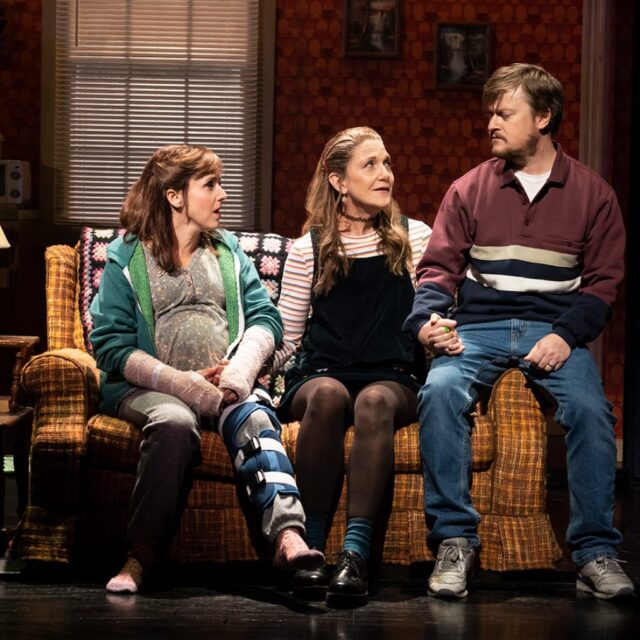
Making a smooth transition from its fall 2021 debut at the Atlantic, Kimberly Akimbo is the must-see musical of the season. Adapted by Pulitzer winner David Lindsay-Abaire from his 2000 play of the same name, the show tackles how awkward kids can be during their teen years, as evidenced by the title. Kimberly Levaco (Victoria Clark), who is approaching her sixteenth birthday, becomes friends with super-nerd Seth (Justin Cooley), who is obsessed with anagrams; rearranging the letters in her name, he rechristens her Cleverly Akimbo. The show, the character, and Clark are all that and more.

Kimberly has an extremely rare genetic disorder, similar to progeria, in which she ages at four or five times the normal rate. Most girls look forward to turning sweet sixteen, but for Kimberly, she would be nearing the equivalent of eighty; she is magnificently portrayed by Tony winner Clark, who is sixty-three but infuses the part with a glorious enthusiasm and affection for life and what it offers, living every minute to its fullest, understanding it could — and will — all be over at any second.

Kimberly’s mother, Pattie (Alli Mauzey), is pregnant, stuck at home with carpal tunnel in both hands and making videos for her unborn child. “There’s a high probability that I might be dead soon. / So I won’t be around when you’re growing up, / and this video is the only way for you to know who I was. / And I want you to know who I was because / people are going to tell you things about me that just aren’t true,” she sings insensitively, bringing up her own potential death and focusing on her fetus instead of paying attention to Kimberly, who really is dying and might never get to meet her sibling.

Kimberly’s father, Buddy (Steven Boyer), is a low-level gambler and drinker who works at a gas station and does not know how to express love for his daughter; he’s still too much of a child himself. “I should be happy for her,” he sings when she makes a new friend, but he doesn’t know how. “I should be happy.” Later, he says, “I never pictured myself a father. I mean, I like kids, I just . . . I’m more of a bachelor uncle type.” He is more excited than Kimberly when he wins a Game Boy in a bet.

Kimberly (Victoria Clark, center) has issues with her parents (Alli Mauzey and Steven Boyer) in Broadway musical (photo © Joan Marcus)

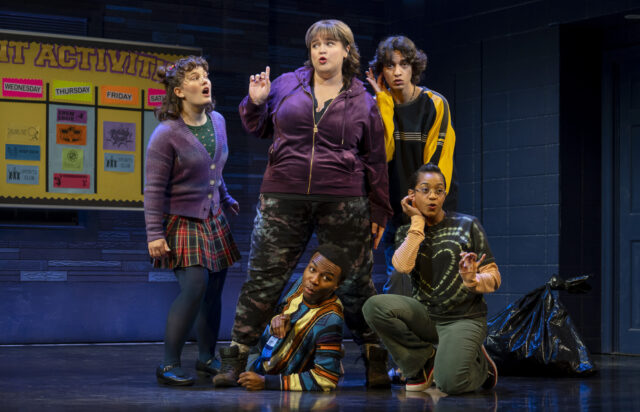
Kimberly teams up with Seth for their sophomore bio class project, in which they have to explore a disease. Seth wants to use Kimberly’s condition, but she’s not so sure. Meanwhile, the quartet of Delia (Olivia Elease Hardy), Martin (Fernell Hogan), Aaron (Michael Iskander), and Teresa (Nina White) is pairing up for the project and preparing for Show Choir, a competition against other schools. In a fab subplot, they are also trying to figure out how to pair up relationship-wise, not quite knowing yet who’s gay or straight and who likes who.

They are planning on performing a medley from Dreamgirls.. It’s no accident that Lindsay-Abaire chose that particular musical, whose title song begins, “Every man has his own special dream / and your dream’s just about to come true / Life’s not as bad as it may seem if you / open your eyes to what’s in front of you.” High school kids are supposed to dream about the future, but Kimberly is running out of time. Meanwhile their main rival, West Orange, is doing Evita, a musical about Argentinian leader Eva Perón, whose life was cut short by cancer at the age of thirty-three.

Everything goes even more akimbo when Buddy’s sister, Debra (Bonnie Milligan), the black sheep of the family, arrives unexpectedly; the Levacos had escaped Lodi to get away from Debra, who has a penchant for breaking the law with a greedy selfishness and spending time in the hoosegow. She has a master plan involving bank fraud and a stolen US mailbox — itself a funny prop because the younger generations today mainly think of them as relics in the age of social media and texting, similar to pay phones — and attempts to get Kimberly, Seth, Delia, Martin, Aaron, and Teresa to help her with the scheme.

As Kimberly’s sixteenth birthday approaches, the cleverly askew storylines all come together for a poignant finale.

Debra (Bonnie Milligan) finds a crew to attempt a heist in Kimberly Akimbo (photo © Joan Marcus)

Kimberly Akimbo is about much more than a teen with a horrible disease; it’s a spectacularly insightful depiction of the joys and fears that teens experience, at school and at home, with friends and family, as they mature into young adults. Kimberly has an illness that strikes only one in fifty million people — meaning only seven people in the United States might have it — but she represents us all, children and grown-ups. Lindsay-Abaire’s (Rabbit Hole, Ripcord) book and lyrics capture the exhilarating highs and the devastating lows that are parts of everyday life, which is like an endless series of anagrams we try to unravel; when Pattie says, “I hate getting old,” she’s not just speaking for herself. And when she shares her anxiety over having another baby and Kimberly declares, “Scared it would be like me?,” it’s a feeling many can relate to. As Kimberly sings in “Anagram”: “With a change of perspective . . . ha-ha-ha-ha . . . / nothing’s defective / I wonder what you see / when you look at me.”

Tony winner Jeanine Tesori’s (Fun Home, Caroline, or Change) score matches the ups and downs of the plot, from the tender piano of “Anagram” to the jubilance of “Skater Planet” and “This Time,” with playful choreography by Danny Mefford (how do they ice skate like that?), realistic costumes by Sarah Laux, and terrific sets by David Zinn that range from a suburban skating rink to a high school hallway to the Levaco living room.

Mauzey (Wicked, Cry-Baby) and Boyer (Hand to God, Time and the Conways) are terrific as Kimberly’s parents, who attempt to navigate through what for them is also a traumatic situation, knowing their teenage daughter will not be with them much longer, while Jimmy Awards finalist Cooley excels as the awkward but determined and hopeful Seth, and Milligan (Head Over Heels, Gigantic), as a thief, essentially steals every scene she’s in.

But the centerpiece of the show is the unforgettable performance by Clark (Gigi, Sister Act), who won her Tony for The Light in the Piazza before most of the rest of the cast members were born, or were mere babes. Her every movement and gesture, her voice, and, most critically, her bright, searching eyes will have you convinced she is a fifteen-year-old high school student carrying all the requisite baggage — while also knowing that any day could be her last. But the show is not about aging and death; it’s an infectious celebration of life.

At one point, Martin says, “Who cares? It’s not like any of this counts.” Seth responds, “What do you mean?” Martin answers, “I mean, high school. This town. It’s not even real life. It’s just the crap you have to get through before you get to the good part.” Teresa chimes in, “And what’s the good part?” Martin answers, “Um, the rest of our lives?” Kimberly Akimbo makes it clear that right now is the good part, no matter how long the rest of your life is.

OHIO STATE MURDERS

Audra McDonald stars in Adrienne Kennedy’s long-in-coming Broadway debut, Ohio State Murders (photo by Richard Termine)

OHIO STATE MURDERS
James Earl Jones Theatre
138 West Forty-Eighth St. between Sixth & Seventh Aves.
Tuesday – Sunday through January 15, $114-$244
212-362-7600
www.lct.org

One of my favorite virtual presentations during the pandemic lockdown was “The Work of Adrienne Kennedy: Inspiration & Influence,” a collaboration between DC’s Round House Theatre and Princeton’s McCarter Theatre Center, a deep dive into the career of playwright Adrienne Kennedy, who was born in Pittsburgh in 1931 and has only recently become more well known for her outstanding oeuvre. The Round House and McCarter hosted panel discussions and staged excellent recorded productions of He Brought Her Heart Back in a Box, which made its world premiere at TFANA in 2018; Kennedy’s very personal 1996 play, the Obie-winning Sleep Deprivation Chamber, which she wrote with her son, Adam P. Kennedy; the world premiere of Etta and Ella on the Upper West Side, adapted from a 1999 story; and 1992’s Ohio State Murders, one of Kennedy’s Alexander Plays, featuring her alter ego, writer Suzanne Alexander. (Chicago’s Goodman Theatre also put on an exemplary livestreamed version of Ohio State Murders.)

I was excited when I heard that Ohio State Murders would mark Kennedy’s Broadway debut, at the age of ninety-one, in a new production starring six-time Tony winner Audra McDonald and inaugurating the James Earl Jones Theatre (previously the Cort), named after the ninety-one-year-old award-winning actor. And then I was devastated to find out that the show would be closing about a month early, shutting down January 15 instead of February 12 (following a December 8 opening), despite mostly rave reviews, the latest in a series of notable Black plays posting early closing notices since the end of the lockdown, including Ain’t No Mo’, for colored girls who have considered suicide/when the rainbow is enuf, Chicken & Biscuits, and Thoughts of a Colored Man. I was even more shocked after seeing Tony winner Kenny Leon’s splendid production.

As the audience enters the theater, a recording of a 2015 interview with Kennedy, conducted by her grandson, Canaan Kennedy, plays on a loop, with the playwright talking about her life and career, focusing on having a family and studying and teaching at universities. Beowulf Boritt’s intellectual set consists of more than a dozen bookshelves at multiple angles, on the floor and hanging from the ceiling, as if Alexander is surrounded by an education that will not be available to her or other Black people. A metaphoric chill is in the air from a tear on the back wall through which appears a video projection of falling snow.

Ohio State Murders takes place at Ohio State University in Columbus, where Kennedy earned her BA. The frame story is that Suzanne has returned to Ohio State to give a lecture. She begins: “I was asked to talk about the violent imagery in my work; bloodied heads, severed limbs, dead father, dead Nazis, dying Jesus. The chairman said, we do want to hear about your brief years here at Ohio State but we also want you to talk about violent imagery in your stories and plays. When I visited Ohio State last year it struck me as a series of disparate dark landscapes just as it had in 1949, the autumn of my freshman year.”

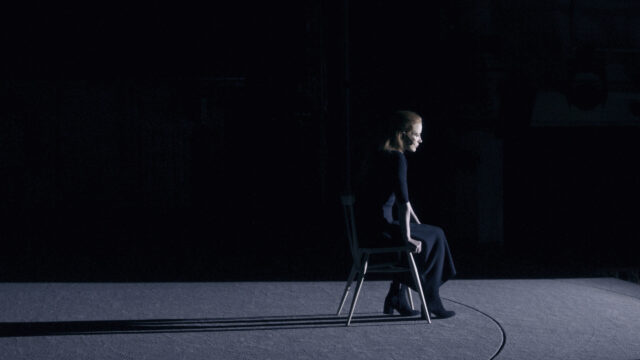
Audra McDonald shifts between past and present in Ohio State Murders at James Earl Jones Theatre (photo by Richard Termine)

Suzanne goes on to share a heartbreaking tale of what happened to her at the school, involving a white English professor, Robert Hampshire (Bryce Pinkham), her violin-playing roommate, Iris Ann (Abigail Stephenson), her landlady, Mrs. Tyler (Lizan Mitchell), dorm head Miss Dawson (Mitchell), Aunt Louise (Mitchell), close friend Val (Mister Fitzgerald), and law student David Alexander (Fitzgerald), who will become her husband. Hampshire has a particular fondness for Thomas Hardy’s Tess of the d’Urbervilles, which deals with a rape/seduction and a strong-willed woman, and King Arthur, about whom Hampshire reads, “‘Till the blood bespattered his stately beard. / As if he had been battering beasts to death. / Had not Sir Ewain and other great lords come up, / His brave heart would have burst then in bitter woe: / ‘Stop!’ these stern men said, ‘You are bloodying yourself!’ ” Meanwhile, Suzanne is deeply affected after seeing Sergei Eisenstein’s 1925 silent classic, Battleship Potemkin, about the 1905 Russian Revolution. Tess, Arthur, and the film all relate to Suzanne’s personal experience at college and illuminate the sources of her violent imagery.

McDonald (Lady Day at Emerson’s Bar and Grill, Frankie and Johnny in the Clair de Lune) is marvelous as Suzanne, a role usually performed by two actors, one in the present, one in the past. (The original had Ruby Dee and Bellary Darden, while Lisagay Hamilton and Cherise Boothe shared the part in the New York premiere from TFANA in 2007.) Despite the tragedies and disappointments that hover around Suzanne, McDonald portrays her as remarkably even-tempered, almost to the point of being detached from the horrific truth. She weaves between 1950 and today with a graceful ease and a mere adjustment to her costume (a button-down blouse and long skirt, designed by Dede Ayite). Tony nominee Pinkham (A Gentleman’s Guide to Love & Murder, Love’s Labour’s Lost) is calm and steady as Hampshire, who hides a dark secret. It’s always a pleasure to see Mitchell (On Sugarland, Cullud Wattah), who switches between three roles.

Tony winner Leon (Topdog/Underdog, A Soldier’s Play) maintains a gentle, almost frustrating pace, giving room for Kennedy’s words to tell the story without melodramatic embellishment. Justin Ellington’s sound and Allen Lee Hughes’s lighting enhance the mysterious atmosphere that pervades the play, along with Jeff Sugg’s projections and Dwight Andrews’s original music.

Following the curtain call, which includes the cast honoring a large photograph of Kennedy, the interview starts again. As with the rediscovery of Alice Childress, the Charleston-born Black playwright who made her posthumous Broadway debut last season with 1955’s Trouble in Mind, followed shortly by TFANA’s production of her 1966 drama Wedding Band: A Love/Hate Story in Black and White, Kennedy’s is a voice that deserves to be heard, must be heard; her plays, many of which are experimental and challenge traditional narrative techniques, shine a light on racial injustice in America over the last half century and more, up to today. See Ohio State Murders on Broadway while you still can and help celebrate Adrienne Kennedy while she is still with us.