this week in art

JESÚS “BUBU” NEGRÓN: THE BACK PORTRAIT

the back portrait

On the High Line at 17th St.
July 25-27, free, 2:00 – 7:00
art.thehighline.org
www.jesusbubunegron.com

On streets and in parks all around New York City, tourists pay to get their portraits or caricatures drawn. Puerto Rican sculptor and performance artist Jesús “Bubu” Negrón turns that around, literally and figuratively, in “The Back Portrait,” an ongoing project he conceived in San Juan in 2000 and is coming to the High Line July 25-27. From two o’clock to seven o’clock each day, Negrón will draw, using color markers and crayons, people sitting down with their backs to him. Negrón will give the sitter the original drawing, keeping a photocopy for himself to put on display, calling into question original works of art versus copies. Participation is free and first come, first served. Negrón’s previous work, which often equates “artists” with “artisans,” includes “[Standard memes (campaign for the awareness and activation of the neighborhood)],” in which local residents in San Juan helped revive derelict buildings in their communities via memes, “Honoris Causa,” in which Negrón invited two street vendors to set up their carts inside the Whitney lobby for the 2006 biennial, merging art with a different kind of commerce, and “Banco Marímbula,” a public square bench turned into a musical instrument using parts from a 1957 Victrola.

PANORAMA NEW YORK CITY

The Lab hosts interactive installations using cutting-edge technology (photo by twi-ny/mdr)

The Lab is back at Panorama with interactive, cutting-edge art projects (photo by twi-ny/mdr)

Randall’s Island Park
July 28-30, $125 per day, $345 for all three days
www.panorama.nyc
randallsisland.org

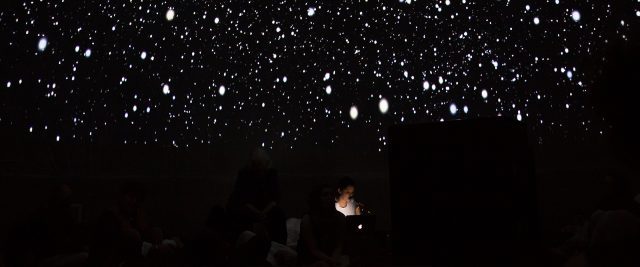
Last year’s inaugural Panorama festival was everything it promised it would be, three days of cool music, art, technology, and food on Randall’s Island. It’s back for its second go-round, taking place July 28-30. Tickets are $125 per day and $345 for the full weekend to see such performers as Future Islands, Girl Talk, MGMT, Spoon, Solange, DJ Shadow, and Frank Ocean on Friday, Belle & Sebastian, Matoma, Vince Staples, Motor City Drum Ensemble, and Tame Impala on Saturday, and Cloud Nothings, Justice, Glass Animals, a Tribe Called Quest, and Nine Inch Nails on Sunday at four different locations — the main stage, the Pavilion, the Parlor, and the Point. Eats and drinks will be available from El Paso, Oddfellows, Roberta’s Pizza, Salvation Taco, Ed & Bev’s, Loco Coco, Spicy Pie, Trapizzino, Uma Temakeria, Matchabar, Pasquale Jones, PDT, Sam’s Fried Ice Cream, and others. The Lab is also back, a 360-degree virtual-reality theater with such interactive works as Future Wife’s “Boolean Planet,” Emilie Baltz’s “Dream Machine,” Prism’s “Future Portrait,” Ekene Ijeoma’s “Heartfelt,” the Windmill Factory’s “Right Passage,” Dirt Empire’s “The Ark Dome Show,” and SOFTlab’s “Volume.” Among the sponsors selling products, giving away samples, and hosting unique experiences are Rough Trade, Barefoot Wine & Bubbly, Sephora, Califia, Macy’s Pool Party, Bai, the Global Inheritance Recycling Store, and Tullamore Dew. Keep watching twi-ny for daily highlights as the fest approaches.

PRISMATIC PARK: CACONRAD

Poet CAConrad will be giving personalized (Soma)tic poetry rituals in Madison Square Park through July 23 (photo by twi-ny/mdr)

Poet CAConrad will be offering free personalized (Soma)tic poetry rituals in Madison Square Park through July 23 (photo by twi-ny/mdr)

(SOMA)TIC POETRY RITUALS
Madison Square Park Oval Lawn
Twenty-Fourth St. between Madison & Fifth Aves.
Through July 23, free, 12 noon – 5:00 pm (workshops nightly at 6:00)
www.madisonsquarepark.org
caconrad.blogspot.com

“Every single human being is creative. When we commit ourselves to nurturing our artistic capacities we improve our ability to more deeply discern the world around us and make the constructive decisions needed in order to thrive in this world,” fifty-one-year-old poet CAConrad writes in his (Soma)tic Manifesto. Through July 23, Conrad will be performing “(Soma)tic Poetry Rituals” in Madison Square Park, under one of American artist and MacArthur Fellow Josiah McElheny’s three sculptures that comprise “Prismatic Park,” a collaborative public art project that is hosting free dance, music, and poetry through October 8, sponsored by Danspace Project, Blank Forms, and Poets House. Born in Kansas and raised in Pennsylvania, Conrad is the author of such books as The City Real & Imagined, ECODEVIANCE: (Soma)tics for the Future Wilderness, and the upcoming While Standing in Line for Death. In 1998, Conrad’s boyfriend, AIDS activist Earth (Mark Holmes), was brutally raped, tortured, and murdered in Tennessee at the age of thirty-six. In order to break out of his subsequent depression and his inability to break away from a factorylike existence that had been with him since childhood when his family ran a casket company, Conrad developed rituals that helped respark his creative energy and his life in general. He is currently in the midst of a six-day residency in Madison Square Park, sitting (in the shade) at a small table under McElheny’s open red vaulted-roof pavilion (with red and yellow glass), where the public is invited to join him for approximately twenty minutes as Conrad develops a personalized (Soma)tic poetry ritual for each individual participant, involving crystals, liquids, and writing. The rituals are meant to help anyone seeking new ways to cope with today’s world; they are not limited to writers. The personalized rituals — bring pen and paper to take copious notes — are first come, first served, from 12 noon to 5:00, followed by workshops from 6:00 to 8:00; on July 22, Conrad delves into crystal trees, while on July 23 he will read tarot cards. “Prismatic Park,” which also features a blue sound wall and a reflective green dance floor, continues with concerts by Joe McPhee & Graham Lambkin (July 25-30), Shelley Hirsch (August 22-27), Matana Roberts (September 5-10), and Limpe Fuchs with poet Patrick Rosal (October 3-8), dance by Netta Yerushalmy (August 1-6) and Jodi Melnick (September 12-17, 19-24), and poetry by Joshua Bennett (August 15-20), Donna Masini (August 29 – September 3), and Mónica de la Torre (September 26 – October 1).

LYGIA PAPE: A MULTITUDE OF FORMS

(photo by twi-ny/mdr)

Lygia Pape, “Livro do tempo” (“Book of Time”), tempera and acrylic on wood, 365 parts, 1961-63 (photo by twi-ny/mdr)

The Met Breuer
945 Madison Ave. at 75th St.
Through July 23, suggested admission $12-$25
212-731-1675
www.metmuseum.org
www.lygiapape.org

There’s only a few more days to see the best current exhibition in New York City by an artist you’ve never heard of but need to. Continuing at the Met Breuer through Sunday, “Lygia Pape: A Multitude of Forms” is the first retrospective of multidisciplinary Brazilian artist Lygia Pape, who passed away in 2004 at the age of seventy-seven. “My concern is always invention. I always want to invent a new language that’s different for me and for others, too,” she said. “I want to discover new things. Because, to me, art is a way of knowing the world . . . to see how the world is . . . of getting to know the world.” The show opens up a whole new world of invention, a wonderland of geometric form, color, time, and space, consisting of a wide range of drawing, woodcuts, painting, sculpture, film, dance, installation, and performance art taking on the personal and the political, the psychological and the cultural. During her five-decade career, Pape (pronounced pah-PAY) was part of the Concretists, Grupo Frente, and Neoconcretism, pushing the boundaries of the picture plane as she merged genres in unique ways. Her “Pinturas,” “Relevos,” and “Tarugos” demonstrate the development of her style, as square boxes, horizontal bars, and skewed lines eventually emerge from her canvas, creating a three-dimensionality that invades the viewer’s space. Her woodcuts, called “Tecelares,” and ink drawings, known as “Desenhos,” furthered her geometric abstraction, while her “Poema-objetos” turned paper into sculpture, leading to such works as “Livro da criação” (“Book of Creation”), a facsimile of which visitors can engage with, offering an alternate view of their surroundings.

(photo by twi-ny/mdr)

Lygia Pape, “Roda dos prazeres” (“Wheel of Pleasures”), porcelain vessels, droppers, distilled water, flavorings, and food coloring, 1967 (photo by twi-ny/mdr)

In the short 1967 film O ovo (“The Egg”), Pape breaks through a white box on the beach. In “Divisor” (“Divider”), dozens of heads jut out from a huge white sheet as the participants walk through the streets of Rio de Janeiro. “Ballet neoconcreto I” and “Ballet neoconcreto II” might look like an experimental film of moving geometric shapes but instead are recordings of live performances in which dancers are actually inside the forms, guiding them. “Her trajectory, especially in the 1960s and 1970s, was informed by the irreverence of underground cinema and the influence of vernacular and indigenous cultures and shaped by a strong awareness of her role as a woman artist,” Glória Ferreira explains in her exhibition catalog essay. “Roda dos prazeres” (“Wheel of Pleasures”) is activated at specific times, allowing museumgoers to taste the colored liquids arranged in a circle of bowls, each a different flavor. The massive “Livro do tempo” (“Book of Time”) features 365 painted blocks, as if each day is represented by a new semaphore. “Banquete tupinambá” (“Tumpinamba Banquet”) consists of a wooden table and two chairs covered in red feathers, a lightbulb dangling over it, two polyurethane breasts almost hidden within the work. In its own room is “Ttéia 1, C,” a mesmerizing installation of golden thread pouring down like gorgeous sunlight in the darkness. And yes, those are mummified cucarachas in “Box of Cockroaches.” Much of Pape’s oeuvre is tinged with but not overwhelmed by sociopolitical messages; in fact, she was imprisoned for three months in 1973 for her political activities in a country that experienced tremendous upheaval during her lifetime. But that didn’t stop Pape from doing what she does best, creating remarkable art while existing on the fringes. “I always enjoyed marginality. I made a point about staying in the periphery. I was very much an anarchist,” Pape noted in 2000. “Marginality . . . is a bourgeois concept,” she also wrote. There is nothing marginal or bourgeois about this revelatory exhibition. (For more on Lygia Pape and the show, which is beautifully curated by Iria Candela, you can watch the May 4 Met symposium “To Live Is to Invent: Perspectives on the Art and Times of Lygia Pape” here.)

50 YEARS OF MIXED-UP FILES

mixed up files 2

METCELEBRATES
Metropolitan Museum of Art
1000 Fifth Ave. at 82nd St.
Saturday, July 15, free with museum admission, 11:00 am – 3:00 pm
212-570-3949
www.metmuseum.org
www.simonandschuster.com

“Claudia knew that she could never pull off the old-fashioned kind of running away. That is, running away in the heat of anger with a knapsack on her back. She didn’t like discomfort; even picnics were untidy and inconvenient: all those insects and the sun melting the icing on the cupcakes. Therefore, she decided that leaving home would not be just running from somewhere but would be running to somewhere. To a large place, a comfortable place, an indoor place, and preferably a beautiful place. And that’s why she decided upon the Metropolitan Museum of Art in New York City.” So begins E. L. Konigsburg’s classic children’s book, From the Mixed-up Files of Mrs. Basil E. Frankweiler, which is celebrating its golden anniversary this year. The Met itself is joining in the fun, hosting “50 Years of Mixed-up Files,” a special afternoon honoring the Newbery Medal–winning book about Claudia, her brother Jamie, and their imaginative adventures throughout the museum. On July 15 from 11:00 am to 3:00 pm, there will be hour-long Art Trek tours at 11:00 and 2:00 for children ages seven to eleven, stopping at works and galleries mentioned in the book, including the “marble sarcophagus with garlands and the myth of Theseus and Ariadne” (ca. 130-150 AD) and George Jacobs’s ca. 1782-83 “tester bed (lit à la duchesse en impériale)”; a social media scavenger hunt (#MixedUpMetContest) in which kids try to find five of ten specific works of art (including “Cat Statuette intended to contain a mummified cat,” “Pectoral and Necklace of Sithathoryunet with the Name of Senwosret II,” and an armchair made for Marie Antoinette) and post the photos on Facebook, Instagram, or Twitter; re-create the cover of the book at a selfie station on the Met’s front steps; and purchase a limited-edition Mixed-up Files cookie in the American Wing Café. In addition, four artists have been invited to create their own versions of works of art from the book to display in the galleries. Perhaps you’ll even encounter the ghost of Ms. Konigsburg, who, in the mid-1960s, would teach classes at the Met while her three children wandered around the museum.

RUBIN BLOCK PARTY: SOUNDS OF THE STREET

Annual Rubin Museum Block Party will celebrate the sounds of the street this year

Annual Rubin Museum Block Party will celebrate the sounds of the street this year

Rubin Museum of Art
West 17th St. between Sixth & Seventh Aves.
Sunday, July 16, free (including free museum admission all day), 1:00 – 4:00
rubinmuseum.org

The Rubin Museum plans to make some noise at its annual block party, taking place July 16 from 1:00 to 4:00 on West Seventeenth St. This year’s fête is inspired by the new exhibition “The World Is Sound,” which explores the impact of sound in Tibetan Buddhism in the creation / death / rebirth cycle, with ritual music, immersive installations, and the largest “Om” ever, recorded by visitors to the Om Lab. The block party will have spaces for meditation, hands-on art activities for adults and children, a silent disco with Nepali pop curated by Dorjee Dolma, Himalayan snacks, bubble painting, the Wheel of Sounds and the Wheel of Feelings, and live performances by the New York Suwa Taiko Association, the Blue Angels Drumline, poets John Giorno and Tenzin Dickyi, MSHR (Birch Cooper and Brenna Murphy), and Dana Flynn of Laughing Lotus Yoga in addition to a Kirtan concert with the Bhakti Center. Partyers can also stop by “Drawing Sound,” a live painting and sound collaboration curated and hosted by Rhiannon Catalyst, and check out presentations by ACHA Himalayan Sisterhood (music selections), Adhikaar (oral histories), Grassroots Movement in Nepal (Nepali children’s songs), India Home (Garba dance), Tibetan Community of NY/NJ (musical instruments demos), and the United Sherpa Association (translating English names into Tibetan). As a bonus, the museum will be open for free all day long (11:00 am – 6:00 pm), so you can experience such exhibits as “Henri Cartier-Bresson: India in Full Frame,” “Masterworks of Himalayan Art,” and “Sacred Spaces” asw well as “The World Is Sound.”