this week in art

FIRST SATURDAY: BEST OF THE BOROUGH

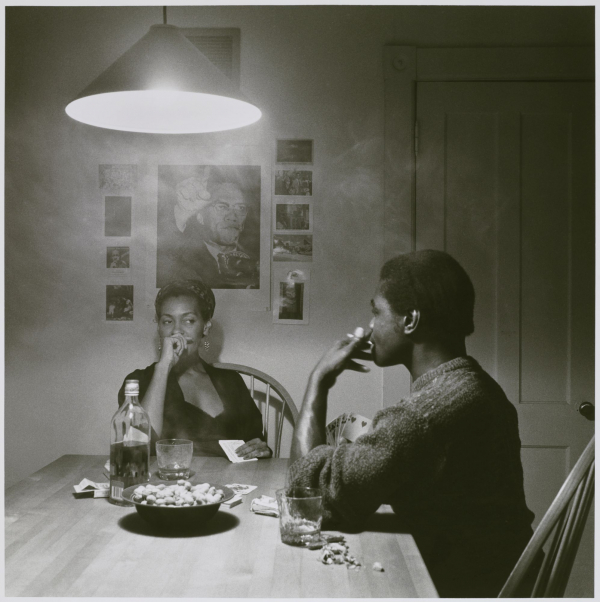
Carrie Mae Weems, “Untitled (Man Smoking / Malcolm X),” from the Kitchen Table series, gelatin silver photograph, 1990 (© Carrie Mae Weems / photo by Sarah DeSantis, Brooklyn Museum)

Carrie Mae Weems, “Untitled (Man Smoking / Malcolm X),” from the Kitchen Table series, gelatin silver photograph, 1990 (© Carrie Mae Weems / photo by Sarah DeSantis, Brooklyn Museum)

Brooklyn Museum
200 Eastern Parkway at Washington St.
Saturday, December 1, free, 5:00 – 11:00
212-864-5400
www.brooklynmuseum.org

The Brooklyn Museum celebrates the world’s preeminent borough again in its monthly free First Saturday program in December with the second part of “Best of the Borough.” There will be live music by Deva Mahal, Roze Royze of Set It Off, the Soul Summit Music Festival, and Jimi Tents; a curator tour of Egyptian art with senior curator Ed Bleiberg; Cave Canem pop-up poetry readings by Hafizah Geter, Cynthia Manick, and Nicholas Nichols; the artist talk “Something to Say” with Kameelah Janan Rasheed and Brooklyn Hi-Art! Machine; a screening of Brooklyn Film Festival “Best Brooklyn Project” winner Catch One Bedroom (Darien Sills-Evans, 2018), followed by a Q&A with members of the cast and crew; a tour of the museum’s history during the Black Power era with archivist Molly Seegers; a screening of Digging for Black Pride (Philip Burton Jr., 1971) sponsored by the Weeksville Heritage Center and followed by a discussion with Zenzele Cooper and Obden Mondesir; pop-up gallery talks with teen apprentices on “Half the Picture: A Feminist Look at the Collection”; a hands-on art workshop with figure drawing of live models inspired by Kehinde Wiley; and two Day With(out) Art screenings of Alternate Endings, Activist Risings, featuring short films from ACT UP NY, Positive Women’s Network, Sero Project, the SPOT, Tacoma Action Collective, and VOCAL NY, presented by Visual AIDS. In addition, the galleries will be open late so you can check out “Soul of a Nation: Art in the Age of Black Power,” “Kwang Young Chun: Aggregations,” “Syria, Then and Now: Stories from Refugees a Century Apart,” “Half the Picture: A Feminist Look at the Collection,” “Rob Wynne: FLOAT,” “Infinite Blue,” “A Woman’s Afterlife: Gender Transformation in Ancient Egypt,” and more.

MAIRA KALMAN: BOLD AND THE BRAVE BOOK SIGNING AND EXHIBITION

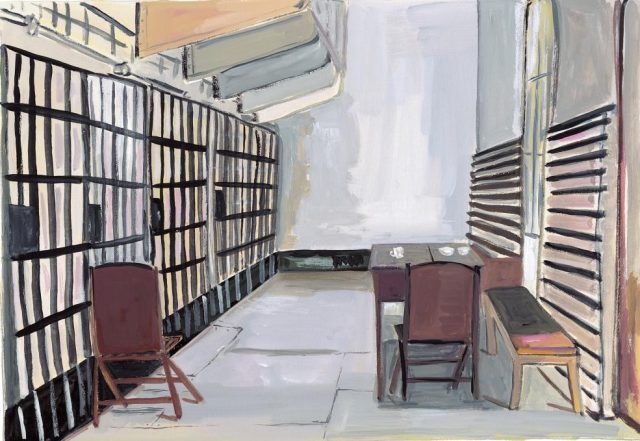
Maira Kalman, Sometimes the women were jailed for months, gouache on paper, 2018

Maira Kalman, “Sometimes the women were jailed for months,” gouache on paper, 2018 (courtesy Julie Saul Gallery)

Who: Maira Kalman
What: Book signing and exhibition
Where: Julie Saul Gallery, 535 West 22nd St. between Tenth & Eleventh Aves., sixth floor, 212-627-2410
When: Saturday, December 1, free, 3:00 -6:00
Why: Artist Maira Kalman will be at Chelsea’s Julie Saul Gallery on Saturday for the opening of her latest exhibit, “Bold & Brave,” in the project gallery, consisting of twenty-nine gouache paintings made in association with the book Bold & Brave: Ten Heroes Who Won Women the Right to Vote (Knopf, November 13, $18.99), written by Sen. Kirsten Gillibrand and illustrated by Kalman. Kalman will be signing books from 3:00 to 6:00. (She will also be signing copies of Sara Berman’s Closet, which she wrote with her son, Alex Kalman.) Among the heroes depicted in the book are Susan B. Anthony, Harriet Tubman, Alice Paul, Inez Milholland, Ida B. Wells, Mary Church Terrell, Elizabeth Cady Stanton, Sojourner Truth, Jovita Idar, and Lucy Burns. “They fought so women could be heard,” writes Gillibrand, who also pays tribute to her grandmother Dorothea “Polly” Noonan, who was recently portrayed by Edie Falco in the New Group world premiere of The True. Also on view at the gallery is Sarah Anne Johnson’s “The Cave.”

MARY CORSE: A SURVEY IN LIGHT

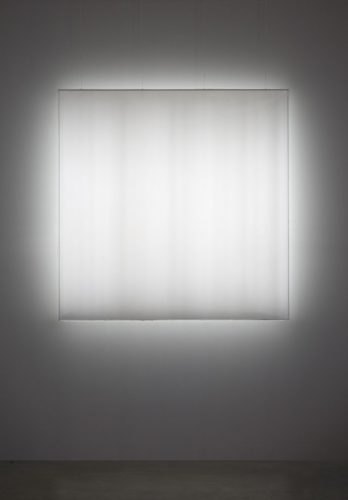
Mary Corse, “Untitled (Space + Electric Light),” Argon light, plexiglass, and high-frequency generator, 1968 ( Museum of Contemporary Art San Diego; museum purchase with funds from the Annenberg Foundation. Photograph by Philipp Scholz Rittermann)

Mary Corse, “Untitled (Space + Electric Light),” argon light, plexiglass, and high-frequency generator, 1968 ( Museum of Contemporary Art San Diego; museum purchase with funds from the Annenberg Foundation. Photograph by Philipp Scholz Rittermann)

Whitney Museum of American Art
99 Gansevoort St.
Through November 25, $18-$25
212-570-3600
whitney.org

“Your perception creates the painting,” Mary Corse says in a video about her first museum survey, “Mary Corse: A Survey in Light,” continuing at the Whitney through November 25. Since the mid-1960s, the California native has been addressing unique aspects of light, time, and space in her paintings and sculptures, the vast majority of which are shades of white. Many of the works change as you approach them, appearing different when seen from different angles and distances, forming an ever-changing relationship between viewer, surface, and light. “Corse’s White Light paintings are not works that depict movement but rather works that embody, and require, movement. To truly see Corse’s art we must move: there is no ideal vantage point,” Whitney director Adam D. Weinberg writes in the foreword to the catalog. “As much as we might try, we cannot ever find the perfect viewing position; experiencing a Corse painting is in and of itself a process.” The exhibition consists of two dozen works ranging from shaped monochrome paintings, screenprints, and acrylic on wood and plexiglass to her White Light, Black Light, and Black Earth series, documenting her changing use of materials as she began incorporating glass microspheres (the material used to reflect light in road markings), hidden Tesla coils to transmit electricity, and argon gas into her work. “I try to bring reality into the painting,” she says in the video. “I try to bring the reality of our moment here on this ball of mud; it’s not that the painting relates to nature but it is nature.”

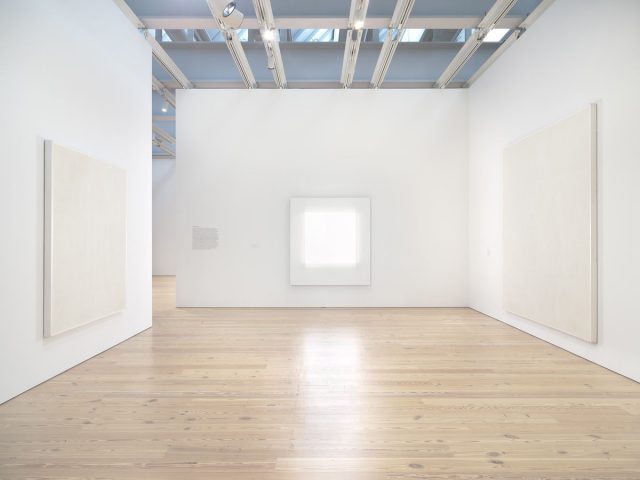
Installation view of “Mary Corse: A Survey in Light,” Whitney Museum of American Art (© Mary Corse. Photograph by Ron Amstutz)

Installation view of “Mary Corse: A Survey in Light,” Whitney Museum of American Art (© Mary Corse. Photograph by Ron Amstutz)

The work demands, and rewards, viewer engagement in a way that is distinct from that of other artists from the Light and Space movement, which includes James Turrell, Robert Irwin, Larry Bell, and Doug Wheeler. Divided into “Beginnings,” “Painting with Light,” “Black Earth, Black Light,” and “New Forms in White Light,” the Whitney show traces Corse’s career and experimental process primarily chronologically as she followed her own path. In 1970, the Berkeley-born artist moved away from Los Angeles to live and work in remote Topanga Canyon, building her own kiln and enjoying a more private life. “Untitled (Two Triangular Columns),” a pair of eight-plus-feet-high white columns with a space between them, echoes such paintings as “Untitled (Hexagonal White)” and “Untitled (White Diamond, Negative Stripe),” which feature a strip running down their centers. An entrancing glowing light emanates from “Untitled (White Light Series)” and “Untitled (Space + Electric Light).” Shapes and colors shift as you make your way around “Untitled (White Grid, Vertical Strokes)” and “Untitled (Horizontal Strokes).” Such 1970s pieces as “Untitled (Black Light Painting)” and “Untitled (Black Earth Series)” offer a stark counterpoint to the white light works. The more recent Inner Band paintings are like optical illusions in subtle motion. Exhibition curator Kim Conaty writes in the catalog, “For Corse, the subjectivity of perception — the acknowledgment that everyone experiences visual phenomena differently — has been a consistent driving force in her artistic practice for more than fifty years.” This survey ably represents Corse’s career, a long overdue exhibition that is, dare we say, illuminating. (In addition, Dia:Beacon has a new gallery of Corse’s work on view through 2021.)

RUPTURE

rupture

Art During the Occupation Gallery, Bushwick
119 Ingraham St., Buzzer 05
Ground Floor Main Gallery, Brooklyn Fire Proof Building
Tuesday, November 13, and Wednesday, November 14, $15, 7:30
www.art-during-the-occupation-gallery.com

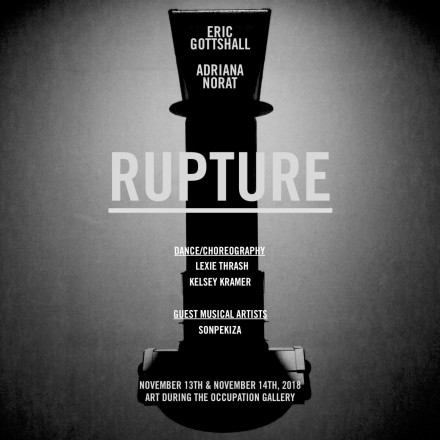
Art During the Occupation Gallery in Bushwick is temporarily deinstalling its current exhibition, David B. Frye’s “Return of the Mack,” in order to present the two-night experiential art performance Rupture. The thirty-five-minute piece features dance and choreography by Lexie Thrash and Kelsey Kramer, featuring performance artist Eric Gottshall, sound artist Adriana Norat, and musical artist Sonpekiza, exploring ideas of fear, pessimism, displacement, and death through music, movement and wearable sculpture. Tickets are $15; the shows begin at 7:30 and will be followed by a reception with the artists.

JORGE PALACIOS: LINK

Palacios’s (photo by twi-ny/mdr)

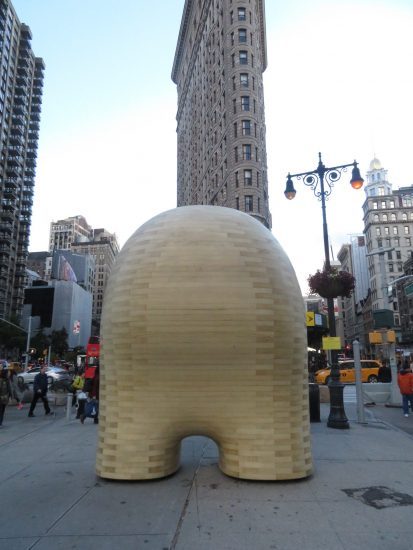
Jorge Palacios’s “Link” stands in the shadow of the Flatiron Building (photo by twi-ny/mdr)

Flatiron Plaza North
Intersection of Broadway, Fifth Ave., and 23rd St.
Through November 6, free
www.noguchi.org
link slideshow

“Jorge Palacios at the Noguchi Museum” continues through January 20 at the Long Island City institution, the museum that opened in 1985 by sculptor Isamu Noguchi, who was born in Los Angeles, raised in Japan, and lived and worked in New York for much of his career. In conjunction with the exhibition, which features nine pieces by Spanish sculptor Jorge Palacios that were inspired by Noguchi’s experimental style, Palacios’s monumental “Link” is on view through November 6 on Flatiron Plaza North. The smooth sculpture, a tribute to Noguchi’s work in public spaces that involved scale and civic engagement — for example, “Red Cube” in the Financial District — stands thirteen feet high and ten feet wide, consisting of narrow, rectangular pieces of Accoya wood that effortlessly wrap around to form an abstract shape that resembles an alien figure, a human rear end, or even a Humpty Dumpy-like character, with a small hole in the bottom. A collaboration between the New York City Department of Transportation’s Art Program, the Flatiron/23rd Street Partnership Business Improvement District, and the Noguchi Museum, “Link” is fun distraction in a crowded area, whether seen up close or from afar, the Flatiron Building rising behind it.

SOUL OF A NATION: ART IN THE AGE OF BLACK POWER

Faith Ringgold, “United States of Attica,” offset lithograph on paper, © 2018 courtesy ACA Galleries, © 2018 Faith Ringgold

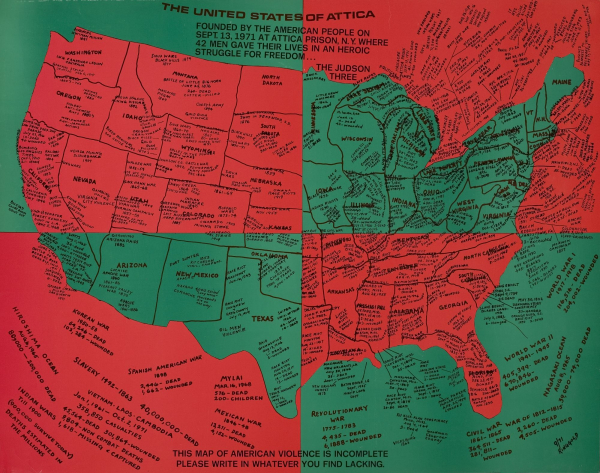
Faith Ringgold, “United States of Attica,” offset lithograph on paper, © 2018 courtesy ACA Galleries, © 2018 Faith Ringgold

FIRST SATURDAYS
Brooklyn Museum
200 Eastern Parkway at Washington St.
Saturday, November 3, free (some events require advance tickets), 5:00 – 11:00
212-864-5400
www.brooklynmuseum.org

The Brooklyn Museum explores art and Black Power in the November edition of its free First Saturday program. There will be live performances by Antoine Drye, Shelley Nicole’s blaKbüshe, and the Brooklyn Dance Festival; an Art & Dialogue discussion with curators Valerie Cassel Oliver and Catherine Morris; a hands-on workshop in which participants can create miniature paintings inspired by jazz and the work of Alma Thomas, William T. Williams, and others; a curator tour of “Soul of a Nation: Art in the Age of Black Power” with Ashley James; original poetry and music by Jaime Lee Lewis, Jennifer Falu, Joekenneth Museau, Asante Amin, Frank Malloy, and Terry Lovette in addition to excerpts from the 1968 collection Black Fire: An Anthology of Afro-American Writing; pop-up poetry with Sean DesVignes, Joel Dias-Porter, and Omotara James of Cave Canem; an “Archives as Raw History” tour with archivist Molly Seegers; and the community talk “Black Art Futures Fund.” In addition, the galleries will be open late so you can check out “Soul of a Nation: Art in the Age of Black Power,” “Syria, Then and Now: Stories from Refugees a Century Apart,” “One: Do Ho Suh,” “Half the Picture: A Feminist Look at the Collection,” “Something to Say: Brooklyn Hi-Art! Machine, Deborah Kass, Kameelah Janan Rasheed, and Hank Willis Thomas,” “Cecilia Vicuña: Disappeared Quipu,” “Rob Wynne: FLOAT,” “Infinite Blue,” “A Woman’s Afterlife: Gender Transformation in Ancient Egypt,” and more.

TONY OURSLER: TEAR OF THE CLOUD

(photo by twi-ny/mdr)

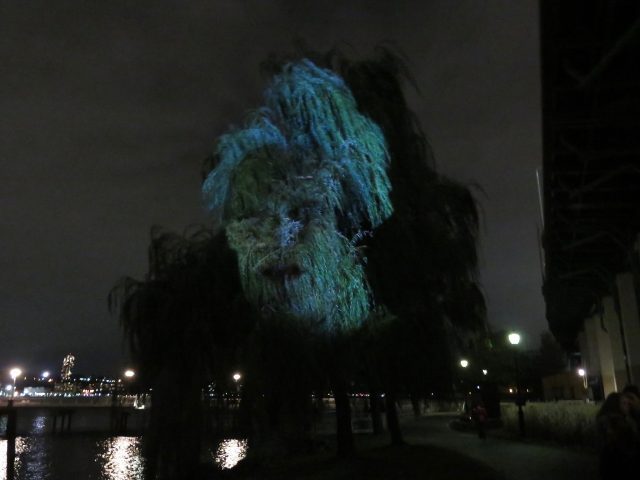
Speaking figures are projected onto a tree along the Hudson River in Tony Oursler’s “Tear of the Cloud” (photo by twi-ny/mdr)

Riverside Park South / Hudson River
Enter at West 68th Street and Riverside Blvd.
October 30-31, free, 7:00 pm – 10:00 pm
www.publicartfund.org
flickr slideshow

For many years I’ve marveled at Tony Oursler’s unique and fantastical installations, living narratives in which people’s faces and bodies are projected onto sculptural works, either life-size versions of their bodies, miniature tableaux, or more abstract objects. The New York City native, who grew up on the banks of the Hudson River in Nyack, has now expanded his repertoire with “Tear of the Cloud,” a large-scale multimedia work on and around the landmarked 69th Street Transfer Bridge (Gantry), formerly a dock for car floats for the New York Central Railroad. (Previously, Oursler’s “The Influence Machine” took over Madison Square Park in 2000, in which he created a kind of giant séance; both that and “Tear of the Cloud” are Public Art Fund projects.) From seven to ten o’clock every night but Monday through Halloween, Oursler beams images onto the front and sides of the dock, on the base of the elevated West Side Highway, on a weeping willow tree, and onto the surface of the water itself. The visuals are supplemented by audio tracks of music, stories, and dialogue about the history of the area, dating from Lenape times and the Oneida community to the tech-heavy present and future.
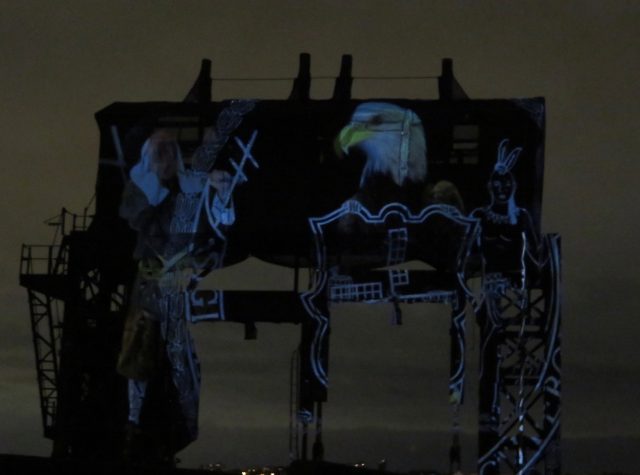
(photo by twi-ny/mdr)

Tony Oursler’s “Tear of the Cloud” consists of a wide range of iconic and abstract sound and images (photo by twi-ny/mdr)

Oursler incorporates a vast range of people, places, and things into the work, focusing on modes of communication, historical figures, and seminal eureka moments, including Samuel F. B. Morse painting his daughter for “Susan Walker Morse (The Muse),” hollow-face illusions, artificial intelligence bots, Haverstraw bricks used in city construction, IBM’s Deep Blue, the color guard, the Great West Point Chain, Thomas Edison’s Black Maria movie studio, the Headless Horseman, the Jacquard loom, molecular recorders, the telegraph, PCBs, Morse code, Indian Point, the Manhattan Project, Jimi Hendrix, Timothy Leary, LSD, Woodstock, Franz Mesmer, a viking-like Millerite, punch cards, actress and feminist Pearl White from The Perils of Pauline, the talking drum, Edgar Allan Poe’s “The Raven,” the official seal of the City of New York, and Mary Rogers being fished out of the water after being murdered in Sibyl’s Cave in New Jersey, which inspired Poe’s “The Mystery of Marie Rogêt.” Among the more than two dozen performers making appearances are costume and prop designer Enver Chakartash, assistant editor Jack Colton, Grandmaster Flash, Spencer Davis, Constance Dejong, Jim Fletcher, Holly Stanton, Jason Scott Henderson, animator Sakshi Jain, Kate Valk, and soundtrack composers MV Carbon, Corey Riddell, Idrissa Kone, and Oursler himself in addition to the Manhattan Project Chorus and the New Red Order collective.

One of the finest and most influential experimental artists of the last four decades, Oursler is not about to make it simple for viewers to figure out exactly what is happening. As you walk all around the area — make sure to go down the pier and to look and listen in all directions — you’ll take in abstract audio and visuals that might not form a complete narrative but are instead like the many tributaries that ultimately feed into the enormous Hudson River. Fortunately, the official website features a well-annotated glossary as well as a map identifying all of the figures and scenes. Oursler refers to the installation as a “visual palimpsest, depicting the layering of information associated with unforeseen legacies of the waterway [inspired by] the mnemonic effect of the river and the many intertwined tropes associated with the Hudson Valley region.” Oursler named the work after Lake Tear of the Clouds in Essex County, which is the highest source of the Hudson; the title of the work (the first word of which can be read as either teer or tayr) also evokes digital storage, acid rain, climate change, and even the “Keep America Beautiful” commercial in which an actor portraying a Native American sheds a lone tear after seeing how we shamelessly pollute the Earth. However, as Oursler makes clear in a long, projected, hard-to-read text, he is acknowledging what has been done to the environment but going far beyond merely apologizing. There are only two more nights to catch this fab installation; be sure to allow at least an hour in order to properly absorb its many facets.