this week in art

KARA WALKER’S KATASTWÓF KARAVAN WITH JASON MORAN

Kara Walker, The Katastwóf Karavan, 2017 (Installation view, Prospect.4: The Lotus in Spite of the Swamp, Prospect New Orleans, New Orleans, Louisiana, 2018). Steel frame mounted to lumber running gear, aluminum, red oak and muslin wall panels, propane fired boiler, water tank, gas generator, brass and steel 38-note steam calliope, calliope controller panel with MIDI interface, iPad controller with QRS PNO software; 152 × 216 × 100 inches (386.1 × 548.6 × 254 cm). © Kara Walker. Image courtesy Sikkema Jenkins & Co., New York. Photograph by Alex Marks

Kara Walker, The Katastwóf Karavan, steel frame mounted to lumber running gear, aluminum, red oak and muslin wall panels, propane fired boiler, water tank, gas generator, brass and steel 38-note steam calliope, calliope controller panel with MIDI interface, iPad controller with QRS PNO software, 2017 (© Kara Walker. Image courtesy Sikkema Jenkins & Co., New York. Photograph by Alex Marks)

Whitney Museum of American Art
Pamella and Daniel DeVos Family Largo
99 Gansevoort St.
Saturday, October 12, free, 1:00 – 6:30
whitney.org
www.karawalkerstudio.com

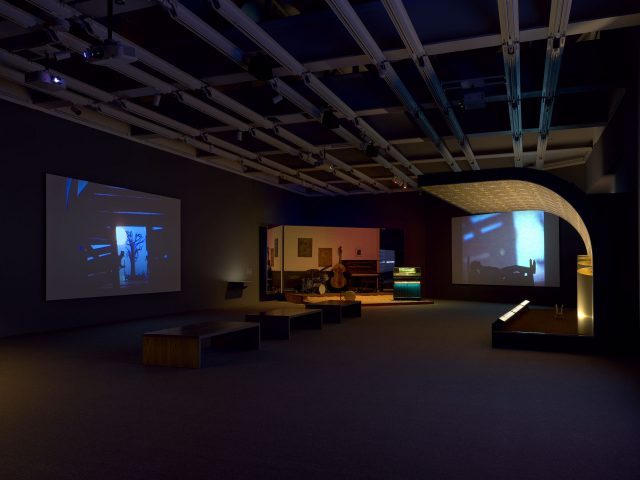
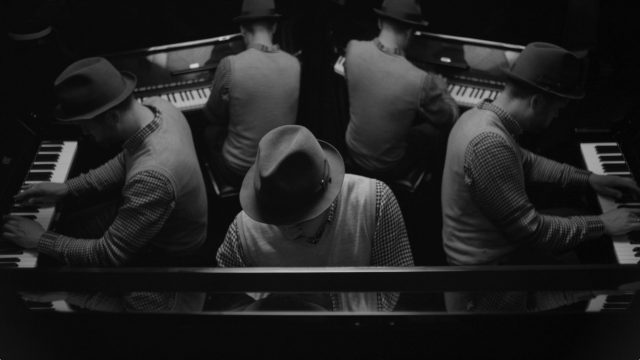
Two years ago, Kara Walker’s site-specific Katastwóf Karavan nearly didn’t make it to New Orleans’ Prospect.4 Triennial: The Lotus in Spite of the Swamp because of disagreements over shipping costs. But it ultimately took its place on Algiers Point, and now the completely fabricated wagon will be pulling into the Pamella and Daniel DeVos Family Largo outside the Whitney, where it will perform for free from 1:00 to 6:30 on Saturday. The California-born, New York-based artist was inspired to construct the wagon after reading an insufficient, small historical plaque (see below) at Algiers Point identifying the location where enslaved Africans were “held before being ferried across the river to the Slave Auctions” as well as after hearing calliope music coming from the Natchez riverboat, a steamboat reminiscent of the kind used to transport the slaves. The four-wheeled, four-ton circus-style wagon features Walker’s trademark silhouette figures of slaves being abused by masters on all four sides in water-cut steel, with a loud, thirty-eight-note steam-powered calliope inside, custom made by Kenneth Griffard. The presentation is taking place in conjunction with jazz musician Jason Moran’s solo show at the Whitney, which continues through January 5; Texas native Moran will play the calliope at 6:00 on Saturday.

In the Prospect.4 performance handout, Walker, whose My Complement, My Enemy, My Oppressor, My Love ran at the Whitney in 2007-8, explained, “I was thinking a lot about music as the bearer of our emotional history, and about the way Jazz and gospel and African American Music are testaments to survival of our culture in the face of unrelenting, nihilistic ‘Progress’ and how it’s regarded as a monument in American History etc. But also thinking about how the Industrial Revolution, the Steam Engine and Cotton Gin were pivotal in usurping and grinding up the bodies of laborers and how much of that action, John Henry style, occurs today, with Humans fighting uphill battles to prove themselves against the latest technology. Steam engines are quaint things of the past, but industry presses on without us. The Machines have changed, but the action stays the same. How would it be if the old steam engines that ate us, swallowed too, our songs and pain, and what if, when its time was done, and slated for the scrapheap, the Steam Engine sang out in solidarity?”

algiers point

Incorporating the Haitian Creole word for “catastrophe” in its name, Katastwóf Karavan — “We simply say ‘Slavery’ as if that were a legitimate job instead of what it was, a Catastrophe for millions,” Walker explains — will also play such civil-rights-era, celebratory, and protest songs as “We Shall Overcome,” Aretha Franklin’s “Respect,” Prince’s “When Doves Cry,” and Marvin Gaye’s “What’s Going On?” Walker, whose Fons Americanus is currently wowing visitors at the Tate Modern and whose Domino Sugar Factory installation A Subtlety caused a sensation in New York five years ago, holds nothing back in her work, confronting racial prejudice and inadequate histories head-on. “Forgetting is preferable to remembering, as remembering stirs action,” she writes in the handout.

JENNY HOLZER: VIGIL

mail

Rockefeller Center
30 Rockefeller Plaza
October 10-12, free, 8:00 – 10:00 pm
creativetime.org
projects.jennyholzer.com

For more than forty years, Jenny Holzer has been producing text-based art, carving words into marble, projecting them on walls and buildings, running them digitally across sculptural signs, compiling them in lists, and even stitching them onto a dress Lorde wore to the Grammys. Her work has been seen on Singapore’s city hall, Silo No 5. in Montreal, the Potomac River, NYU’s Bobst Library, the New York Public Library, the Guggenheim, and Rockefeller Center. Her latest project takes her back to Rock Center with “Vigil,” a commission from the public arts organization Creative Time, which will be holding its tenth annual summit next month, asking the question “Can speaking truth to power unravel the age of disillusion we find ourselves in?”

From 8:00 to 10:00 on the evenings of October 10-12, the Ohio-born, New York-based Holzer will zero in on the rise of gun violence in the US, projecting excerpts from the 2017 book Bullets into Bells: Poets & Citizens Respond to Gun Violence, which combines poetry from established writers with responses from gun control activists, politicians, survivors of mass shootings, and family members of victims; stories from the award-winning activist website Moments that Survive, collected by Everytown for Gun Safety, which is dedicated to ending gun violence; and poems by teenagers who refuse to be silent. Holzer previously collaborated with Creative Time on “For New York City: Planes and Projections” and “For the City” in 2004-5, and her ongoing “It Is Guns” series, featuring such statements as “Scream Again,” “The President Backs Away,” and “Too Late Now” on trucks, has traveled to Chicago, Miami, Atlanta, Tallahassee, New York, and other American cities.

NEXT WAVE 2019

(photo by Heidrun Lohr)

The Second Woman repeats the same scene from John Cassavetes’s Opening Night one hundred times (photo by Heidrun Lohr)

BAM Howard Gilman Opera House, Peter Jay Sharp Building, 230 Lafayette Ave.
BAM Fisher, Fishman Space, 321 Ashland Pl.
October 15 – December 15
718-636-4100
www.bam.org

Like myriad loyal BAMgoers, I look forward every year to the announcement of the Next Wave Festival at the Brooklyn Academy of Music, which has been presenting cutting-edge, experimental, and innovative dance, music, film, theater, opera, and hard-to-categorize multidisciplinary performances from around the world for nearly forty years. We eagerly scour the schedule to see when our longtime BAM favorites will be returning, scanning for such beloved names and companies as Robert Wilson, Sasha Waltz, Grupo Corpo, Batsheva, Philip Glass, Sankai Juku, Ivo van Hove, Mark Morris, Théâtre de la Ville, William Kentridge, Laurie Anderson, and the incomparable Pina Bausch, programmed by masterful executive producer Joe Melillo since 1999.

But this year’s lineup features nary a single familiar name, including that of Melillo, who retired after the Winter/Spring season. For his debut Next Wave Festival, new artistic director David Binder has opted to include a roster of performers all making their BAM debuts as well. But don’t be scared off by the lack of recognition. There was a time when no one in New York had ever seen Pina Bausch, Sankai Juku, Batsheva, Sasha Waltz, et al. And by its very nature, the Next Wave is all about the future of performance, delivered to an eager and intrepid audience open to anything and everything.

(photo by Ernesto Galan)

Dead Centre’s Hamnet tells the story of Shakespeare’s son (photo by Ernesto Galan)

“In programming my first season at BAM, I was inspired by the genesis of Next Wave and the groundbreaking work of my predecessors, Harvey Lichtenstein and Joe Melillo,” Binder said in a statement. “Next Wave is a place to see, share, and celebrate the most exciting new ideas in theater, music, dance, and, especially, the unclassifiable adventures. We’ve invited a slate of artists who have never performed at BAM. Each and every one of them is making a BAM debut, with artistic work that’s surprising and resonant. I’m excited to launch this season and to build BAM’s next chapter
with you.”

The 2019 Next Wave roster is an impressive one, kicking off October 15-20 with Michael Keegan-Dolan and Teaċ Daṁsa’s Swan Lake / Loch na hEala, about a young girl sexually assaulted by a priest. In The Second Woman, Alia Shawkat performs the same scene from John Cassavetes’s Opening Night one hundred times with one hundred different men over the course of twenty-four consecutive hours. Christiane Jatahy’s What if they went to Moscow? explores film and theater in a retelling of Anton Chekhov’s Three Sisters that takes place concurrently onstage at the BAM Fisher and onscreen at BAM Rose Cinemas, the audiences switching places as the performance repeats. In Dante or Die’s User Not Found, audience members sit in a café at the Greene Grape Annex on Fulton St., following the exploits of a man a few tables away. Dimitris Papaioannou breaks boundaries as he explores human existence in The Great Tamer. And Glenn Kaino’s When a Pot Finds Its Purpose will be the inaugural free exhibition at the new Rudin Family Gallery at BAM Strong.

(photo by Justin Jones)

Dante or Die’s User Not Found takes place in the Greene Grape Annex on Fulton St. (photo by Justin Jones)

The 2019 Next Wave Festival also includes Bruno Beltrão/Grupo de Rua’s Inoah, Dumbworld’s free outdoor art piece He Did What?, Selina Thompson’s free interactive installation Race Cards, Dead Centre’s Hamnet, Marlene Monteiro Freitas’s Bacchae: Prelude to a Purge, Untitled Projects/Unicorn Theatre, UK’s The End of Eddy, Peeping Tom’s 32 rue Vandenbranden, Fuel/National Theatre/Leeds Playhouse’s Barber Shop Chronicles, Kyle Marshall Choreography’s A.D. & Colored, Kate McIntosh’s In Many Hands, and Meow Meow’s A Very Meow Meow Holiday Show. Still worried about unfamiliarity? If you’ve been to BAM before, you should be ready, willing, and able to be surprised, and if you’ve never been to BAM, you should be preparing to make your debut.

DOWNTOWN BROOKLYN ARTS FESTIVAL

Peter Brook (photo ©-Marian Adreani)

Peter Brook will be celebrated at several events during the Downtown Brooklyn Arts Festival this weekend (photo © Marian Adreani)

Brooklyn Cultural District
The Plaza at 300 Ashland and other locations
October 4-6, free – $115
www.dbartsfestival.org

Downtown Brooklyn is the place to be this weekend for the Downtown Brooklyn Arts Festival, taking place around the Plaza at 300 Ashland from Friday to Saturday. There will be an African drum circle, live music and dance, talks and discussions, theater, glass-making demonstrations, film screenings, classes, treasure hunts, art exhibitions, and more; while many events are free, others require ticketing at BAM, Theatre for a New Audience, the Mark Morris Dance Center, and the New York Transit Museum, among others. Below are some of the highlights.

Friday, October 4
Kickoff with live performance by Soul Tigers Marching Band and dance party with Soul Summit, the Plaza at 300 Ashland, free, 5:00 – 8:00

Free Demonstration Night: The Two-Part Mold, with Kellie Krouse and Jeffrey Close, UrbanGlass, free, 6:00 – 9:00

Peter Brook\NY, with Paul Auster, Marie-Hélène Estienne, and Jeffrey Horowitz, Center for Fiction, $10 (includes $10 off at bookstore), 7:00

Pop-Up: An Artistic Treasure Hunt, by Strike Anywhere and the Tours Soundpainting Orchestra, Fort Greene, free, 7:00

Saturday, October 5
African Drum Circle with Mr. Fitz, the Plaza at 300 Ashland, free, 11:00

NYTM Train Operators Workshop, New York Transit Museum, free with museum admission, 11:30 & 3:30

Dance: Pas de Deux, with Brooklyn Ballet, set to Jean-Phillippe Rameau’s “Gavotte et Six Doubles,” the Plaza at 300 Ashland, free, 2:00

Rhys Chatham: The Sun Too Close to the Earth / Jonathan Kane and Zeena Parkins: Oh, Suzanne, ISSUE Project Room, $20-$25, 8:00

Sunday, October 6
Dance: Tribal Truth, in collaboration with Jamel Gaines Creative Outlet, the Plaza at 300 Ashland, free, 12:00

MC Oddissee, the Plaza at 300 Ashland, free, 1:00

Brooklyn Navy Yard: Past, Present & Future Tour, $15-$30, 2:00

Pop-Up: Nkiru Books, with DJ set by Talib Kweli, the Plaza at 300 Ashland, free, 2:00 – 5:00

BRAZILIAN MODERN: THE LIVING ART OF ROBERTO BURLE MARX

“Gardens are works of art, and have to be treated as such,” Roberto Burle Marx (photo by twi-ny/mdr)

“Gardens are works of art, and have to be treated as such,” the multitalented Roberto Burle Marx said (photo by twi-ny/mdr)

The New York Botanical Garden
2900 Southern Blvd., Bronx
Through Sunday, September 29, $10-$28
718-817-8700
www.nybg.org

This is the last weekend to see one of the most beautiful exhibits of the summer, “Brazilian Modern: The Living Art of Roberto Burle Marx.” The New York Botanical Garden’s wide-ranging survey of the life and career of São Paulo-born landscape architect and conservationist Roberto Burle Marx is the Bronx institution’s largest botanical exhibition in its history, consisting of plants, painting, sculpture, photographs, quotations, ephemera, and more. The installation is highlighted by a glorious, swirling black-and-white mosaic walkway and Modernist Garden, designed by Burle Marx protégé Raymond Jungles, that leads to a living wall fountain and the Enid A. Haupt Conservatory, which is filled with native Brazilian plants and other species. Marx, who passed away in 1994 at the age of eighty-four, brought back many of them from his extensive travels.

“As far as I’m concerned, there are no ugly plants,” Roberto Burle Marx, “Function of the Garden” lecture (photo by twi-ny/mdr)

“As far as I’m concerned, there are no ugly plants,” Roberto Burle Marx, “Function of the Garden” lecture (photo by twi-ny/mdr)

Blue signs identify Brazilian native plants from Neoregelia and Clusia grandiflora to Aechmea blanchetiana and Philodendron Burle Marx. “One must bring nature into the reach of man and, above all, take man back to nature,” he said in his “Gardens and Landscape” lecture. The display, curated by Edward J. Sullivan, Ph.D., also features a water garden with Bismarck palms, Amazonian water lilies, a dazzling wall of staghorn ferns, a room of Marx’s abstract paintings and tapestries and intricate environmental drawings, a detailed timeline, and an interactive look at the Sítio, which served as his home, a studio, and a salon, where he met with major landscape architects and artists.

“Nature is a complete symphony, in which the elements are all intimately related — size, form, color, scent, movement, etc. . . . . It is . . . an organization endowed with an immense dose of spontaneous activity, possessing its own modus vivendi with the world around it,” Roberto Burle Marx, 1962 (photo by twi-ny/mdr)

“Nature is a complete symphony, in which the elements are all intimately related — size, form, color, scent, movement, etc. . . . . It is . . an organization endowed with an immense dose of spontaneous activity, possessing its own modus vivendi with the world around it,” Roberto Burle Marx, 1962 (photo by twi-ny/mdr)

It’s a pleasure to spend hours with Burle Marx, who appears to have been a friendly man with a vivacious thirst for art in every facet of his life. Interestingly, not much is known about his family situation, despite Dr. Sullivan’s attempts to gather information from those who knew him. But what is known is upbeat and positive, as depicted in photos of him with his thick white hair and bushy mustache and through his many quotes.

“The garden is, it must be, an integral part of civilized life: a deeply felt, deeply rooted, spiritual, and emotional experience,” Roberto Burle Marx, “The Garden as a Form of Art,” 1962 lecture (photo by twi-ny/mdr)

“The garden is, it must be, an integral part of civilized life: a deeply felt, deeply rooted, spiritual, and emotional experience,” Roberto Burle Marx, “The Garden as a Form of Art,” 1962 lecture (photo by twi-ny/mdr)

On Saturday from 1:00 to 4:00, Artes Brasileiras will present live music, while on Sunday the Silva Dance Company will perform at the same time and the Cinema Brasileiro! film series will screen Joao Vargas Penna’s 2018 documentary Landscape Film: Roberto Burle Marx. Do whatever you can to make sure you experience this one-of-a-kind exhibition about a one-of-a-kind artist and environmentalist.

PHENOMENAL NATURE: MRINALINI MUKHERJEE

(photo by twi-ny/mdr)

“Mrinalini Mukherjee: Phenomenal Nature” continues at the Met Breuer through September 29 (photo by twi-ny/mdr)

The Met Breuer
945 Madison Ave. at 75th St.
Through September 29, suggested admission $12-$25
212-731-1675
www.metmuseum.org

It’s a shame that Indian artist Mrinalini Mukherjee didn’t live long enough to see her lovely Met Breuer retrospective, “Phenomenal Nature.” This first major US survey follows the career of Mukherjee, who passed away in 2015 at the age of sixty-five, as she balanced between figuration and abstraction, the traditional and the modern, and Western and non-Western modalities while moving from fiber wall hangings and free-standing works to ceramic and bronze objects. The show, arranged chronologically, features her feminist totems that at times evoke a walk through the Star Wars Cantina, populated by strange and intriguing, often erotically charged creatures.

(photo by twi-ny/mdr)

Mrinalini Mukherjee, Aranyani
(Goddess of the Forests),
fiber, 1996 (photo by twi-ny/mdr)

Inspired by nature, Mukherjee’s colorful fiber and hemp sculptures reference both humans and animals and bear Sanskrit names such as Apsara (Celestial Nymph), Yakshi (Female Forest Deity), Rudra (Deity of Terror), and Black Devi (Black Goddess). Thoughtfully curated by Shanay Jhaveri, it’s a menagerie of snakes, peacocks, palm fronds, flowers, and figures with sexual organs that form their own kind of iconography; other pieces mimic furniture, from chairs to lamps, but there is nothing mundane about Mukherjee’s oeuvre, which she intended to be seen as an artistic whole rather than craft pieces. “My work is physical — my body, my materials, the way of life, the environment, all work together,” she said. The fifty-seven works are on view through September 29, a poignant introduction to a sadly little-known artist you can learn more about at the free MetFridays lecture “Mrinalini Mukherjee: Materials and Experience,” with Julia Bryan-Wilson, Fred Moten, and Jhaveri at the Met Fifth Ave. at 6:30 on September 27.

MARTA MINUJÍN: MENESUNDA RELOADED

(photo by twi-ny/mdr)

Marta Minujín’s La Menesunda has a neon-heavy room evocative of Buenos Aires and Times Square (photo by twi-ny/mdr)

New Museum of Contemporary Art
235 Bowery at Prince St.
Through September 29, $12-$18
212-219-1222
www.newmuseum.org

If you missed Mika Rottenberg’s “Easypieces” at the New Museum, you still have a chance to catch Marta Minujín’s similarly immersive, astute, and funny “Menesunda Reloaded,” continuing through September 29. The Buenos Aires-born Minujín, collaborating with Rubén Santantonín, debuted the participatory installation La Menesunda in 1965 at the Instituto Torcuato di Tella in her home city to huge acclaim, with long lines of eager art lovers waiting for their chance to go inside the multimedia labyrinth and experience the unique happening, one at a time. “‘LA MENESUNDA’/is a caprice/a nonsense/way of creating difficult/strange/embarrassing ‘situations’/for those who are willing to accept them/INTENSIFYING EXISTENCE/beyond gods and ideas/feelings/mandates and desires,” the pamphlet at the opening described.

(photo by twi-ny/mdr)

Visitors meet a masseuse or a makeup artist in “The Woman’s Head” (photo by twi-ny/mdr)

You’ll have to wait in line at the New Museum as well, but it moves pretty quickly as people make their way up and down stairs and into a series of rooms Minujín, who was only in her early twenties when she made the piece, calls “The Woman’s Head,” “The TV Tunnel,” “The Intestines,” “The Swamp,” “The Rotating Basket,” and “The Forest of Forms and Textures,” among others. Each space offers different types of interactions as visitors can see themselves on an old television monitor, watch a couple in bed, get a schpritz from a makeup artist, and navigate through glowing neon, soft sculptures, and a mirrored area with confetti. The exhibition is supplemented with a black-and-white documentary of people going through the original installation, but avoid watching it until after you come out so it doesn’t ruin any of the surprises.

(photo by twi-ny/mdr)

La Menesunda features hidden surprises around every corner and through mysterious peepholes (photo by twi-ny/mdr)

Now seventy-six, Minujín counted among her friends and colleagues Claes Oldenburg, Allan Kaprow, Carolee Schneemann, Christo, and Andy Warhol and has constructed such other immersive environments as El Batacazo, The Academy of Failure, and Eróticos en Technicolor. She is quite a character, as she reveals in a catalog interview with Helga Christofferson and Massimiliano Gioni in which she touts her success and large ego, declares her work is not spectacle-driven, and explains why she hasn’t gone to a doctor since the birth of her daughter. When asked if La Menesunda was purposely designed so that it was possible for people to exit before seeing every room, she responds, “Yes. I always liked the idea that something is missing. For instance, I am very famous in Argentina, so I signed a dollar with the statement: ‘Take me, I am yours.’ People would then have to think about whether they wanted to sell the dollar with my signature on it, or use it. It’s like if you found a dollar bill signed by Andy Warhol in New York, would you sell it, keep it to sell it later, or spend it? I always want to create that kind of situation. That’s what I like about art: to wake up senses and ideas, to wake people up from their everyday lives, to wake up feelings they’ve never felt before.” Anticipating Instagram-friendly pop-up galleries and the need for publicly-announced instant gratification, La Menesunda accomplishes all that and more.