this week in art

ARTIST TALK AND MORE: RACHEL FEINSTEIN AT THE JEWISH MUSEUM

(photo by twi-ny/mdr)

Rachel Feinstein will discuss her survey exhibition at the Jewish Museum on February 13 (photo by twi-ny/mdr)

The Jewish Museum, Scheuer Auditorium
1109 Fifth Ave. at 92nd St.
Thursday, February 13, $12-$18, 6:30
Exhibit continues through March 22, $8-$18, pay-what-you-wish Thursday from 5:00 – 8:00, free Saturday
212-423-3200
thejewishmuseum.org

Rachel Feinstein’s first survey exhibition, “Maiden, Mother, Crone” at the Jewish Museum, leads visitors down the Arizona-born, New York City-based multidisciplinary artist’s unique rabbit hole, an abstract wonderland where mythology, fairy tales, religious iconography, sexuality, and family are interwoven through a distinctly feminist lens. Mirrors figure prominently, allowing us to take a close look at ourselves and our innate biases. In conjunction with the show, Feinstein will give the Gertrude and David Fogelson Lecture at the museum on February 13, followed by a book signing of the companion monograph. The exhibit is fashioned like a fantastical trip though winding pathways with life-size statues, maquettes, paintings, film, and installation that are not always what they initially seem. A former fashion model who studied at Columbia, Feinstein creates works layered with nuance and filled with little surprises.

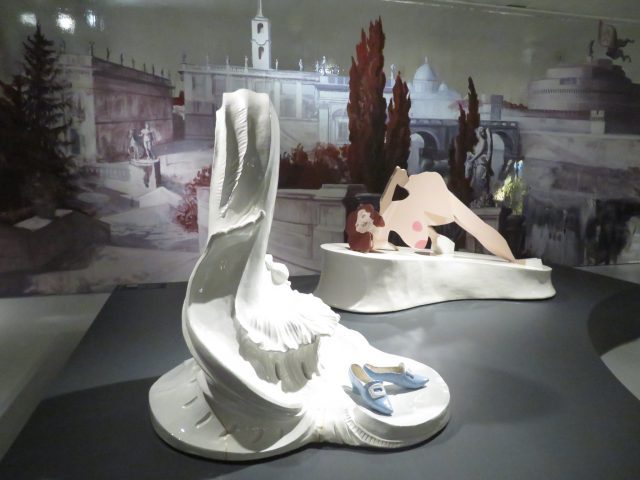
Model, a wood, plaster, and enamel paint construction with mirrors, is flanked by St. Sebastian and St. Michael, equating pop culture and religion. One room features Goldstein, a white-painted, carefully carved wood wall that evokes a tropical getaway, while another offers Panorama of Rome, Mylar wallpaper of Ancient Roman architecture surrounding such classical-inspired statuary as Corinne, a swirling Majolica piece made with the Nymphenburg Porcelain Manufactory and based on an eighteenth-century Commedia dell’Arte figurine; The Orphan and Bleeding Shepherdess, which subvert convention with frank images of the female body and its functions; and Butterfly and Puritan’s Delight, which play with fairy-tale tropes.
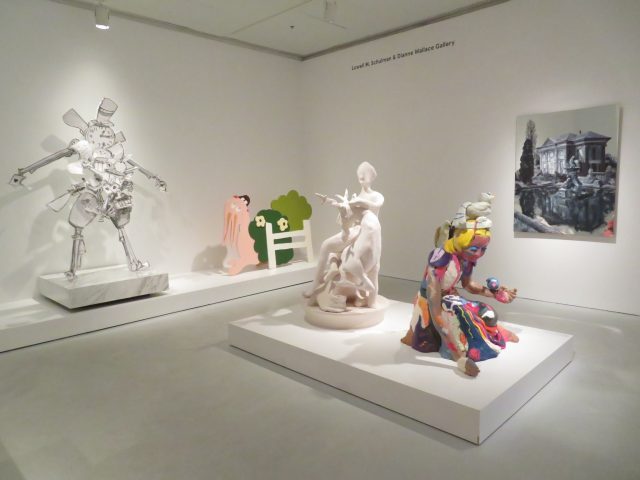
(photo by twi-ny/mdr)

Rachel Feinstein’s fantastical fairy-tale world will be on view at the Jewish Museum through March 22 (photo by twi-ny/mdr)

Also on view are the stained wood Adam and Eve, which intertwines the biblical couple with nature in the Garden of Eden; a yearning depiction of the Crucifixion, Feinstein’s first work after having witnessed the destruction on 9/11 from her downtown apartment; the colorful Flower Girl, a Play-Doh-like youth with animals congregating all over her; Mr. Time, a fanciful black-and-white working clock based on a drawing by Feinstein’s son when he was ten; and a series of six cameo-like paintings of women on oval mirrors, five elderly ladies and a younger prima ballerina.

The inherent tension in Feinstein’s oeuvre, involving color, materials, and meaning in a kind of twisting of Hans Christian Andersen and Lewis Carroll, is also evident in her 1994-96 experimental short film Spring and Winter, in which she reconfigures Charles Perrault’s Sleeping Beauty story with an eye to the source material, Giambattista Basile’s Sun, Moon, and Talia, which was not so child friendly, as well as the true story of Art and Nan Kellam, a couple who lived in isolation on an island off the coast of Maine; in the film, Feinstein portrays a paper doll, a maiden, and a crone. There’s a theatricality to virtually everything Feinstein creates; in fact, her 2014 Folly installation in Madison Square Park was accompanied by a performance festival. “Maiden, Mother, Crone” continues through March 22; on March 12 ($18, 6:30), the panel discussion “Dialogue and Discourse — Once Upon a Time: Narrative in Art” features Feinstein with Lisa Yuskavage, Sofia Coppola, Tamara Jenkins, and Florence Welch, moderated by curator Kelly Taxter, and there will be such special gallery talks as “Mirrors of Civilization” and “The Dark Side of Fairy Tales” as well as Thursday Evening Cocktails through February, where attendees can try Feinstein’s potent potable of choice, the Negroni, an Italian favorite consisting of gin, vermouth rosso, and Campari.
FANFAIRE NYC

fanfaire nyc

The High School of Art and Design
245 East 56th St.
Saturday, February 8, and Sunday, February 9, $5-$15 per day, $10-$20 two-day pass, 10:00 am – 6:00 pm
www.fanfairenyc.com

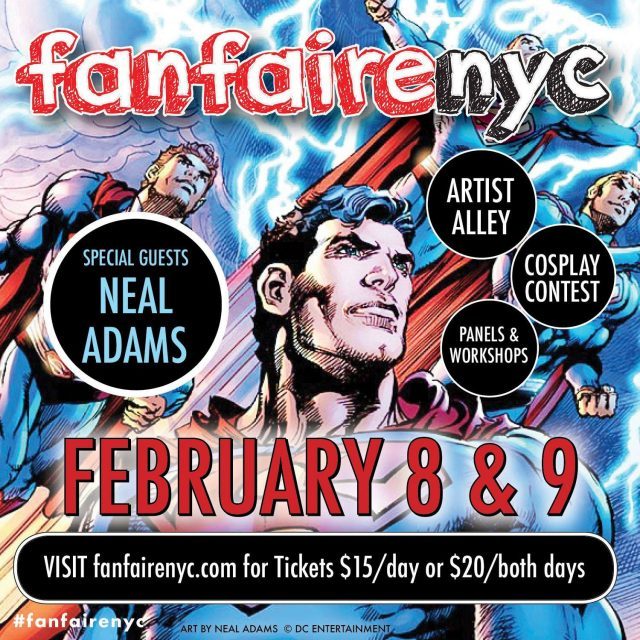
Fanfaire NYC takes place this weekend, a two-day festival celebrating cartooning, animation, graphic design, architecture, and fashion. An annual benefit for the High School of Art and Design, the multidimensional fest features more than 125 artists and vendors, talks and panels, workshops, costume contests, video games, movie screenings, and portfolio reviews. This year’s guests range from artists and professors to cosplayers and editors, from character designers and executives to writers and high school alum, including Neal Adams, Abe Audish, Bob Camp, Klaus Janson, Chip Kidd, Geoff Spear, and David Mazzucchelli. Founded in 1936, the High School of Art and Design, which is a public school, has boasted such graduates as Adams, Tony Bennett, Calvin Klein, Marc Jacobs, Art Spiegelman, Amy Heckerling, and Steven Meisel. Below are only some of the highlights:

Saturday, February 8
Graphic Design & Illustration Portfolio Review, with Joann Hill and Cryssy Cheung, Library, sixth floor, advance registration required, 10:00 am

Careers in Animation, with Bob Camp, Sachio Cook, Chrissy Fellmeth, and Abe Audish, moderated by Kiara Arias and Jaydan Hyman, Black Box, LL2, 10:30

Tracing Is Not a Crime, with Neal Adams, moderated by Josh Adams, Classroom 1, sixth floor, 10:30
​
My Life in Ink, with tattoo artist Keith “BANG BANG” McCurdy, Black Box, LL2, 12:00

Breaking into Comics and Other Tales, with Klaus Janson, moderated by Chris Allo, Black Box, LL2, 1:30

Storytelling in Comics with David Mazzucchelli, Classroom 1, sixth floor, 3:00

Mythconceptions — Behind the Scenes of George O’Connor’s Olympians, with George O’Connor, Black Box, LL2, 4:30

Sunday, February 9
Ink Flow: Learning to Ink Like Neal Adams, with Neal Adams, moderated by Josh Adams, Classroom 1, sixth floor, 10:00 am

Freelance isn’t Free — How to Build Yourself as an Artist and Run a Business, with Lucinda Lewis, Chrissy Fellmeth, Nik Virella, and Cristian S. Aluas, moderated by Miss Kill Joy, Auditorium, LL2, 12:00

Cosplay Competition: People’s Choice Masquerade, Auditorium, LL2, 2:00 – 5:00

Inside the Art of Sequential Visual Storytelling, with Carl Potts, Black Box, LL2, 2:30

Children’s Books: More than Drawing Cute Bunnies, with Joann Hill, Classroom 3, sixth floor, 3:00

DYNAMIC DUO: The art of last impressions, slide presentation, discussion, and book signing, with Chip Kidd, Geoff Spear, and Charles Kochman, Black Box, LL2, 4:00 – 6:00

​

FIRST SATURDAYS: FUTURA NOIR

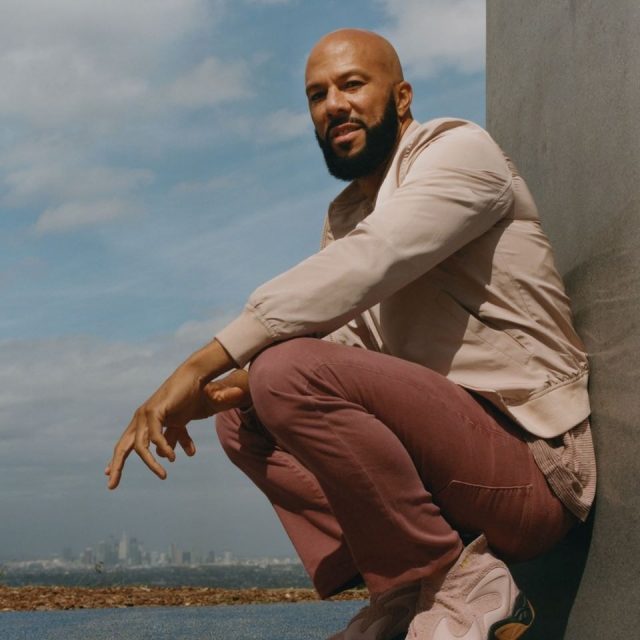
Common will sit down for a fireside chat as part of Brooklyn Museum First Saturday program this week

Common will sit down for a fireside chat as part of Brooklyn Museum First Saturday program this week

Brooklyn Museum
200 Eastern Parkway at Washington St.
Saturday, February 1, free (some events require advance tickets), 5:00 – 11:00
212-864-5400
www.brooklynmuseum.org

The Brooklyn Museum has a wide-ranging program with several surprises for its annual Black History Month edition of its free First Saturday gathering. There will be live performances by Topaz Jones, Niles Luther, NVR Sleep (Rodney Hazard, Mikey, Fab Roc, and ClassicNewWave), and Bri Blvck; an Ancestral Healing sound bath from HealHaus, with intention-setting by Omar Davis and a sound bath facilitated by Phyllicia Bonanno; a screening of Billy Gerard Frank’s 2019 short film Second Eulogy: Mind the Gap, followed by a talkback with artist and activist Renee Cox, artist Christopher Udemezue, and Frank, moderated by writer and curator Ebony L. Haynes; a Scholar Talk with Niama Safia Sandy on race, power, nationalism, and imperialism; a curator tour of “Jacques-Louis David Meets Kehinde Wiley” led by Lisa Small and Eugenie Tsai; teen apprentice pop-up gallery talks focusing on works by Black artists in the American Art galleries; a hands-on art workshop where participants can make an urban garden, inspired by Kehinde Wiley; a poetry reading with Osyris Antham, Chanice Hughes-Greenberg, and Cyrée Jarelle Johnson; and “Real People: A Fireside Chat with Common,” a conversation with artist, actor, and activist Common (Lonnie Rashid Lynn), moderated by Peloton cycling instructor Tunde Oyeneyin. In addition, the galleries will be open late so you can check out “Jacques-Louis David Meets Kehinde Wiley,” “Out of Place: A Feminist Look at the Collection,” “One: Xu Bing,” “JR: Chronicles,” and more.

ANTONY GORMLEY AT PARSONS SCHOOL OF DESIGN

Antony Gormley

Antony Gormley, rendering of New York Clearing (© the artist)

Who: Antony Gormley
What: Artist talk at Parsons School of Design addressing the question “What is sculpture good for?”
Where: The New School, the Auditorium, Alvin Johnson/J.M. Kaplan Hall, 66 West Twelfth St.
When: Tuesday, February 4, free with advance registration, 6:00
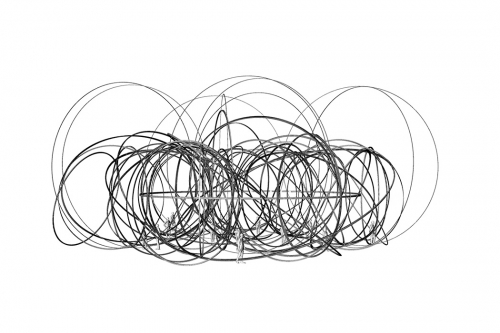
Why: On February 4, British sculptor Antony Gormley will be at Parsons School of Design to discuss his latest work, New York Clearing, which will be on view in Brooklyn Bridge Park’s Pier 3 from February 5 to March 27. The “drawing in space,” consisting of eighteen kilometers of looping and coiling square aluminum tubing, is part of the global project CONNECT, BTS, organized by K-pop sensation BTS. “It’s a truth universally acknowledged that creativity can transcend the boundaries of language, culture, and history,” the superstar boy group explains on the official website. “Art embodies a will to respond to the world, and to communicate that response to others; it is always there, no matter what the era, moving with or despite the times. . . . CONNECT, BTS reaches for a collective experience that might be only the beginning of new communication between art, music, and people.” Curated by Daehyung Lee, CONNECT, BTS also includes Danish artist Jakob Kudsk Steensen’s Catharsis in London, the performance series Rituals of Care curated by Stephanie Rosenthal and Noémie Solomon in Berlin, and Argentine artist Tomás Saraceno’s Aerocene Pacha in Buenos Aires, as well as a yet-to-be-named work in Seoul. “Art only becomes art when it is shared,” the London-born Gormley, whose Event Horizon dazzled and frightened people in Madison Square Park nearly ten years ago, has said. Admission to the February 4 discussion is free with advance registration.

IMPULSE

(photo by twi-ny/mdr)

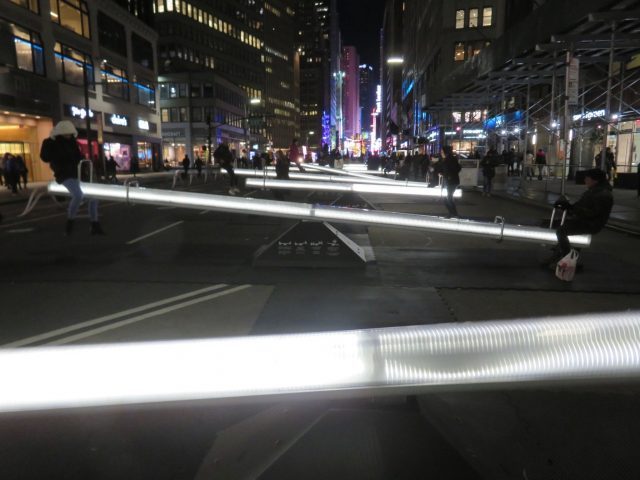
Twenty giant seesaws offer illuminating rides in the Garment District (photo by twi-ny/mdr)

Winter Garden, Garment District
Broadway between 37th & 38th Sts.
Through February 1, free,
garmentdistrict.nyc

If the winter doldrums are getting you down, if the cold and dark are wearing on your nerves, the Garment District Alliance and the New York City Department of Transportation’s Seasonal Streets Program have just the thing to break the monotony: a seesaw. Through February 1, Impulse will continue on Broadway between Thirty-Seventh & Thirty-Eighth Sts., twenty giant teeter-totters equipped with motion-detector LED lights and sound (the subtle sound design is by Mitchell Akiyama, with electronics by Robocut Studio) that come together in happy-making union.

Designed by Lateral Office and CS Design in collaboration with EGP Group and fabricated by Generique Design, the installation brings the playground fixture to a usually busy urban environment, but the street is cut off to vehicular traffic so up to four people at a time can “ride, take a free ride / Take their place / Have their seat / It’s for free.” Just be fair to your fellow teeterboarders who might be waiting patiently as you go up and down, up and down, amid relaxing light and sound, as well as plenty of laughter.

NAM JUNE PAIK: THE MAESTRO OF TIME

Gallery Korea of the Korean Cultural Center New York
460 Park Ave. between Fifty-Seventh & Fifty-Eighth Sts., sixth floor
Monday – Friday through January 31, free
212-759-9550
www.koreanculture.org

To celebrate its fortieth anniversary, the Korean Cultural Center New York is hosting the three-part exhibition “Nam June Paik: The Maestro of Time,” which continues at Gallery Korea weekdays through January 31. The free show also honors the fourteenth anniversary of the death of the Father of Video Art, who passed away on January 29, 2006, in Miami when he was seventy-three. The centerpiece is Paik’s massive M200/Video Wall, a barrage of eighty-six television monitors blasting colorful sounds and images that Paik created for the bicentennial of the passing of Wolfgang Amadeus Mozart, who died in Vienna in 1791 at the age of thirty-five. The video sculpture, which Paik referred to as “moving wall paintings,” predicted the age of digital information bombardment as pictures and snippets of performances fly by, from the Korean American artist’s friends and collaborators Joseph Beuys, Merce Cunningham, and John Cage to David Bowie and a man dressed as Mozart. As Paik said way back in 1965, “The cathode-ray tube will someday replace the canvas.”

(photo by twi-ny/mdr)

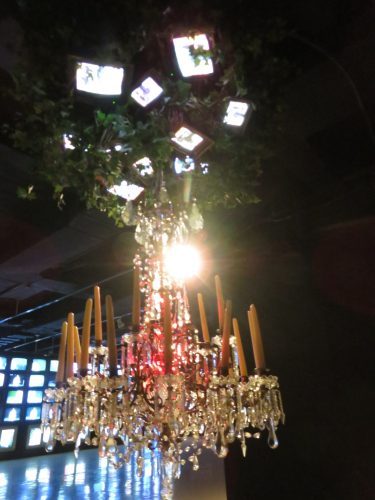
Nam June Paik’s Video Chandelier No. 4 is part of Korean Cultural Center New York celebration and tribute (photo by twi-ny/mdr)

Tucked away in a corner of the gallery is Paik’s Video Chandelier No. 4, a low-hanging chandelier dangling from what appears to be the top of a tree that has small video monitors in its leaves instead of fruit, strikingly linking technology to nature. Also on view is a series of black-and-white photographs by Jae-young Choi of one of Paik’s avant-garde gut performances, in which the man who coined the term “electronic superhighway” staged a shamanistic ritual on his birthday in 1990, paying tribute to Beuys. Gallery Korea is open 9:00 to 5:00 Monday to Friday but will stay open till 8:00 on January 29.

member: POPE.L, 1978-2001

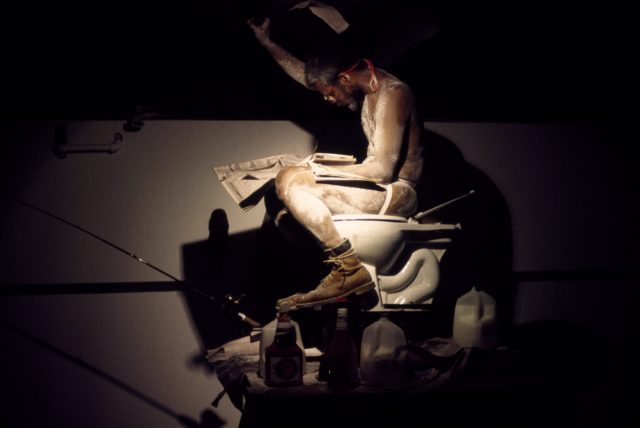
Pope. L. Eating the Wall Street Journal (3rd Version). Sculpture Center, New York, NY. 2000, Digital c-print on gold fiber silk paper. 6 by 9 in. 15.24 by 22.86 cm. © Pope. L. Courtesy of the artist and Mitchell – Innes  &  Nash, New York.

Pope.L, Eating the Wall Street Journal (3rd Version), digital c-print on gold fiber silk paper, Sculpture Center, New York, 2000 (© Pope. L. / courtesy of the artist and Mitchell – Innes & Nash, New York)

MoMA, Museum of Modern Art
11 West 53rd St. between Fifth & Sixth Aves.
Through February 1, $14-$25 (sixteen and under free)
212-708-9400
www.moma.org

The first thing you must do when you go to MoMA is check out whether there is a backpack hanging on the wall at the end of the “member: Pope.L 1978–2001” exhibition; if it’s not there, it means that Newark-born Conceptual artist William Pope.L is somewhere in the galleries, either performing on a yellow square near the front, doodling on the walls, or interacting with visitors. Since the late 1970s, Pope.L has been holding interventions and live performances that expose racism, classism, poverty, homelessness, and other societal ills. “I am a fisherman of social absurdity, if you will,” he has said. “I am more provocateur than activist. My focus is to politicize disenfranchisement, to make it neut, to reinvent what’s beneath us, to remind us where we all come from.” The show, which continues through February 1, features photographs, film footage, and paraphernalia from many of his Crawls and acts of resistance, in which he takes to the streets in unusual ways as a form of protest.

(photo by twi-ny/mdr)

Pope.L has been adding doodles to the walls during run of show at MoMA (photo by twi-ny/mdr)

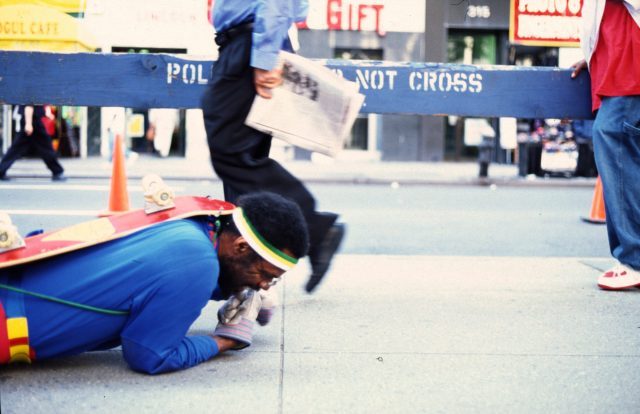
In Thunderbird Immolation, he doused himself with cheap wine and surrounded himself with matches, evoking the Buddhist ritual of self-immolation but here calling into question the marketing of cheap alcohol in poor minority communities. For The Great White Way and Snow Crawl, Pope.L put on a Superman suit. For Member a.k.a. Schlong Journey, he donned business attire and had a long white cardboard tube with a stuffed white bunny on the end protruding from his crotch, as if it were an enormous phallus, as he walked around Harlem, revealing issues of black masculinity and white supremacy. For Sweet Desire a.k.a. Burial Piece, he buried himself in the ground standing up, only his shoulders and head visible, and looked at a melting bowl of ice cream that he could not bend his head over and eat, emphasizing “have-not-ness.” And for Eating the Wall Street Journal, Pope.L built a tall toilet throne which he climbed up to and then, while sitting on the bowl, read, then tore up, chewed, and spat out pages of the newspaper because of its promise of individual wealth.

Pope.L. The Great White Way, 22 miles, 9 years, 1 street. 2000-09. Performance. © Pope. L. Courtesy of the artists and Mitchell – Innes & Nash, New York.

Pope.L, The Great White Way, 22 miles, 9 years, 1 street, 2000-09 (© Pope.L / courtesy of the artists and Mitchell – Innes & Nash, New York)

In a back room, you can watch several of his experimental performances, including Eracism, Aunt Jenny Chronicles, and Egg Eating Contest; be sure to look behind the screen for a bonus. The Black Factory Archive consists of items donated by people from around the country that they consider black objects. “The Black Factory is an industry that runs on our prejudices,” Pope.L wrote of the project. “We harvest all your confusions, questions, and conundrums, and transform them into the greatest gift of all: possibility!” And in ATM Piece, he chained himself to the front door of a midtown bank, wearing only a skirt made out of bills. Throughout the galleries, you’ll also see small rectangles cut out of the wall; “Typically what cannot be seen is what we most like to see,” he says of the work, Hole Theory. On January 26 at 2:00, MoMA’s Creativity Lab will host a discussion on Pope.L with Brooklyn-based artist Steffani Jemison and MoMA curatorial assistant Danielle Jackson that examines Pope.L’s influence.

(photo by twi-ny/mdr)

Pope.L exhibitions at MoMA and the Whitney are filled with hidden surprises (photo by twi-ny/mdr)

Member is part of “Pope.L: Instigation, Aspiration, Perspiration,” a collaboration between MoMA, the Public Art Fund, and the Whitney. On September 21, PAF staged Conquest, in which blindfolded volunteers from across the diversity spectrum crawled from the West Village through Washington Square Park and ultimately to Union Square Park. Groups of five, from people in wheelchairs to pregnant women, from the elderly to the blind and deaf and men and women with prosthetic limbs, as well as able-bodied participants, crawled one block each, raising ideas of physical privilege. And Pope.L’s Choir is on view at the Whitney through March 8 in the free main-floor space, a thousand-gallon tank surrounded by microphones that fills up with water sourced from the Hudson after he poured in some water from Flint, Michigan, then empties out via a pipe system as snippets of gospel music and other sounds can be heard. Around the gallery are such phrases as “NGGR WATER,” “HLLOW WTR,” and “NDVSBL WTR,” evoking Jim Crow, segregated drinking fountains, and the lead crisis in Flint. “I think there’s a kind of arrogance in using this kind of material in this quantity,” he says on the audioguide to Choir. ”I think that in some ways, I’m expressing a kind of privilege in being able to do this. There’s a kind of edge to that in the work.” That statement applies directly to member at MoMA and Pope.L’s entire career as well.