this week in art

42nd ANNUAL BRIC CELEBRATE BROOKLYN! FESTIVAL: LIVE EVERYWHERE

celebrate brooklyn

Who: Kes, Lila Downs, Junglepussy, Madison McFerrin, Shantell Martin, ?uestlove, Angelique Kidjo, Yemi Alade, Buscabulla, Glendalys Medina, the Tallest Man on Earth, Common, Robert Glasper, Karriem Riggins, Michelle Buteau
What: BRIC Celebrate Brooklyn! Festival
Where: BRIC Facebook, YouTube
When: Saturday, July 25, and Sunday, July 26, free, 8:00
Why: Every summer I make sure to return to the borough of my birth, in the park where my parents used to push me around in a stroller, to revel in the BRIC Celebrate Brooklyn! Festival, a months-long party of music, dance, art, food, and camaraderie. Of course, with New York City in pandemic lockdown, the in-person festival has been canceled; however, you can get a taste of what you’re missing when Celebrate Brooklyn! goes virtual this weekend. A wide-ranging collection of international performers will be taking part, with Kes, Lila Downs, Junglepussy, Madison McFerrin with Shantell Martin, and ?uestlove (DJ set) on Saturday night and Angelique Kidjo, Yemi Alade, Buscabulla with visual artist Glendalys Medina, the Tallest Man on Earth, and Common joined by Robert Glasper and Karriem Riggins on Sunday evening. The event will be hosted live on Facebook, YouTube, and Brooklyn cable channels by comedian and actress Michelle Buteau. In addition, there will be an all-star finale celebrating the greatest borough in the world. The festival is free, but donations will be accepted for the BRIC Creative Future Relief Fund here.

SO⅃​ OS 10 — DIAMANDA GALÁS: BROKEN GARGOYLES

Diamanda Galás

Diamanda Galás will present work-iin-progress piece from empty Bowery gallery on July 23 (photo by Austin Young, graphic design by Robert Knoke)

Who: Diamanda Galás
What: Livestreamed broadcast from empty gallery
Where: Fridman Gallery
When: Thursday, July 23, $5, 8:00
Why: Fridman Gallery and CT::SWaM​ (Contemporary Temporary:: Sound Works and Music) continue their SO​⅃​OS livestreamed performance series on July 23 with experimental musician, lecturer, activist, and visual artist Diamanda Galás. The San Diego-born Galás, who has released such albums as Plague Mass, Defixiones: Orders from the Dead, Vena Cava, Schrei X, and The Refugee, will present Broken Gargoyles, an audiovisual installation recorded in the empty Fridman Gallery on Bowery and offsite and mixed remotely, featuring music, script, video, and photography by Galás and two expressionist poems by Georg Heym, “Das Fieberspital” and “Die Dämonen der Städte”; Galás willl read an excerpt from the latter. (You can see a clip from her 2013 performance of the poem here.) A work in progress made with artist and sound engineer Daniel Neumann, video artist Carlton Bright, and artist Robert Knoke, Broken Gargoyles takes its name from the phrase used in WWI to describe facially disfigured soldiers and includes a war-era photo by Ernst Freidrich. Tickets are five dollars to watch the livestream or any time thereafter; you can also still catch earlier SO​⅃​OS installments by such artists as Neumann, Luke Stewart, Mendi and Keith Obadike, and Marina Rosenfeld / Ben Vida (solos). The series concludes July 30 with the multidisciplinary Augmentation and Amplification with Janet Biggs, Mary Esther Carter, Richard Savery, and A.I. Anne.

A CONVERSATION WITH DARA BIRNBAUM: SCREENING AND LIVE Q&A

Kiss the Girls: Make Them Cry (still), 1979. Dara Birnbaum (American, born 1946). Color video, sound; 6:50 min. Courtesy of the artist and Electronic Arts Intermix (EAI), New York.

Dara Birnbaum, Kiss the Girls: Make Them Cry, still, color video, sound, 1979 (courtesy of the artist and Electronic Arts Intermix (EAI), New York)

Who: Dara Birnbaum, Alex Kitnick, Asad Raza, Marianna Simnett
What: Special streaming and live conversation with Q&A
Where: Marian Goodman Gallery Zoom
When: Thursday, July 23, free with registration, 2:00
Why: New York native Dara Birnbaum has been making video and installation art since the 1970s, at the cutting edge of the emerging discipline. On July 23, Marian Goodman Gallery will host a screening of the pioneer’s breakthrough five-minute 1978-79 video, Technology/Transformation: Wonder Woman, which welcomed visitors to the contemporary galleries at the new MoMA prior to the pandemic lockdown (it was initially displayed in a SoHo storefront), and Kiss the Girls: Make Them Cry, a seven-minute video from 1979 in which Birnbaum uses clips from the popular Hollywood Squares game show to explore coded gestures, pop culture imagery, and gender representation. (The setup for the show is like a modern-day Zoom meeting come to life in three dimensions.) The screening will be followed by a live conversation and audience Q&A with Birnbaum, art historian Alex Kitnick, and artists Asad Raza and Marianna Simnett.

VIRTUAL BOOK LAUNCH EVENT: RAPHAEL MONTAÑEZ ORTIZ

El Museo

El Museo del Barrio will celebrate the publication of Raphael Montañez Ortiz’s first monograph on July 22

Who: Javier Rivero Ramos, Chon Noriega, Kevin Hatch, Ana Perry, Marcos Dimas, Pedro Reyes, Juan Sanchez
What: Virtual book launch of Raphael Montañez Ortiz monograph with conversation and live Q&A
Where: El Museo en Tu Casa Zoom
When: Wednesday, July 22, free with RSVP, 7:00
Why: In 1969, Brooklyn-born artist and educator Raphael Montañez Ortiz founded and became the first director of El Museo del Barrio. “The cultural disenfranchisement I experience as a Puerto Rican has prompted me to seek a practical alternative to the orthodox museum, which fails to meet my needs for an authentic ethnic experience. To afford me and others the opportunity to establish living connections with my own culture, I founded El Museo del Barrio,” he said. In 2014, El Museo honored Ortiz with the exhibition “Museum Starter Kit: Open with Care”; on July 22, they’ll pay tribute to the eighty-six-year-old Nuyorican multidisciplinary deconstructionist with a virtual launch party for his first monograph, featuring a live conversation on Zoom, followed by a Q&A; among the participants are monograph editor Javier Rivero Ramos, contributors Chon Noriega, Kevin Hatch, and Ana Perry, and artists Marcos Dimas, Pedro Reyes, and Juan Sanchez.

“One of the most radical creators and pioneers of his generation, Raphael Montañez Ortiz offers El Museo del Barrio an opportunity to push the boundaries of identities, showcase moments of harmony and tension in our lived history as a museum, and challenge and expand limited visual art narratives. Entropy speaks about the need for transformation, about the irreversible changes that are generated within complex systems. This spirit is evidenced in El Museo del Barrio today and for years to come,” El Museo executive director Patrick Charpenel said in a statement. Ramos added, “For far too long, canonical art history devoted to American art of the second half of the twentieth century neglected one of its most innovative artists. Premised on the Eurocentric myth of the homo faber, it failed to comprehend the trailblazing character of Raphael Montañez Ortiz and his lifelong endeavor to harness the human condition’s primal energies. At once a painter, performance artist, sculptor, filmmaker, teacher, community organizer, and writer, the work of Raphael Montañez Ortiz defies disciplinary categorization. This publication offers for the first time a panoramic view of a prolific career spanning more than six decades.”

CARMEN ARGOTE’S LAST LIGHT SCREENING AND Q&A

Carmen Argote goes for a haunting walk in new short film Last Light

Carmen Argote goes for a haunting walk in new short film Last Light

Who: Carmen Argote, Erin Christovale
What: Livestream premiere and live Q&A
Where: The Hammer Museum at UCLA
When: Tuesday, July 21, free with RSVP, 9:00 EDT
Why: Mexican-born, LA-based multidisciplinary artist Carmen Argote was scheduled to open her latest exhibition, “Hand Dog Glove,” at Clockshop in Los Angeles, but the Covid-19 pandemic has put that on hold. In the interim, Argote, the gallery, and the Hammer Museum at UCLA have teamed up to present the livestream premiere of Argote’s haunting twelve-minute film, Last Light, which she started making just before the lockdown and continued during the crisis. “Is this fear so paralyzing?” she asks as she walks through the emptying streets of her city, considering ideas of loneliness, childhood, and demolition. “I feel like I’m not made to last; I’m not the one who’s gonna make it.” Argote, who was hospitalized early in the crisis for a non-cornonavirus-related illness, takes walks as part of her discipline. In her artist statement she explains, “I explore notions of home and place. I respond to architecture and site to reflect on personal histories and on my own immigrant experience. My practice uses the act of inhabiting as a starting point, working within a space and its cultural, economic, and personal context as a material. I work at a human scale and in relationship to how my body inhabits space.” The premiere will be livestreamed on July 21 at 9:00, followed by a Q&A with Argote and Hammer associate curator Erin Christovale. (Click on the above photo to watch the trailer.)

GALERIE LELONG CONVERSATIONS: JAUME PLENSA WITH MARY SABBATINO

Plensa

Jaume Plensa is back in his Barcelona studio, where he will take part in the inaugural “Galerie Lelong Conversation” (photo courtesy Galerie Lelong)

Who: Jaume Plensa, Mary Sabbatino
What: Artist talk inaugurating “Galerie Lelong Conversations”
Where: Galerie Lelong Zoom
When: Thursday, July 9, free with advance registration, 2:00
Why: “April is the cruellest month, breeding / Lilacs out of the dead land, mixing / Memory and desire, stirring / Dull roots with spring rain.” So begins T. S. Eliot’s epic 1922 poem, “The Waste Land.” Spanish artist Jaume Plensa uses that quote for the title of his new online exhibition, “Jaume Plensa: April is the cruelest month,” which continues on Galerie Lelong’s website through July 10. The show consists of drawings on Super Alfa Guarro paper from his new “STILL” series, created during the month of April, when Plensa was sheltering in place at home, unable to get to his studio. Each of the works contains letters, either arranged randomly, in the shape of a heart, or forming such words as panic, dementia, suicide, insomnia, and anxiety on the fingers of a hand. In the exhibition text, gallery vice president and partner Mary Sabbatino explains, “Language is not the only means to communicate and can sometimes work against comprehension. ‘We are best when together,’ says Plensa. In the contemplation of these drawings, we see a world both intimate and expansive, expressive of shared human experience during a time when the world was ‘still.’”

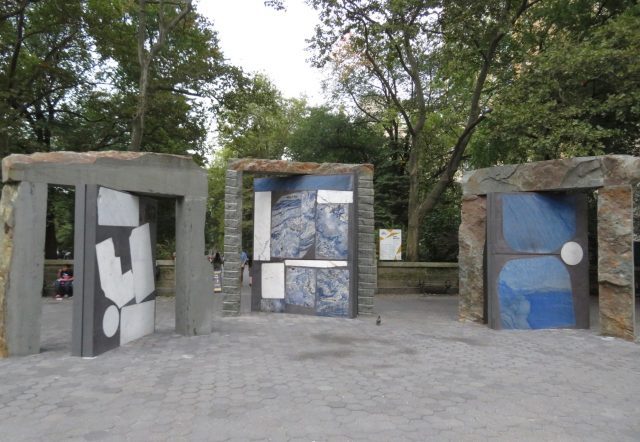
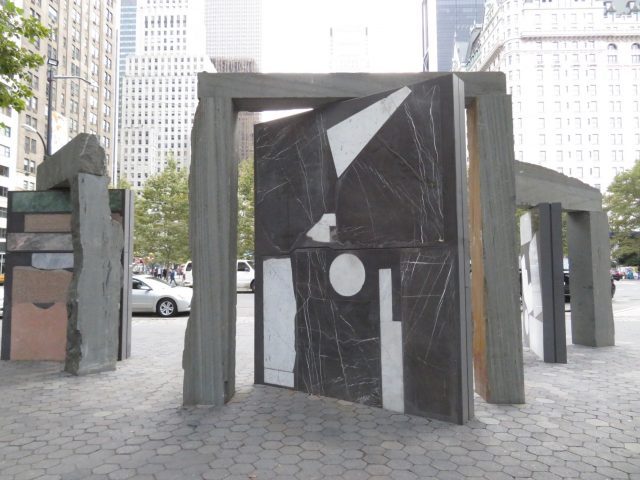
On July 9 at 2:00, in conjunction with the closing of the exhibition the next day, Sabbatino will host a live Zoom “Galerie Lelong Conversation” with Plensa, who is back in his Barcelona studio. Plensa is best known in New York City for his large-scale works Echo in Madison Square Park and Behind the Walls at Rockefeller Center; for more on the artist, check out the trailer for Pedro Ballesteros’s new documentary, Jaume Plensa: Can You Hear Me? The next “Galerie Lelong Conversation” will take place in August with Brooklyn-based artist Leonardo Drew, who had a solo show at the gallery last year. And as Eliot also wrote in “The Waste Land”: “There is shadow under this red rock, / (Come in under the shadow of this red rock), / And I will show you something different from either / Your shadow at morning striding behind you / Or your shadow at evening rising to meet you; I will show you fear in a handful of dust.”

INSIDER INSIGHTS: GERHARD RICHTER PAINTING

Gerhard Richter reveals his creative process in fascinating documentary (photo courtesy of Kino Lorber)

Who: Brinda Kumar, Corinna Belz
What: Livestreamed prerecorded discussion
Where: MetMuseum Facebook and YouTube
When: Tuesday, June 23, free, 6:00
Why: In conjunction with the expansive Met Breuer exhibition “Gerhard Richter: Painting After All,” which opened March 4 for a brief run before the pandemic lockdown and hopefully will continue once the crisis is over, the Met’s “Insider Insights” series will examine Corinna Belz’s 2011 documentary, Gerhard Richter Painting. [Ed. note: It was announced on June 22 that the Met Breuer will be closing for good, so the exhibition will not be coming back.] On June 23 at 6:00, writer-director Belz will be joined by Met Modern and Contemporary Art assistant curator Brinda Kumar for a prerecorded interview discussing the making of the film, which can be streamed for free through July 31 here.

There’s nothing abstract about the title of Belz’s documentary on the German artist, no missing words or punctuation marks. Gerhard Richter Painting is primarily just that: Ninety-seven minutes of Gerhard Richter painting as he prepares for several exhibitions, including a 2009 show at the Marian Goodman Gallery in New York City. In 2007, Belz got a rare chance to capture Richter on camera, making a short film focusing on the stained-glass window he designed for the Cologne Cathedral. Two years later, the shy, reserved Richter, who prefers to have his art speak for itself, invited Belz into his studio, giving her remarkable access inside his creative process, which revealingly relies so much on chance and accident. Belz films Richter as he works on two large-scale canvases on which he first slathers yellow paint, adds other colors, then takes a large squeegee and drags it across the surface, changing everything. It’s fascinating to watch Richter study the pieces, never quite knowing when they are done, unsure of whether they are any good. It’s also painful to see him take what looks like an extraordinary painting and then run the squeegee over it yet again, destroying what he had in order to see if he can make it still better. “They do what they want,” he says of the paintings. “I planned something totally different.”

from

About halfway through the film, a deeply concerned Richter starts regretting his decision to allow the camera into his studio. “It won’t work,” he says. “At the moment it seems hopeless. I don’t think I can do this, painting under observation. That’s the worst thing there is.” But continue he does, for Belz’s and our benefit. Belz (Life After Microsoft, Peter Handke: In the Woods, Might Be Late) even gets Richter to talk a little about his family while looking at some old photos, offering intriguing tidbits about his early life and his escape to Düsseldorf just before the Berlin Wall went up. Belz also includes clips from 1966 and 1976 interviews with Richter, and she attends a meeting he has with Goodman about his upcoming show, lending yet more insight into the rather eclectic artist. “To talk about painting is not only difficult but perhaps pointless, too,” Richter, who turned eighty-eight in February, says in the 1966 clip. However, watching Gerhard Richter Painting is far from pointless; Belz has made a compelling documentary about one of the great, most elusive artists of our time. “Man, this is fun,” Richter says at one point, and indeed it is; watching the masterful artist at work is, well, a whole lot more fun than watching paint dry.