Who:Battery Dance What:First annual Battery Dance Gallery Crawl Where: Eight Tribeca galleries When: Saturday, November 20, free with advance RSVP, 2:00 – 4:00 Why: Founded in 1976 by president and artistic director Jonathan Hollander, Battery Dance “envisions a time when the universal expression of dance will ignite a movement across geographic, social, and cultural boundaries to improve people’s quality of life.” The company has been doing just that with unique programming both inside and outdoors, in New York City and around the world. The company is adding to its central presentation, the free Battery Dance Festival, held downtown for forty years, with the first annual Battery Dance Gallery Crawl. On November 20 between 2:00 and 4:00, eight current and former Battery Dance members and a special guest will perform in eight galleries near its home base in Tribeca, reacting directly to the art on display; the shows are free with advance RSVP and proof of full vaccination. “Coming out of pandemic-enforced isolation, we saw a renaissance on our streets with empty, distressed storefronts remade into gorgeous spaces for art. It seemed like a beckoning for us — come, dance, bring the neighbors out, and let’s celebrate each other and our community,” Hollander said in a statement. Below is the full list of performers, galleries, and their current exhibitions.
DRIFT: FRAGILE FUTURE
The Shed, the McCourt
545 West 30th St. at Eleventh Ave.
Wednesday – Sunday through December 19, exhibition $25, Drifters and exhibition $35
Includes admission to Ian Cheng: Life After BOB
646-455-3494 theshed.org online slideshow
Since 2007, the Amsterdam-based duo DRIFT, a partnership between Lonneke Gordijn and Ralph Nauta, have been exploring the intersection and interdependence of humans, nature, and technology. Their environmentally conscious, multidimensional works are like individual ecosystems that present hope for a future potentially doomed by climate change. Continuing through December 19 at the Shed at Hudson Yards, Fragile Future is a wonderland of experiential installations, presented by Superblue, which specializes in immersive art.
The exhibition begins with Fragile Future, a light sculpture with a modular system based on the growth of dandelions, constructed from LED lights, phosphor bronze, printed circuit board, and the hairs and seeds of dandelions themselves. Coded Coincidence consists of dozens and dozens of beaded lights that move about a long, rectangular, netted space, sudden gusts of air making them mimic the flight of elm seeds in the spring. There’s an emotional aspect to the movement as they travel in groups and gather in a corner, or, with a kind of sadness, one gets trapped in the netting, alone until it can be freed and join the rest of the herd.
Ego might be composed of nylon fiber, ultra-high molecular weight polyethylene fiber monofilaments, polyester, and polyvinyl fluoride and run by motors set to specific algorithms, but it seems to have an organic life of its own. Created for Nederlandse Reisopera’s production of Monteverdi’s opera L’Orfeo, about the love between Orpheus and Eurydice and his descent into the underworld, Ego is a monumental handmade woven block that rises, falls, spreads out, collapses, and twists and turns as if magically floating through space, evoking human emotions amid a gentle soundscape. Describing its construction, Gordijn explains in a Drift video, “It depends on how that ego is shaped, how flexible it is, or how rigid it is. Because if it is rigid, there is only one truth, and if it’s flexible, you can move along with what is needed in order for it to accept certain truths or accept how life is or how the world is being built. And I think it’s a big difficulty in everybody’s life to be flexible in your vision and to be flexible in your perspective. But we have to be flexible, and I like that about Ego, that it can be a very rigid block but it can also completely change. It can be a solution.”
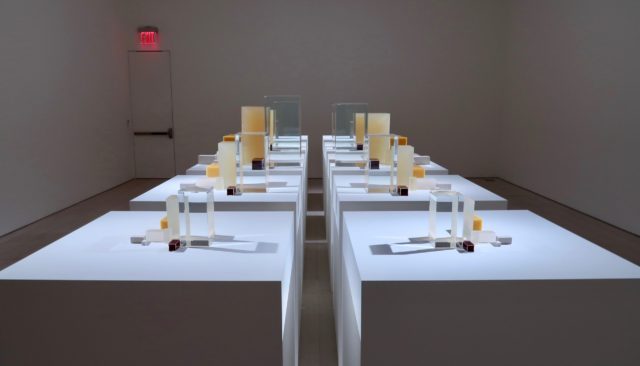
The next room is filled with “Materialism,” a collection of reverse-engineered sculptures that reduce such consumer products as a Big Mac menu, a coffee cup, an iPhone, a pencil, and a bicycle into colored blocks based on the size of their raw materials, resulting in miniature architectural models meant to reveal how we exploit the earth and its labor force.
In the two-channel, twelve-minute film Drifters, Drift’s iconic concrete blocks float through New York City at one end of a long room and across mountains, rivers, and forests at the other end, searching for where they came from and what awaits them.
The pièce de resistance takes place in the McCourt, the Shed’s 17,000-square-foot McCourt performance venue, only at certain times and with an extra charge, so plan your visit carefully. Four levitating Drifters, real versions of the blocks from the film in the previous room, move slowly throughout the space for more than an hour, set to a droning soundtrack by Anohni, the English singer-songwriter who used to lead the band Antony and the Johnsons. The blocks are floating without wires, engaged in a butoh-like dance as they very (very) slowly flip, lower, and rise, sometimes dangling just overhead. Occasionally they gently bump into each other in a kind of soft kiss. The audience can walk around the area, sit in folding chairs, or lie down on their backs on the floor as these monoliths put on a mesmerizing show that could be an outtake from Stanley Kubrick’s 2001: A Space Odyssey. During the performance, I asked Gordijn how they did it. After offering two guesses that she quickly said no to, I suggested a third, which she simply smiled at. It’s extraordinarily peaceful and relaxing while also instilling hope for a future where humans, nature, and technology can exist together in harmony.
[On December 10 and 11, Ego will be activated by special dance performances, featuring Company Wo. (Daniel Kersh, Marcella Ann Lewis, Erika Choe, Jordan Demetrius Lloyd, and Myssi Robinson) from 11:30 to 5:00 and Project-TAG (Mizuho Kappa) from 5:30 to 8:00 on Friday and Limón Dance Company (Jessica Sgambelluri) from 11:30 to 2:00 and Battery Dance (Durgesh Gangani, Jillian Linkowski, Razvan Stoian, Randall Riley, Sarah Housepian, and Vivake Khamsingsavath) from 2:30 to 8:00 on Saturday.]
Drift exhibit at Pace features self-portraits of founders Lonneke Gordijn and Ralph Nauta (photo by twi-ny/mdr)
DRIFT MATERIALISM: PAST, PRESENT, FUTURE
Pace Gallery
540 West Twenty-Fifth St. between Tenth & Eleventh Aves.
November 5 – December 18, free www.pacegallery.com
In an April 2020 online Pace discussion with musician Lee Ranaldo — he was supposed to play live with Ego when it was previously at Pace but it was canceled because of the pandemic — Gordijn said about the lockdown, “One of the beautiful things I found in the last days or weeks, actually, was that I realized that every night at a certain time, a group of crows is flying the same circles as if they’re all waiting for each other. Every day it is around 8:00, before sunset. This sort of connection with a place, where you start to get to know the animals, the plants, and the particularities, that is what I would love to explore more and the relationship that you can have with that.”
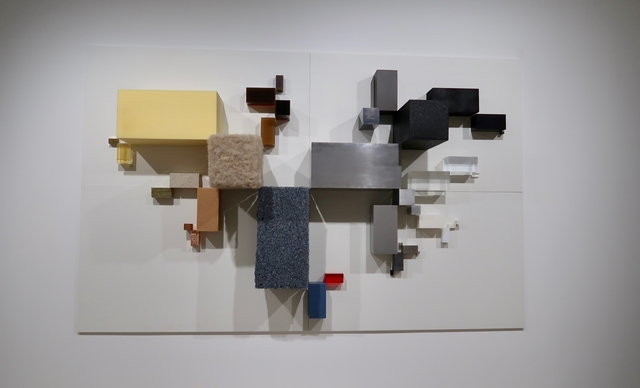
It is that kind of worldview that makes Drift’s work so compelling. In conjunction with Drift: Fragile Future, Pace is presenting “Drift Materialism: Past, Present, Future,” which expands on the “Materialism” room at the Shed. Continuing through December 18, the small show features sculptures that resemble Russian Constructivism filtered through children’s blocks. For the large-scale wall hanging 1980 Beetle, Gordijn and Nauta took apart a Volkswagen and put it back together. The resulting blocks represent forty-two materials, reduced to their accumulated mass.
Drift usually deconstructs inanimate objects, but two new works explore the molecular elements of the human body, side-by-side self-portraits of Gordijn and Nauta that are exactly equal. In the back room, the augmented reality Block Universe consists of a plexiglass sun surrounded by planets; the gallery supplies iPads that depict orbiting Drifters and other elements. The title comes from the theory that everything is happening at once, that past, present, and future exist in unison.
“We’re not having relationships with the materials and objects around us anymore,” Nauta explains in a Drift video. “And if you start losing the connection with this, you’re going to be very unhappy, because you lose the wonder in life.”
Next up is Drift’s kinetic sculpture Amplitude, a permanent commission slated to go on view at 45 Rockefeller Plaza, providing yet more wonder.
Who:David Godlis,Lucy Sante What: Book launch with live discussion Where:Rizzoli Bookstore, 1133 Broadway between 25th & 26th Sts. When: Thursday, October 28, free with advance RSVP, 6:00 Why: When last we saw photographer David Godlis, he was taking part in a November 2020 Rizzoli Zoom discussion with writer Luc Sante, Blondie cofounder and guitarist Chris Stein, and Reel Art Press music editor Dave Brolan, talking about Godlis Streets (Reel Art Press, $39.95), which features Godlis’s New York City and Boston street photography from the 1970s and ’80s. Some of us have also caught him in Lewie and Noah Kloster’s brand-new seven-minute documentary Shots in the Dark with David Godlis, in which the longtime official photographer of the New York Film Festival goes back to his CBGB days.
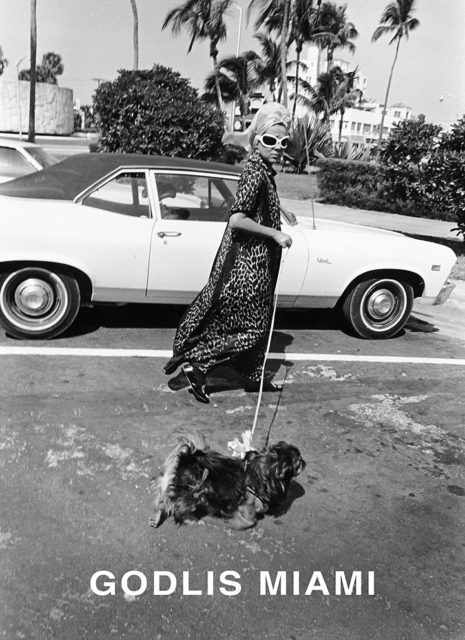
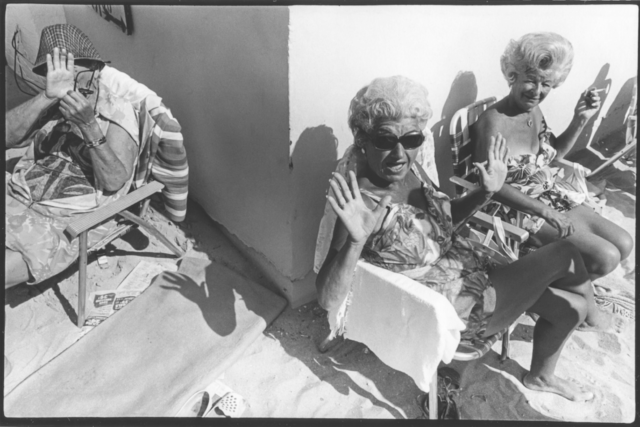
On October 28, Godlis will be at Rizzoli in person, joined by the recently transitioned Lucy Sante (Low Life,Kill All Your Darlings), for the launch of his newest book, Godlis Miami (Real Art Press, $39.95), comprising photos Godlis shot down south, capturing a part of South Beach that no longer exists.
“I first went to Miami Beach when I was a kid in the 1950s,” he writes. “There are black and white snapshots of me sitting on the beach, wearing my Davy Crockett T-shirt, squinting under palm trees. My grandparents had retired there. For Jewish Eastern European immigrants, who had lived out their working life on the streets of New York City, retiring to sunshine, warm weather, beaches, and palm trees was a slice of heaven. For a kid visiting in the 1950s and early 1960s, it was like going to Jewish Disneyland. Goodbye, snow. Hello, coconuts. And so, when I returned to Miami Beach in 1974, with a camera, all these memories of Florida came flowing back to me. As I tripped the shutter over and over, taking pictures on those beaches I had walked upon as a little kid, everything clicked. Pun intended.”
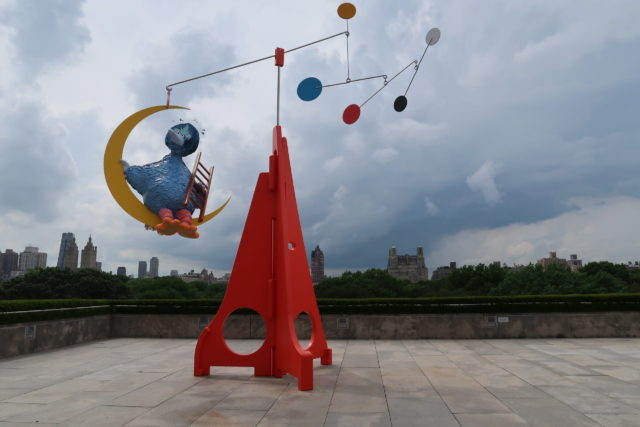
Big Bird rides on a crescent moon on Met roof (photo by twi-ny/mdr)
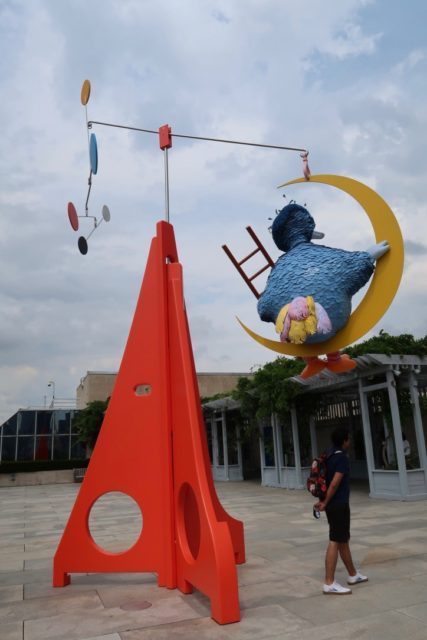
Who:Alex Da Corte, Shanay Jhaveri What: In-person discussion of Alex Da Corte’s Roof Garden Commission Where: The Grace Rainey Rogers Auditorium, the Met Fifth Avenue When: Friday, October 29, free with museum admission and advance RSVP, 5:30 (installation on view through October 31) Why: In previous works, Camden-born, Philadelphia-based artist Alex Da Corte has embodied such famous real and fictional figures as Eminem, Mr. Rogers, and the Wicked Witch of the West. For his commission on the Met’s Iris and B. Gerald Cantor Roof Garden, As Long as the Sun Lasts, Da Corte took on the persona of Jim Henson in creating a work that melds childhood memories with visions of the endless sky, inspired by Alexander Calder’s mobiles and sculpture, Little Tikes plastic outdoor activity gyms, Donna Summer’s Four Seasons of Love album cover, the blue Garibaldo character from the Brazilian version of Sesame Street that he watched as a kid in Venezuela, the song from the 1985 movie Follow That Bird in which Big Bird gets painted blue, and the Italo Calvino titular short story.
Alex Da Corte’s As Long as the Sun Lasts continues through Halloween (photo by twi-ny/mdr)
The result is a playful and colorful kinetic sculpture that moves with the wind as Big Bird, covered in more than seven thousand handmade feathers, rides around on a crescent moon, holding on to a ladder of hope. Referring to his transformation into Henson, Da Corte says in a Met interview with curator Shanay Jhaveri, “It stems from thinking about characters I loved or didn’t understand and wanted to understand more. And I see Jim as quite a thoughtful maker.” For those who want to understand more about the installation, which is on view through October 31, Da Corte — likely in costume as Henson — and Jhaveri will sit down for another talk, in the Grace Rainey Rogers Auditorium at the Met on October 29 at 5:30.
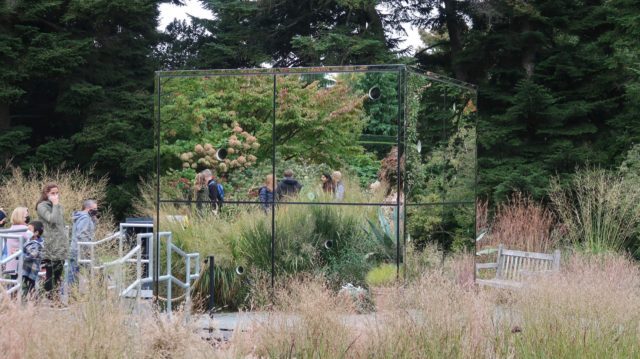
Yayoi Kusama’s Infinity Mirrored Room — Illusion Inside the Heart sits like a UFO in a grassy field at NYBG (photo by twi-ny/mdr)
KUSAMA: COSMIC NATURE
The New York Botanical Garden
2900 Southern Blvd., Bronx
April 10 – October 31, $15 children two to twelve, $35 adults, $10 for Infinity Room, 10:00 am – 6:00 pm
718-817-8700 www.nybg.org online slideshow
“How vast and boundless the provisions of nature!” Yayoi Kusama has declared. The ninety-two-year-old Japanese artist has been attracted to the natural world since she was a little girl, when her grandmother ran a plant nursery in Nagano, and she later studied the nihonga style of painting, dating back to the Meiji Period, which depicts scenes from nature through a contemporary artistic lens. Kusama’s fascination with living things is on display in the endlessly fun exhibition “Kusama: Cosmic Nature,” which continues at the New York Botanical Garden through October 31.
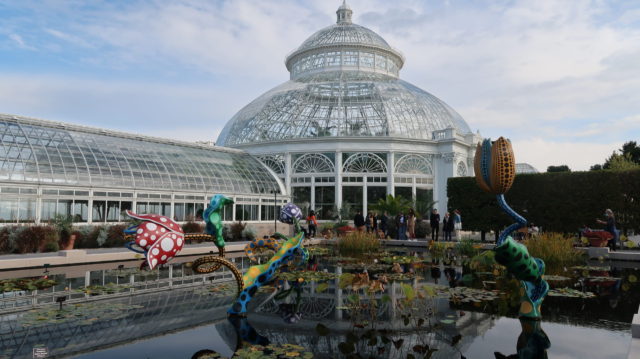
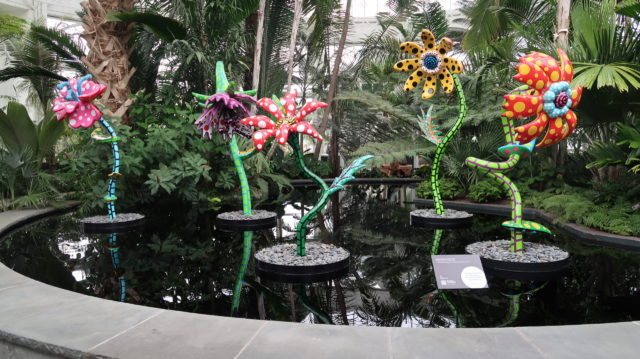
Hymn of Life — Tulips emerge out of the Conservatory Courtyard Hardy Pool (photo by twi-ny/mdr)
The show, comprising drawing, painting, sculpture, video, and installation, opened in April, but it has taken a distinct turn this fall, adapting its focus to pumpkins and chrysanthemums. “My pumpkins, beloved of all the plants in the world,” Kusama said. “When I see pumpkins, I cannot efface the joy of them being my everything, nor the awe I hold them in.” For the final month, the garden has brought in hundreds of real gourds, lining the flights of steps leading to the LuEsther T. Mertz Library Building and the Enid A. Haupt Conservatory; in addition, three enormous real pumpkins are on plinths outside the conservatory, each weighing more than a ton.
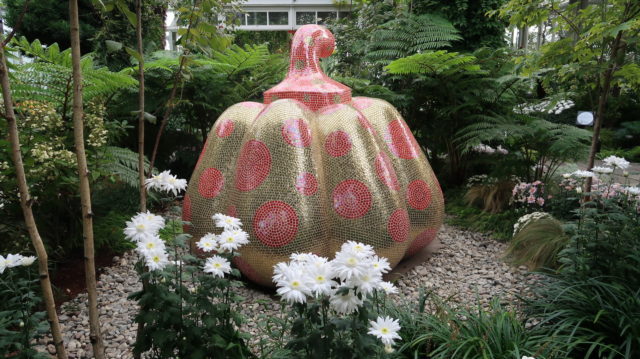
Starry Pumpkin occupies the place of honor in the Enid A. Haupt Conservatory (photo by twi-ny/mdr)
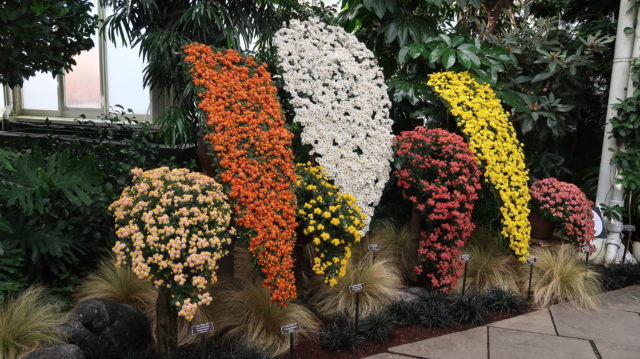
Several of Kusama’s small and large-scale pumpkins are scattered throughout the 250-acre Bronx oasis. Starry Pumpkin (2015) has the place of honor in the center of the conservatory, a glittering object surrounded by red, white, and yellow chrysanthemums in arrangements based on Kusama’s 2014 painting Alone, Buried in a Flower Garden (which is on view in the library), along with sections inspired by the Kengai (Cascade) style that resembles flowers hanging over a cliff, and the kiku method of Shino-tsukuri (Driving Rain) that gives the plants a windblown appearance. Inside the library are also the acrylic and felt pen on canvas Pumpkin TWOTOEL (2004) and soft sculptures of pumpkins from 2016 entitled The Sun Has Gone Down, I Am Scared as Much as Being Alone and Suppressing the Burning Desire for Death, which give an indication of Kusama’s longtime exploration of life and death and the often unusual names she gives her works.
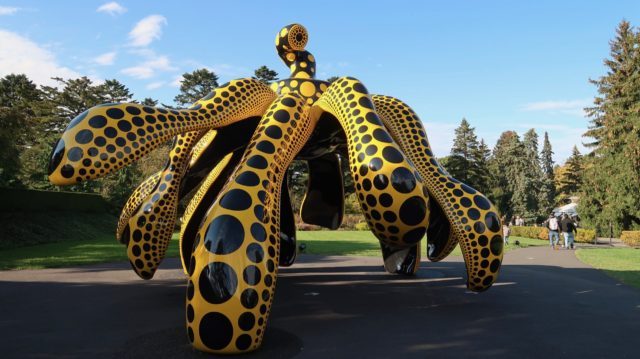
Visitors are allowed to walk under Kusama’s Dancing Pumpkin (photo by twi-ny/mdr)
Near the conservatory is the monumental Dancing Pumpkin (2020), a black and yellow creature you can walk under that resembles one of Louise Bourgeois’s spiders, while Pumpkins Screaming About Love Beyond Infinity (2017) lights up and creates mirrored views that seem to go on forever in the Visitor Center Gallery. “What appealed to me most was the pumpkin’s generous unpretentiousness,” Kusama has explained. “That and its solid spiritual balance . . . its fat belly and unadorned features . . . its burly, psychological power.”
My Soul Blooms Forever welcome people inside the conservatory (photo by twi-ny/mdr)
But “Kusama: Cosmic Nature” is a lot more than just pumpkins. The longest line is for Infinity Mirrored Room — Illusion Inside the Heart (2020), which sits in the middle of a field of tall grass and in between two small gardens, like a UFO landing in the country; holes in the exterior change the inside lighting and allow you to peer inside, where you will see your own face on the other side. I Want to Fly to the Universe (2020) is a smiling red, white, and blue star residing in the reflecting pool outside the Visitor Center. For Narcissus Garden (1966/2021), Kusama has placed 1,400 stainless-steel shiny balls bobbing atop a pond in the Native Plant Garden. Ascension of Polka Dots on the Trees (2002/2021) consists of trees wrapped in red polyester covered in white polka dots. Hymn of Life — Tulips (2007) features three large, colorful, childlike flowers in the Conservatory Courtyard Hardy Pool. The five waterbound urethane-painted stainless-steel flowers of My Soul Blooms Forever welcome people inside the conservatory. The exhibit also includes the obliteration greenhouse Flower Obsession (2017/2021), complete with household items and plastic stickers. Inside the Ross Gallery is a timeline and the multiscreen Walking Piece (1966/2021) composed of stills from one of Kusama’s most well known performances, wandering through New York City in a kimono and under an umbrella.
Chrysanthemum arrangements are inspired by the Kengai (Cascade) style that resembles flowers hanging over a cliff (photo by twi-ny/mdr)
“I am happy that I have painted flowers. . . . There are no objects more interesting,” Kusama, who has voluntarily lived in a Tokyo psychological institute since 1977 and still works every day in her nearby studio, has stated. As “Kusama: Cosmic Nature” reveals, Kusama has created a lot of other parts of the living world, all pieces of an endless universe that exists beyond death, in her deeply personal futuristic environment that is filled with abounding wonder.
CROSSING THE LINE FESTIVAL
FIAF and other locations
55 East 59th St. between Madison & Park Aves.
October 20 – November 6, free – $25
212-355-6100 fiaf.org
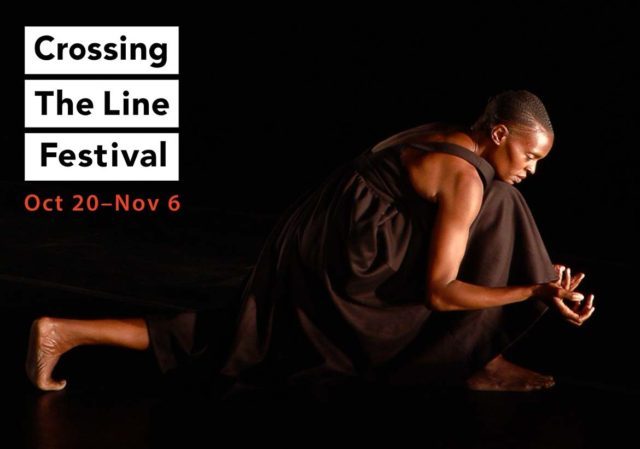
Igbo-Nigerian American multidisciplinary artist Okwui Okpokwasili has not let the pandemic lockdown slow her down. After appearing in the Public’s outstanding revival of Ntozake Shange’s for colored girls who have considered suicide / when the rainbow is enuf in the late fall of 2019, Okpokwasili has taken part in Danspace Project’s Platform series, the New Museum exhibition “Grief and Grievance: Art and Mourning in America,” and numerous online discussions and special presentations. Her 2017 film, Bronx Gothic, was screened virtually by BAM. In June, she led a procession through Battery Park City for the River to River Festival. And in May, I caught her captivating project On the way, undone, in which she and a group of performers walked across the High Line wearing futuristic head gear made of light and mirrors, vocalizing as they headed toward Simone Leigh’s Brick House sculpture.
Okpokwasili is now the centerpiece of FIAF’s 2021 Crossing the Line Festival, taking place at multiple locations from October 20 to November 6. Throughout the festival, her video installation Before the whisper becomes the word, made with her regular collaborator, director, and husband, Peter Born, will be on view in the FIAF Gallery, exploring remembrance, community mourning, and history. On October 20 at 7:00, she will speak with festival curator Claude Grunitzky in the FIAF Skyroom about the show. “This installation is a crossroads, a midpoint, a caesura. A place caught between worlds,” she said in a statement. “Can we remember what came before while imagining the shape of a future landscape? We enter mid-song, a song that marks a singular moment in time while also expressing an entire lineage. The song is a container for an unreliable memory. From whose mouth is history born? Whose words are trusted when it comes to the telling of what happened? If the history we learn is that which is spoken aloud, what is learned by listening to the whispers that have not been written?”
Christopher Myers’s Fire in the Head will make its world premiere at FIAF’s Crossing the Line Festival
Okpokwasili will also be presenting On the way, undone at the Weeksville Heritage Center in Brooklyn October 21-23 ($25). In a High Line video, she says about the work, “I hope it’s a kind of medicine . . . an architecture of sound, light, that is in some way trying to imagine a portal, an opening through space and time, and it’s imagining a woman’s future self, a young girl’s future self singing back to her.”
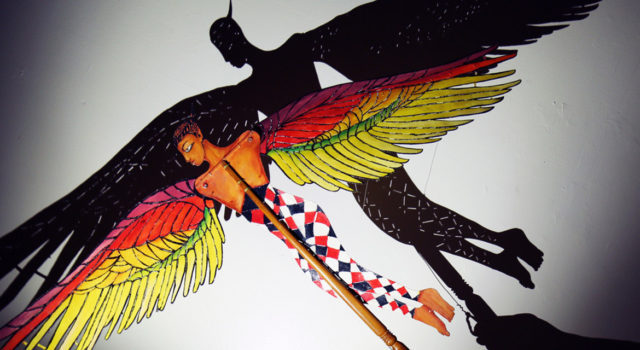
In addition, the festival includes nora chipaumire’s Nehanda, an opera that was excerpted for River to River at the Clemente Soto Vélez Cultural & Educational Center and for FIAF will be broadcast in two cycles both online ($15) and in person ($25) at FIAF’s Tinker Auditorium, divided into eight “days”: natives, whites, pungwe, thinkers, komuredhi judhas nemajekenisheni, white verdict, killings, and manifesting, with an artist talk on October 30 at 5:00; a concert by Grammy nominee Somi in Florence Gould Hall on October 28 ($25); Christopher Myers’s Fire in the Head, a tribute to Vaslav Nijinsky with shadow puppets taking place October 29 and 30 ($25, 7:30) at the Chinese Consolidated Benevolent Association; and Kaneza Schaal’s work-in-progress KLII, November 4-6 in Florence Gould Hall ($25), an exorcism of colonialism and the ghost of King Leopold II, incorporating archival footage and texts by Mark Twain and Patrice Lumumba.
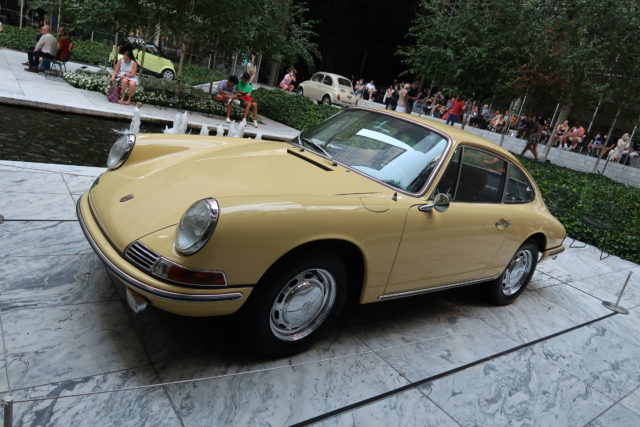
Four classy cars will be parked in MoMA’s sculpture garden through October 15 as part of “Automania” (photo by twi-ny/mdr)
AUTOMANIA
Museum of Modern Art
The Abby Aldrich Rockefeller Sculpture Garden
West 54th St. between Fifth & Sixth Aves.
Through October 15 www.moma.org online slideshow
You better rev it up and go if you want to catch the part of MoMA’s current “Automania” exhibition that is parked in the Abby Aldrich Rockefeller Sculpture Garden, as it will be pulling out at the end of the week.
In 1998, the Guggenheim presented “The Art of the Motorcycle,” a survey of the history of two-wheeled motorized transport, a show that was greeted with a significant amount of disdain for elevating a vehicle into the realm of fine art. On July 4, MoMA opened “Automania,” which includes nine cars and an Airstream in addition to lithographs, posters, photographs, signs, books, paintings, short films, and other ephemera. Four of the cars are on view through October 15 in the sculpture garden, alongside Henri Matisse’s The Back I-IV, Aristide Maillol’s The River, Alexander Calder’s Man-Eater with Pennants, and Isa Genzken’s Rose II.
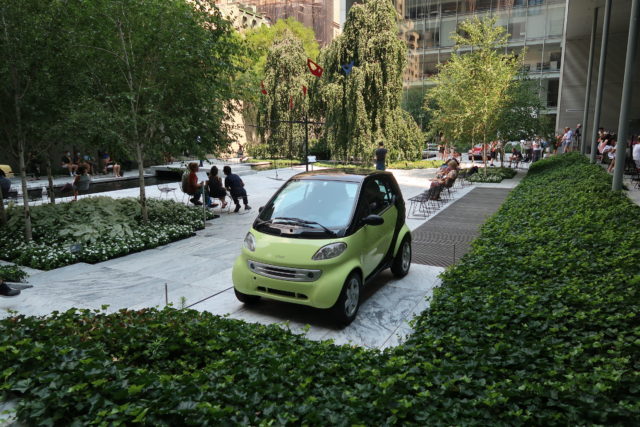
“Automania” features such colorful vehicles as a 2002 Smart Car Coupé (photo by twi-ny/mdr)
Joining those familiar works are a 2002 Smart Car Coupé, a 1973 Citroën DS 23 Sedan, a 1953 Jeep M-38A1 Utility Truck, a 1965 Porsche 911 Coupé, and a 1968 Fiat 500f City Car. Just outside the entrance to the garden is a 1990 Ferrari Formula 1 Racing Car. Each vehicle is accompanied by a label and audio guide entry detailing its creation and use. “Commonly referred to as the Cincquecento, the Nuova 500 is a compact, rear-engine city car that helped make automobile ownership attainable for an Italian public recovering from the economic devastation of World War II,” the text for the Fiat explains. On the third floor you’ll find a 1963 Airstream Bambi Travel Trailer, a 1946 Cisitalia 202 GT Car, a 1963 E-Type Roadster, and a 1959 Volkswagen Type 1 Sedan.
While making your way through the exhibit, you can listen to “I’m in Love with My Car: An Automania Driving Mix” a playlist that includes songs by Grace Jones, Yo La Tengo, Chuck Berry, War, the Beach Boys, Tracy Chapman, Prince, Buzzcocks, the Beatles, Public Enemy, Bruce Springsteen, the Rolling Stones, and others.