The public is invited to watch Tony Orrico create installation drawing in DTW lobby August 31 – September 2
Dance Theater Workshop
219 West 19th St. between Seventh & Eighth Aves.
August 31 – September 2, free, 5:00 – 9:00
212-924-0077 www.dancetheaterworkshop.org
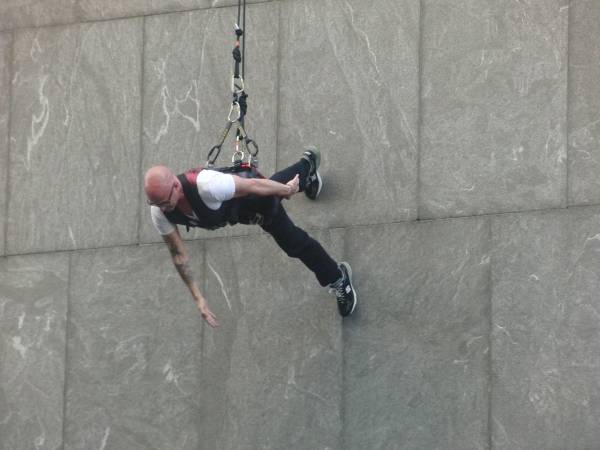
From August 31 through September 2, visual artist and performer Tony Orrico will create a movement-based drawing in three parts in the Dance Theater Workshop lobby, working nonstop for four hours each day, from 5:00 to 9:00, with the public is invited to watch free of charge. More than just a wall mural, “Penwald: 4: unison symmetry standing” will feature Orrico using his body in unique ways as the piece comes together, right in front of everyone’s eyes. On his website Orrico writes that “this series considers explorations of symmetry and biomechanics alongside themes of measurement, pathway, gravity, energy, chaos, efficiency, endurance, limitation, repetition, and isolation.” Born in Illinois in 1979, Orrico has danced with Shen Wei Arts and Trisha Brown, presented site-specific performance-art pieces at such locations as Judson Memorial Church and Dixon Place in New York City, Sara Park in Arizona, and a barren landscape in Porto, Portugal; earlier incarnations of “Penwald” have taken place at Postmaster Gallery, PlaceMark, and the Red Horse Café. The final installation will be on view at DTW for an extended period of time.
William Cordova’s “Laberintos (after octavio paz)” is set up like dominoes ready to come tumbling down at any moment (photo by twi-ny/mdr)
MoMAPS1
22-25 Jackson Ave. at 46th Ave.
Warm Up: Saturdays from 2:00 to 9:00 through September 4, $15 (free for Long Island City residents)
Greater New York: Thursday through Monday from 12 noon – 6:00 pm through October 18
Suggested donation: $10 (free with MoMA ticket within thirty days of MoMA visit)
718-784-2084 www.ps1.org “pole dance” slideshow
MoMA PS1’s third quinquennial, their five-year survey of contemporary art in the metropolitan area, is an engaging and involving collection of multimedia work from approximately seventy artists. Taking on everything from environmentalism and racism to marketing and celebrity, the show moves along at a breezy pace. Various artists get their own relatively large galleries, including David Benjamin Sherry (yes, you can walk through the doors), Leidy Churchman, Vlatka Horvat, and Zipora Fried, while others get their own small rooms, like Conrad Ventur, who presents the history of Shirley Bassey singing “This Is My Life” as seen through rotating crystal prisms. David Brooks’s “Preserved Forest” installation comments on the deforestation along a new superhighway in Brazil, while Gilad Ratman’s two-channel video, “The 588 Project,” features a bubbling, muddy ooze seemingly coming alive. Visitors are encouraged to add colorful strips of tape to Franklin Evans’s “timecompressionmachine” and to play the strings of Naama Tsabar’s pair of speaker walls. One of the most powerful pieces is Hank Willis Thomas’s “Unbranded,” consisting of advertising photographs tailored to the African American community, organized chronologically from the 1960s to the present, in which all text and brand names have been removed, leaving just the central image to be judged on its own. In the same room, William Cordova’s “Laberintos (after octavio paz)” collects record sleeves from an Ivy League institution that borrowed 200 Inca artifacts from Peru in 1914 and refuses to return them; the albums are arranged in a perilous maze that appears likely to collapse at any moment. As usual, there’s art just about everywhere you look or listen at PS1; Nico Muhly’s specially commissioned sound piece loops in the elevator, and Aki Sasamoto collaborated with Saul Melman on “Skewed Lies / Central Governor” in the boiler room, where live performances are scheduled September 17-19 and October 15-17. Also downstairs, in the cinema, Ronald Bronstein’s FROWNLAND (2007) continues through August 30, with Bronstein discussing the film with Amy Taubin on August 28; future screenings include works by Dani Leventhal and Fern Silva as well as Tomonari Nishikawa and Redmond Entwistle, with upcoming performances by Andrew Lampert and Trisha Baga. In addition, Dutch artist Guido van der Werve will be presenting an orchestra performance October 2 & 9.
Solid Objectives — Idenburg Liu have installed the playful, interactive “Pole Dance” in the PS1 courtyard (photo by twi-ny/mdr)
The summer-long hot and sweaty Warm Up series has two Saturdays remaining, with Big Freedia, DJ Rusty Lazer, DJ Rashad, GHE20 GOTHIK DJs Venus X and Brenmar, and Traxx getting booties shaking on August 28, and House of House, DJ Mehdi, and a live set by Holy Ghost! ready to close out the season on September 4. The winner of this year’s Young Architects Program, Solid Objectives — Idenburg Liu (SO – IL), has filled the courtyard with large beach balls, overhead netting, hammocks, wading pools, and sand, where people can relax or toss around the balls while also getting sprayed with mist. Some of the poles in the section immediately to the right are linked to sound, so you can orchestrate your own concert or watch a show choreographed by Kyra Johannesen on August 28 at 2:30. You can also grab burgers, beer, and dogs at the regular Warm Up barbecue, but be prepared for some massive crowds. Summer Saturdays at PS1 have become a right of passage for New Yorkers, who are able to experience art, music, film, dance, food, sport, literature, and more, all in one fabulous setting.
In preparation for “Nobody’s Fool,” his major exhibition opening at the Asia Society on September 9, Japanese artist Yoshitomo Nara and his design team, YNG, are constructing a special installation this week in the cavernous Wade Thompson Drill Hall in the Park Ave. Armory. When it’s finished, “Home,” a one-story living environment, will be transferred a few blocks uptown; in the meantime, visitors are invited to get a free sneak peek at the work-in-progress every afternoon from 4:00 to 7:00 through this Friday. The fifty-one-year-old Tokyo-based Neo Pop artist is most well known for his paintings, sculptures, and drawings of wide-eyed childlike characters who are not quite as cute as they first appear, evil and danger lying not too far below the surface. Nara’s punk-rock influences are evident at the armory, where a glassed-in room holds dozens of his drawings, many of which include musical elements, from a young girl playing air guitar to a Ramones postcard. Meanwhile, music blasts as workers continue building “Home” right out in the open. Don’t look too hard for Nara himself; the shy artist has done a good job of avoiding being in the spotlight so far this week. In order to enter the hall, visitors must wear closed-toe shoes, shoulders must be covered, and yellow hard hats will be given out. Be sure to pick up a card that offers two-for-one admission to the upcoming show; in addition, Nara and curator Miwako Tezuka will be at the Asia Society on Friday night for a Q&A and discussion following a screening of Koji Sakabe’s 2007 documentary, TRAVELING WITH YOSHITOMO NARA. Tickets are also now available for such related events as an artist talk with Nara and Hideki Toyoshima on September 10, a live performance by Shonen Knife on September 25, and a screening of Lewis Rapkin’s documentary about the contemporary Japanese indie music scene, LIVE FROM TOKYO, on October 29.
Multimedia performance artist Miranda July, who wrote, directed, and starred in the charming romantic comedy ME AND YOU AND EVERYONE WE KNOW, published the wonderful short-story collection NO ONE BELONGS HERE MORE THAN YOU, and has staged such live pieces as THINGS WE DON’T UNDERSTAND AND ARE DEFINITELY NOT GOING TO TALK ABOUT, has installed her interactive, outdoor Venice Biennale work, “Eleven Heavy Things,” on the Center Lawn in Union Square Park. The steel-lined fiberglass sculptures demand human interaction, whether it means placing a digit in “Finger Tablet,” a tall, narrow, vertical piece that announces, “This is not the first hole my finger has been in; nor will it be the last,” standing with someone atop “Pedestal for Strangers,” on which it is written, “We don’t know each other, we’re just hugging for the picture. When we’re done I’ll walk away quickly. It’s almost over,” or sticking one’s head in “Two-faced Tablet,” which on one side proclaims, “What I look like when I’m lying” and on the other declares, “What I look like when I really mean it.” You can also decide which of the three “Pedestals for Guilty Ones” best suits you: “The Guilty One,” “The Guiltier One,” or “The Guiltiest One.” There are also bizarrely colored headdresses for people to pretend they’re wearing as well as one blank slate with three holes that can be anything you want it to be. The final public art piece sponsored by Deitch Projects, “Eleven Heavy Things” is a delightful, inviting piece that feels at home in the park, a gathering place for friends, lovers, tourists, and activists since 1839. As with many of her works, July plays with space and language, in this case offering people the opportunity to take fun pictures while also bringing them together, particularly strangers who might not otherwise notice one another in this big, bustling metropolis.
Last summer, a section of the High Line running from Gansevoort St. to 20th opened as a city park, stunningly designed by Diller Scofidio + Renfro and landscape architects James Corner Field Operations. Between 1934 and 1980, the elevated railway line supplied passage for freight trains from West 34th St. to Spring, then fell into disrepair in the 1980s and 1990s before being rescued by the Friends of the High Line, who worked tirelessly for years to turn the tracks, which were overgrown by weeds and covered in trash, into a usable public space. And what a public space it is, a gorgeous walkway filled with colorful plants and trees, smartly designed benches and loungers, and a fabulous viewing platform that looks out over Tenth Ave. This month, the park is hosting free exercise classes, walking tours, and stargazing on Tuesdays, with Wild Wednesday #4: Weed Wars! Uninvited Guests on the High Line scheduled for August 25. September will include history and nature walking tours, film screenings, yoga, kids drawing classes, live music and dance, and more. (Some events require advance RSVPs and paid tickets, while others are free with no reservations necessary.)
The High Line — the next section of which is scheduled to open in 2011 — is also home to several fascinating art projects. The most exciting is Stephen Vitiello’s “A Bell for Every Minute,” a sound sculpture, commissioned by Creative Time, that is set up in the 14th St. Passage. The Richmond-based artist and electronic musician, who was born in New York City in 1964, worked under Nam June Paik, and is associate professor of kinetic imaging at Virginia Commonwealth University, recorded the chimes of fifty-nine bells in the New York City and surrounding area, from the historic clock at Gracie Mansion to the Jefferson Market Library’s bell tower, from the John J. Harvey’s fireboat bell to the Ashokan Center’s sleigh bell, from the United Nations peace bell and the Coney Island Dreamland bell to Central Park’s Delacorte Clock and Juilliard’s school bells, in addition to chimes from Battery Park City, Governors Island, the Mahayana Temple, Green-Wood Cemetery, the Brooklyn Heights Synagogue, Aqueduct, Gleason’s Gym, Trinity Church, and the Frying Pan, among others. Each bell has its own assigned minute in which it rings for a few seconds, echoing in the chamber, before they all come together at the top of the hour, chiming in unison, creating a wondrous cacophony that is as comforting as it is thrilling. The site-specific installation also features a metallic map that locates where each sound comes from, with lines overlapping each other, adding a cool visual aspect to the piece.
Valerie Hegarty, “Autumn on the Hudson Valley with Branches,” mixed media, including acrylic paint on vinyl, fiberglass, aluminum wire, epoxy, resin, plywood, fabric, and plastic, 2009 (photo by twi-ny/mdr)
The first installation commissioned for the High Line, Spencer Finch’s “The River That Flows Both Ways” stands in the Chelsea Market Passage. Working with Creative Time, Finch took a seven-hundred-minute journey along the Hudson River, which winds its way right alongside the High Line, taking one picture of the water every minute. He then narrowed down the various colors he captured into single pixel points that he turned into glass panes, setting them up chronologically, offering a new way to travel the Hudson. On the east side of the High Line between 17th & 18th Sts., Richard Galpin’s “Viewing Station” gives visitors the opportunity to get a unique interpretation of the buildings right across the street. Galpin took a photograph of the scene, removed the color, transferred the image to stainless steel, and cut out shapes that match particular outlines of sections of the buildings; viewers then look through a box, lining up Galpin’s cut-out “photo” with the actual buildings, resulting in a titillating sensation that plays with space and perspective. On the 20th St. fence at the current northern end of the public part of the High Line, Valerie Hegarty has installed “Autumn on the Hudson Valley with Branches,” which comments on the life, death, and rebirth of the High Line itself. Adapted from Jasper Francis Cropsey’s 1860 painting “Autumn on the Hudson River,” Hegarty’s work appears to be a victim of time and the elements, with ragged holes and jagged tears in the canvas, the color fading terribly, and tree branches poking through. But just as the High Line has been resurrected, Hegarty’s piece hangs by the gate that will lead to the section of the park to be opened next year. And on September 7, Demetrius Oliver will be at the Tenth Ave. Square for the unveiling of his High Line commission, a twenty-five-by-seventy-five-foot billboard called “Jupiter.”
Electronic musician Ikue Mori interprets Christian Marclay’s “Ephemera” score at the Whitney with pianist Sylive Courvoisier (photo by twi-ny/mdr)
Whitney Museum of American Art
945 Madison Ave. at 75th St.
Wednesday – Sunday through September 26
Admission: $12-$18 (pay-what-you-wish Fridays from 6:00 to 9:00)
212-570-3600 www.whitney.org
Since the late 1970s, New York-based multidisciplinary artist Christian Marclay has been exploring the intimate connection between sound and image through sculpture, video, photography, live music, collage, and site-specific installation. His unique approach to this relationship is on view at the Whitney in the thrilling interactive exhibition “Festival,” which includes dozens of Marclay’s highly original scores, including “Graffiti Composition,” comprising graffiti scribbled on posters by passersby in Berlin; “Pret-a-Porter,” consisting of clothing that has musical notations on them; “Zoom Zoom,” a slideshow of photographs of signs that contain onomatopoeiac language; “Mixed Reviews,” translated music reviews that run around one gallery space in a seemingly endless line of text; “Covers,” a collection of empty record sleeves; “The Bell and the Glass,” a double video projection that draws comparisons between the Liberty Bell and Marcel Duchamp’s “The Bride Stripped Bare by Her Bachelors”; and “Chalkboard,” in which visitors are encouraged to write or draw anything they want on a giant musical staff. All of these scores and more are meant to be interpreted and improvised by musicians, guaranteeing that no two performances will ever be the same. Live events, all free with paid museum admission, continue daily through August 27, with such upcoming “concerts” as Peter Evans and Zeena Parkins performing “Box Set” on August 18 at 1:00, David Moss taking on “Manga Scroll” on August 20 at 7:00, Kato Hideki, Zeena Parkins, Sara Parkins, and Nels Cline teaming up for “The Bell and the Glass” on August 21 at 1:30, Robin Holcomb and Wayne Horvitz interpreting “Graffiti Composition” on August 25 at 4:00, and Bill Frisell playing “Wind Up Guitar” on August 26 at 1:00. There will also be Artist’s Talks every Friday afternoon, with Moss on August 20, Marina Rosenfeld on August 27, and Guy Klucevsek on September 3 and 17. “Festival” is indeed a festival of word, sound, and image, a fascinating celebration of aural and visual language by a masterful artist whose reach knows no boundaries.
In conjunction with “Festival,” which runs through September 26, Marclay’s “Fourth of July” has been extended at the Paula Cooper Gallery in Chelsea through August 24. (Also currently at the Whitney are “Jill Magid: A Reasonable Man in a Box,” “Off the Wall: Part 1 — Thirty Performative Actions,” and “Collecting Biennials.”)
Christian Marclay transforms a Fourth of July celebration in exhibit at Paula Cooper Gallery (photo by twi-ny/mdr)
Paula Cooper Gallery
521 West 21st St. between Tenth & Eleventh Aves.
Monday – Friday through August 24, 10:00 am – 5:00 pm
Admission: free
212-255-1105 www.paulacoopergallery.com
For more than three decades, innovative multidisciplinary artist Christian Marclay has been creating visual and aural art that comes alive in unique and captivating ways. Through film, video, sound recording, photography, and site-specific installations, Marclay lays bare the artistic process, utilizing and transforming such objects as turntables, vinyl records, and, now, fragmented photographs in his shows. For the current “Fourth of July,” which has been extended at the Paula Cooper Gallery in Chelsea through August 24, the New York-based artist and composer started with pictures he took of a marching band and crowd at a 2005 Independence Day parade in Hyde Park, blew up seven of the photos to large size, then tore them randomly and framed forty of the ripped pieces, creating a very different kind of musical event. The result is a fascinating new look at something old and familiar, a reexamination of the old red, white, and blue American spirit as seen by zeroing in on smaller, incomplete elements, focusing on a drum, a cymbal, or a body part that was not necessarily the central image of the original photograph. His jagged celebration has a sound and feeling all its own. The exhibition is running in conjunction with Marclay’s excellent “Festival” at the Whitney, which continues through September 26, with daily live performances of the artist’s unusual scores interpreted by a rotating group of outstanding experimental musicians through August 27.