this week in art

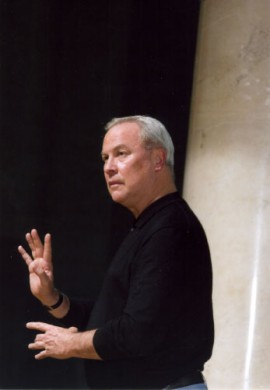
JOHN DUBROW: NEW PAINTINGS

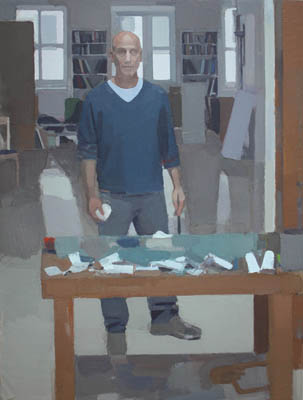
John Dubrow, “Self-Portrait,” oil on linen, 2009

Lori Bookstein Fine Art
138 Tenth Ave. between 17th & 18th Sts.
Tuesday – Saturday through October 30
Admission: free
212-750-0949
www.loribooksteinfineart.com

If you’ve seen some of John Dubrow’s previous shows at Lori Bookstein — the current one is his fifth solo presentation — you might be somewhat confused by its name, “New Paintings,” as several of the works will appear to be familiar. Indeed, Dubrow, born in Massachusetts in 1958 but based in New York City since 1983, has revisited three urban landscapes, breathing new life into them with his master brushstroke and innate sense of color. In the show’s six portraits (including poet Mark Strand, painters William Bailey, Tine Lundsfryd, and Ruth Miller, and a self-portrait), three park scenes, and one street scene, Dubrow infuses each piece with abstract spots of color that demand extended viewing as they slowly make their way to the forefront of the canvas, from the purple and gold in the lower right corner of “Bleecker Playground II” to the green tabletop in “Ruth Miller” to the yellow paper in “Mark Strand.” The combination of Dubrow’s intimate portraits of artists, done in their respective indoor work environments, and outdoor cityscapes, painted from memory and featuring blurred faces, makes for an exhilarating effect that should not be rushed through.

HIMALAYA FILM FESTIVAL

Kiran Krishna Shrestha’s BHEDAKO OON JASTO . . . IN SEARCH OF A SONG is part of first Himalaya Film Festival in New York City

Quad Cinema
34 West 13th St.
October 22-28
212-255-2243
www.quadcinema.com
www.himalayafilmfestival.us

Celebrating the natural beauty and history of its region, the Himalaya Film Festival has brought its self-described “visual feast” to the Netherland, Japan, and Estonia and makes its North American debut this week at the Quad. At 12:30 on Friday afternoon, Bhutan-based Tibetan artist Tashi Norbu will kick off the festival by painting a Buddha and chanting as part of the Himalayan Spirit Expo. The festival includes more than two dozen shorts, features, and documentaries, including PEOPLE OF DARKNESS (Dorji Wangchuk), JOURNEY OF A RED FRIDGE (Lucian Muntean & Natasa Stankovic), CHILDREN OF GOD (Yi Seung-jun), HOLY MEN AND FOOLS (Michael Yorke), and A ROUGH CUT ON THE LIFE AND TIMES OF LACHUMAN MAGAR (Dinesh Deokota), offering adventurous filmgoers “the chance to experience the Himalayan region, to travel beyond the image of the region as it is presented in regular movies, and meet the intriguing diversity and uniqueness of the Himalayas.”

GREGORY CREWDSON: SANCTUARY

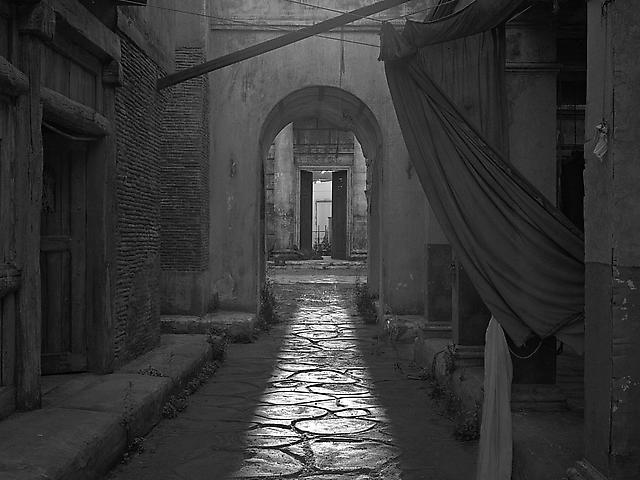
Gregory Crewdson, “Untitled (17),” pigmented inkjet print, 2009

Gagosian Gallery
980 Madison Ave. between 76th & 77th Sts.
Tuesday – Saturday through October 30
Admission: free
212-744-2313
www.gagosian.com

Brooklyn native Gregory Crewdson makes a dramatic turn in his latest series of photographs, on view at the uptown Madison Ave. Gagosian Gallery through October 30. For years, Crewdson has been taking pictures of carefully arranged tableaux vivants that look like scenes from a never-made movie, filled with mystery and intrigue. For “Sanctuary,” Crewdson went to the famous Cinecittà Studios in Rome, a place where Italian and international directors have gone for decades to make the kind of films that Crewdson has alluded to in his previous work. But in this new series, the first he has done outside America, Crewdson shoots the bare bones of Cinecittà, the vacant streets and backlots, with no people present, just stark architecture overgrown with weeds and rusted scaffolding. Crewdson has returned to black and white for the first time in nearly fifteen years, giving the photos, taken either at sunrise or sunset, a haunting quality; in some ways they are a natural progression for the artist, as if they represent what is left after he completes his staged color photographs, leaving behind empty sets filled with similar mystery and intrigue. Many of the photos feature doorways and other openings and entrances (or exits) that serve as additional frames within the pictures; one even resembles a white movie screen. “As with much of my work,” Crewdson says about the series, “I looked at the blurred lines between reality and fiction, nature and artifice, and beauty and decay.” The result is another mesmerizing collection from one of the country’s most inventive photographers. (While at Gagosian, be sure to also check out “Dike Blair: Sculptures and Paintings,” in which the New York-based artist transforms the wooden crates that paintings and sculptures are shipped in into works of art themselves.)

HENRY DARGER

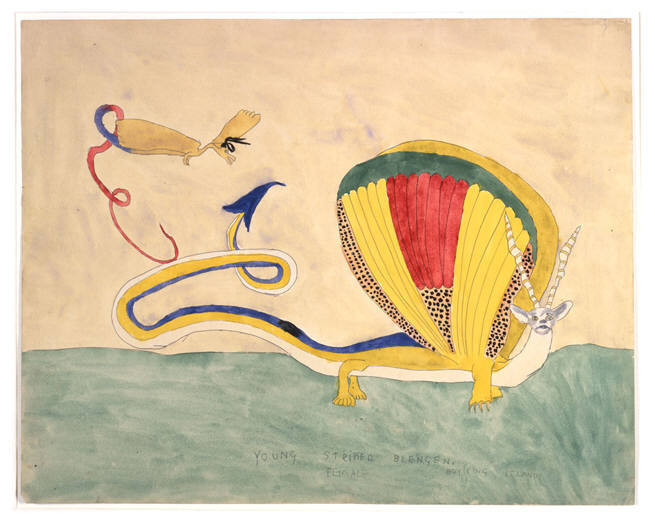
Henry Darger, “Young Striped Blengen Female, Boy King Islands,” watercolor and pencil on paper (image copyright Kiyoko Lerner)

Andrew Edlin Gallery, 134 Tenth Ave., through October 23, free, 212-206-9723
American Folk Art Museum, 45 West 53rd St., Tuesday – Sunday through October 24, $8-$12 (free Fridays after 5:30), 212-265-1040
www.edlingallery.com
www.folkartmuseum.org

We’ve seen numerous Henry Darger exhibits and documentaries over the last ten years or so, but we were shocked when we encountered the latest show at the Andrew Edlin Gallery in Chelsea. Curator Valérie Rousseau has put together a small but rousing collection of early collages and drawings by the reclusive outsider artist who created the wildly bizarre fifteen-thousand-page illustrated manuscript THE STORY OF THE VIVIAN GIRLS, IN WHAT IS KNOWN AS THE REALMS OF THE UNREAL, OF THE GLANDECO-ANGELINNIAN WAR STORM, CAUSED BY THE CHILD SLAVE REBELLION. While several large, horizontal paintings of the Vivian Girls — young female warriors with little penises — might be familiar to Darger enthusiasts, portraits of such military leaders as General Jack Ambrose and General Great Heart, watercolors on paper amateurly mounted on carboard (or painted directly on cardboard), are more likely to be new and quite surprising, as is a picture of a Dr. Doolittle-like horned animal called a young striped Blengen female and the human-plant creatures that populate “At Jennie Richee though storm rages on they steal towards Manley Headquarters. “The exhibit also features Western images of men with rifles on horseback and various structures either in the background or right up front. A number of character positions are repeated or reversed from picture to picture, indicating Darger’s usage of found images that he traced, primarily from newspapers and magazine ads.

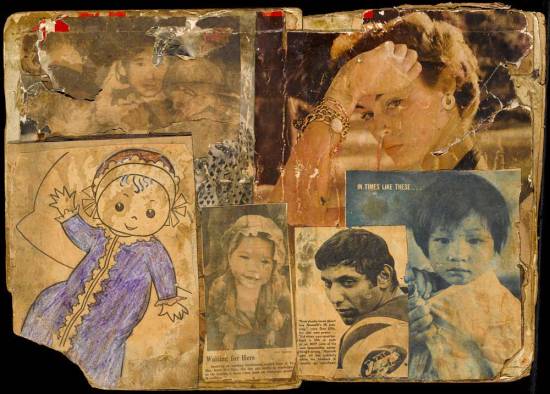
Henry Darger, Untitled (“In Times Like These…”), crayon, coloring book page, and collage on Kodak board, midtwentieth century (gift of Kiyoko Lerner)

The show at Andrew Edlin is a must-see for Darger fanatics; another treat is “The Private Collection of Henry Darger,” which has been extended through October 24 at the American Folk Art Museum. Darger filled his Chicago apartment with myriad clippings and pages from all sorts of sources, putting them up anywhere and everywhere he could, immersing himself in this pseudo-world he created in his mind. He made collages out of many of these pieces of paper, painting over them and even placing stamps around them like borders. As always, Darger’s work and the pictures he collected walk a fine line between art and perversion; his collection of images of young girls can be equally disturbing and fascinating.

TALK ABOUT NOTHING

Theater innovator Robert Wilson will discuss emptiness and the void on December 6 at the Rubin Museum

Rubin Museum of Art
150 West 17th St. at Seventh Ave.
October 18 – January 29, $15-$30
212-620-5000
www.rmanyc.org

Running in conjunction with the exhibition “Grains of Emptiness,” which opens November 5 and includes works by Sanford Biggers, Theaster Gates, Atta Kim, Wolfgang Laib, and Charmion von Wiegand relating to Buddhist ritual practice and impermanence, Talk About Nothing features nearly two dozen conversations pairing artists, writers, musicians, filmmakers, philosophers, and religious leaders discussing “what is and what isn’t.” The intriguing series, produced by resident Rubin programming genius Tim McHenry, begins October 18 with British author Karen Armstrong and 96th Street Mosque head Imam Shamsi Ali and continues with such pairings as British sculptor Antony Gormley and the Venerable Tenzin Priyadarshi of MIT’s Dalai Lama Center for Ethics and Transformative Values, film director Mike Nichols and math and science philosopher Christopher Potter, video installation pioneer Bill Viola and Buddhist teacher Dzogchen Ponlop Rinpoche, actor Brian Cox and psychology professor Alison Gopnik, comedian Sandra Bernhard and author Michael Cunningham, composer Nico Muhly and writer Andrew Solomon, multimedia performance artist Laurie Anderson and writer Charles Seife, and theater director Peter Sellars and academic and author Raj Patel. Although some of the events are already sold out, stand-by tickets could be available, so what have you got to lose? Well, nothing. You can also score free tickets to multiple talks by submitting a three-minute YouTube video about nothing by October 27 and placing in the top three.

AN-MY LÊ AND LYNNE TILLMAN IN CONVERSATION

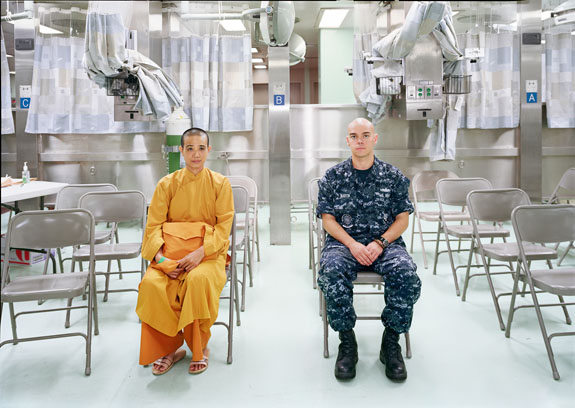
An-My Lê, “Patient Admission, US Naval Hospital Ship Mercy, Vietnam,” archival pigment print, 2010

Murray Guy
453 West 17th St. between Ninth & Tenth Aves.
Saturday, October 16, 4:30
Exhibition continues through October 30
Admission: free
212-463-7372
www.murrayguy.com

Vietnamese-American artist An-My Lê, who fled Saigon with her family in 1975 when she was fifteen, has been photographing war and the military since the early-to-mid-1990s, taking documentary shots of troops in training, Vietnam War reenactments, and landscapes of such bases as 29 Palms in California. In her latest series, on view at Murray Guy through October 30, Lê visited hospital ships, training areas, and landing sites in Haiti, Indonesia, Ghana, Egypt, Senegal, and Vietnam, capturing the men and women of the U.S. military in everyday situations and posing for the camera. Men in fatigues laze about in front of a lush green forest, a supply distribution convoy makes its way along a barren beach, a highly decorated officer prepares for a portrait session aboard the USS Ronald Reagan, one soldier helps another during combat life-saving training, and a security guard surveys the ocean landscape from the rail of the U.S. naval hospital ship Comfort. In the north gallery, Lê displays a succession of portraits of woman soldiers, including a line shack supervisor, an aircraft carrier arresting gear mechanic, and a forward look-out. Meanwhile, in the south gallery, five prints of the USS Dwight Eisenhower passing through the Suez Canal take the viewer on a brief ride. Although none of the shots involve actual combat on the front lines, together they offer a different look at war: gorgeously composed shots, many in spectacular deep focus, that are beautiful in their own right in or out of context. The exhibit can perhaps best be summarized by “Patient Admission,” which depicts a Buddhist monk and a U.S. soldier sitting on metal folding chairs aboard the US naval hospital ship Mercy, their hands in their laps, a silver vertical beam separating them in the background, a complex visual commentary on war and peace. An-My Lê will be at Murray Guy for a special discussion with writer Lynne Tillman on Saturday, October 16, at 4:30, shedding yet more light on this stunning series.

TWI-NY TALK: FRANK STEFANKO & DANNY CLINCH

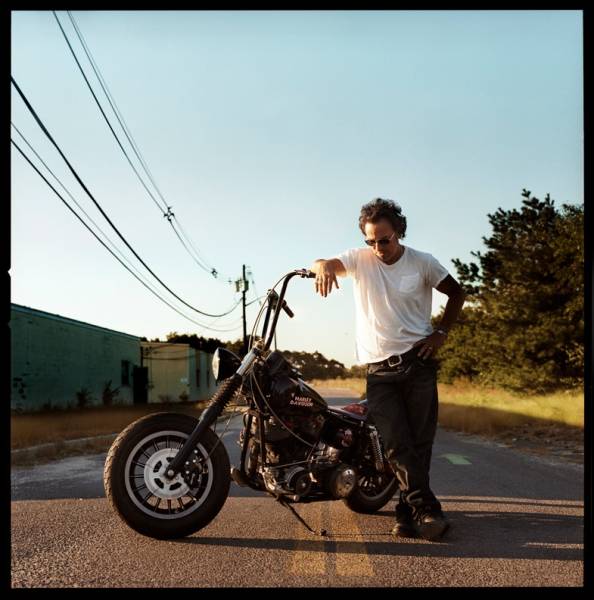
Danny Clinch, “Harley, Allaire Industrial Park, Wall Township, NJ 2007” (© Danny Clinch, 2007)


FROM DARKNESS TO A DREAM

Morrison Hotel Gallery
124 Prince St.
October 15 – November 7, free
212-941-8770
www.morrisonhotelgallery.com

The Boss might be off the road and in between albums right now, but that doesn’t mean there isn’t plenty of Bruce Juice to be devoured these days. Bruce Springsteen was recently in Toronto for the world premiere of THE PROMISE: THE DARKNESS ON THE EDGE OF TOWN STORY, Thom Zimny’s behind-the-scenes documentary of the making of the seminal 1978 album, and the film is currently being aired on HBO prior to the release of the highly anticipated DARKNESS boxed set on November 16. On October 15, the Morrison Hotel Gallery’s SoHo branch looks back at those glory days and beyond with “From Darkness to a Dream,” an exhibit of familiar and never-before-seen photographs of Springsteen taken by Frank Stefanko, who shot the covers for DARKNESS and THE RIVER, and Danny Clinch, who has been shooting Bruce since 1999, including the covers for THE RISING, MAGIC, and WORKING ON A DREAM. Stefanko, who met Springsteen through Patti Smith, captures Bruce at a pivotal time in his career, during the three-year hiatus following the breakout success of BORN TO RUN, when Bruce’s future was in doubt. Clinch, who met Springsteen while an assistant for Annie Liebovitz during the TUNNEL OF LOVE sessions, reveals a more mature, relaxed Bruce, whether onstage, in the studio, or hanging around with his motorcycles. Stefanko and Clinch recently discussed with twi-ny their involvement with Springsteen and the upcoming SoHo show.

twi-ny: Frank, you photographed Bruce during a turning point in his career, when it took him three years to release DARKNESS ON THE EDGE OF TOWN and another two-plus years to make THE RIVER. In your book DAYS OF HOPES AND DREAMS, Bruce wrote that you “latched onto the very conflicts and ideas I was struggling to come to terms with: Who am I? Where do I go now? He showed me the people I was writing about in my songs. He showed me the part of me that was still one of them.” What do you think it was about the two of you that made you instantly click?

Frank Stefanko: I think the most important thing we did, before ever putting a roll of film in the camera, was to sit down in my living room and chat. In our “getting to know each other” conversation, we found out we had a lot in common. We both came from working-class families. Bruce’s mother was Italian and his father was Dutch Irish. My mother was also Italian and my father was Czechoslovakian. We had families that worked hard, and there was a sense of honesty and dignity. The best of these cultures — honesty, dignity, work ethic — seemed to rub off on us. It helped me to understand the character of the young man I was to capture on film. There were other similarities between us. We both were New Jerseyians, we both loved the Jersey Shore, and we both grew up with the same music around us, so this guy who was about to stand before my lens seemed very familiar to me.

twi-ny: Danny, as evidenced by your December 2008 show at the Morrison Hotel Gallery on Bowery, you’ve taken pictures of such musical icons as Johnny Cash, Lucinda Williams, Neil Young, Joan Jett, Tupac Shakur, Radiohead, Norah Jones, Michael Stipe, Kanye West, Tom Waits, and James Brown. How does Bruce Springsteen compare as a photographic subject with these other superstars, both shooting him in a prepared, posed setting as well as when he’s performing onstage?

Danny Clinch: Honestly, Bruce is a great subject; he gets the process. A subject has to participate in some way for the photograph to be successful. Also, as a photographer you have to be ready to get it when it’s there. He also understands that giving me great access backstage or onstage will result in good photographs. But it takes time to get that trust.
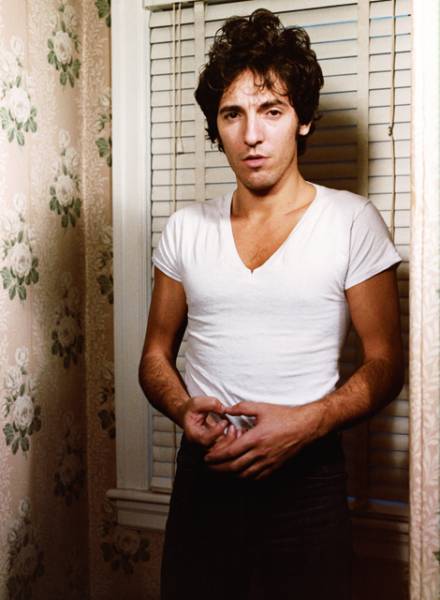
Bruce Springsteen, “Darkness,” Back Cover / Album Square (© Frank Stefanko, 1978)

twi-ny: In the 1970s and ’80s, Bruce was notoriously protective of his career, from the songs he would put on record to the album covers and promotional photographs he would allow to be seen by the public. In the 2000s, he seems to be much more relaxed about both, releasing several records in a relatively short period of time and being seen much more often in photo spreads. Would you both agree that there has indeed been such a change in Bruce’s attitude about his image, and if so, why do you think that is? How do you think your two sets of images, from completely different periods, will either complement or compete with each other when hung together in the gallery?

DC: What I remember about the ’70s and ’80s were the Springsteen album photographs that are ingrained in my memory. Some of them were Frank’s. But if you look at Frank’s photographs from back then, it seems Bruce was already open to having Frank come hang where the band was, a diner, on the street, leaning on his car. These weren’t glamour photos; these were documents of who he was at the time. And he has given me the same opportunities. Although I am often hired to do these shoots, sometimes Bruce and I come up with some ideas/inspiration and just get together and shoot some photographs, knowing that we’ll use ’em down the road. This is why I think our photographs will complement well in the gallery show. It’s a different era, but the same trust was given to get these great opportunities.

FS: I have noticed a loosening of restrictions over the years regarding Bruce’s images. Some of it may be because Bruce and his management may be more comfortable with the fact that there is nothing to hide. I think Bruce has matured, and those issues have become less important, while other issues affecting humanity and the planet have become more important. In general, however, I just think that because he is one of the most photographed performers alive today, with his images everywhere, you start to get a sense of . . . well, this is part of the legacy and it’s OK. Regarding Danny Clinch’s images and mine hanging together in our show, Danny and I have talked about this and we both agree. The fact that these images have been taken with thirty years between them, they work beautifully together. There is a common thread that weaves these images together . . . they have soul. There is a moody, soulful quality in both of our work that has transcended time and space. You will see a younger, DARKNESS-era Bruce and a more mature, contemporary Bruce; however, we both are able to show the soul, moods, and essence of the artist that is Bruce Springsteen.