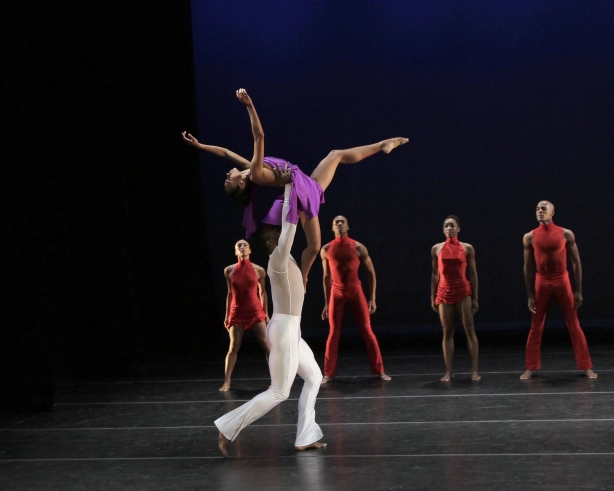
Christopher L. Huggins’s “Anointed” is one of the highlights of Alvin Ailey American Dance Theater season at City Center (photo by Paul Kolnik)
New York City Center
130 West 56th St. between Sixth & Seventh Aves.
Through January 2
Tickets: $25-$150
212-581-1212
www.alvinailey.org
www.nycitycenter.org
As always, Alvin Ailey American Dance Theater’s annual year-end season at City Center includes world premieres, brand-new productions of earlier works, performances with live music, revivals of classics, and plenty of “Revelations,” which is in the midst of its fiftieth anniversary. The first program of all-new works took place on December 21, beginning with the world premiere of former Ailey member Christopher L. Huggins’s celebratory “Anointed.” In the first section, “Passing,” set to Moby’s “Grace,” Olivia Bowman Jackson, representing Ailey artistic director Judith Jamison, who is stepping down from her position in January, and Glenn Allen Sims, playing the part of Alvin Ailey, perform a gentle pas de deux, both dressed in black, before Sims follows a glowing light and exits the stage. In the second section, “Sally Forth,” set to Sean Clements’s percussion-based “Blessed Love,” Jackson emerges wearing Jamison’s trademark purple, continuing Ailey’s legacy with Megan Jakel, Rachael McLaren, Akua Noni Parker, and Khilea Douglass. The piece concludes with “52 and Counting,” featuring Moby’s “God Moving Over the Face of the Waters” as Sims reemerges in white, now the heavenly spirit of Ailey watching the full company perform before teaming up with Jackson again and handing over the reins to new artistic director Robert Battle (Abdur-Rahim Jackson). “Anointed” is a wonderful tribute to the past, present, and future of the company.

AAADT’s Briana Reed and Samuel Lee Roberts in Geoffrey Holder’s “The Prodigal Prince” (photo by Paul Kolnik)
In honor of his retiring mentor, associate artistic director Masazumi Chaya has restaged Jamison’s 1989 work, “Forgotten Time,” a seven-part ballet that begins in silence as six male dancers and six female dancers look up at an unseen image, then, dressed in skin-tight, flesh-colored costumes re-created by Jamison, break off into pairs and perform thrilling lifts, carries, and pulls, exhibiting marvelous body control in Timothy Hunter’s soft lighting as a score by Le Mystere des Voix Bulgares plays. Sims and Jermaine Terry join together for a particularly awe-inspiring duet. A new production of Geoffrey Holder’s 1968 dazzler, “The Prodigal Prince,” was a terrific choice to follow the much quieter “Anointed” and “Forgotten Time.” Based on the life of Haitian painter Hector Hyppolite, “The Prodigal Prince” comes alive with colorful costumes, loud tribal music, and flashy choreography, all by Holder, with lighting and special stage effects by Clifton Taylor. The brash, bold, exciting piece is divided into five sections (“Conversations with the Gods,” “The Feather Brush,” “The Dream of Africa — A Divine Sleep,” “Homecoming and Inheritance,” and “The Beginning”) as Hyppolite (Samuel Lee Roberts) meets Voudoun goddess Erzulie Freda Dahomey (Parker) and John the Baptist (Jamar Roberts) in a vision and is joined by the Mambo/Le Serviteur (Hope Boykin), a pret-savanne spirit (Michael Francis McBride), and the rest of the company, their faces hidden behind masks, with religious rituals taking place and a general love of life bursting forth. “The Prodigal Prince” will be performed again December 23, December 26, and January 2, with “Forgotten Time” scheduled for December 26, December 28, and January 1 and “Anointed” December 29 and January 2.

 Born in São Paulo, Brazil, but based in New York City for many years, Vik Muniz has been making portraits and re-creating artistic masterpieces using such materials as sand, sugar, jewels, junk, paper, and pigments and showing them in galleries and museums around the globe. In 2007, he returned to Brazil and met with the catadores, men and women who work at Jardim Gramacho, the largest landfill in the world, picking out recyclable materials they can then sell to survive. He comes to know Tiaõ and Zumbi, who help run the Association of Recycling Pickers of Jardim Gramacho, as well as such other catadores as Suelem, Isis, Irma, Magna, and Valter, each a character in his or her own right, with unique stories to tell. Filmmaker Lucy Walker (BLINDSIGHT, COUNTDOWN TO ZERO) documents Muniz’s interaction with these dirt-poor people, who live in Rio’s dangerous favelas, as he sets out to capture their images by using the garbage they sift through to eke out some kind of living. Despite their surroundings, they are proud and happy, welcoming in Muniz, who is not shy about calling himself the most successful Brazilian artist in the world and sharing his determination to give something back. WASTE LAND is about art and ecology, about class consciousness and the vast separation between the rich and the poor. The film proceeds in a fairly standard, straightforward manner, putting Muniz and the project on too high a pedestal, which is not surprising given that the initial idea was Walker’s; the heartwarming subject matter, more than the filmmaking itself, is the reason it has been a hit at international festivals, including winning Audience Awards at Sundance and Berlin earlier this year. WASTE LAND is being screened at the Museum of Modern Art on December 29 as part of the series “The Contenders 2010,” a collection of influential and innovative international movies the institution believes will stand the test of time. MoMA has already shown such works as Luca Guadagnino’s I AM LOVE, Christopher Nolan’s INCEPTION, Roman Polanski’s THE GHOST WRITER, and Mads Brügger’s THE RED CHAPEL, and upcoming films include Tom Hooper’s THE KING’S SPEECH, Mark Romanek’s NEVER LET ME GO, and Banksy’s EXIT THROUGH THE GIFT SHOP. WASTE LAND is also being shown December 23 and 29 at IndieScreen in Williamsburg.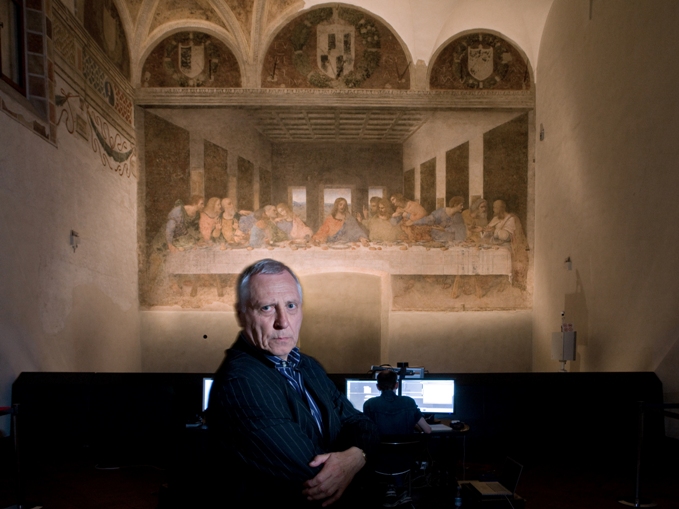



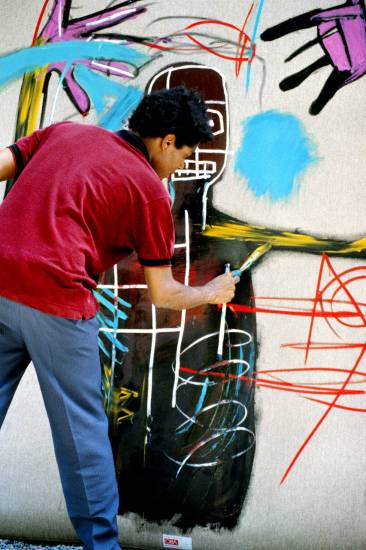
 Director Tamra Davis (GUNCRAZY) transports viewers back to the 1980s New York art scene in the intimate documentary JEAN-MICHEL BASQUIAT: THE RADIANT CHILD, which is having a special return engagement at Film Forum by popular demand. In 1986, just as the career of street artist Jean-Michel Basquiat was exploding, Davis filmed him being interviewed by designer Becky Johnson, a revealing portrait that she put away in a drawer for more than twenty years. Davis finally brings out that footage, making it the centerpiece of this new examination of the ambitious, influential artist and musician who experienced massive success before falling hard and fast and dying of a drug overdose at the age of twenty-seven in 1988. Davis, a friend of Basquiat’s, conducts new interviews with many of the people from his inner circle, including art dealers Jeffrey Deitch, Larry Gagosian, Annina Nosei, Tony Shafrazi, and Bruno Bischofberger; Basquiat’s girlfriends Suzanne Mallouk and Kelle Inman; close Basquiat friends Diego Cortez and Fab 5 Freddy; NEW YORK BEAT cable TV host Glenn O’Brien; and fellow artist Julian Schnabel, who directed Basquiat in DOWNTOWN 81. Davis has also dug up amazing footage from the 1980s of Basquiat that shows him to be a unique, driven figure who used whatever he could — from broken windowframes and doors he’d find on the street to immense canvases — to spread his art and world view, which began with drawings in which he identified himself as Samo, criticizing contemporary art as “the same old shit.” Ultimately, though, it was his relationship with Andy Warhol that was the beginning of the end. JEAN-MICHEL BASQUIAT: THE RADIANT CHILD is a dazzling document of a fascinating time and a cautionary tale of success that comes too fast, too soon.