this week in art

THE HARDER THEY COME

Ivan (Natey Jones, far left) arrives in the city seeking fame and fortune in The Harder They Come (photo by Joan Marcus)

THE HARDER THEY COME
Newman Theater, the Public Theater
425 Lafayette St. at Astor Pl.
Tuesday – Sunday through April 9, $105
publictheater.org

There’s a big difference between a show or movie with music and a fully fledged musical, in which original songs help propel the narrative. That divergence is one of the central flaws in the world premiere of The Harder They Come, at the Public’s Newman Theater through April 9.

The 1972 movie is a Jamaican cult favorite that recently celebrated its fiftieth anniversary; it follows a country boy named Ivanhoe Martin, portrayed by reggae legend Jimmy Cliff in his first and only starring role as an actor, who arrives in Kingston with little more than a guitar and the dream of making a hit record. The soundtrack is one of the all-time greats, consisting of genre-defining tunes by the Maytals (“Sweet and Dandy,” “Pressure Drop”), the Slickers (“Johnny Too Bad”), Desmond Dekker (“007 [Shanty Town]”), the Melodians (“Rivers of Babylon”), Scotty (“Draw Your Brakes”), and Cliff himself, who contributed six songs, including the title track, the only one written specifically for the film.

In her book, Public writer-in-residence and Tony and Pulitzer Prize winner Suzan-Lori Parks, who has written such hard-hitting plays as Topdog/Underdog, Fucking A, and Father Comes Home from the Wars . . . , squeezes too many songs that were background and incidental in the film into the show’s narrative, forcing them into the plot.

An accomplished singer-songwriter, as evidenced by her terrific Plays for the Plague Year, a three-hour intimate performance piece about the pandemic that reopens at Joe’s Pub on April 5, Parks adds several new songs to The Harder They Come, including “Hero Don’t Never Die,” “Please Tell Me Why,” and “Better Days,” expanding, and sometimes changing, the motivations of various characters as Parks attempts to smooth out the bumps and choppiness of the film.

Alas, that is part of its charm. And I’m still trying to understand why the second act opens with Johnny Nash’s “I Can See Clearly Now,” which Cliff recorded in 1993 for the film Cool Runnings about the 1988 Jamaican Olympic bobsled team. The song was part of Reggae Hit the Town: Crucial Reggae 1968-1972, a bonus disc added to the soundtrack album years later; Dekker’s “Israelites” also is in the show from the same collection.

Preacher (J. Bernard Calloway) has a tight hold on his congregation in world premiere at the Public (photo by Joan Marcus)

The story is a rough and violent drama that begins with Ivan traveling to the big city to give his mother, Daisy (Jeannette Bayardelle), her pittance of an inheritance. She wants him to return to the country, but Ivan (Natey Jones) is determined to stay and become a star. With no place to go, he hooks up with the Holy Redeemer Church after meeting and instantly falling for the young and innocent Elsa (Meecah), the orphan ward of the church’s well-connected Preacher (J. Bernard Calloway).

Desperate to make a record, Ivan ultimately signs a terrible contract with local music mogul Hilton (Ken Robinson), a wealthy man who controls what gets played when and where. With no money, Ivan starts working for ganja dealer Jose (Dominique Johnson), who is in cahoots with a plainclothes cop named Ray (Dudney Joseph Jr). Everywhere he goes, Ivan creates conflict with the avaricious men of Kingston, battling religion, drug lords, law enforcement, and corporate greed in his determination to get what he believes he deserves. “You can get it if you really want it / But you must try, try and try, try and try,” he sings.

Instead of laying low like his best friend, Pedro (Jacob Ming-Trent), who also sells for Jose, Ivan can’t stop speaking his mind. After an altercation with a policeman, Ivan is on the run, attempting to hold things together while also reveling in his newfound fame.

Directed by Tony Taccone (Bridge & Tunnel, Wishful Drinking) with codirector Sergio Trujillo, who is best known for his choreography for jukebox bio-musicals (Summer: The Donna Summer Musical, A Bronx Tale), The Harder They Come contains numerous wonderful scenes with fabulous music, performed by a strong cast (Ming-Trent stands out, his character providing comic relief and an honest perspective) and an excellent six-piece band; Kenny Seymour’s orchestrations and arrangements do justice to the originals, although some snippets are too much of a tease and a few of Parks’s new songs are overly melodramatic. In addition, you never get to hear the title track in full; as a kind of encore, it is performed at the very end, but one stanza is curiously left out.

Local music mogul Hilton (Ken Robinson) offers Ivan (Natey Jones) a bad deal in The Harder They Come (photo by Joan Marcus)

Choreographer Edgar Godineaux makes sure the movement never gets out of hand on Clint Ramos and Diggle’s two-level shanty town set, strewn with garbage drums, used tires, multiple old TV sets and speakers on the walls, bamboo, palm leaves, and muted greens and yellows inspired by the Jamaican flag (found also on the railings near the stage), along with earth-toned colors that are also prominent in Emilio Sosa’s costumes. The sound is by Walter Trarbach, with lighting by Japhy Weideman.

In the film, directed by Perry Henzell and cowritten with Trevor Rhone, Cliff’s Ivan already had a hard edge, a willingness to become an outlaw to fight for what he thinks is fair. But in Parks’s version, Jones (Get Up Stand Up, Tina: The Tina Turner Musical) portrays a far more naive and good-natured Ivan, more sensitive to Elsa’s needs and not as inherently dangerous. Cliff’s Ivan is proud of what he did to the policeman and glories in becoming a hero-villain who cheats on his wife and smokes big spleefs, while Jones’s Ivan claims the incident was accidental and never fully inhabits the character’s bad side.

The show has been stripped of its nuance, too easily pitting good vs. evil amid hierarchical, colonialist power structures. While a lot has changed since the film came out half a century ago, a lot hasn’t. This theatrical iteration — Henzell oversaw the script for a 2005 British adaptation — ends up caught somewhere in between.

[Note: The Public is hosting the “Wheel & Come Again” art auction on the mezzanine level, with more than a dozen works available, from $300 to $1000, inspired by the film and musical, raising funds to benefit scholarships at the Edna Manley College of the Visual and Performing Arts in Kingston.]

PATTIE BOYD PRESENTS MY LIFE IN PICTURES

Pattie Boyd will be discussing and signing copies of her new book at Rizzoli (photo courtesy Reel Art Press)

Who: Pattie Boyd, Dave Brolan
What: Book talk and signing
Where: Rizzoli Bookstore, 1133 Broadway at 26th St., 212-759-2424
When: Monday, April 3, $59.87 (includes admission, signing line access, and book), 6:00
Why: “I decided very early on that there never needed to be a dull moment in life. If you find yourself feeling dull, just change your mind,” model, photographer, and muse Pattie Boyd proffers in her new book, My Life in Pictures (Reel Art Press, December 2022, $49.95).

Born in England in March 1944, Boyd has not had a very boring life. She went to boarding school in Nairobi, began modeling as a teenager, and married and divorced George Harrison and Eric Clapton. She was the muse behind Harrison’s “Something” and Clapton’s “Layla” and “Wonderful Tonight” and appeared on an endless stream of magazine covers. But all the while she was dazzling people in front of the camera, she was also taking her own photographs.

On April 3 at 6:00, Boyd will be at Rizzoli to discuss her life and career, joined by photo editor, curator, and archivist Dave Brolan from Reel Art Press. My Life in Pictures features photographs of Boyd by such lensmen as David Bailey, Eric Swayne, Norman Parkinson, Terence Donovan, Robert Freeman, and Robert Whitaker; photos by Boyd of Twiggy, Mick Jagger, Billy Preston, and the Beatles; and diary entries, artifacts, artworks, and other memorabilia, including letters from John Lennon and Yoko Ono. Tickets are still available with a copy of the book and come with access to the signing line. (Boyd will only be signing books purchased at Rizzoli.)

“I liked the idea of being independent and working but not all the time,” Boyd, who married real estate developer Rod Weston in 2015, writes in the book. “I wasn’t pinned down to anything nine to five. I thought that would be an incredibly boring thing to do.”

EVERY OCEAN HUGHES: RIVER

Every Ocean Hughes’s River will be performed March 24–26 in conjunction with photography exhibit (photo courtesy Every Ocean Hughes)

Who: Every Ocean Hughes
What: Live performance
Where: Whitney Museum of American Art, the Susan and John Hess Family Theater, 99 Gansevoort St.
When: March 24, 7:00; March 25, 4:00 & 7:00; March 26, 4:00, $25; exhibition continues through April 2
Why: Multidisciplinary artist Every Ocean Hughes activates her Whitney photography exhibition “Every Ocean Hughes: Alive Side” with four live performances this weekend in the Susan and John Hess Family Theater. Formerly known as Emily Roysdon, Hughes investigates legacy, loss, and inheritance in “Alive Side,” consisting of photographs of the west side piers right outside the Whitney; Hughes calls them “unmarked memorials, found monuments to the lives that needed that unregulated space. To those who died living queerly. Those who died of neglect, poverty, AIDS, violence, and politics. And to those seeking life by crossing West Street.” The black-and-white photos of the dilapidated wooden piers sticking out of the water, some works sliced diagonally in half, are framed in bright pastel colors that evoke the rainbow pride flag. The exhibit also features the forty-minute video One Big Bag, in which a death doula portrayed by Lindsay Rico describes and enacts rituals surrounding the end of life; “the whole process is a creative process,” she says.

Every Ocean Hughes, The Piers Untitled (#12 collaged, #9, #14 collaged, #4), 2009-23 (photo by Ron Amstutz)

On March 24–26, the Maryland-born Hughes, who lives and works in her home state and Stockholm, will present River, a thirty-minute live performance incorporating song, text, choreographed movement, and set design exploring the crossing that takes place at death, the descent into the underworld. The cast includes Rico, Geo WyeX, Æirrinn, and Nora Brown, with movement direction by Monica Mirabile, costumes by Montana Levi Blanco, and lighting by Timothy Johnson. Tickets are $25; it is recommended they be purchased in advance.

MERET OPPENHEIM: MY EXHIBITION

Wide-ranging Meret Oppenheim continues at MoMA through March 4 (photo by Jonathan Muzikar)

MERET OPPENHEIM: MY EXHIBITION
MoMA, Museum of Modern Art
The Robert B. Menschel Galleries, 3 East
11 West 53rd St. between Fifth & Sixth Aves.
Through March 4, $14-$25 (sixteen and under free)
212-708-9400
www.moma.org

In a 2010 SWI video, Lisa Wenger, the niece of Meret Oppenheim, said of her aunt, the German-born Swiss artist who died in 1985 at the age of seventy-two, “Immediately bought by MoMA in New York, [Object] is the work that most people associate Meret Oppenheim with, in a way fantastic, because she was so young — she was, like, twenty-two or twenty-three when that happened — and on the other hand, it was her prison, and she very often would say, ‘Uch, god, this damn fur cup,’ when people reduced her as an artist to that work or wanted her to do just this type of work, but that fur-covered cup and saucer was certainly her trademark, and it still is an icon of surrealism.”

That “damn fur cup” is part of “Meret Oppenheim: My Exhibition,” which continues at MoMA through March 4, but it is not the centerpiece. It is merely one of nearly two hundred paintings, drawings, sculptures, films, assemblages, reliefs, collages, jewelry design, and more on display. The pieces are so wide-ranging that it would at first be easy to assume it was a group show, but it’s all by Oppenheim, a surrealist and conceptualist who played by her own set of rules. As detailed in cocurator Nina Zimmer’s catalog essay, Oppenheim told television journalist Frank A. Meyer in 1983, when asked about whether she specifically tried to be uncategorizable, “Not at all! I simply always did what I felt like doing; anything else wouldn’t agree with the way I work. Committing to a particular style would’ve bored me to death.”

Meret Oppenheim, Stone Woman (Steinfrau), oil on cardboard, 1938 (private collection)

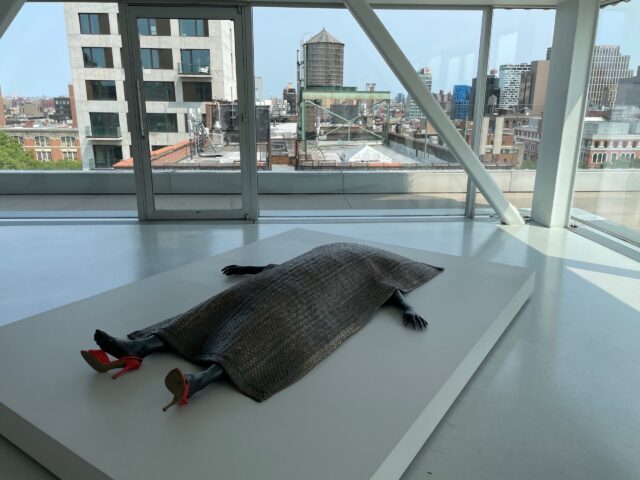
Oppenheim did help to shape her legacy through twelve pencil, colored pencil, and ballpoint pen drawings, collectively titled M.O.: My Exhibition, that essentially lay out plans for a retrospective of her work. The MoMA show also includes the dark Suicides’ Institute, an ink in which a young boy looks up at four hanged people; the cartoonish One-Eyed and Sitting Figure with Folded Hands; the Surrealist Little Ghost Eating Bread and The Night, Its Volume and What Endangers It; Ma gouvernante – My Nurse – Mein Kindermädchen, a pair of high-heeled shoes on a platter, with the heels wrapped like lamb chop booties; Fur Gloves with Wooden Fingers; the somewhat abstract gouache Three Murderers in the Woods; the small circular wall piece The House at the Bridge; the geometric oil Sun-Bedecked Fields; the transformed clock Animal-headed Demon; the gelatin silver print X-Ray of M.O.’s Skull; and a ten-minute clip from Desire Caught by the Tail, the Pablo Picasso play for which Oppenheim designed costumes and sets for a 1956 production.

“Meret Oppenheim: My Exhibition” celebrates legacy of German-born Swiss artist (photo by Jonathan Muzikar)

In a 1933 poem, Oppenheim wrote, “Finally! / Freedom!” The next year, in another poem, she declared, “Let the walls loose.”

That’s precisely the feeling one gets while experiencing “Meret Oppenheim: My Exhibition.”

EDWARD HOPPER’S NEW YORK

Edward Hopper, Early Sunday Morning, oil on canvas, 1930 (Whitney Museum of American Art / © 2022 Heirs of Josephine N. Hopper / Licensed by Artists Rights/Society, New York)

EDWARD HOPPER’S NEW YORK
Whitney Museum of American Art
99 Gansevoort St.
Through March 5, $18-$25
212-570-3600
whitney.org

Blockbuster solo exhibitions often elevate already famous artists to the next stratosphere, in the minds of the general public if not always the critics. Major shows spotlighting Rembrandt, Picasso, van Gogh, Matisse, Warhol, Basquiat, Magritte, Kusama, and others are events that draw enormous lines. People are traveling from around the world to see “Vermeer” at the Rijksmuseum, a collection of twenty-eight of the thirty-seven extant works attributed to the Dutch painter, the most ever on view in one show; however, be careful about planning your trip to Amsterdam, as it’s already sold out through its June 4 closing date.

What’s much harder to do is to humanize that superstar artist, but that’s exactly what the Whitney has done with “Edward Hopper’s New York,” an intimate and appealing exhibit that continues through March 5. Hopper has long been the centerpiece of the Whitney’s holdings, which comprise more than three thousand of his drawings, paintings, watercolors, letters, personal objects, photographs, film, and other paraphernalia. “Edward Hopper’s New York” has a razor-sharp focus on Hopper’s relationship with the city, where he began studying in 1899; he moved to New York in 1908, eventually settling in Washington Square in 1913, and married fellow artist Josephine Nivison in 1924. They had no children, instead concentrating on their work and going to the theater with a near-obsession.

The Whitney is packing them in in the fifth-floor galleries, in dramatic opposition to the works themselves, which mostly feature a single human figure, if any, and almost always modeled by his wife. The paintings are filled with a pervasive loneliness in a giant municipality re-created in Hopper’s imagination; this is no bustling Big Apple but rather a contemplative metropolis without skyscrapers or mass transit. (Even his canvases of bridges and railroad tracks are devoid of cars, buses, and trains.) Instead, the Nyack-born Hopper has transformed his longtime home into a vision of small-town America that could exist nowhere else. The paintings explore the often accidental formal beauty of the city’s built environment in their careful composition and sometimes surprising color juxtapositions.

Edward Hopper, Night Shadows, etching, 1921 (Whitney Museum of American Art / © 2022 Heirs of Josephine N. Hopper / Licensed by Artists Rights/Society, New York)

“Hopper’s New York was a product of his personal experiences in the city throughout his lifetime, of the particular ways that he engaged with the sites and sensations around him,” Whitney curator Kim Conaty writes in her catalog essay. “The painstaking deliberateness with which he absorbed, reflected upon, then refined his impressions — ‘I’m thinking out my picture,’ he once responded to a neighbor who approached him as he sat idly in the park — can be gleaned from his pace of output, which increasingly averaged but two or three canvases a year.” New York can be a push-push place, but the Hoppers were in no rush.

Divided into such sections as “Reality and Fantasy,” “The Window,” “The Horizontal City,” and “Theater,” the show comprises dozens of works that contain haunting, mysterious narratives. In Morning Sun, a woman sits on a bed, the light pouring in as she stares emptily out a window. In Morning in a City, a naked woman stands next to an unmade bed that is too small for her; she holds a piece of clothing and looks out a window for something or someone missing.

In New York Movie, a woman in a blue outfit with a red stripe running down the side, most likely an usher, stands against the wall at the right, a hand on her chin, deep in thought; at the left, we can see only a few rows in the movie theater and a sliver of the black-and-white film, with only two people in the audience, the lush red velvet seats and a touch of blue echoing the usher and the entrance curtain, casting the picture in an elegant loneliness.

In Early Sunday Morning, one of the grandest American works of the twentieth century, a glowing light casts long shadows across an empty sidewalk in front of a two-story building, including, impossibly, a blue one emanating from a gray fire hydrant; the first-floor storefronts are closed, the second filled with windows, some partially covered with yellow shades. It was based on a scene from Elmer Rice’s 1929 Pulitzer Prize-winning play, Street Scene, expanded from Rice’s earlier Sidewalks of New York. “There was neither plot nor situation,” Rice told the New York Times that February. “One merely saw the house shaking off its sleep and beginning to go about the business of the day.” That is precisely what Hopper captures, in that and so many other paintings.

Edward Hopper, New York Movie, oil on canvas, 1939 (Museum of Modern Art/ © 2022 Heirs of Josephine N. Hopper/Licensed by Artists Rights Society, New York / image courtesy Art Resource)

The Hoppers were avid theatergoers, which is creatively displayed in an installation that includes dozens of ticket stubs they saved, along with a small notebook detailing the shows they saw, accompanied by projections of photographs of the theaters they went to and scenes from the productions they took in. They generally paid $1.10 for balcony seats for such plays as An American Tragedy, Pygmalion, The Front Page, and Dead End; they splurged for $3.30 orchestra seats for Hamlet with John Gielgud, as Hopper noted on the back of the stub from November 24, 1936. The vitrine also shines a light on Hopper’s numerous works that are set inside theaters.

Another section traces the Hoppers’ attempt to combat the potential intrusion of New York University into the serenity of Washington Square Park, the neighborhood where Hopper moved to in 1913 and lived the rest of his life. Amid such works as Skyline Near Washington Square, the charcoal drawing Town Square (Washington Square and Tower), and Roofs, Washington Square is a glass case that highlights an exchange of letters between Hopper and Parks Commissioner Robert Moses. The room also focuses on Edward’s relationship with Jo, pointing out that when she posed for him, they would often create fictional characters and situations, role-playing. Several watercolors by Jo are on view as well as a charming short video of them both working in their home studio.

Lovingly curated by Conaty, the show welcomes viewers into the Hoppers’ world like no other solo exhibition I can recall; there’s a constant chatter in the galleries by New Yorkers and tourists alike discussing the paintings and the city with enthusiasm, regardless of their prior knowledge of art or Manhattan. The works have a way of uniting everyone at the Whitney, perhaps in part as a response to the loneliness depicted in so many of the canvases (and in real life during the pandemic lockdown). “Edward Hopper’s New York” might not be an exact replica of the city, but it gracefully represents the town we savor every day.

UNBREAKABLE SPIRIT: COMMEMORATING ONE YEAR OF UKRAINE’S RESILIENCE AND RESISTANCE

Ukrainian Institute commemoration event on February 24 features art, film, dance, lectures, panel discussions, and more

Who: Sofika Zielyk, Olia Rondiak, Kathy Nalywajko, Ivanna Klympush-Tsintsadze, Evelyn Farkas, Marcy Kaptur, Adrian Karatnycky, Urmas Reinsalu, Taisa Markus, Denys Drozdyuk, Antonina Skobina, more
What: Ukrainian Institute commemoration event
Where: The Ukrainian Institute, 2 East Seventy-Ninth St. at Fifth Ave.
When: Friday, February 24, free, 12:00 – 6:00 pm
Why: On February 24, 2022, Russia invaded Ukraine, starting a war that has resulted in the deaths of more than forty thousand people in addition to more than fifty-five thousand wounded, at least fifteen thousand missing, and some fourteen million displaced. Russian president Vladimir Putin’s plan was to “demilitarize and denazify” Ukraine, but he never expected to be in a real battle twelve months later. The Ukrainian Institute will commemorate a year that has proved the strength, valor, and courage of Ukraine, under the leadership of President Volodymyr Zelenskyy, with “Unbreakable Spirit: Commemorating One Year of Ukraine’s Resilience & Resistance,” an afternoon of free programming on February 24 that includes art exhibitions, film screenings, panel discussions, dance, and special remarks. On the first floor will be “Window on Ukraine,” “The Pysanka: A Symbol of Hope” with curator and ethnographer Sofika Zielyk and more than five hundred eggs, and a Ukrainian bookstore.

The second floor features a concert hall and Chandelier Room where contemporary Ukrainian paintings will be on display as part of the Kozytskiy Charity Foundation’s “We and the World” initiative, short films and documentaries will be shown from noon to 4:00, and conversations with experts will be held. On the third floor will be a healing space with handmade motanky sculptures with artist Olia Rondiak and a “Lives Cut Short” print and video tribute to fallen artists, curated by Ukrainian dancers Denys Drozdyuk and Antonina Skobina, with live presentations from 4:00 to 6:00. There will also be remarks and conversations with Ukrainian Institute president Kathy Nalywajko, Ukrainian MP Ivanna Klympush-Tsintsadze, American national security advisor Evelyn Farkas, Congresswoman Marcy Kaptur, Eurasia Center senior fellow Adrian Karatnycky, Estonian minster of foreign affairs Urmas Reinsalu, White & Case partner Taisa Markus, Ukrainian female former POWs, and others. Slava Ukraini!

BODY AS VESSEL: VIVIAN CACCURI AND MILES GREENBERG ON “THE SHADOW OF SPRING”

Vivian Caccuri and Miles Greenberg will discuss their collaboration “The Shadow of Spring” at the New Museum (photos courtesy of the artists)

Who: Vivian Caccuri, Miles Greenberg, Bernardo Mosqueira
What: Artist talk on “The Shadow of Spring”
Where: New Museum Theater, 235 Bowery at Prince
When: Thursday January 26, $10, 6:30
Why: You’d be doing yourself a disservice if you head to the New Museum to catch the subtle, intimate three-floor exhibition “Theaster Gates: Young Lords and Their Traces” before it closes on February 5 without also checking out multidisciplinary artists Vivian Caccuri and Miles Greenberg’s “The Shadow of Spring” in the lobby gallery.

Commissioned exclusively for the space, the show features two urethane fountains by Greenberg, each containing a kind of totem of broken human figures, in between two maplike embroidered wall hangings by Caccuri depicting faceless naked people engaged in various types of contact. The frames and base are speaker systems thumping out music that merges with the sounds of water dripping in the fountains, sending ritualistic vibrations throughout the room. Caccuri’s Vessel Flame and Vessel Body were inspired by Dante’s Inferno and raves held at her studio; the sounds were adapted from recordings of Greenberg’s body following workouts. Greenberg’s Mars and Janus statues were developed from one of his durational performances and used 3D scans to create the fragmented body parts. This is the first time Caccuri and Greenberg have collaborated together, presenting an encased environment that explores the relationship between sound and body, ritual and community, and nature and humanity.

On January 26 at 6:30, Caccuri, born and based in São Paulo, and Greenberg, who was born in Montreal and lives and works in New York and Reykjavik, Iceland, will be at the New Museum Theater for the artist talk “Body as Vessel,” in which they will discuss “The Shadow of Spring” in addition to their individual practices and processes; Brazilian exhibition curator Bernardo Mosqueira will moderate the conversation.