this week in art

RENOIR, IMPRESSIONISM, AND FULL-LENGTH PAINTING

Pierre-Auguste Renoir, “The Umbrellas (Les Parapluies),” oil on canvas, ca. 1881-85 (courtesy the National Gallery, London)

The Frick Collection
1 East 70th St. at Fifth Ave.
Tuesday – Sunday through May 13, $18 (pay-what-you-wish Sunday 11:00 am – 1:00 pm)
212-288-0700
www.frick.org

The Frick takes a unique approach to the work of French artist Pierre-Auguste Renoir in the small but delightful exhibition “Renoir, Impressionism, and Full-Length Painting.” For the first time ever, nine large-scale figurative Renoir paintings have been brought together from around the world and displayed in the Frick’s East Gallery, which has never before been dedicated to a single show; in addition, it is a one-time-only event, as the Frick will be its only home. Inspired by the Paris Salons of the 1870s and 1880s, Renoir created several long, rectangular canvases that celebrated French fashion and style. Renoir favors solitary figures in “The Dancer,” “La Parisienne,” and “Madame Henriot ‘en travesti’ (The Page),” concentrating on the subjects’ dress, the first two set against an Impressionistic background. In the Frick’s own “La Promenade,” a mother guides her two young daughters through the park, all three elegantly attired amid lush blues and greens. On one wall, an 1883 trilogy of works that focus on dancing couples hang side by side. In “Dance in the City,” a formally dressed man and woman dance demurely, his right hand gently grasping the middle of her back, her gloved left hand placed delicately on his right shoulder. In “Dance in the Country,” a more casually dressed couple seems to be having more fun, the man gazing lovingly at the woman, the woman smiling at the viewer; a straw hat lying in the lower right corner adds to the simplicity and genuineness of the moment. And in “Dance at Bougival,” the most intimate and sensual of the three, the man and woman hold on to each other with bare hands as people in the background chatter on, with glasses of beer on a table and cigarette butts littering the ground. Seen together, the works form a dramatic triptych of love, romance, and class structure in late-nineteenth-century Paris. The most surprising piece in the exhibition is “The Umbrellas (Les Parapluies),” a complex canvas dominated by a woman carrying a picnic basket in the left foreground and facing the viewer, a group of open umbrellas at the top extending deep into the background. A man gazes upon the woman, perhaps about to offer her some cover, while a little girl holding a hoop looks at the viewer from the lower right. The subjects’ faces and the geometric patterns of the umbrellas, the basket, the hoop, and various hats battle for attention in this sharply painted scene. The show also delves into Renoir’s use of models as well as how some of the works changed over time, as revealed by close inspection and x-ray technology. Organized by Frick deputy director Colin B. Bailey, “Renoir, Impressionism, and Full-Length Painting” is a lovely examination of Renoir’s own artistic dance with size.

FIRST SATURDAYS: CONNECTING CULTURES

Brooklyn Museum director Arnold Lehman mans the staff desk at new long-term “Connecting Cultures” installation

Brooklyn Museum
200 Eastern Parkway at Washington St.
Saturday, May 5, free, 5:00 – 11:00 (some events require free tickets distributed in advance at the Visitor Center)
212-864-5400
www.brooklynmuseum.org

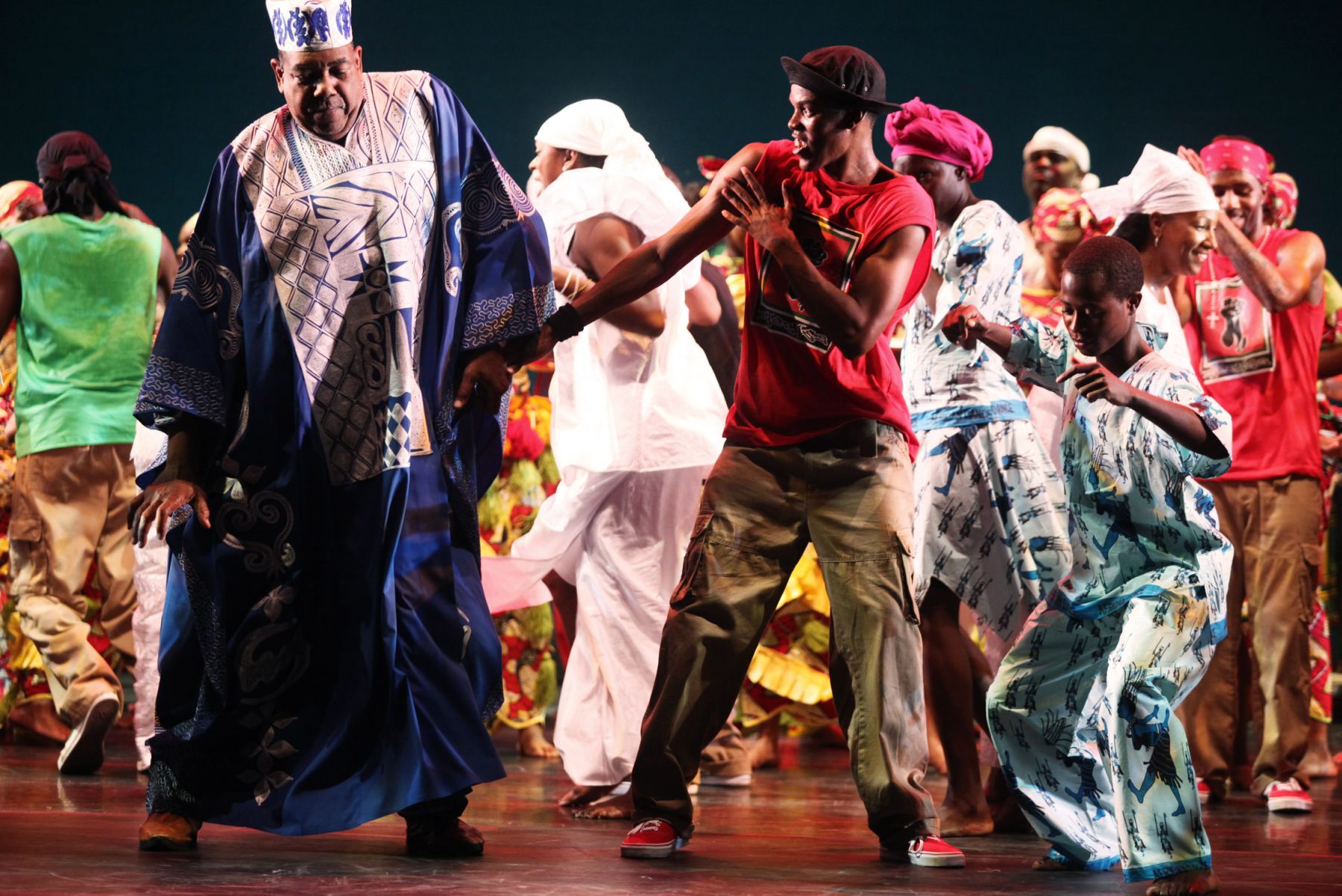
The Brooklyn Museum will celebrate the opening of its latest long-term installation, “Connecting Cultures: A World in Brooklyn,” at this month’s First Saturdays program. The exhibit juxtaposes works in three sections, “Connecting Places,” “Connecting People,” and “Connecting Things,” with a desk where people can interact with a museum staffer. Saturday night features live performances by Los Colombian Roots, Forces of Nature Dance Theatre, Brown Rice Family, and Stone Forest Ensemble. Ann Agee will discuss her period room in “Playing House,” chief curator Kevin Stayton will give a talk on “Connecting Cultures,” and visitors can climb the rooftop of Heather Hart’s “Raw/Cooked” installation “The Eastern Oracle: We Will Tear the Roof Off the Mother.” (Be sure to wear flat, rubber-soled shoes.) Haley Tanner will read from and sign copies of her debut novel, Vaclav & Lena, and DJ Spooky will lead the traditional dance party. As always, the galleries will be open late, giving visitors plenty of opportunity to check out “Keith Haring: 1978-1982,” “Playing House,” “Rachel Kneebone: Regarding Rodin,” “Raw/Cooked: Heather Hart,” “Newspaper Fiction: The New York Journalism of Djuna Barnes, 1913–1919,” “Question Bridge: Black Males,” and “Body Parts: Ancient Egyptian Fragments and Amulets.”

PULSE CONTEMPORARY ART FAIR

Fairgoers can take part in Inner Course’s psychic playroom “Knowing Me, Knowing You” at Pulse

The Metropolitan Pavilion
125 West 18th St. between Sixth & Seventh Aves.
May 3-6, $20 per day, $25 four-day pass
www.pulse-art.com
pulse favorites slideshow 2012

In order to avoid the mad rush of art fairs that took over the city, several regulars moved their dates to the first week of May. While Red Dot ended up canceling the 2012 edition because of labor union disputes, you can still check out Verge NYC, NADA is holding its inaugural fair, and there’s a deafening buzz about the Frieze Art Fair on Randall’s Island. But one of our annual favorites, Pulse, will be at the Metropolitan Pavilion May 3-6, with its usual highly manageable mix of painting, sculpture, video, installation, and performance. This year’s special projects include Shannon Gillen & Guests’ “BOTLEK,” Annie Han and Daniel Mihalyo’s “City Surface,” Jennie C. Jones’s “Rest, Dopamine Rising,” Kristofer Porter’s “Tappan Zee Burro,” Risa Puno’s interactive “Good Faith & Fair Dealing,” Fred Wilson’s “Sneaky Leaky” and “Reign,” and Inner Course’s participatory “Knowing Me, Knowing You.” The selection committee of Stefan Roepke, Thomas Von Lintel, and Cornell DeWitt have invited nearly fifty galleries, which will be showing works by such artists as Kim Dorland, Vik Muniz, Jim Campbell, Marco Breuer, William Eggleston, Deborah Kass, Matthias Meyer, David LaChapelle, Courtney Love, Tracey Moffatt, Andrew Masullo, and Ed Ruscha, but the most intriguing lineup comes courtesy of Creative Capital, which will be presenting an all-star grouping of Ralph Lemon, Dread Scott, Eve Sussman, Stephen Vitiello, Zoe Leonard, Futurefarmers, and others. The Pulse Play lounge will feature video, video game, and technology works, while the Impulse section highlights recent solo shows.

Update: The 2012 edition of Pulse is another highly satisfying, well-organized fair boasting a fine collection of contemporary international artists. Andreas Bauer’s (balzerARTprojects) cut-paper collages of comic books and magazines, in which he excises all words, are little architectural wonders. At RH Gallery, Soledad Arias’s text-based acoustic prints and neon sculptures give a preview of her current show on Duane St. Works by Chuteppa, Clemencia Labin, Daniel Verbis, Graciela Sacco, Michael Scoggins, and others emerge from the walls at Diana Lowenstein. The New Jersey-born, Oakland-based Chris Duncan (Halsey McKay) creates a dazzling effect with string, mirrors, and wood in “Mirror, Mirror.” An alluring physicality emerges from Ralph Fleck’s (Purdy Hicks) thickly painted cityscapes. Reinier Gerritsen’s (Julie Saul) Wall Street subway photos are composites of multiple images, resulting in an exact moment that actually never occurred inside trains, while Eve Sussman’s (Creative Capital) 3D panoramic view finders reveal trains from outside. Matt Haffner (Pentimenti) uses cut paper and acrylic to create silhouetted scenes. Paul Paddock’s (frosch&portmann) watercolors are significantly more devious upon closer inspection, while you’ll get a surprise when you delve deeper into Mary Tsiongas’s (Richard Levy) “Vanish II.” You can take a break by playing Risa Puno’s (Galerie Stefan Roepke) “Good Faith & Fair Dealing” maze game. If you missed Dare Wright’s recent show at Fred Torres, you can still see the star photograph from “The Lonely Doll.” Geoff McFetridge’s (Cooper Cole) stylized acrylic paintings are graphic charms. Sigrid Viir’s (Temnikova & Kasela) photographs of constructed scenes set up like paintings won the Pulse Prize for the Impulse section. And Andrew Masullo’s (Daniel Weinberg) brightly colored small canvases of different geometric shapes, which unfold as he paints them, not knowing which way they will eventually hang, are a highlight of Pulse just as they are one of the standouts at the current Whitney Biennial.

PEN WORLD VOICES FESTIVAL OF AMERICAN LITERATURE

Salman Rushdie will deliver the Arthur Miller Freedom to Write Lecture at this year’s PEN World Voices Festival of International Literature (photo by twi-ny/mdr)

Multiple locations
April 30 – May 6, free – $75
www.pen.org

This year’s PEN World Voices Festival of International Literature celebrates the ninetieth anniversary of the organization, which is dedicated to freedom of speech and human rights around the globe, with a bevy of events beginning April 30 and continuing through May 6. Here are just some of the many highlights: On Monday night, Graydon Carter, Victor S. Navasky, George Packer, and Katha Pollit will pay tribute to the late Christopher Hitchens at the Jerome L. Greene Performance Space, and Hank Dutt, Onome Ekeh, Emily Howard, and Beth Levin will take part in the U.S. premiere of Kevin Malone’s thirty-five-minute Clockwork Orange operetta at the Top of the Standard. On Tuesday, Mike Daisey will host “Revolutionary Plays Since 2000: The Future of Political Theater” at the CUNY Graduate Center, an evening of readings, discussion, and live music with Lasha Bugadze, Mahmoud Dowlatabadi, Laila Soliman, and the Civilians. On Wednesday, the amazing trio of Martin Amis, Margaret Atwood, and E. L. Doctorow will gather together for a TimesTalk at the Times Center, while the Kronos Quartet presents “Exit Strategies” at the Metropolitan Museum of Art with Rula Jebreal, Tony Kushner, and Marjane Satrapi. There are more than a dozen programs on Thursday, including Elevator Repair Service performing the site-specific Shuffle, a mash-up of classic novels at NYU’s Bobst Library, screenings of Satrapi’s Persepolis and Chicken with Plums at MoMA, and “Herta Müller on Silence” at Deutsches Haus. On Friday, Jennifer Egan will talk about “How to Create Your Own Rules” with Jacob Weisberg at the New School, seventeen writers will come together for “A Literary Safari” at the Westbeth Center, and the all-day “John Cage: How to Get Started” at Symphony Space will feature David Harrington of the Kronos Quartet, Aleksander Hemon, Etgar Keret, Sonia Sanchez, and audience performers. On Saturday, “An Evening with Doon Arbus, Francine Prose, and Michael Cunningham — and Diane Arbus” consists of readings from the recent biography Diane Arbus: A Chronology and a screening of A Slide Show and Talk by Diane Arbus at MoMA, author-illustrator Brian Selznick will be in conversation with David Levithan at the New School, Egan, Teju Cole, Karl O. Knausgaard, Riikka Pulkkinen, Luc Sante, and others will interact with R. Justin Stewart’s art installation at the Invisible Dog Art Center for “Messiah in Brooklyn,” and Sanchez, Keret, Adam Mansbach, Sharifa Rhodes-Pitts, Marcus Samuelsson, and Tracy K. Smith will discuss “Memory in Harlem” at the Schomburg Center for Research in Black Culture. The festival concludes on Sunday with Cunningham, Deborah Eisenberg, Daniel Kehlmann, and Edmund White at the Museum of Jewish Heritage for “A Place Out of Time: Gregor von Rezzori’s Bukovina Trilogy” and Salman Rushdie delivering the Arthur Miller Freedom to Write Lecture at the Cooper Union, followed by a pop Q&A led by Gary Shteyngart.

LUMINANCE

Gabriel Barcia-Colombo’s “Tube” takes television characters outside the box (photo by twi-ny/mdr)

WORK FROM THE INTERACTIVE TELECOMMUNICATIONS PROGRAM AT NYU
Paley Center for Media
25 West 52nd St. between Fifth & Sixth Aves.
Through April 29, free with general admission of $10
212-621-6600
www.paleycenter.org
luminance slideshow

Six NYU students and alumni from the Interactive Telecommunications Program have fun reimagining television and video in creative and unusual ways in “Luminance,” running through this weekend at the Paley Center in Midtown. Curated by ITP adjunct professor Gabriel Barcia-Colombo, the exhibition features works that expand viewing into three-dimensional space, influenced by the participation of the viewer, with each piece accompanied by an artist statement and commentary by the Paley Center’s Ron Simon. In Toby Schachman’s “Time Travelers,” visitors can see their image merge on-screen with Creative Commons scenes of flowers, strawberries, sunrises, and sunsets. Rui Pereira’s “IEM” brings back the HAL 9000, as color patterns and clips from 1980s music videos directly answer personal questions. (Try not to inquire if he loves you.) In “Golden Treasures of Snows,” Molly Schwartz invites visitors to drive animated images of nature ― what she calls “a hierarchy of animals and vehicles, representing confidence, mischievousness, silence, concentration, messengers, and rogues” ― using a ship’s wheel to control what appears on-screen. In “Little Memories,” Andrea Wolf employs miniatures and super-8 home movies projected onto the wall to create a trio of realistic situations, including a car traveling down a long road in “Movement.” The highlight is Barcia-Colombo’s “Tube,” in which two characters have escaped the confines of a 1964 RCA television set, only to find themselves trapped in a glass case on top of it, digital and analog coming together to enter another, still limiting, space. And downstairs, Martín Bravo’s “Skittish Tree” is a projection that responds to sound, illuminated branches seemingly shaking in the wind. Although computers and handheld devices have changed the way people watch movies and television programs, these engaging works take the technology outside the box, instead of the box taking the technology outside.

YANG FUDONG

Yang Fudong’s seven-channel THE FIFTH NIGHT continues at Marian Goodman through Saturday

Marian Goodman Gallery
24 West 57th St. between Fifth & Sixth Aves.
Tuesday – Saturday through April 28, free, 10:00 am – 6:00 pm
212-977-7160
www.mariangoodman.com

In the spring of 2009, Chinese artist Yang Fudong presented the five-hour, five-part Seven Intellectuals in a Bamboo Forest at Asia Society in addition to the six-screen Tate Liverpool commission East of Que Village at Midtown’s Marian Goodman Gallery. The Shanghai-based Yang is back at Marian Goodman with three new works that further his unique investigation of the process of visual storytelling. In the North Gallery, The Fifth Night unfolds like a Chinese scroll painting, with seven monitors lined up one after another on a parallel line in an otherwise dark room. Set in a 1930s-like Shanghai square, the film, made with seven cameras shooting at once, offers different angles of the same general scene. Characters wander around dreamlike, climb up a spiral staircase that goes nowhere, and pass by blacksmiths at work in the middle of the night. Yang has created a mysterious atmosphere where gangster cars and rickshaws pass through multiple screens in the background as lonely men and women move slowly through the surreal goings-on. Shot in black-and-white and using natural sound, The Fifth Night upends traditional narrative, toying with time, space, and reality while examining the very process of filmmaking itself. In the South Gallery, the nearly twenty-minute Ye Jiang (The Nightman Cometh) focuses on an ancient, scarred warrior considering his fate in a snow-covered landscape where an overturned cart hints at something gone terribly wrong. Dressed in an old-fashioned uniform, he evokes both fairy tale and history, contemplating his future as the place, a kind of spiritual way station, is visited by ghostly people and animals. Set to a minimalist elegiac score by Jin Wang, The Nightman Cometh is a beautifully realized, meditative film with gorgeous painterly imagery, which should come as no surprise, as Yang studied painting at the Academy of Fine Arts Hangzhou. Also on view is “International Hotel,” a small series of black-and-white photographs taken at the Art Deco swimming pool at the International Hotel in Shanghai that evoke post-WWII propaganda campaigns.

IT’S THE POLITICAL ECONOMY, STUPID

Institute for Wishful Thinking, “Post-Fordist Variations,” detail, mixed media, 2011 (photo by twi-ny/mdr)

Austrian Cultural Forum
11 East 52nd St. between Madison & Fifth Aves.
Daily through April 22, free, 10:00 am – 6:00 pm
212-319-5300
www.acfny.org

During his 1992 presidential campaign, Bill Clinton famously declared, “It’s the economy, stupid.” Austrian-American curators Oliver Ressler and Gregory Sholette have taken that statement and added a slight twist for “It’s the Political Economy, Stupid,” a group show running through Sunday at the Austrian Cultural Forum in Midtown. Through sculpture, installation, drawing, video, and photography, the artists fight back against the growing economic crisis encircling the globe as governments do nothing to prevent it ― or in fact make it worse. In the lobby, Dread Scott continually calls out, “Money to Burn,” in a video depicting him in the Financial District burning actual money while asking passersby to help. The Institute for Wishful Thinking goes back to 1975 in their multimedia display focusing on the iconic Daily News headline “Ford to City: Drop Dead,” supplementing it with cards that make such proclamations as “Paulson to City: Banks First” and “Blankfein to City: No Worries.” Linda Bilda’s “Labor and Capital” sculpture projects the two performing a ghostly dance on a wall, while flo6x8’s “Body Versus Capital” documents Spanish flashmobs dancing inside banks. Julie Christensen’s slide show, “How Communities Are Reusing the Big Box,” reveals how big box stores that have gone out of business are being repurposed by local neighborhoods. Zanny Begg and Ressler’s “The Bull Laid Bear” video does an excellent job of explaining the economic crisis, using cartoon bears as talking heads. Ira Rosenberger’s “Espiral ― A Dance of Death in 8 Scenes” harkens back to Kurt Jooss’s 1932 ballet, “The Green Table,” as a woman in black-and-white face paint moves ominously behind quotes detailing the history of Austrian finance. And Bilda’s large wall mural, “The Future and End of the Golden World,” features male and female prolls, rightist perverts, unprincipled media, bureaucrats, political activists, Bill Gates, Sam Walton, Warren Buffet, Henry Paulson, NGOs, and others, with politicians being tempted by lobbyists at the center. “It’s the Political Economy, Stupid” offers an intriguing, varied look at how artists are dealing with the financial crisis, employing a creative blend of humor and anger to make their salient points.