this week in art

EDMUND CLARK — GUANTANAMO: IF THE LIGHT GOES OUT

Edmund Clark, “Camps I — Isolation Unit in Camp 1,” chromogenic colour print, 2009 (© 2009 by Edmund Clark)

Flowers Gallery
529 West 20th St. between Tenth & Eleventh Aves.
Through January 12, free
212-439-1700
www.flowersgallery.com
www.edmundclark.com

The act of organized torture — especially what went on at Guantanamo, as depicted in news accounts and such documentaries as Michael Winterbottom’s The Road to Guantanamo — is meant to disorient, dislocate, disillusion, and dehumanize its victims. Award-winning British photographer Edmund Clark turns the tables in intriguing ways in “Guantanamo: If the Light Goes Out,” which continues through January 12 at Flowers gallery in Chelsea. Clark seeks to rehumanize everyone on Guantanamo by taking photos that include no people, refusing to give a public face to the men and women who work there and those who were tortured there. Instead, he focuses on three aspects of home: the naval base where the military and their families live, the prison camp itself, and the houses and apartments (primarily in the UK and Asia) where former detainees moved after being released. Clark does not arrange the photos geographically, which disorients viewers, who can’t quite be exactly sure what they’re looking at. The photos themselves are striking, showing the bright green interior of an isolation unit, a children’s slide inside a former detainee’s new home, a three-level boxed shelf containing soldiers’ hats, a mobile force-feeding chair, and the prison exercise cage. One of the most compelling shots is of a dark night with the only barely visible element being the long fence that separates the naval base from Cuba. The second part of the exhibit, “Letters to Omar,” collects xeroxes of postcards that one prisoner, Omar Deghayes, received during his years in Guantanamo; the military never allowed him to see the originals, instead making copies and then redacting much of the text. Finally, an audiovisual slideshow combines images of those postcards with an audio track melding a man describing how he was tortured with a woman reading the official camp procedures. “When you are suspended by a rope you can recover but every time I see a rope I remember. If the light goes out unexpectedly in a room, I am back in my cell,” says Binyam Mohamed, aka Prisoner #1458, whose quote lends the exhibition and accompanying book — named Best Photographic Book at the 2011 New York Photo Awards — their title. “Guantanamo: If the Light Goes Out” indeed sheds new light on a dark moment in U.S. history.

WADE GUYTON OS / RICHARD ARTSCHWAGER!

Wade Guyton’s reflective “U” sculptures are a highlight of midcareer survey at the Whitney (photograph by Ron Amstutz)

Whitney Museum of American Art
945 Madison Ave. at 75th St.
Wade Guyton OS through January 13
Richard Artschwager! through February 3
212-570-3600
www.whitney.org

The Whitney is currently home to a pair of splendid exhibitions by two New York City-based artists that relate surprising well to each other despite being, at initial glance, so very different. “Wade Guyton OS” is the first midcareer survey of forty-year-old Indiana native Wade Guyton, who worked with curator Scott Rothkopf to turn the third floor of the Whitney into a kind of three-dimensional personalized computer operating system, featuring more than eighty works, including new site-specific pieces created for the show. The bulk of Guyton’s oeuvre consists of paintings he first develops in Microsoft Word, then prints out on linen using a medium-size Epson UltraChrome inkjet printer. Much is left to chance, as he folds the large-scale linen pieces to fit into the printer, but the material gets caught in the machine, resulting in random rips, tears, streaks, and splotches. He often incorporates letters in his works, including a series of 2006 pieces in which multiple versions of the letter U hover in or over a raging fire, and a 2007 black-and-white series of mangled Xs. He has also used the letter U in a dazzling collection of U-shaped mirrored stainless-steel sculptures containing reflections of one another as well as of the Whitney’s ceiling and floor and the works hanging on the wall nearby, playing with reality and perception, what is real and what is not. Guyton overprints onto pages from books, referencing art history while displaying them in linoleum-lined vitrines meant to evoke the linoleum floor in the kitchen of his studio. In addition, Guyton often uses found objects in his work. “Untitled Action Sculpture (Five Enron Chairs)” comprises five side-by-side Marcel Breuer Cesca chairs that Guyton acquired on eBay. “Untitled Action Sculpture (Chair)” was fashioned from a broken tubular steel Cesca chair he found on the street in the East Village and twisted into a new form. The chairs take on added meaning since Breuer is the architect who designed the Whitney building, which the institution will soon be leaving to head to new digs downtown.

Richard Artschwager, “Exclamation Point (Chartreuse),” plastic bristles on a mahogany core painted with latex, 2008 (© Richard Artschwager / photo by Robert McKeever)

Born in Washington, DC, Artschwager was forty-two when he had his first solo exhibition, at Leo Castelli in 1965, seven years before Guyton was born. Now eighty-nine, Artschwager continues to amass a hard-to-categorize collection of painting, drawing, sculpture, and installation renowned for its use of offbeat materials. His gray paintings on Celotex have a texture that gives them a mysterious sculptural quality. Paintings such as “Plaque” and sculptures such as “Hair Sculpture — Shallow Recess Box” contain rubberized horsehair. And such pieces as “Door II” and “Bookcase III” are made of that classic suburban element, Formica. Guyton’s chairs might actually feel at home at several of Artschwager’s tables, including 1964’s “Description of Table,” composed of melamine laminate on plywood, and 1988’s “Double Dinner,” made of wood, Formica, paint, and rubberized hair that makes it look like it’s alive. In the 1970s, Artschwager concentrated particularly on household objects, compiling nearly one hundred paintings and sculptures of a door, a window, a table, a basket, a mirror, and a rug. Whereas Guyton uses pages from books and magazines in his work, Artschwager has created such pieces as “Bookends,” “Untitled (Book),” and the aforementioned “Bookcase III,” none of which reveals actual pages or covers. And while Guyton uses the letters X and U, Artschwager has fun with quotation marks and, most vibrantly, exclamation points, one of which is composed of plastic chartreuse bristles and dazzles the mind. (Of course, another exclamation point makes its way into the exhibition’s name.) Artschwager also leaves his mark with a series of “blps,” elongated black dots that can be found at various places in the Whitney as well as on and around the High Line, near the Whitney’s future home. While “Wade Guyton OS” and “Richard Artschwager!” are not meant to be a dual exhibition, seeing them together offers fascinating insight into the work of two major artists, several generations apart, who view the world in unique, and at times startlingly similar, ways.

CHARLES RAY

Charles Ray, “Sleeping Woman,” “Shoe Tie,” “Young Man,” solid stainless steel, 2012 (photo by twi-ny/mdr)

Matthew Marks
Tuesday – Saturday through January 12, free, 10:00 am – 6:00 pm
522 West 22nd St. between Tenth & Eleventh Aves.
212-243-0200
www.matthewmarks.com
charles ray slideshow

Los Angeles-based artist Charles Ray latest show in Matthew Marks’s vast 22nd St. space consists of a trio of new sculptures that create a sense of welcoming community. Set apart from one another, they still manage to feel together; despite being made of shiny silver machined solid stainless steel, they bring a warmth to the gallery. Upon first entering the large room, visitors encounter the 1,400-pound “Shoe Tie,” a depiction of Ray himself bent over on the floor, naked, tying an imaginary shoe on his bare right foot. Moving counterclockwise, to the far south is “Young Man,” a 1,500-pound bearded man looking straight ahead, standing naked and unashamed. To the east rests “Sleeping Woman,” a 6,000-pound fully dressed female on a small bench, the top half of her body scrunched together, her legs sticking out with her sneakered feet touching the ground. Although it doesn’t appear to be the most comfortable position, she seems to be sleeping sweetly. The detail on all three works is impressive, from the hair on their head to the expressions on their faces to the tips of their toes. Ray, who will turn sixty this year, has been incorporating the human body in his work since the early 1980s, from large-scale, professionally dressed women to a quartet of naked, same-sized parents and children holding hands (“Family Romance”) to white-painted aluminum figures (“Aluminum Girl,” “The New Beetle”) to mysterious installations that include live humans (“Leak,” “Shelf”). His current show at Matthew Marks adds a fresh, glittering perspective to a body of work so intrinsically linked to the human body.

FIRST SATURDAYS: OUTSIDE THE FRAME

Mickalene Thomas will be at the Brooklyn Museum on Saturday night to discuss beauty, race, and gender with fellow artist Carrie Mae Weems and curator Eugene Tsai (photo by twi-ny/mdr)

Brooklyn Museum
200 Eastern Parkway at Washington St.
Saturday, January 5, free, 5:00 – 11:00 (some events require free tickets distributed in advance at the Visitor Center)
212-864-5400
www.brooklynmuseum.org

The Brooklyn Museum’s free First Saturday program for January is highlighted by what should be a fascinating discussion, with artist Mickalene Thomas and one of her major influences, award-winning photographer and videographer Carrie Mae Weems, in conversation with curator Eugene Tsai; Thomas’s “Origin of the Universe” continues at the museum through January 20, while her smaller gallery shows in Chelsea and on the Lower East Side, “How to Organize a Room Around a Striking Piece of Art,” are on view through January 5. Also on the schedule that night are live music by Ljova and the Kontraband, Lez Zeppelin, Das Racist’s Himanshu “Heems” Suri, Prince Rama’s Taraka and Nimai Larson, who have formed the Now Age, and Company Stefanie Batten Bland, which will perform A Place of Sun, a dance piece inspired by the BP oil spill. In addition, Writers for the 99% will discuss their book, Occupying Wall Street: The Inside Story of an Action that Changed America, Catherine Morris will give a curator talk on the exhibition “Materializing ‘Six Years’: Lucy R. Lippard and the Emergence of Conceptual Art,” an art workshop will teach participants to get creative with frames, and Art House Co-op, Trade School, and the Hip-Hop Dance Conservatory will lead interactive educational activities. Also on view at the museum now are “GO: a community-curated open studio project,” “Raw/Cooked: Duron Jackson,” Yoko Ono’s “Wish Tree,” and “Aesthetic Ambitions: Edward Lycett and Brooklyn’s Faience Manufacturing Company” as well as long-term installations and the permanent collection.

CHRISTMAS TREE AND NEAPOLITAN BAROQUE CRÈCHE

The Met’s Christmas tree is filled with peaceful little scenes featuring lovely figures of angels, people, and animals (photo by twi-ny/mdr)

Metropolitan Museum of Art
Medieval Art Sculpture Hall, first floor
Through January 6
212-535-7710
www.metmuseum.org

Once again the Met’s annual Christmas tree has risen in front of a 1763 Choir Screen from the Cathedral of Valladolid, and it will remain on view through the Epiphany on January 6. The tall spruce is surrounded by eighteenth-century cherubs, angels, and miniature Neapolitan handmade figures, from the collection of Loretta Hines Howard, acting out the Nativity (or crèche), some created by such well-respected sculptors as Giuseppe Sammartino, Salvatore di Franco, Giuseppe Gori, and Angelo Viva. Be sure to walk all around the tree to see all the little scenes that are going on around the bustling town. And the Met now allows non-flash photography of the tree, so you can take pictures as well.

COIL 2013

Multiple venues
January 3-19, $20-$30 per performance, $75 passport for five shows, $122 for ten
www.ps122.org

Every January, Performance Space 122 uncoils its COIL festival, several weeks of cutting-edge experimental dance, theater, art, and music. The 2013 winter celebration runs January 3-19 at multiple venues in Manhattan, Brooklyn, and Queens but not at PS122 itself, which is undergoing a major renovation. COIL actually got an early start last month with Kristen Kosmas’s There There at the Chocolate Factory (through January 12), in which a woman has to suddenly replace Christopher Walken in a one-person show with the help of her Russian translator. Radiohole presents the world premiere of Inflatable Frankenstein at the Kitchen January 5-19, offering an unusual look at Mary Shelley’s book and James Whale’s film. In fall 2011, Emily Johnson brought her dazzlingly original The Thank-You Bar to New York Live Arts; now she and her Catalyst company is bringing Niicugni to the Baryshnikov Arts Center, a work that explores time and place. Annie Dorsen and Anne Juren examine femininity through a magic show with nudity in Magical, making its U.S. premiere January 15-19 at New York Live Arts. The BodyCartography Project follows up its 2011 COIL presentation, Symptom, with Super Nature, an ecological dance at Abrons Arts Center with live music by Zeena Parkins and scenic installation by Emmett Ramstad that is also part of the fourth annual American Realness festival. Other performances include the return of Pavel Zuštiak / Palissimo’s Amidst and Brian Rogers’s Hot Box. From January 15 to 18, COIL will host SPAN, a free noon dialogue with some of the artists, and the annual Red + White Party takes place January 13 at SPiN NYC with Ping-Pong, the Vintage DJ, and the National Theater of the United States of America. COIL offers a great opportunity to experience exciting new directions in the multidisciplinary arts, and with most tickets no more than twenty dollars and running times less than seventy minutes, you can’t give much of an excuse not to check a few things out.

ANN HAMILTON: THE EVENT OF A THREAD

Ann Hamilton’s interactive “the event of a thread” spreads across the Wade Thompson Drill Hall at Park Avenue Armory (photo by twi-ny/mdr)

Park Avenue Armory, Wade Thompson Drill Hall
643 Park Ave. at 67th St.
Tuesday – Sunday through January 6, $12
212-933-5812
www.armoryonpark.org
the event of a thread slideshow

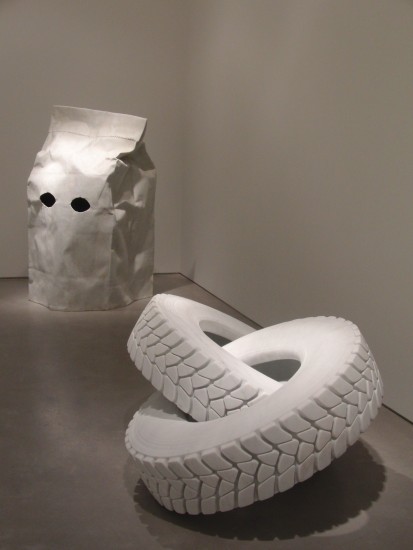
First and foremost, Ohio-born visual artist Ann Hamilton’s “the event of a thread” at Park Avenue Armory is fun, fun, fun. Visitors get to push each other on wooden swings that hang seventy feet from the ceiling of the vast Wade Thompson Drill Hall, the movements manipulating an enormous white cloth that dances with the manufactured wind, rising and falling like ocean waves and drifting like clouds, especially when viewed from below, lying on the floor underneath it. But there’s much more to this interactive site-specific commission, curator Kristy Edmunds’s final contribution as the institution’s artistic director. (Edmunds has played a major role in transforming the armory into one of the city’s most exciting spaces for experimental public art.) Hamilton’s multisensory shared experience is about warp and weft, speaking and listening, reading and writing, voice and gesture, music and memory; it’s about interdependence and multiple meanings; it’s about community, connection, crossing, concordance, and communication; and it’s about flying home. Hamilton weaves a different kind of social media web with “the event of a thread,” bringing people physically together to work as a unit to effect change. At the entrance to the hall, two members of Anne Bogart’s SITI Company, wearing bulky animal-hair coats, are seated at a table, reading carefully organized texts by Charles Darwin, Ralph Waldo Emerson, Aristotle, Susan Stewart, Ann Lauterbach, and others; their voices are broadcast via paper-bag radios scattered throughout the room (which visitors are encouraged to pick up and listen to). Also on the table are dozens of pigeons in small cages, waiting to be released at the end of the day so they can fly home to their roost as a performer sings. At the far end of the hall, a lone woman sits at a second table, writing letters with a pencil while watching the activities going on behind her via a mirror.

One of two readers recites from a concordance scroll as part of Ann Hamilton’s multisensory “the event of a thread” at Park Avenue Armory (photo by twi-ny/mdr)

Taking her title from the Encyclopaedia Brittanica article “Weaving, Hand” written by textile artist Anni Albers (wife of Josef Albers), Hamilton explores the nature of crossings, beginning with cross stitching. In an essay in the must-read newspaper that accompanies the project, Hamilton writes that “‘the event of a thread’ is made of many crossings of the near at hand and the far away: it is a body crossing space, is a writer’s hand crossing a sheet of paper, is a voice crossing a room in a paper bag, is a reader crossing with a page and with another reader, is listening crossing with speaking, is an inscription crossing a transmission, is a stylus crossing a groove, is a song crossing species, is the weightlessness of suspension crossing the calling of bell or bellows, is touch being touched in return. It is a flock of birds and a field of swings in motion. It is a particular point in space at an instant of time.” The work takes on yet another crossing when viewed from above; the armory usually does not allow visitors on the upper balcony level, but for “the event of a thread” people can walk up the stairs and stand parallel to the huge sheet, watching the intense pulley system lift and lower it in a thrilling marionette-like dance, comparing the men, women, and children on the swings, who are actually making the cloth move, to the unseen hand of a supreme being. With “the event of a thread,” Hamilton has created an awesome spectacle, a complex combination of elements that can be enjoyed in multiple ways.