this week in art

THE ART OF SCENT 1889-2012

(photo by twi-ny/mdr)

Fragrant exhibition at Museum of Arts and Design take visitors on an olfactory tour of the history of perfume (photo by twi-ny/mdr)

Museum of Arts and Design
2 Columbus Circle at 58th St. & Broadway
Through March 3
800-838-3006
www.madmuseum.org

A rather unique exhibit at the Museum of Arts & Design in Columbus Circle, one that truly “stinks,” has been extended through March 3. “The Art of Scent 1889-2012” collects twelve of the world’s most beloved, influential, and (in)famous perfumes, displaying them as if they were sculptures or paintings, firmly establishing them as individual works of art. Designed by the architectural firm Diller Scofidio + Renfro, the exhibition, the first major museum retrospective to elevate perfume in such a way, consists of a dozen stations along a wall, indentations where visitors put their head in and breathe in the fragrances, accompanied by an illuminated paragraph that appears then disappears, like the smells themselves, detailing the scent’s creator and development. Curated by Chandler Burr, the fragrances are arranged chronologically, following the changing trends in the industry, including the implementation of synthetic materials and modern technology. First up on the aromatic tour is Aimé Guerlain’s 1889 scent Jicky, which combines the terpene alcohol linalool, the chemical compound coumarin, and the flavorant ethyl vanillin; the text explains, “Though subtle in effect, the synthetics were both disorienting and liberating. By freeing olfactory artists from an exclusively natural palette, they turned scent into an artistic medium, and made Jicky one of the first true works of olfactory art.” Museumgoers will react differently to each scent as they get whiffs of Enest Beaux’s Chanel N°5, Pierre Wargnye’s Drakkar Noir, Annie Buzantian and Albert Morillas’s pleasures, Jean-Claude Ellena’s Osmanthe Yunnan, and Daniela Andrier’s disturbing Untitled, lent by such parfumeries as Hermès, Prada, L’Oréal, Clarins, Estée Lauder, Clinique, Guerlain, and other cosmetic companies. A second room delves into further detail about the creation of perfume with video interviews, a multipart evolution of one particular scent, and a table where visitors can dip strips into the actual liquid products and sample the real thing. The deluxe catalog ($285) includes eleven of the perfumes in printed glass vials — only Chanel chose not to participate — with each scent assigned to a different artistic discipline: Francis Fabron’s L’Interdit is considered abstract expressionism, Olivier Cresp’s Angel surrealism, Jacques Cavallier’s L’Eau d’issey minimalism, and Untitled post-brutalism. On February 13, MAD will host the special program “Technology and Innovation in Fine Fragrance,” with Burr and Rochas house perfumer Jean-Michel Duriez leading an interactive discussion in which attendees will be able to sniff-sample raw materials and complex fragrances.

LEO VILLAREAL: BUCKYBALL / HIVE

“Buckyball”: Mad. Sq. Art, Madison Square Park, through February 15
“Hive (Bleecker Street),” Bleecker St. 6 / Lafayette St. F interchange, permanent
www.villareal.net

Since the late 1990s, Leo Villareal has been creating eye-catching LED artworks using intricate computer programs. Born in New Mexico and based in New York City, where he graduated from NYU’s Interactive Telecommunications Program, Villareal has created site-specific projects for MoMA PS1, the Tampa Museum of Art, the National Gallery of Art, and BAM, where his five-part “Stars” continue to dance on the building’s facade. He currently has two more works dazzling New Yorkers, one aboveground, the other in the subway. In Madison Square Park, “Buckyball” is a thirty-foot-tall geodesic dome, containing a smaller dome, that uses math and geometry to produce a whirlwind of light and color. On view through February 15, “Buckyball,” inspired by and named for architect Buckminster Fuller, consists of 180 LED tubes that display 16 million pixelated colors shooting through them in endless random designs developed by Villareal’s unique software programming. “Buckyball” evokes the synapses of the brain as well as a slow-motion gyroscope, with very different effects as day turns into night. Be sure to recline on the special zero-gravity benches that proved the best angle for experiencing the meditative, mind-expanding piece.

Villareal used a honeycomb as inspiration for “Hive (Bleecker Street),” an LED sculpture commissioned by the MTA for the Bleecker St./Lafayette St. subway station. On a low ceiling by the new transfer point between the F and the 6, colored lights fill hexagonal tubes, almost like a living, breathing subway map with its own unique route. “Hive” was influenced by British mathematician John Horton Conway’s zero-player cellular automaton Game of Life, which evolves on its own as it deals with underpopulation, overcrowding, and unpredictability, sort of like the New York City subway system itself. Be sure to ride the escalator up to see the work slowly unfurl before you. While “Buckyball” will remain on view in the park through February 15, “Hive” is a permanent work that is part of the MTA’s Arts for Transit and Urban Design program.

CULTUREMART 2013

Bora Yoon collaborates with Adam Larsen and R. Luke DuBois in surreal WEIGHTS AND BALANCES (photo by James Chung)

Bora Yoon collaborates with Adam Larsen and R. Luke DuBois in surreal WEIGHTS AND BALANCES (photo by James Chung)

HERE
145 Sixth Ave. at Dominick St.
Through February 10, $10 in advance, $15 within twenty-four hours of show
212-647-0202
www.here.org

The HERE Artist Residency Program, known as HARP, is now in the second week of its annual Culturemart festival, consisting of unique, experimental works, often in double features, from emerging presenters in such disciplines as dance, theater, music, visual arts, and puppetry as well as a melding of several of them. On February 4-5, Mei-Yin Ng’s Lost Property Unit explores loneliness and solitude in the digital age, referencing television and movies through dance, live and prerecorded music, and robot sculptures, while in Hai-Ting Chinn’s Science Fair the mezzo-soprano combines opera with science in a multimedia performance. On February 6-7, Robin Frohardt’s The Pigeoning uses music and puppets to look at the end of the world, while Joseph Silovsky’s Send for the Million Men is a solo piece that reexamines the Sacco and Vanzettti case with puppets and handmade projectors. Also on February 6-7, Bora Yoon’s Weights and Balances is a surreal opera featuring an interactive performance design by R. Luke DuBois. On February 8-9, Stein / Holum Projects’ The Wholehearted is a work in progress about a woman boxer looking back at her glory days. On February 9 at 2:00, there will be a free performance of David T. Little’s opera-theater piece Artaud in the Black Lodge, which links Antonin Artaud, William S. Burroughs, and David Lynch through a libretto by Anne Waldman. The festival, which also celebrates HERE’s twentieth anniversary, concludes February 9-10 with HERE artistic director Kristin Marting and David Morris’s Trade Practices, a live, interactive market in which audience members become participants in the event.

CANSTRUCTION

Gensler & WSP Flack + Kurtz’s “CAN’s Best Friend” joins the fight against hunger at the World Financial Center (photo by twi-ny/mdr)

Gensler & WSP Flack + Kurtz’s “CAN’s Best Friend” joins the fight against hunger at the World Financial Center (photo by twi-ny/mdr)

World Financial Center Winter Garden
200 Vesey St.
Through February 10, free, 10:00 am – 6:00 pm
212-945-0505
www.worldfinancialcenter.com
www.sdanyc.org/canstruction
canstruction 2013 slideshow

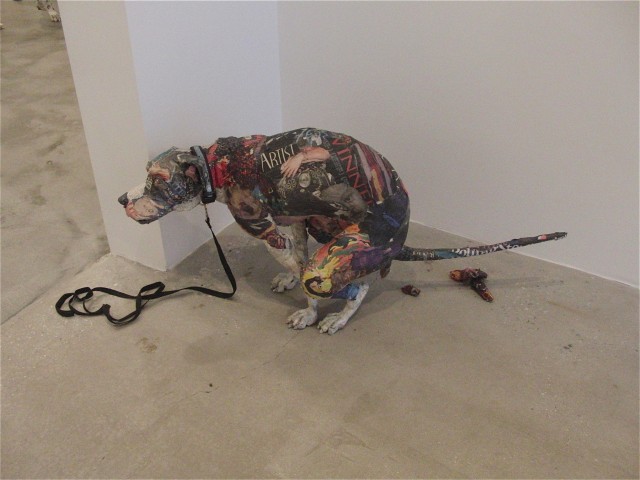
Sponsored by the Society for Design Administration, the annual Canstruction competition believes that “one can make a difference.” The twentieth anniversary of the charity event — visitors are asked to bring a can of high-quality, nonperishable food to donate, although it is not required — was delayed because of Hurricane Sandy, but it has now settled into the World Financial Center, where it will continue through February 11. This year there are two dozen entries fighting it out for such awards as Juror’s Favorite, Structural Integrity, Best Meal, Best Use of Labels, and the Cheri Award, named in honor of Canstruction founder Cheri Melillo, who passed away in 2009 at the age of sixty. Nearly 74,000 pounds of food were collected last year, resulting in an equal number of meals for hungry New Yorkers; the competition now takes place in more than one hundred cities around the world and has raised more than fifteen million pounds of food since it first began in 1992. Among the stand-outs at this year’s Canstruction — all of which are built in a single night using as many as four thousand cans and are best seen through a camera lens to get the full effect — are Severud Associates Consulting Engineers’ “CAN You Check Mate Hunger?,” three chess pieces that suggest taking “a tactical approach to fighting hunger”; WJE Engineers & Architects’ “New York Breakfast,” a giant Anthora coffee cup; DeSimone Consulting Engineers’ “Candroid,” a green android whose mission statement includes the Jimmy Carter quote “We know that a peaceful world cannot long exist one-third rich and two-thirds hungry”; Gensler & WSP Flack + Kurtz’s “CAN’s Best Friend,” a Jeff Koons-like large balloon dog made of cans of crabmeat and organic vegetables; Gilsanz Murray Steficek’s “If You Believe, They Put a CAN on the Moon,” a rocket and crescent moon that explains, “It’s one small step for a CAN, one giant leap against Hunger”; and the MTA’s “Can You Dig It?,” a construction worker helping build the Second Avenue subway. But the runaway star — and our choice to win big when the awards are announced on February 4 — is Leslie E. Robertson Associates’ “Topping Hunger,” a spinning top that seems to defy gravity. “In a world where hunger is seemingly spinning out of control,” its mission statement declares, “it is time to take a stand.”

FIRST SATURDAYS: AFRICAN INNOVATIONS

Unidentified Lega artist, “Three-Headed Figure (Sakimatwemtwe),” South Kivu or Maniema province, Democratic Republic of the Congo, wood, fiber, kaolin, nineteenth century (Brooklyn Museum, Museum Expedition 1922, Robert B. Woodward Memorial Fund)

Unidentified Lega artist, “Three-Headed Figure (Sakimatwemtwe),” South Kivu or Maniema province, Democratic Republic of the Congo, wood, fiber, kaolin, nineteenth century (Brooklyn Museum, Museum Expedition 1922, Robert B. Woodward Memorial Fund)

Brooklyn Museum
200 Eastern Parkway at Washington St.
Saturday, February 2, free, 5:00 – 11:00 (some events require free tickets distributed in advance at the Visitor Center)
212-864-5400
www.brooklynmuseum.org

The Brooklyn Museum celebrates Black History Month at February’s free First Saturdays program with a focus on the long-term installation “African Innovations,” which comprises approximately 200 works spread across 2,500 years. The evening will include live music by the Republic of Cameroon’s Kaïssa, the multinational Akoya Afrobeat, and Sierra Leone’s Bajah + the Dry Eye Crew, guided pop-up gallery tours, the debut of Zimbabwe dancer-choreographer Rujeko Dumbutshena’s Jenaguru, children’s workshops on traditional West African instruments and linguist staffs, a curator talk on “African Innovations” with Kevin D. Dumouchelle, the multimedia Afrika21 project, a screening of Africa Straight Up preceded by a discussion with Applause Africa, a fashion show with designs inspired by African textiles and music by Ethiopian DJ Sirak, and a book club discussion of Nigerian writer Chinua Achebe’s 1958 novel Things Fall Apart. Also on view at the museum now are “GO: a community-curated open studio project,” “Raw/Cooked: Duron Jackson,” and “Aesthetic Ambitions: Edward Lycett and Brooklyn’s Faience Manufacturing Company” as well as long-term installations and the permanent collection.

OUTSIDER ART FAIR 2013

The Outsider Art Fair will include a special exhibition dedicated to Renaldo Kuhler’s fantastical Rocaterrania

The Outsider Art Fair will include a special exhibition dedicated to Renaldo Kuhler’s fantastical Rocaterrania

Center 548
548 West 22nd St, between Tenth & Eleventh Aves.
January 31 – February 3, Thursday preview (6:00 – 9:00) $50, Friday – Sunday $20 per day, $30 run-of-show
www.outsiderartfair.com

For its twentieth anniversary, the Outsider Art Fair promises to be significantly different. Since 1993, the fair, dedicated to the work of emerging and well-known self-taught folk artists, was run by show master Sanford Smith, but art dealer Andrew Edlin, who runs his eponymously named gallery in Chelsea and whose uncle Paul Edlin was an outsider artist himself, has bought the fair with his new company, Under Wide Open Arts, and moved it from such previous locations as the Puck Building and 7 W 34th St. to the Dia Center of the Arts on West 22nd St., where NADA New York and the Independent now take place. More than three dozen galleries from around the world will be participating, including Haiti’s Galerie Bourbon-Lally, London’s Henry Boxer Gallery and Rob Tufnell, Tokyo’s Yukiko Koide Presents, Switzerland’s Galerie du Marché, Baton Rouge’s Gilley’s Gallery, Chicago’s Carl Hammer Gallery, Virginia’s Grey Carter-Objects of Art, Berkeley’s Ames Gallery, Dallas’s Chris Byrne, Miami’s Pan American Art Projects, and Iowa City’s Pardee Collection, along with such local mainstays as Ricco Maresca, Fountain Gallery, American Primitive, Feature Inc., Gary Snyder, Vito Schnabel, Galerie St. Etienne, and, of course, Andrew Edlin. Among this year’s special programs are a series of talks and panel discussions, including “Voyages” with Geneviève Roulin Tribute recipient Mario Del Curto on Friday at 4:00, “Rewriting the History of Art Brut: The Case of Gaston Chaissac” with Dr. Kent Minturn on Friday at 4:45, a Saturday-morning “Uncommon Artists” symposium at the American Folk Art Museum, “Women’s Mad Art” with Dr. Thomas Röske and “Agnes Richter’s Jacket: Enigma, Talisman, Narrative” with Dr. Gail A. Hornstein on Saturday at 4:00, and “A Bridge Between Art Worlds” with Daniel Baumann, Massimiliano Gioni, and Ralph Rugoff on Sunday at 4:00. In addition, the Geneviève Roulin Tribute to Mario Del Curto will take place Thursday at 6:00 as part of the early preview; an exhibition of twelve of Del Curto’s photographs will be on view on the second floor during the fair, along with the special exhibition “Renaldo Kuhler & Rocaterrania.”

ALINA SZAPOCZNIKOW: SCULPTURE UNDONE, 1955–1972

Alina Szapocznikow, “Petit Dessert I (Small Dessert I),” colored polyester resin and glass, 1970–71 (© The Estate of Alina Szapocznikow/Piotr Stanisławski/ADAGP, Paris. Photo by Thomas Mueller, courtesy Broadway 1602, New York, and Galerie Gisela Capitain GmbH, Cologne)

Alina Szapocznikow, “Petit Dessert I (Small Dessert I),” colored polyester resin and glass, 1970–71(© The Estate of Alina Szapocznikow/Piotr Stanisławski/ADAGP, Paris. Photo by Thomas Mueller, courtesy Broadway 1602, New York, and Galerie Gisela Capitain GmbH, Cologne)

Museum of Modern Art, Special Exhibitions Gallery, third floor
11 West 53rd St. between Fifth & Sixth Aves.
Through January 28
Museum admission: $25 ($12 can be applied to the purchase of a film ticket within thirty days)
212-708-9400
www.moma.org

It would be a mistake to categorize the work of Alina Szapocznikow as a morbid depiction of suffering and death because the Polish sculptor spent time in three Nazi concentration camps and ultimately died of cancer at the age of forty-seven. Instead, “Alina Szapocznikow: Sculpture Undone, 1955–1972,” continuing at MoMA through January 28, calls for a reexamination of this forward-thinking experimental artist. Comprising more than one hundred sculptures, drawings, and photographs, the exhibition reveals Szapocznikow to be well ahead of her time, belonging in the same canon as such influential artists as Hannah Arendt, Lynda Benglis, and Eva Hesse. “Spanning one of the most rich and complex periods of the twentieth century, Szapocznikow’s oeuvre responded to many of the ideological and artistic developments of her time,” write Elena Filipovic and Joanna Mytkowska in the introduction to the exhibition catalog. “Still, as a sculptor who emerged during the postwar period working in a classical figurative manner, Szapocznikow’s later conception of sculpture shifted considerably, leaving behind a legacy of provocative objects — at once sexualized, fragmented, vulnerable, humorous, and political — that sit uneasily between Surrealism, Nouveau Réalisme, and Pop art.”

Alina Szapocznikow, “Souvenirs,” polyester resin and photographs, 1967 (the Estate of Alina Szapocznikow/Piotr Stanisławski)

Alina Szapocznikow, “Souvenirs,” polyester resin and photographs, 1967 (the Estate of Alina Szapocznikow/Piotr Stanisławski)

Primarily using polyester resin — along with polyurethane foam, photographs, nylon stockings, bronze, newspaper, wood, metal, and even cigarettes — Szapocznikow, who spent much of her professional life in Paris, cast works based on her own body as well as those of models and her adopted son, resulting in a compelling collection of breasts, hands, legs, torsos, heads, and mouths that stand on pedestals or hang on the wall. In “Petit Dessert I (Small Dessert I),” the lower half of a woman’s face, lips slightly apart, sits in a glass dish, a yellow blob oozing over the side. “Goldfinger,” a direct riff on the James Bond villain, is an upside-down figure, the head and lower body connected by a car part, all bathed in gold. “Femme illuminée (Illuminated Woman)” is a five-foot-high plaster woman with extremely long legs, her breasts cupped in red resin, her neck leading to a large, amorphous mass of other colored resin. “Lampe-bouche (Illuminated Lips)” is just that, a collection of lip lamps that actually light up. And “Dłoń. Projekt Pomnika Bohaterów Warszawy II (Hand. Monument to the Heroes of the Warsaw Ghetto)” is a deformed hand made of patinated plaster and iron filings, its fingers reaching out, trying desperately to grasp something. Szapocznikow’s works range from charming, funny, and playful to dark, scary, and mysterious, often in the same piece. “Sculpture Undone” is a compelling journey through the life and career of an intriguing artist deserving of more attention. The show is supplemented by short video documentaries on the artist by Krzystof TchóRzewski, Jean-Marie Drot, and Helena Wlodarczyk, and MoMA has posted on the exhibition website the three-hour symposium that was held on Szapocznikow back in October.