this week in art

BLUES FOR SMOKE

Rodney McMillian, “Asterisks in Dockery,” mixed-media installation, 2012 (photo by Sheldan C. Collins)

Rodney McMillian, “Asterisks in Dockery,” mixed-media installation, 2012 (photo by Sheldan C. Collins)

Whitney Museum of American Art
945 Madison Ave. at 75th St.
Wednesday – Sunday through April 28, $14-$18 (pay-what-you-wish Fridays, 6:00 – 9:00)
212-570-3600
www.whitney.org

In 1960, jazz pianist and composer Jaki Byard released his solo debut, Blues for Smoke, an improvisatory record that features on its cover a train puffing out dark clouds as it makes its way down the tracks. The album lends its name to an exciting multimedia exhibit at the Whitney that examines the impact of the blues on the arts. The show is highlighted by David Hammons’s extraordinary 1989 installation, “Chasing the Blue Train,” which greets visitors on the third floor. A blue train makes its way across tracks that take it through a tunnel covered in coal and a landscape with upturned piano tops as John Coltrane’s 1957 Blue Train album plays from a boom box, the work riffing on Coltrane’s name (coal, train) while celebrating the blues. Zoe Leonard’s “1961, 2002-Ongoing” consists of a row of suitcases of different shades of blue, evoking impermanence and creating a mystery about what might be inside; nearby, Martin Kipperberger’s “Martin, into the Corner, You Should Be Ashamed of Yourself” is a life-size replica of the artist standing in the corner, suffering from a case of the blues. Specially commissioned for the show, Kori Newkirk’s “Yall” consists of a shopping cart nearly completing a circle of blue on the floor, calling to mind exclusion, homelessness, and failed capitalism. Kira Lynn Harris lines a stairwell and entrance with silver Mylar in “Blues for Breuer,” paying tribute to the architect of the Whitney building, which will be taken over by the Met in 2015 when the Whitney moves downtown.

Installation view, Blues for Smoke (photo by Sheldan C. Collins)

Works by Martin Wong, Martin Kipperberger, Zoe Leonard, and others form a blues aesthetic at the Whitney (photo by Sheldan C. Collins)

Curated by Bennett Simpson in consultation with Chrissie Iles, “Blues for Smoke” also features works by Romare Bearden, Carrie Mae Weems, Glenn Ligon, Liz Larner, Jean-Michel Basquiat, Rachel Harrison, Mark Morrisroe, Alma Thomas, Beauford Delaney, Kara Walker, William Eggleston, and Lorraine O’Grady, all contributing to the overall examination of the blues aesthetic. A media room includes viewing stations where people can watch classic performances, while Stan Douglas’s “Hors-champs” plays continuously in its own space on the first floor, offering a unique view of a live recording on the front and back of a screen hanging from the ceiling. In addition, the Whitney is hosting a series of live events that continue through the end of the exhibition, which closes April 28, including “Blues for Smoke: Matana Roberts, Keiji Haino, and Loren Connors” on April 20 at 8:00 (featuring a solo performance by Roberts and a duo guitar improvisation by Haino and Connors), “Through the Lens of the Blues Aesthetic: An Evening of Short Films Selected by Kevin Jerome Everson” on April 25 at 7:00, the live concert “Blues for Smoke: Annette Peacock” on April 26 at 7:00, and the three-day “Blues for Smoke: Thomas Bradshaw,” in which the playwright will be creating a new piece that will be shown April 26-28.

CHELSEA ART WALK SPRING 2013

Hauser & Wirth inaugurates new space with Dieter Roth show (photo by twi-ny/mdr)

Hauser & Wirth inaugurates new space with Dieter Roth show (photo by twi-ny/mdr)

On the fifteenth anniversary of his death at age sixty-eight, the work of eclectic German-born Swiss artist Dieter Roth and his son inaugurates Hauser & Wirth’s vast new space on West Eighteenth St. while also celebrating the gallery’s twentieth anniversary. “Dieter Roth. Björn Roth” (through April 13) includes paintings, assemblages, and installations using such objects as chocolate, bananas, sugar, toys, and Dieter’s actual clothes. Organized by Dieter’s son, Björn, and grandsons, Oddur and Einar, the exhibit also features 128 monitors showing Dieter at work, a tower of colorful sugar figures, another tower of chocolate figures that are slowly degrading, the floor from Dieter’s Iceland studio, a kitchen loaded with myriad objects, and a bar that serves free espresso on set days.

John Dubrow, “Standing Playground, Early Summer,” oil on linen, 2012-13

John Dubrow, “Standing Playground, Early Summer,” oil on linen, 2012-13 (© John Dubrow)

In “John Dubrow: Recent Work” (April 20) at Lori Bookstein, the Massachusetts-born, New York City-based painter once again displays his marvelous skill and astonishing facility with color in a series of outdoor scenes along with three portraits. Dubrow often applies paint thickly with a palette knife, blurring faces in such canvases as “Church and Reade,” “Standing Playground, Early Summer,” “Bleecker Playground,” and “Hudson River Park,” incorporating areas of reds, blues, greens, and yellows that are worth examining up close.

Wayne Gonzales explores a California parking lot (photo by twi-ny/mdr)

Wayne Gonzales takes multiple views of a California parking lot in compelling new series (photo by twi-ny/mdr)

For the eponymous “Wayne Gonzales” (April 27) at Paula Cooper, the New Orleans-born, New York City-based artist explores a California parking lot in photorealistic acrylic paintings that go from black-and-white to blue, gray, and deep yellow, zooming in and out of focus on cars, playing with time and space as he depicts the same area from just a slightly different angle or distance, some of the cars still there, others gone and replaced by new ones.

Helen Frankenthaler, “Untitled,” oil and enamel on canvas, 1951 (© 2013 Estate of Helen Frankenthaler/Artists Rights Society [ARS], New York)

Helen Frankenthaler, “Untitled,” oil and enamel on canvas, 1951 (© 2013 Estate of Helen Frankenthaler/Artists Rights Society [ARS], New York)

Last week, the line ran nearly the length of Twenty-Fourth St. between Tenth & Eleventh Aves. to get a last look at Gagosian’s terrific “Jean-Michel Basquiat” exhibition. This week you should expect long lines for the final days of the revelatory “Painted on 21st Street: Helen Frankenthaler from 1950 to 1959” (April 13) at Gagosian’s Twenty-First St. space, comprising nearly thirty works that shed light on an extraordinary decade in Frankenthaler’s career. Curated by MoMA’s John Elderfield, the show features such energetic and lovely paintings and stained canvases as “The Jugglers,” “Open Wall,” and the spectacular title work, which deservedly greets visitors on its own wall by the entrance. A native New Yorker, Frankenthaler, who died in 2011 at the age of eighty-three, left behind a unique legacy highlighted by her own take on abstract expressionism.

Dana Melamed’s “Duality of Matter” is filled with haunting wall pieces (photo by twi-ny/mdr)

Dana Melamed’s “Duality of Matter” consists of haunting wall pieces (photo by twi-ny/mdr)

In “Duality of Matter” (April 13) at Von Lintel, Israeli-born artist Dana Melamed creates miniature ghostlike scenes that hang on the walls, sculptures made of transparency film, paper, pencil shavings, charcoal, wire, acrylic paint, recycled industrial components, and aluminum mesh on which Melamed, who lives in New Jersey and works in New York City, uses a blowtorch. The resultant pieces are like abandoned ghost towns that combine construction and deconstruction, examining, in Melamed’s words, “human aggression towards humanity and towards nature.”

Will Kurtz, “Another Shit Show” (photo by twi-ny/mdr)

Will Kurtz’s “Another Shit Show” is filled with dog droppings (photo by twi-ny/mdr)

Making our way through Will Kurtz’s “Another Shit Show” (April 27) at Mike Weiss reminds us of heading across East Thirty-Fifth St. every morning, navigating between dog droppings that negligent canine owners have carelessly left on the sidewalk. The Brooklyn-based artist’s second solo show centers on “Linda the Dog Walker,” an old hippie woman walking a half dozen pooches in the back of the gallery, which is filled with more than a dozen other dogs as well, each made of wood, glue, wire, and carefully chosen newspaper articles.

Matsutani, “Gutai Spirit Forever” (photo by twi-ny/mdr)

Takesada Matsutani, “Gutai Spirit Forever,” installation view (photo by twi-ny/mdr)

Takesada Matsutani, who is represented in the Guggenheim’s truly splendid “Gutai: Splendid Playground” exhibition, is currently also enjoying his first U.S. retrospective, “Gutai Spirit Forever: Part 2, Works from 1977-2012” (April 20) at Galerie Richard. The second half of the show features abstract, monochromatic works from the last thirty-six years in addition to a central installation in which graphite drips onto a block and cloth on the floor.

Dyed water pours down from above in Miroslav Balka’s “The Order of Things” (photo by twi-ny/mdr)

Dyed water pours down from above in Miroslaw Balka’s “The Order of Things” (photo by twi-ny/mdr)

There’s a beautiful sound emanating from behind the closed door at Gladstone, where Miroslaw Balka’s “The Order of Things” continues through April 20. It sounds like a waterfall, but in fact it’s more than five thousand gallons of dyed-black water rushing from two pumps dangling from the ceiling and into a pair of huge steel vats reminiscent of Richard Serra’s slabs. There’s a small wooden seat in the front where viewers can sit and contemplate what is occurring before them, an installation in which the Warsaw sculptor invites visitors to contemplate the past, present, and future, industry and nature, and art itself.

FIRST SATURDAY — “WORKT BY HAND”: HIDDEN LABOR AND HISTORICAL QUILTS

Elizabeth Welsh, “Medallion Quilt,” cotton, circa 1830 (Brooklyn Museum, Gift of the Roebling Society)

Elizabeth Welsh, “Medallion Quilt,” cotton, circa 1830 (Brooklyn Museum, Gift of the Roebling Society)

Brooklyn Museum
200 Eastern Parkway at Washington St.
Saturday, April 6, free, 5:00 – 11:00 (some events require free tickets distributed in advance at the Visitor Center)
212-864-5400
www.brooklynmuseum.org

The Brooklyn Museum celebrates the recent opening of “‘Workt by Hand’: Hidden Labor and Historical Quilts,” which examines the craft and culture behind approximately three dozen masterpieces from the collection, at the April free First Saturday program. There will be live performances by Jessy Carolina & the Hot Mess, Adia Whitaker and Ase Dance Theater Collective, Jesse Elliott (These United States) and friends, and Brooklyn Ballet, which will present Quilt with violinist Gil Morgenstern. Elizabeth A. Sackler Center for Feminist Art curator Catherine Morris will give a talk on “‘Workt by Hand,’” Robyn Love will share her knitting project “SpinCycle,” there will be a screening of Barbara Hammer and Gina Carducci’s Generations, followed by a Q&A with Carducci, a felt collage workshop, a book club discussion with Bernice McFadden about her latest novel, Gathering of Waters, and a zine-making cookbook workshop with Brooklyn Zine Fest and Malaka Gharib and Claire O’Neil of The Runcible Spoon. In addition, the galleries will remain open late so visitors can check out “LaToya Ruby Frazier: A Haunted Capital,” “Käthe Kollwitz: Prints from the ‘War’ and ‘Death’ Portfolios,” “Fine Lines: American Drawings from the Brooklyn Museum,” “Gravity and Grace: Monumental Works by El Anatsui,” “Raw/Cooked: Marela Zacarias,” “Aesthetic Ambitions: Edward Lycett and Brooklyn’s Faience Manufacturing Company,” and more.

JEAN-MICHEL BASQUIAT

Jean-Michel Basquiat, “Untitled (Two Heads on Gold),” acrylic and oil paintstick on canvas, 1982 (© the Estate of Jean-Michel Basquiat/ADAGP, Paris, ARS, New York 2013)

Jean-Michel Basquiat, “Untitled (Two Heads on Gold),” acrylic and oil paintstick on canvas, 1982 (© the Estate of Jean-Michel Basquiat/ADAGP, Paris, ARS, New York 2013)

Gagosian Gallery
555 West 24th St. between Tenth & Eleventh Aves.
Through April 6, free, 10:00 am – 6:00 pm
212-741-1111
www.gagosian.com

You can expect tremendous crowds Friday and Saturday at Gagosian’s West 24th St. space as the blockbuster “Jean-Michel Basquiat” exhibition comes to a close. Eight years ago, the Brooklyn Museum presented the revelatory, chronological “Basquiat,” which cast the street-artist-turned-Warhol-progeny in a whole new spotlight, displaying his awe-inspiring talent from his early days as a graffiti artist to his drug-addled, rambling final canvases prior to his overdose death in 1988 at the age of twenty-seven. This show comes as financial interest in Basquiat is reaching new peaks, with an untitled 1981 work selling for $16.3 million at Phillips de Pury & Company last year and the Wall Street Journal reporting that the Brooklyn-born artist’s 1982 “Dustheads” will be auctioned at Christie’s next month for an expected $25-$35 million. The Gagosian show consists of nearly fifty paintings, hung conceptually, with each work getting plenty of breathing room, the better to be enjoyed both on its own merits and in context of the glam punk’s greater oeuvre. The museum-quality exhibition highlights Basquiat’s bold, brash sense of color and often violent brushstrokes along with his intriguing use of words and language, his love of jazz and boxing, and such repeated imagery as crowns, halos, and the copyright symbol.

There’s both an anger and a primitivism in his work that continues to draw a diverse, still-growing audience: We feel his pain; we understand his desperate need to express himself. Basquiat is that rare street artist whose work still manages to come alive in a gallery or museum setting, whether on canvas, a door, or a wooden fence. In pieces such as “La Hara” and “Untitled (Two Heads on Gold),” the abstract characters seem to jump off the canvas as if living, breathing figures. Words instantly imbued with meaning leap out at us in such canvases as “In Italian” (“sangre,” “liberty,” “blood,” “teeth,” “corpus”) and “Revised Undiscovered Genius of the Mississippi Delta” (“Mark Twain,” “Negroes,” “Udder,” “Cotton,” “The Deep South,” “El Raton”). Sneaker prints hover in the background of “Eyes and Eggs,” as if Basquiat stepped over his depiction of a short-order cook. All these years later, we still see Basquiat as one of us, speaking for the disenfranchised, the forgotten, the poor, the trod upon, someone who rose out of the streets, perhaps like any of us can, despite his tragic end. The Gagosian show presents Basquiat as a graffiti poet and a jazz musician, emitting dazzling sounds and rhythms that move the heart and soul.

SCOTLAND WEEK 2013

David Eustace’s captivating “Highland Heart” exhibit will be on view at Hudson Studios April 5-7 (© David Eustace)

David Eustace’s captivating “Highland Heart” exhibit will be on view at Hudson Studios April 5-7 (© David Eustace)

SCOTLAND WEEK / TARTAN WEEK
Multiple venues
Through April 21
www.scotland.org
www.scotlandshop.com

The sixth annual Scotland Week, also known as Tartan Week, kicks into high gear this weekend, celebrating Scottish art and culture with a diverse group of events taking place all over the city. On Friday, former minesweeper and prison guard David Eustace will unveil a new collection of photographs, “Highland Heart,” stunning black-and-white images of the Western Islands, at Hudson Studios in Chelsea. On Saturday morning at 8:00, some ten thousand people are expected to take part in the 10K Scotland Run in Central Park, followed by the Kirkin o’ the Tartan and Pre-Parade Brunch at the Church of Our Saviour and the Tartan Day Parade, which will make its way up Sixth Ave. from Forty-Fifth to Fifty-Fifth Sts. with bagpipers, Scottish clans, music groups, Scottish terriers, and more. On Saturday night, the Caledonia Collective at Webster Hall will consist of Stanley Odd, Rachel Sermanni with Louis Abbott of Admiral Fallow, and Breabach. Stanley Odd will also share a bill with the View Saturday night at the Knitting Factory and Sunday night at Bowery Ballroom. On April 7, Alan Cumming begins a three-month Broadway run starring as the title character in the one-man National Theatre of Scotland production of Macbeth, set in a mental ward. On April 8, Scottish fashion will be on display at “From Scotland with Love: The Scottish Lion Meets the Asian Dragon,” a cocktail party and fashion show at Stage 48. On April 9, Ian Gow, curator of the National Trust for Scotland, will receive the Great Scot Award at the black-tie “Celebration of Scotland’s Treasures” dinner at the Metropolitan Club. On April 12, Ken Loach’s Cannes Jury Prize winner The Angels’ Share opens at Lincoln Plaza and the Landmark Sunshine. And on April 14, the Scottish Ensemble, a string orchestra highlighted by trumpeter Alison Balsom, will perform at Town Hall with a program that includes the U.S. premiere of James MacMillan’s “Seraph.” A h-uile la sona dhuibh ’s gun la idir dona dhuibh!

HEARD•NY: NICK CAVE

Nick Cave’s “Heard•NY” transforms Vanderbilt Hall into a performance petting zoo (photo by twi-ny/mdr)

Nick Cave’s “Heard•NY” transforms Vanderbilt Hall into a performance petting zoo (photo by twi-ny/mdr)

Grand Central Terminal, Vanderbilt Hall
89 East 42nd St. between Lexington and Vanderbilt
Daily crossings at 11:00 and 2:00, tours at 3:30 through March 31
www.creativetime.org
heard•ny rehearsal slideshow
heard•ny performance slideshow

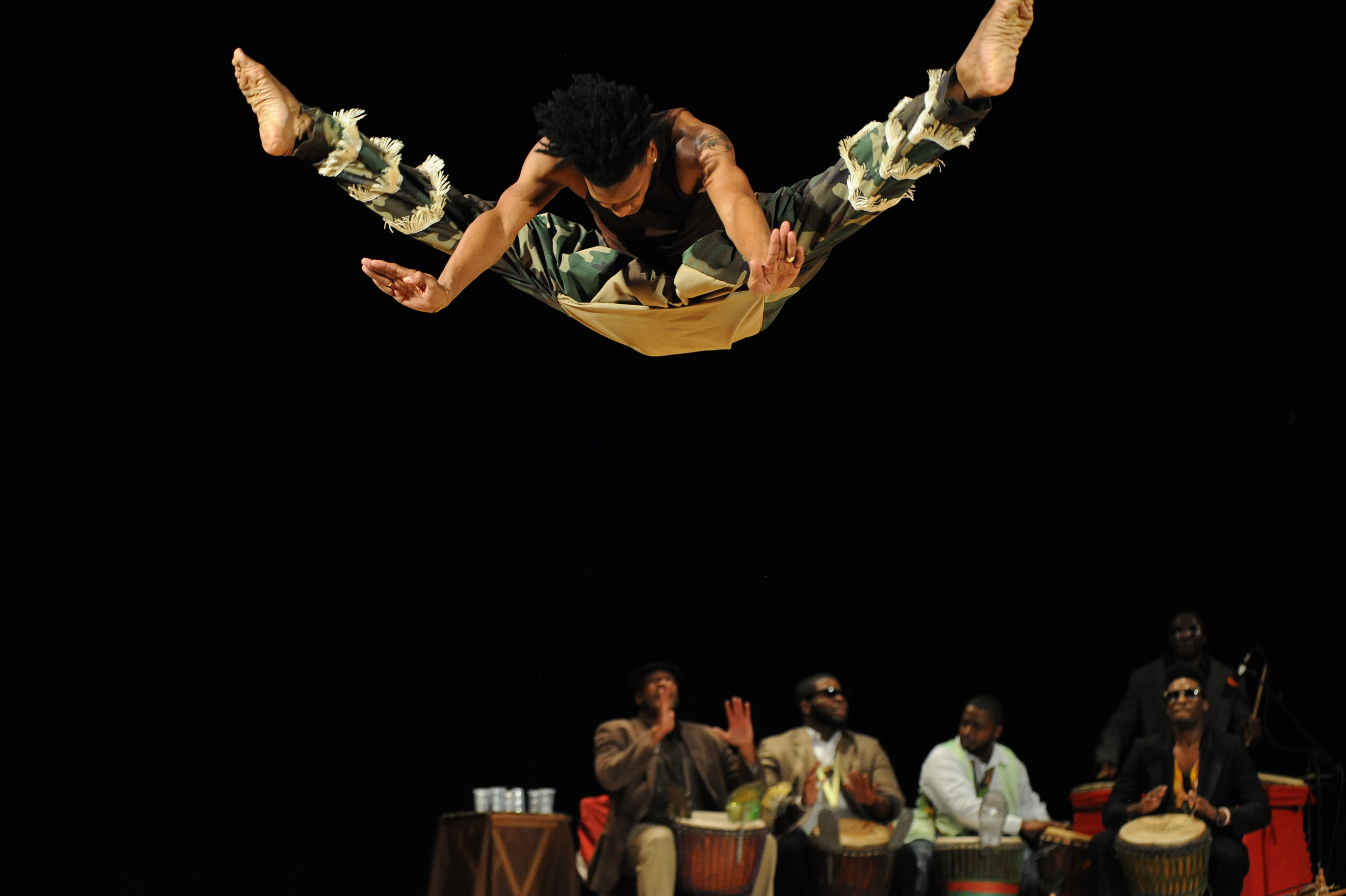
Artist Nick Cave has transformed Grand Central Terminal’s Vanderbilt Hall into a unique and wonderful petting zoo like none other. The Missouri-based Cave, who makes colorful, life-size Soundsuits out of found and recycled materials, has created a menagerie of exotic horses for “Heard•NY,” which continues as part of GCT’s centennial celebration through March 31. On each roped-in side of Vanderbilt Hall, Cave has placed fifteen horses on saw horses. Each day at 11:00 and 2:00, the saw horses are removed and student dancers from the Ailey School march into the area and get inside the horse suits, two dancers per animal. They then parade around the periphery of the rectangle, allowing onlookers to take photographs and to pet them, before commencing a dance choreographed by Cave and William Gill, set to music played by a harpist and a percussionist. The horses stomp their hooves, proudly lift their heads, kick out, and form trios, then meet at the center, where the dancer in the back of the animal separates from the front, forming a collection of multicolored cheerleaders, evoking psychedelic Cousin Itts, who spin around, fall to the ground, and then get back inside their respective horses and eventually return the Soundsuits to their saw horse, although they no longer look like costumes but living and breathing horses taking a break until the next performance. It’s a great deal of fun, a playful riff not only on the perpetually busy and crowded Grand Central Terminal — where so many people are always in a rush, never stopping to enjoy the wonders around them — but also the concept of zoos themselves, where animals are put on display for the enjoyment of humans. Show up about a half hour before showtime to get a good spot, because it fills up quickly and often reaches capacity; one of the four sides of each corral is reserved for children so kids don’t have to compete with adults for a better view. Each performance, which is free, takes about twenty to twenty-five minutes and is an absolute charmer not to be missed.

WK 360 CLOSING EVENT + ARTIST TALK + GIVEAWAY

WK 360: A MID-CAREER SURVEY DOCUMENTING 25 YEARS
Jonathan LeVine Gallery
557 West 23rd St. between Tenth & Eleventh Aves.
Saturday, March 30, free, 4:00-6:00
212-243-3822
www.jonathanlevinegallery.com
www.wkinteract.com

French-born, New York-based street artist WK Interact has been creating perpetual-motion-intensive black-and-white site-specific works for a quarter of a century, interacting with urban environments around the world. His swirling, sprawling manipulated photocopy projects, like his 2011 “Project Brave” tribute in Brooklyn to the heroes of 9/11 on the tenth anniversary of the tragedy, can be found on walls and buildings as well as in art galleries. His latest show, “WK 360: A Mid-career Survey Documenting 25 Years,” comes to a close at Jonathan LeVine’s pop-up gallery on West 23rd St. in Chelsea on Saturday, and it’s going out in a big way. Starting at 4:00, all guests will receive a free copy of the exhibition catalog. At 5:00, WK will give an artist talk, and he will also sign copies of his monograph and a 30×40-inch map (both available for purchase) of the locations of his artwork in Lower Manhattan over the years.