this week in art

AMERICAN DARKNESS: GREGORY CREWDSON AND O. WINSTON LINK

O. Winston Link, “Ghost Town, Stanley, VA, silver gelatin print, 1957 (courtesy Danziger Gallery)

O. Winston Link, “Ghost Town, Stanley, VA, silver gelatin print, 1957 (courtesy Danziger Gallery)

Danziger Gallery
527 West 23rd St. between Tenth & Eleventh Aves.
Tuesday – Friday through June 14, 11:00 am – 6:00 pm, free
212-629-6778
www.danzigergallery.com

In 1955, Brooklyn-born engineer and commercial photographer O. Winston Link began a five-year period in which he documented the last large steam-powered locomotives in America, granted special access by the president of the Norfolk & Western Railway. Primarily using a Graphic View 4×5 camera with custom-built flash equipment, Link took stunning nighttime shots of trains as they made their way through Virginia, West Virginia, Maryland, and North Carolina, in carefully constructed tableaux that beautifully define 1950s America. Link served as a major influence on another Brooklyn-born photographer, Gregory Crewdson, whose own abilities at setting up cinematic scenes in large-scale pictures was detailed in the excellent 2012 documentary Gregory Crewdson: Brief Encounters. Crewdson was so enamored of Link and his story that he brought him in to his Yale MFA class to talk to his students about his oeuvre; Crewdson is now taking part in a different kind of conversation with Link, called “American Darkness,” continuing at Chelsea’s Danziger Gallery through June 14.

Gregory Crewdson, “Untitled (RVS Automotic),” pigment print, 2007 (courtesy Danziger Gallery / Gagosian Gallery)

Gregory Crewdson, “Untitled (RVS Automotive),” pigment print, 2007 (courtesy Danziger Gallery / Gagosian Gallery)

The show includes sixteen black-and-white photographs by Link primarily depicting trains chugging across a bridge over a swimming hole where kids are playing (“Hawksbill Creek Swimming Hole,” Luray, Virginia, 1956), passing by a sign that boldly declares “Water” (“Highball for the Double Header,” Roanoke, Virginia, 1959), rumbling past a gas station where a couple in a convertible watches the attendant fill the tank (“Sometimes the Electricity Fails,” Vesuvius, Virginia, 1956), and speeding behind a drive-in movie theater where an onscreen airplane is seemingly flying right toward it (“NW1103 Hot Shot East Bound,” Laeger, West Virginia, 1954). The 16×20 or 20×16 silver gelatin prints, most of which feature ghostly plumes of smoke rising into the air, are accompanied by a trio of large-scale photos by Crewdson in the back room, works that echo Link’s pictures in mood, setting, and lighting, although Crewdson’s are far more stylized, like scenes from a movie that was never made. Railroad tracks can be seen fading off in the right side of “Untitled (Dispatch),” an unattainable escape route for a woman standing alone in a parking lot near a trio of taxis. A group of kids hang around central, horizontal tracks in a rural town in “Untitled (Railway Children).” And a man sits by himself on a street corner, with the clouds at the top of the photo reminiscent of steam from a train, in “Untitled (RBS Automotive).” Crewdson titled the show from a quote from Pauline Kael’s review of David Lynch’s 1986 film, Blue Velvet, in which she wrote, “This is American darkness — darkness in color, darkness with a happy ending.” That same kind of darkness permeates these photos, which reunite a pair of truly American artists who capture the spirit of the country in similar yet unique ways.

MUSEUM MILE FESTIVAL 2013

Museum Mile Festival attendees can get a sneak peek at El Museo del Barrio’s “La Bienal 2013: Here Is Where We Jump, which includes Edgar Serrano’s “A dios” (acrylic and latex on canvas, 2012 / photo courtesy of the artist)

Museum Mile Festival attendees can get a sneak peek at El Museo del Barrio’s “La Bienal 2013: Here Is Where We Jump, which includes Edgar Serrano’s “A dios” (acrylic and latex on canvas, 2012 / photo courtesy of the artist)

Multiple locations on Fifth Ave. between 82nd & 105th Sts.
Tuesday, June 11, 6:00 – 9:00 pm
Admission: free
www.museummilefestival.org

Several uptown museums will be opening their doors for free as part of the thirty-fourth annual Museum Mile Festival, taking place Tuesday night, June 11, from 5:45 to 9:00. Fifth Ave. will be filled with live performers and family-friendly activities between 82nd & 104th Sts., including chalk drawing, face painting, Sammie & Tudie’s Imagination Playhouse, the Little Orchestra Society, Silly Billy the Very Funny Clown, Isle of Klezbos, Magic Brian, various DJs, and more. The participating museums (with at least one of their current shows listed here) include El Museo del Barrio (“La Bienal 2013: Here Is Where We Jump”), the Museum of the City of New York (“A Beautiful Way to Go”), the Jewish Museum (“Six Things: Sagmeister & Walsh,” “Jack Goldstein x 10,000”), the National Academy (“Jeffrey Gibson: Said the Pigeon to the Squirrel,” “Pat Steir: Blue River”), the Guggenheim (“New Harmony: Abstraction Between the Wars, 1919-1939”), the Neue Galerie (“Koloman Moser: Designing Modern Vienna 1897-1907”), and the Metropolitan Museum of Art (“Photography and the American Civil War,” “The Civil War and American Art”), along with the Goethe-Institut (which has moved downtown), the Museum for African Art (which is building a new home), and the Cooper-Hewitt, National Design Museum (which is currently undergoing renovation). Don’t try to do too much, because it can get rather crowded; just pick one or two exhibitions in one or two museums and enjoy.

ELLSWORTH KELLY AT NINETY / SINGULAR FORMS / CHATHAM SERIES

Mnuchin

Ellsworth Kelly, “Blue Curves,” oil on canvas, 2009 (photo courtesy Mnuchin gallery)

Matthew Marks Gallery, 502 West 22nd St., 522 West 22nd St., 523 West 24th St., through June 29
Mnuchin Gallery, 45 East 78th St., through June 8
Museum of Modern Art, through September 8

On May 31, one-of-a-kind artist Ellsworth Kelly turned ninety as his home state of New York honored him with a series of wonderful exhibits across the city. The thoughtfully curated shows celebrate Kelly’s unique perspective on line, form, and color, giving his hard-edge paintings and sculptures room to breathe and allowing visitors to experience their many simple pleasures. At Mnuchin Gallery on the Upper East Side, “Singular Forms 1966-2009” (extended through June 8) features the former WWII Ghost Army soldier’s first shaped canvas, 1966’s “Yellow Piece,” which has a playfulness to it that is hard not to smile at. But even more enjoyable is the smart placement of the 2009 oil painting “Blue Curves,” which greets visitors as they enter Mnuchin, the “B”-like canvas immediately visible through an opening and hanging on a wall between two doors; unsurprisingly, the show was curated by Kelly himself. The nine works at Mnuchin also include the weathered steel totem “Curve XI,” the painted aluminum “Red Panel,” and the oil-on-linen “Green Panel,” an engaging group of works that cover five decades.

(photo by twi-ny/mdr)

Ellsworth Kelly’s “Chatham Series” is back together for the first time since 1972 (photo by twi-ny/mdr)

At MoMA, “Ellsworth Kelly: Chatham Series” (through September 8) comprises the artist’s first suite of paintings following his 1970 move from New York City to upstate Spencertown, where he is still based. The exhibit brings together all fourteen canvases, each of which consists of two panels in different colors and slightly different sizes, forming an inverted “L.” Laid out across rooms that allow each piece its own wall, the show exemplifies the very essence of Kelly’s oeuvre, as form and color combine in substantive ways without feeling repetitive or boring. Around the corner from “Chatham Series” is “Ellsworth Kelly: Line Form Color,” a collection of forty works on paper Kelly produced in Paris in 1951 that serve as a kind of primer to the artistic vocabulary he would expand upon over the years.

(photo by twi-ny/mdr)

Ellsworth Kelly, “Curves on White (Four Panels),” oil on canvas, four paintings, each composed of two joined panels, 2011 (photo by twi-ny/mdr)

Matthew Marks dedicates all three of its Chelsea spaces to “Ellsworth Kelly at Ninety” (through June 29), focusing on works created in the last two years. The highlight is 2011’s spectacular “Curves on White (Four Panels)” (at 523 West 24th St.), a dazzling quartet that can be seen at the end of a long hallway, evoking geometric Matisse cutouts in red, blue, yellow, and green on white backgrounds; one can spend hours drinking in its glory. Also on view are “White Relief over Black,” which plays with negative space; “Two Curves,” in both black and white; “Black Form II,” which approximates the shape of a goofy letter “C”; and the Donald Judd–like “Four Panels,” which can be deceptive. At all of these shows, there’s no clutter or excess anywhere — not in the works themselves, not in the way they’re displayed, not even in their titles, which get right to the point, leaving the rest up to the viewer. Matthew Marks’ space at 502 West 22nd St. provides a fitting finale, as “Gold with Orange Reliefs” resides there by itself, a gold canvas — the first time Kelly has used a metallic color — joined by a pair of orange wood reliefs that resemble open quotation marks, as if Kelly is telling us he still has plenty more to say and do.

GARSON YU: T.I.N.Y. (THE INTERACTIVE NEW YORK)

Artist Garson Yu shows how it’s done at his new multimedia public art installation (photo by twi-ny/mdr)

Artist Garson Yu shows how it’s done at his new multimedia public art installation (photo by twi-ny/mdr)

Pier 57, 15th St. & the West Side Highway
Daily through June 16, free, 9:00 am – 7:00 pm
www.hudsonriverpark.org
t.i.n.y. slideshow

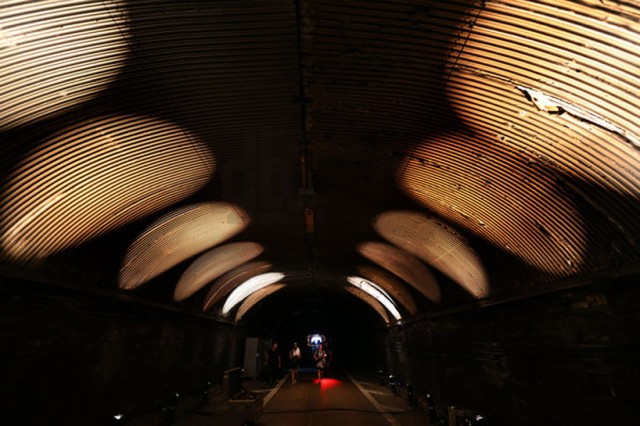
As part of the continuing transformation of Hudson River Park’s Pier 57, Garson Yu has installed the site-specific “T.I.N.Y. (The Interactive New York),” a participatory art project that uses shipping containers to create a unique trip through the sights and sounds of the city. A former New Yorker who was born in Hong Kong and is currently based in Los Angeles, Yu runs yU+co, an award-winning company that has designed titles for such films and television series as Life of Pi, 300, The Walking Dead, Watchmen, and Oz the Great and Powerful. For “T.I.N.Y.,” Yu collaborated with his son, Adrian, an NYU Cinema Studies student who shot video across the city, capturing speeding subway trains, midtown traffic, mobs of pedestrians, skateboarders, street musicians, birds, ballplayers, kids riding the swings in Coney Island, and waves on the beach. Those images are projected onto two rows of shipping containers, where they can be viewed from a third, center row of containers between them, set up to look like a subway car, with windows on either side. The accompanying soundtrack includes dogs barking, cars honking, kids screaming, and many other city noises. “Straphangers” can leave messages on the walls of the central row using colored chalk; in addition, they are encouraged to make sounds into microphones placed in colanders, the loudness and frequency affecting the projections’ speed and motion, even making them go backward, like memories flashing past. A sign by the entrance advises, “Shout Yell Holla Make Some Noise.” When we stopped by on June 1, a man kept going over to several of the microphones, hooting and hollering with abandon; it turned out that it was Yu himself, who was sticking around to check out how people were reacting to the piece and to set off a chain reaction, which worked, as various men, women, and children followed suit. Meanwhile, from up above, Yu’s friend Ik-Joong Kang’s white sculpture of a boy with binoculars sitting atop a raised shipping container keeps watch. “We are storytellers,” yU+co explains on its website. “T.I.N.Y.,” which also features a family-friendly Sound Hunt on weekends, invites people of all ages to be part of the ongoing tale.

THE ARTFUL RECLUSE: PAINTING, POETRY, AND POLITICS IN 17th-CENTURY CHINA

Xiang Shengmo, “Invitation to Reclusion,” detail, ink on paper, handscroll, 1625–26 (Los Angeles County Museum of Art, Los Angeles County Fund)

Xiang Shengmo, “Invitation to Reclusion,” detail, ink on paper, handscroll, 1625–26 (Los Angeles County Museum of Art, Los Angeles County Fund)

Asia Society
725 Park Ave. at 70th St.
Through Sunday, June 2, $10, 11:00 am – 6:00 pm
212-288-6400
www.asiasociety.org

The state of the world getting you down? Considering just getting away from it all, leaving everything behind and heading to the mountains to live a life of quiet contemplation and study? As the Ming dynasty fell in China in 1644 to the Manchus, many public servants, who were also painters, poets, and calligraphers, did just that. Their work is documented in the beautiful, meditative exhibit “The Artful Recluse: Painting, Poetry, and Politics in 17th-Century China,” consisting of paintings, drawings, artist books, vertical wall scrolls, and horizontal handscrolls of some twenty feet in length. Splendidly curated by Peter C. Sturman and Susan Tai, the show features works by such talented recluses as Chen Jiru, Dong Qichang, Xiang Shengmo, Chen Hongshou, Gao Jian, Shitao, and madman Bada Shanren, scholar-painters who paid tribute to the past while often slyly commenting on the present and future as the Qing dynasty took over. The scenes depicted often include a solitary subject who is hard to find, perhaps out on the river, inside a hut, or on a mountain path, a mere spec in the vast natural world. Divided into such sections as “Summoning the Recluse: Landscape as Refuge,” “1644: A Landscape Transformed,” “Nanjing: City of Memories,” and “Returning Home: Stability and Normalcy,” the exhibition includes excellent wall labels accompanying each work, shedding light on such gems as Xiang’s “Summoning the Recluse” and “Invitation to Reclusion,” Zhang Feng’s “Immortals’ Secrets in a Stone Cave,” Bada’s “Small Fish,” Shen Shichong’s “Landscape,” and Dong’s “Contemplating the Dao with Emotions Cleansed.” The show runs through June 2, giving visitors the chance to cleanse their own emotions and wonder just what it might be like to really get away from it all.

CELEBRATE ISRAEL PARADE — PICTURE ISRAEL: THE ART AND THE CRAFT

Bad weather couldn’t dampen the spirit of the 2012 Celebrate Israel Parade (photo by twi-ny/mdr)

Bad weather couldn’t dampen the spirit of the 2012 Celebrate Israel Parade (photo by twi-ny/mdr)

57th to 74th St. up Fifth Ave.
Sunday, June 2, free, 11:00 am – 4:00 pm
celebrateisraelny.org

On May 14, 1948, “The Declaration of the Establishment of the State of Israel” proclaimed, “The State of Israel will be open for Jewish immigration and for the Ingathering of the Exiles; it will foster the development of the country for the benefit of all its inhabitants; it will be based on freedom, justice, and peace as envisaged by the prophets of Israel; it will ensure complete equality of social and political rights to all its inhabitants irrespective of religion, race, or sex; it will guarantee freedom of religion, conscience, language, education, and culture; it will safeguard the Holy Places of all religions; and it will be faithful to the principles of the Charter of the United Nations.” It’s been more than a little bumpy along the way, but Israel will be celebrating its maturation into senior citizenship on Sunday, June 2, with festivities in honor of its sixty-fifth birthday. The day kicks off with an 8:00 morning run through Central Park, followed by the Celebrate Israel Parade; the theme this year is “Picture Israel: The Art & the Craft,” focusing on “Illustrate, Create, Paint, Frame It.” The grand marshals are Long Island philanthropists Marty and Melodie Scharf and Israel Consul General Ido Aharoni, while special guests include Dr. Ruth Westheimer, journalists Harry Martin, Robert Moses, and Becky Griffith, and the Israel National Soccer Team, who will be taking on Honduras at Citi Field at 4:00. Among the many performers at the parade will be SOULFARM, the Brooklyn Jumbies, the Areyvut Mitzvah Clowns, Gilad Segev, the Barynya Entertainment Dancers, Amir Gwirtzman, the Rafi Malkiel Ensemble, Mama Doni, the BaRock Orchestra, Eyal Rob, and the Hebrew Wizards Band.

FIRST SATURDAY: LIFE, DEATH, AND TRANSFORMATION IN THE AMERICAS

“Raw/Cooked: Michael Ballou” (photo by twi-ny/mdr)

Michael Ballou, “Go-Go,” acrylic board, monofilament, wire, plywood, plastic cups, rug, with soundtrackby Kurt Hoffman and David Scher, 2013 (photo by twi-ny/mdr)

Brooklyn Museum
200 Eastern Parkway at Washington St.
Saturday, June 1, free, 5:00 – 11:00 (some events require free tickets distributed in advance at the Visitor Center)
212-864-5400
www.brooklynmuseum.org

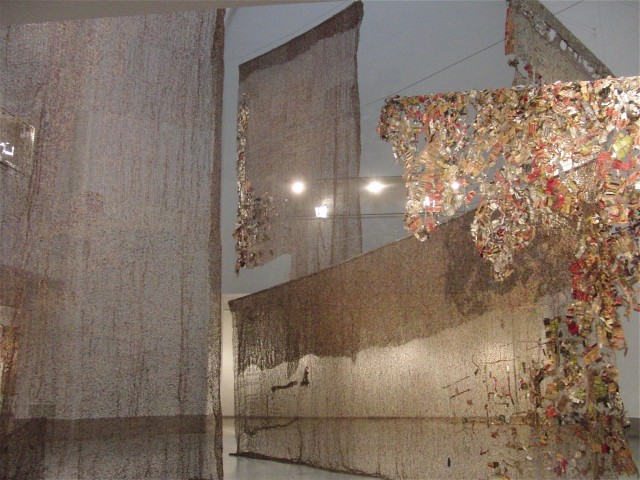
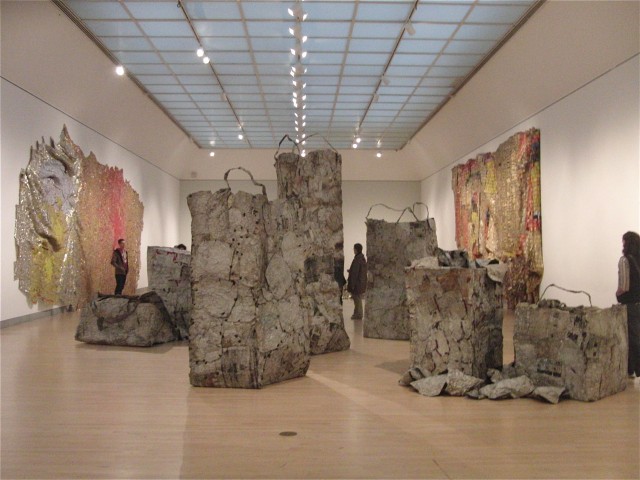
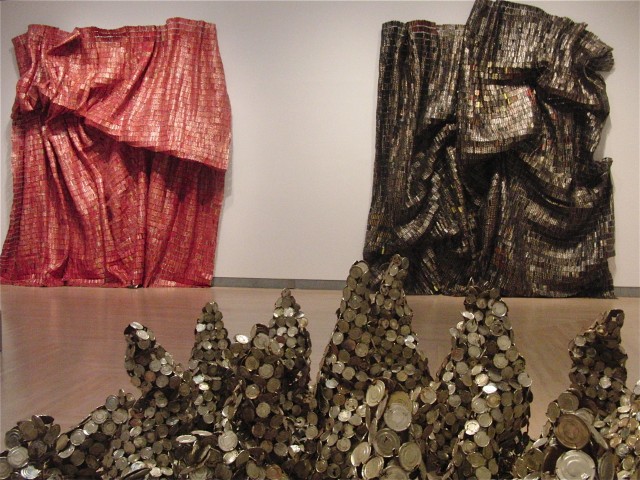
The Brooklyn Museum’s long-term installation “Life, Death, and Transformation in the Americas” is the centerpiece of the June edition of its popular First Saturday program, with a special focus on Peru. The free monthly program will include live performances by Claudia Acuña, Chicha Libre, Rebel Diaz, Marcos Napa, and Mariachi Flor de Toloache, pop-up gallery talks, storytelling presented by the Redhawk Native American Arts Council, a curator talk of the featured exhibit led by Nancy Rosoff and Susan Kennedy Zeller, a Hands-On Art workshop in which participants can make a clay figure, and a participatory despacho ceremony, in which Q’ero healers Don Francisco and Doña Juana invoke reciprocity and loving-kindness. The galleries will remain open late so visitors can also check out “John Singer Sargent Watercolors,” a lovely collection of nearly one hundred stunning works that are a celebration of light and color; “LaToya Ruby Frazier: A Haunted Capital,” moving black-and-white portraits of Frazier and her mother and grandmother; “Käthe Kollwitz: Prints from the ‘War’ and ‘Death’ Portfolios,” devastating woodcut prints by the German Expressionist artist that display the horrors of battle, influenced by the loss of her son in WWI; “Gravity and Grace: Monumental Works by El Anatsui,” a revelatory career retrospective of the fascinating oeuvre of the African artist who uses bottle caps and found metal and wood to create fascinating pieces; “‘Workt by Hand’: Hidden Labor and Historical Quilts,” comprising nearly three dozen American and European quilts; “Raw/Cooked: Michael Ballou” and “Dog Years” by the Williamsburg-based artist, who plays with light and shadow in the former, man’s best friend in the latter; and “Valerie Hegarty: Alternative Histories,” in which Hegarty wreaks havoc on two of the museum’s Period Rooms.