this week in art

THE LINE KING’S LIBRARY: AL HIRSCHFELD AT THE NEW YORK PUBLIC LIBRARY

Al Hirschfeld’s long relationship with the New York Public Library is explored in exhibit at Lincoln Center

Al Hirschfeld’s long relationship with the New York Public Library and the arts is celebrated in exhibit at Lincoln Center

New York Public Library for the Performing Arts
40 Lincoln Center Plaza
Exhibition continues through January 4
Film screening: Bruno Walter Auditorium, 111 Amsterdam Ave., Monday, November 18, free, 6:00
212-642-0142
www.nypl.org/lpa

Twelve years ago, New York celebrated the life and eighty-plus-year career of legendary artist Al Hirschfeld with a major retrospective at the Museum of the City of New York and an exhibit of his celebrity caricatures at the New York Public Library’s main branch; in addition, Abrams released two books of his work, one focusing on New York, the other on Hollywood, and Hirschfeld made appearances to promote the publications. Nearly eleven years after his passing in January 2003 at the age of ninety-nine, the New York Public Library is honoring Hirschfeld again with a lovely exhibit at the Dorothy and Lewis B. Cullman Center, “The Line King’s Library: Al Hirschfeld at the New York Public Library.” Visitors can first stop by a re-creation of Hirschfeld’s work area, complete with his drawing table and barber chair, which is on permanent view at the library entrance. The exhibition is straight ahead, consisting of more than one hundred color and black-and-white drawings and lithographs, posters, books, letters, video, newspaper and magazine clippings, and various other ephemera, divided by the discipline of Hirschfeld’s subjects: theater, music, dance, and film, in addition to a section on those artists who influenced the man known as the Line King.

Oscar-winning documentary on Al Hirschfeld screens for free at NYPL on November 18

Oscar-winning documentary on Al Hirschfeld screens for free at NYPL on November 18

“My contribution is to take the character — created by the playwright and acted out by the actor — and reinvent it for the theater,” Hirschfeld once explained, and the evidence is on the walls, including works depicting Jack Lemmon in Tribute, Lee J. Cobb in Death of a Salesman, Christopher Plummer in Macbeth, Jessica Tandy and Marlon Brando in A Streetcar Named Desire, Rex Harrison and Julie Andrews in My Fair Lady, Alan Cumming in Cabaret, and Jackie Mason in The World According to Me, among so many more. There are also caricatures of Marcel Marceau, S. J. Perelman, George Bernard Shaw, Leonard Bernstein, Vladimir Horowitz, Dizzy Gillespie, Katharine Hepburn, and a dazzling, rarely shown 1969 print of Martha Graham. Another highlight is the original drawing for “Broadway First Nighters,” along with a key identifying the dozens of celebrities gathered in a packed room, and paraphernalia from Hirschfeld’s musical comedy Sweet Bye and Bye, a collaboration with Perelman, Vernon Duke, and Ogden Nash. And for those fans who have spent years trying to find all the inclusions of “Nina” in Hirschfeld’s drawings, “Nina’s Revenge” features his daughter holding a brush and smiling, the names “Al” and “Dolly” (for Dolly Haas, her mother and Hirschfeld’s second wife) in her long hair. In conjunction with the exhibition, there will be a free screening of the Oscar-winning 1996 documentary The Line King: The Al Hirschfeld Story, introduced by the director, Susan W. Dryfoos, on November 18 at 6:00 in the Bruno Walter Auditorium at the New York Public Library for the Performing Arts.

ILYA AND EMILIA KABAKOV: ENTER HERE

KABAKOV

Emilia and Ilya Kabakov discuss their life and work in new documentary (photo by Jacques De Melo)

ILYA AND EMILIA KABAKOV: ENTER HERE (Amei Wallach, 2013)
Film Forum
209 West Houston St.
November 13-26
212-727-8110
www.kabakovfilm.com
www.filmforum.org

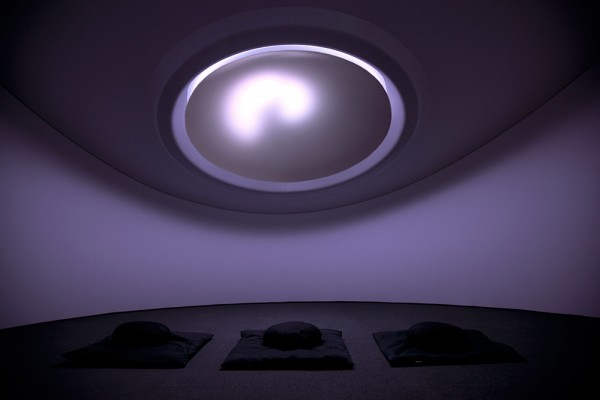
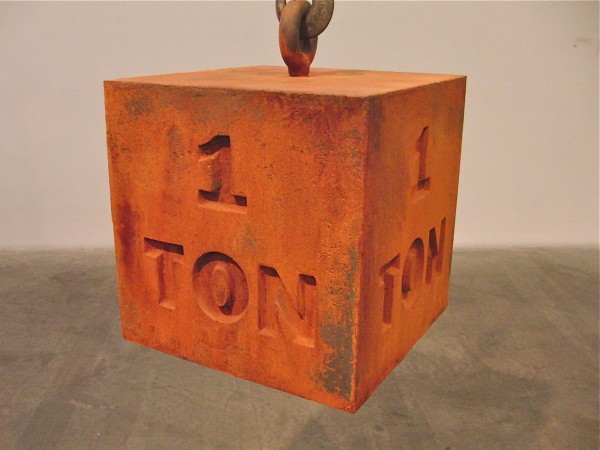
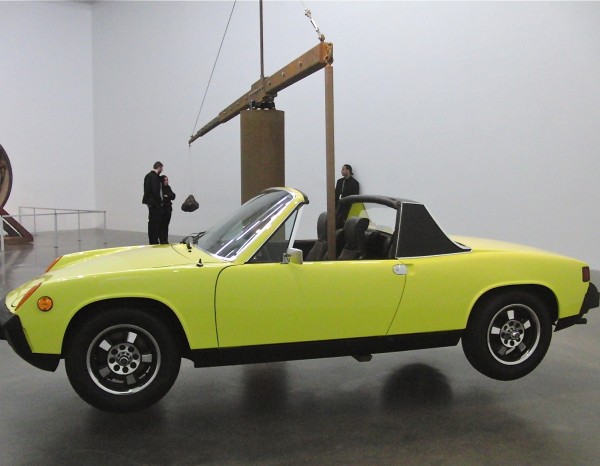
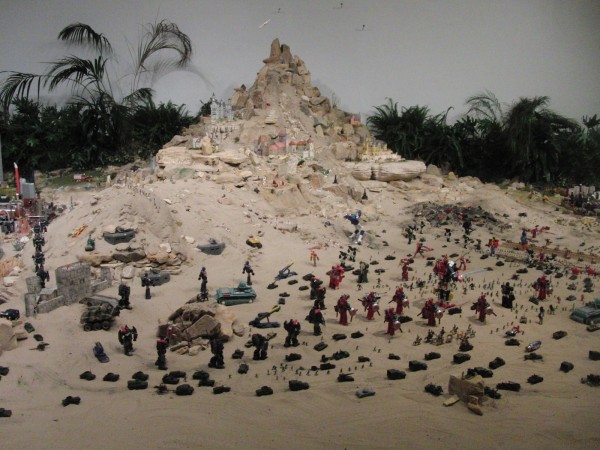
“Epic and boring,” Russian newspaper Vedomosti wrote in a review of Ilya and Emilia Kabakov’s highly anticipated 2008 Moscow exhibition; the same can be said about Amei Wallach’s documentary about the renowned Russian art couple, Ilya and Emilia Kabakov: Enter Here. Wallach assembled the same team she worked with on 2008’s Louise Bourgeois: The Spider, the Mistress and the Tangerine (except for her late codirector, Marion Cajori) to follow the Kabakovs as they prepare for a major series of shows in six venues in Moscow, marking Ilya’s return to the city for the first time since fleeing the country twenty years earlier. Wallach is given virtually unlimited access to Ilya, a soft-spoken conceptual artist filled with fascinating and unusual ideas, and Emilia, whom he married in 1992 and who handles his business affairs and assists her husband in the studio. Wallach delves into Ilya’s past as a struggling artist who was rarely allowed to show his work publicly and became part of an underground avant-garde that also included Oleg Vassiliev, Igor Makarevich, and Andrei Monastyrsky, all of whom appear in the film, as does Robert Storr, Matthew Jesse Jackson, and other scholars. Much of Ilya’s work is innately, if not overtly, political, evoking a changing Russia / Soviet Union as it evolved through such leaders as Stalin, Khrushchev, and Brezhnev, quietly exploring many sociopolitical elements of the twentieth and early twenty-first centuries. The film’s emotional high point involves a voiceover reading a letter from Ilya’s mother that she wrote to him when she was eighty, as the camera takes viewers through such monumental yet intimate and personal installations as “Red Wagon” and “The Toilet.” Among the other works featured are “The Palace of Projects,” “Life of Flies,” “Labyrinth (My Mother’s Album),” “School No. 6,” “How to Meet an Angel,” and “Alternative History of Art,” in which Ilya is joined by his past and future alter egos, Charles Rosenthal and Igor Spivak.

KABAKOV

The Kabakovs attend the opening of their 2008 Moscow exhibition, marking their highly anticipated return to the city

Unlike such other recent art documentaries as Cutie and the Boxer and Gerhard Richter Painting, which focused on unique and engaging characters, the Kabakovs are not particularly entertaining in and of themselves; it’s their work that makes them fascinating, so some stretches of the documentary drag on a bit, and it is difficult for Wallach and editor-cinematographer Ken Kobland to capture on film the feeling of what it is like to experience one of the Kabakovs’ massive installations. (However, it is possible for New Yorkers to see “Catch the Little White Man,” which is on view along with seven paintings at Pace Gallery in Midtown through December 21.) But Ilya and Emilia Kabakov: Enter Here is still a treat, offering an inside look at a husband and wife who are considered the most important Russian artists alive today. “The first thing to say is that art is another world,” Ilya explains early on. “And one must leave one’s body and one’s mentality, and one’s blah, blah, blah . . . and one’s everyday element, and enter another world. This is the major purpose and aim of our work. Leave and come with me to another world.” That’s a difficult offer to pass up. Enter Here begins a two-week run at Film Forum on November 13, with Ilya and Emilia on hand to talk about the film at select screenings on November 13, 16, 23, and 24; the 7:50 show on November 23 will be followed by a Q&A with Wallach and Kobland.

PUBLIC WALKS: CAROL BOVE’S “CATERPILLAR” ON THE HIGH LINE

(photo by Juan Valentin / courtesy of Friends of the High Line)

Free public walk will take ticket holders to wild part of High Line to see Carol Bove’s “Caterpillar” installation (photo by Juan Valentin / courtesy of Friends of the High Line)

High Line at the Rail Yards
Saturdays & Sundays, November – December, free with advance RSVP, 10:00 am, 11:00, 12 noon, 2:00, 3:00
December RSVPs start November 12 at 4:00 pm
“Caterpillar” remains on view through May 2014
www.art.thehighline.org

Red Hook–based artist Carol Bove has installed a specially commissioned series of large-scale sculptures across a three-hundred-yard section of the High Line that is still in its wild, self-seeded state, scheduled to become the third part of the park’s miraculous renovation project next year. Bove, who was born in Geneva and raised in Berkeley, has presented the site-specific “Caterpillar,” seven pieces that alternate between white powder-coated twisting steel (“Celeste,” “Prudence”), a silicon bronze and stainless-steel platform (“Monel”), a brass and concrete vertical object (“Visible Things and Colors”), and rigid, rusted steel beam constructions (“14,” “Cow Watched by Argus”). A kind of contemporary Zen garden on the West Side of Manhattan, “Caterpillar” can only be seen up close as part of public walks being held on Saturdays and Sundays at 10:00, 11:00, 12 noon, 2:00, and 3:00. Tickets are free but must be obtained in advance; RSVPs for the December walks can be made beginning at 4:00 on November 12. To go on the forty-five-minute walk, you’ll have to sign a safety waiver, and it is recommended that you wear sturdy shoes, because you’ll be going over uneven terrain. No one under eighteen will be allowed on the tour. The High Line has been transformed into a glorious outdoor elevated park with wonderful views, cutting-edge art, live performances, food and drink stations, and more, but this is a rare opportunity to experience what it was like before the change. The walks fill up quickly, so don’t hesitate to reserve your spot. (Through January 2014, you can also catch Bove’s indoor installation “The Equinox” on the fourth floor of MoMA.)

SARAH SZE IN CONVERSATION WITH JENNIFER EGAN: TRIPLE POINT

triple point

192 Books
112 Tenth Ave. at Twenty-First St.
Tuesday, November 12, free, 7:00
212-255-4022
www.192books.com
www.sarahsze.com

Boston-born, New York-based visual artist Sarah Sze creates fragile, intricately constructed architectural environments using such materials as string, bottle caps, colored tape, Styrofoam cups, paper, and other items that combine elements of painting and sculpture. Sze, whose “Infinite Line” show ran at Asia Society in 2011-12, is currently representing America at the U.S. Pavilion at the fifty-fifth Venice Biennale with the massive installation “Triple Point,” about which she said in a statement, “Central to the exhibition is the notion of the ‘compass’ and how we locate ourselves in a perpetually disorienting world.” In May 2012, Pulitzer Prize-winning author Jennifer Egan (A Visit from the Goon Squad, The Keep) began posting her New Yorker short story “Black Box” on Twitter in paragraphs of no more than 140 characters, weaving together a written narrative that echoes the ones that Sze builds with objects. On November 12 at 7:00, Sze and Egan will be at 192 Books in Chelsea, celebrating the release of the new book Triple Point (Gregory R. Miller / Bronx Museum of the Arts, October 2013, $45), which examines the installation in detail, featuring an introduction by Biennale co-commissioners Holly Block and Carey Lovelace, an essay by curator Johanna Burton, a conversation between Sze and Egan, and the complete text of Egan’s “Black Box.”

FIRST SATURDAYS: JEAN PAUL GAULTIER

Brooklyn Museum
200 Eastern Parkway at Washington St.
Saturday, November 2, free, 5:00 – 11:00 (some events require free tickets distributed in advance at the Visitor Center)
212-864-5400
www.brooklynmuseum.org

The career of French fashion designer John Paul Gaultier will be celebrated at the Brooklyn Museum’s November edition of its free First Saturdays program. In conjunction with the opening of the multimedia exhibition “The Fashion World of Jean Paul Gaultier: From the Sidewalk to the Catwalk,” there will be a curator talk by Lisa Small, an arts workshop demonstrating how to make Gaultier-inspired fashion plates, fashion-related pop-up gallery talks, a lecture on fashion, ethics, and the law by Susan Scafidi, a special performance by Company XIV and Dances of Vice with Miss Ekat and DJ Johanna Constantine, a discussion with photographer Richard Corman about his book Madonna NYC 83, and screenings of Loic Prigent’s 2009 documentary The Day Before, which follows Gaultier as he prepares for a fashion show, and Luc Besson’s The Fifth Element, for which Gaultier designed the costumes. The night will also include live music by Au Revoir Simone, Watermelon, and Tamar-kali. In addition, the galleries will be open late, giving visitors plenty of opportunity to check out “Valerie Hegarty: Alternative Histories,” “Käthe Kollwitz: Prints from the ‘War’ and ‘Death’ Portfolios,” “Divine Felines: Cats of Ancient Egypt,” “Life, Death, and Transformation in the Americas,” “Connecting Cultures: A World in Brooklyn,” “Wangechi Mutu: A Fantastic Journey,” and other exhibits.

WILLIAM KENTRIDGE: SECOND-HAND READING

William Kentridge

William Kentridge’s latest show at Marian Goodman is another multimedia wonder (photo courtesy Marian Goodman Gallery)

Marian Goodman Gallery
24 West 57th St. between Fifth & Sixth Aves.
Through October 26, free, 10:00 am – 6:00 pm
212-977-7160
www.mariangoodman.com

In his latest exhibit at the Marian Goodman Gallery in Midtown, “Second-hand Reading,” South African multidisciplinary artist William Kentridge examines the concepts of construction, deconstruction, and reconstruction in unique, creative, and, as always, playful ways as they relate to both the artist himself and the viewer. As he noted in “Drawing Lesson One: In Praise of Shadows,” the first of six hour-long Charles Eliot Norton Lectures he gave in the spring of 2012 during his one-year residency at Harvard, we are “made aware of our part in the construction of the image, our part in the construction of the illusion, but most importantly our part in the construction of ourselves. It is in the gap between the object and its representation that this energy emerges, the gap we fill in.” Over the course of the talks, which can be viewed here, Kentridge also discusses mistranslation, practical epistemology, meaning, shadows, words, seeing, the movement between images and ideas, anti-entropy, and life in the studio, where he makes all of his work.

William Kentridge, “The Shrapnel in the Woods,” Indian ink on CRAGGS UNIVERSAL TECHNOLOGICAL DICTIONARY (1826), 2013 (photo courtesy Marian Goodman Gallery)

William Kentridge, “The Shrapnel in the Woods,” India ink on CRAGGS UNIVERSAL TECHNOLOGICAL DICTIONARY (1826), 2013 (photo courtesy Marian Goodman Gallery)

As complex as his talks can get, Kentridge also instills his trademark sense of humor and explores his very personal inclusion of the hand — and full body — of the artist, two elements that are central to the new show, which continues through October 26. “Second-hand Reading” is filled with energy, and its myriad rewards are indeed affected by how much constructing visitors do in their mind. The North Gallery is dominated by kinetic machines, including repurposed megaphones, sewing machines, a bicycle wheel, and a drum kit hanging from the ceiling, all of which must be operated by a gallery employee, who will do so for the asking. Surrounding the machines is a series of large-scale India ink drawings on pages from Craggs Universal Technology Dictionary, featuring trees on which Kentridge has added such phrases as “Tear & Repair,” “The Nicely Built City Never Resists Destruction,” and “The Death of Trees.” The trees not only represent life in South Africa but the source of the paper on which they are drawn; in today’s society, of course, less and less writing is being done on paper.

In the North Viewing Room, the triptych flip-book “NO, IT IS” consists of three extremely entertaining continuous and simultaneous flipbook videos (Workshop Receipts, The Anatomy of Melancholy, and Practical Enquiries) of black-and-white images and different-colored geometric shapes on pages from an old technical encyclopedia. As the pages turn, Kentridge walks across them, takes a seat, and dances with a woman; at the beginning and end, Kentridge’s hand can be seen opening and closing the book. The drawings used for the films hang on the walls of the small space.

(photo by twi-ny/mdr)

William Kentridge, “NO, IT IS,” triptych of three flipbook films, HD video, 2012 (photo by twi-ny/mdr)

In the Conference Room, linocuts of trees are printed on sheets taken from the Shorter Oxford English Dictionary and the Encyclopedia Britannica, while silkscreens on pages from the 1746 Septem Linguarum Calepinus, the 1757 AD Pandectas Duobus Tomis Dilftributus, and other books declare in bold red, “A Safe Space for Stupidity,” “The Full Stop Swallows the Sentence,” and “Against Argument (But Not This One),” phrases Kentridge wrote down while preparing the Harvard lectures.

William Kentridge’s “Rebus” sculptures are best experienced from multiple angles (photo courtesy Marian Goodman Gallery)

William Kentridge’s “Rebus” sculptures are best experienced from multiple angles (photo courtesy Marian Goodman Gallery)

In the South Gallery in the back, two rows of “Rebus” sculptures consist of black bronze works that are like puzzles, changing when viewed from different angles. A lithograph of nine black-and-white typewriters reminds us of how words were at one time put onto the page. “Let Us Enter the Chapter” and “All the Trees in the Library” comprise small drawings on pages of the Shorter Oxford English Dictionary with such words at the top as “Abuse,” “Advocate,” “Wrath,” “Void,” “Symptom,” “Graveyard,” and “Indecipherable.” The show culminates with the poetic seven-minute flipbook film “Second-hand Reading,” which is composed of the many disparate elements in the South Gallery as a concerned Kentridge makes his way across pages from Cassell’s Cyclopædia of Mechanics on which he has added such phrases as “Whichever page you open, there you are” and a cheerleader with a cross on her outfit waves flags as if sending a message, all set to a beautiful score by Neo Muyanga. The exhibit as a whole places Kentridge’s art very firmly in a different kind of age of mechanical reproduction while laying bare his thought process. He is “taking sense and deconstructing it, taking nonsense and seeing if sense can be constructed from it,” as he recently explained, and asking the viewer to participate in the ultimate creation of meaning. The title of the show itself evokes a multitude of meanings, as “second-hand” could refer to Kentridge’s reuse of found objects, the portrayal of his own actual hand, his breathing life into pages from old texts that people can now read in a new light, and the endless passage of time, which hovers over everything. But even more important, it’s all a helluva lot of fun.

(Kentridge fans can still see his visually stunning production of The Nose at the Metropolitan Opera on October 26 and in theaters October 26 and 30, and the Metropolitan Museum of Art just opened their latest Kentridge acquisition, “The Refusal of Time,” which runs through May 11. To read our 2011 twi-ny talk with Mr. Kentridge, please go here.)

VICTORIA COHEN: HOTEL CHELSEA

Victoria Cohen

Victoria Cohen, “Fifth Floor-South Chair,” C-print, 2011 (© 2011 by Victoria Cohen)

Third Streaming
10 Greene St., second floor
Monday – Friday through October 25, free
646-370-3877
www.thirdstreaming.com
www.victoriacohen.com

In the summer of 2011, when New York native Victoria Cohen heard that the Hotel Chelsea was being sold and would be undergoing extensive renovations, she “felt many emotions,” she writes in her debut photo book, the beautiful, deluxe, oversize Hotel Chelsea (Pointed Leaf Press, August 2013, $95). “First and foremost, as an artist, I was angry and sad that an institution such as the Chelsea would have this fate. . . . It just didn’t seem possible — at least to me — that a place with such an extraordinary history, and where so many of the greatest literary minds, visual artists, musicians, and eccentrics of the twentieth century have called home for over a hundred years, could be torn apart.” So Cohen set out to capture the heart and soul of the hotel that had helped give birth to seminal works by Jack Kerouac, Arthur C. Clarke, Leonard Cohen, William S. Burroughs, Larry Rivers, Patti Smith, Allen Ginsberg, Bob Dylan, and so many others. For three weeks, Cohen shot what she calls “portraits” of the hotel’s guest rooms, rooftop, and hallways, although no humans are ever seen.

Victoria Cohen, “Room 1024, Chair,” C-print, 2011 (© 2011 by Victoria Cohen)

Victoria Cohen, “Room 1024, Chair,” C-print, 2011 (© 2011 by Victoria Cohen)

Instead, it is as if ghosts and spirits inhabit Cohen’s pictures, taken with a handheld camera using only natural light. More than two dozen are on view at Third Streaming in SoHo through October 25, wonderfully arranged by curator Michael Steinberg and Cohen. A mop and bucket, seemingly timeless, stand by themselves in a corner. An old piano looks like it might not have been played in years. Brick walls in disrepair on the roof hint at some bad times gone by. But the real mysteries of the Hotel Chelsea, which was recently sold to luxury hotel developer King & Grove, can be found in Cohen’s marvelously composed shots of the guest rooms, each one unique and different, from the dark couch in “Room 632” to the two bright-red chairs in “Eighth Floor South,” from the card table in “Fifth Floor South” to the mini-fridge and coffee paraphernalia against green wallpaper in “Room 203.” One series of photos zeroes in on made beds, while another focuses on rooms with two windows, adding a compelling geometric element to the works. One of the most striking images is “Room 1024,” the camera placed just in front of the entrance to a sparkling living room with chairs that seem to be inviting the viewer to take a seat. In each of these photos, Cohen also invites the viewer to create their own narrative about the past, present, and future, and it’s almost impossible not to.