this week in art

FOUR GIANT RED SNAILS

(photo by twi-ny/mdr)

A quartet of snails have made their way to Columbus Circle through the snow and traffic (photo by twi-ny/mdr)

Columbus Circle
Convergence of Broadway, Eighth Ave., and Central Park West at 59th St.
Through January 6, free
www.pinksnails.com
four giant red snails slideshow

Making your way through midtown Manhattan might be impossibly slow these days, with all of the tourists and holiday shoppers clogging the streets, but if you think you’re having trouble getting anywhere, there are four giant red snails in Columbus Circle that haven’t moved an inch in weeks. The eight-foot mollusks have actually made it from Central Park to Gaetano Russo’s statue of Cristóbal Colón, but they seem to be stuck there, bringing striking color to an otherwise very white and gray area. Made of recycled plastic from landfills, the snails are part of an international REgeneration Art Project created by Italy’s Cracking Art Group and presented by the Villa Firenze Foundation and Galleria Ca d’Oro’s Gloria Porcella. The Cracking Art Group — Renzo Nucara, Marco Veronese, Charles Rizzetti, Alex Angi, Kicco, and William Sweetlove — is dedicated to “changing the history of art through a strong social and environmental commitment to a united revolutionary, innovative use of plastic materials that evoke a strict relationship between the natural and the artificial,” so what better time to see these Dolittle-like creatures than during the holiday season in New York City?

THE NEW RIJKSMUSEUM

The renovation of the Rijksmuseum in Amsterdam turns into one crazy story in two-part documentary (photo courtesy of Pieter van Huystee/Column Film)

The renovation of the Rijksmuseum in Amsterdam turns into one crazy story in two-part documentary (photo courtesy Pieter van Huystee/Column Film)

THE NEW RIJKSMUSEUM (Oeke Hoogendijk, 2008/2013)
Film Forum
209 West Houston St.
December 18 – January 1
212-727-8110
www.filmforum.org

In 2003, Amsterdam’s crown jewel, the Rijksmuseum, was closed to begin a major renovation. Little did everyone know at the time that the project would be delayed for years and go hundreds of millions of dollars over budget. Dutch director Oeke Hoogendijk captures all the surprisingly gripping fun and intrigue in the two-part, four-hour documentary The New Rijksmuseum. Hoogendijk brings her camera into every architectural meeting, monetary debate, and contractor dilemma, gaining remarkable access as no one shies away from sharing their personal and professional feelings on everything from the heated battle with community cycling activists over public use of the building’s entrance as a bike passage to such exacting details as paint color, smoothness of the walls, the art-historical value of certain works, and staying true to Pierre Cuypers’s 1885 building. The first documentary follows museum director Ronald de Leeuw as the process gets under way and continually gets mired in such issues as bidding contests that end up having only one participating company and the city’s dislike for a modern study center addition. In the second film, Wim Pijbes takes over as museum director in 2008, and his problems quickly mount as well as construction work eventually starts and deadlines approach. “I spend more time on cyclists than Rembrandt,” he acknowledges. “It’s my fate.” The interplay among such architects as Antonio Cruz, Antonio Ortiz, and Jean-Michel Wilmotte, a succession of project managers, curators of individual museum galleries, and the director is simply fascinating as they all give their very frank opinions on the renovation of the home of such treasures as Rembrandt’s “The Night Watch” and Vermeer’s “The Milkmaid.” There’s also a whole lot of hysterical eye rolling. Hoogendijk’s two films are part mystery, part thriller, part absurdist comedy, but at the heart of it all is a deep love of art and the understanding of its cultural importance. “You gain all this knowledge only to forget it all again, but the essence remains with you,” says Asian Pavilion curator Menno Fitski. “You don’t have to remember everything you see in a museum. The experience is what makes you feel like a better human being.” The New Rijksmuseum will change the way you experience museums, especially the next time you walk through MoMA, the Met, the Louvre, or any other major cultural institution, and perhaps most of all, it will make you want to go to Amsterdam and see the new Rijksmuseum itself. The two parts are being shown at Film Forum through January 1; although you can see them separately for the price of one admission, it’s a lot more exciting watching them back to back, immersing yourself in this crazy, complicated love story.

ISAAC JULIEN: TEN THOUSAND WAVES / PLAYTIME

(photo by Jonathan Muzikar)

Isaac Julien’s striking TEN THOUSAND WAVES floats across MoMA’s atrium (photo by Jonathan Muzikar)

TEN THOUSAND WAVES
Museum of Modern Art, the Donald B. and Catherine C. Marron Atrium
11 West 53rd St. between Fifth & Sixth Aves.
Through February 17
Museum admission: $25 ($12 can be applied to the purchase of a film ticket within thirty days)
212-708-9400
www.moma.org
www.isaacjulien.com

Comfy Ottomans are arranged throughout MoMA’s Donald B. and Catherine C. Marron Atrium, but visitors aren’t meant to grab a seat and settle in while watching Isaac Julien’s dazzling nine-screen immersive installation, Ten Thousand Waves. To get the full effect, wander around the space, and even check out the upper levels for a view from above. That would fit with some of Julien’s central themes, involving motion, migration, and technological change. The London-born Julien has previously installed the piece on Cuckatoo Island, for the Sydney Biennale; at the Kunsthalle Helsinki; and in Shanghai during the Shanghai Expo, but it is being shown at MoMA in a unique configuration, with the nine screens hanging from the atrium ceiling at different angles and heights, making it feel like a more arduous journey. The inspiration for Ten Thousand Waves came from the 2004 Morecambe Bay tragedy, when nearly two dozen migrant Chinese cockle pickers from Fujian Province drowned in a terrible accident. Julien retells that story with actual footage of the recovery attempt while incorporating elements of the folk legend “The Tale of Yishan Island,” about sixteenth-century fishermen facing disaster on the sea. He also re-creates scenes from Wu Yonggang’s 1934 silent film, The Goddess, with Zhao Tao (wife and muse of Sixth Generation director Jia Zhangke) playing a desperate prostitute (as well as Goddess actress Ruan Ling-yu, who came to a fateful end herself) making her way through the colorful streets of old and new Shanghai (and the Shanghai Film Studios). Overseeing it all is Mazu (Chinese superstar Maggie Cheung), the Goddess of the Sea, who floats through the air in a flowing white costume. The multiple abstract narratives, visual style, sets, and soundtrack (by Jah Wobble and the Chinese Dub Orchestra and composer Maria de Alvear) combine with Gong Fagen’s calligraphy and Wang Ping’s specially commissioned poem, “Small Boats” (other collaborators include multimedia artist Yang Fudong and cinematographer Zhao Xiaoshi), to examine the interplay of commerce and capital in both ancient and modern-day China. Like much of Julien’s oeuvre (Fantôme Afrique, True North), the fifty-minute Ten Thousand Waves is a visually stunning meditative work that offers up no easy answers while warranting multiple visits. In conjunction with the exhibit, MoMA has published a deluxe intellectual biography of Julien, Riot, which features illuminating text by Paul Gilroy, bell hooks, Mark Nash, Laura Mulvey, Christine Van Assche, Julien, and others, including several chapters on Ten Thousand Waves and Playtime, which can currently be seen at Metro Pictures.

(photo courtesy Metro Pictures)

Julien’s PLAYTIME follows a series of characters dealing with the financial crisis in very different ways (photo courtesy Metro Pictures)

PLAYTIME
Metro Pictures
519 West 24th St. between Tenth & Eleventh Aves.
Through December 18, free, 10:00 am – 6:00 pm
212-206-7100
www.metropicturesgallery.com

In Chelsea, Julien’s latest installation at Metro Pictures, Playtime, continues through December 18, exploring some of the same concepts as Ten Thousand Waves, albeit much more directly, as seen through the Collector, the Houseworker, the Artist, the Auctioneer, and the Reporter, each of whom is based on real people. The centerpiece of Playtime is a three-chapter film, projected onto a long, horizontal screen, that looks at the financial crisis in three cities. In London, a vibrant young man (James Franco) speaks adoringly about collecting art and leads viewers to an auction being led by Simon de Pury. In Dubai, where there appears to have never been a financial crisis, a Filipina woman (Mercedes Cabral) cleans a wealthy man’s multimillion-dollar apartment, gazing out at one of the wealthiest cities on the planet while wondering if she will make enough money to have her life back and reunite with the rest of her family. And in Reykjavik, where the financial crisis began in 2008, a photographer (Ingvar Eggert Sigurðsson) looks over a vast, barren landscape. The exhibit also includes Kapital, a two-channel video in which Julien and social theorist David Harvey, author of such books as Spaces of Global Capitalism: Towards a Theory of Uneven Geographical Development and The Enigma of Capital and the Crises of Capitalism, discuss class, Marxist philosophy, social structure, and more with a specially invited group of men and women at London’s Hayward Gallery. And in another video, de Pury sits down for a craftily staged interview with a journalist (Cheung), claiming that the financial crisis actually ended up being a boon to the art market. Although some of the points Julien is making here are rather obvious and far from new, the work still fascinates with its visual acuity and infectious pacing. Perhaps Julien titled it Playtime in tribute to Jacques Tati and his Monsieur Hulot onscreen alter-ego, a charming, dapper man who seems to be living in a different era than everyone else, with few of their cares and worries.

Clips from Isaac Juliens PLAYTIME will screen throughout Times Square this month (photo by Ka-Man Tse for @TSqArts)

A three-minute clip from Isaac Julien’s PLAYTIME will screen throughout Times Square this month (photo by Ka-Man Tse for @TSqArts)

MIDNIGHT MOMENT: ISAAC JULIEN
Times Square
Nightly at 11:57 through December 30
www.timessquarenyc.org

In conjunction with the shows at MoMA and Metro Pictures, Times Square Arts and the Times Square Advertising Coalition is presenting a three-minute clip from Julien’s Playtime every night at 11:57 on seventeen electronic billboards in Times Square through December 30 as part of the ongoing “Midnight Moment” project, which has previously shown work by such artists as Ryan McGinley, Robert Wilson, Tracey Emin, Jack Goldstein, and Björk and Andrew Thomas Huang. It’s rather fitting, of course, that Playtime, which deals so much with art, commerce, and capitalism, can be seen in the heart of one of the planet’s most commercial locations. And it’s difficult to pass up the opportunity to see James Franco hovering over the Crossroads of the World. Julien will be back at MoMA on February 10 for the Modern Mondays presentation “An Evening with Isaac Julien,” sharing film clips and talking about his career.

CHRISTMAS TREE AND NEAPOLITAN BAROQUE CRÈCHE 2013-14

The Three Kings proceed to the Magi in annual Met Christmas tree display (photo by twi-ny/mdr)

The Three Kings proceed to the Magi in annual Met Christmas tree display (photo by twi-ny/mdr)

Metropolitan Museum of Art
Medieval Art Sculpture Hall, first floor
Through January 6, recommended admission $25
212-535-7710
www.metmuseum.org
christmas tree and neapolitan baroque crèche slideshow 2013

Once again the Met’s annual Christmas tree has risen in front of a 1763 Choir Screen from the Cathedral of Valladolid, and it will remain on view through the Epiphany on January 6. The twenty-foot-tall spruce is surrounded by twenty-two eighteenth-century cherubs, fifty-five angels, sixty-nine miniature Neapolitan handmade men, women, and children, and fifty animals, from the collection of Loretta Hines Howard. The terracotta polychromed figures, some created by such well-respected sculptors as Giuseppe Sammartino, Salvatore di Franco, Giuseppe Gori, and Angelo Viva, act out the Nativity (or crèche) and the Procession of the Magi as daily business goes on. The tree was originally designed by Howard and is now overseen by her daughter, Linn, along with Linn’s artist daughter, Andrea Selby Rossi, who add new touches to the settings every year; the display also has music to further the holiday spirit. The Met first displayed the figures in 1957, adding the tree, which was also donated by Howard, in 1964. Be sure to walk all around the area to see all the little scenes that are going on throughout the bustling town. And the Met now allows non-flash photography of the tree, so you can take pictures as well. A lighting ceremony is held every day, at 4:30 Sunday through Thursday and at 4:30, 5:30, and 6:30 on Friday and Saturday, and an Audio Guide is available too ($7). The Met’s celebration of Christmas also continues with such holiday-themed events as “The Crossing: A Christmas Concert” on December 22 and the Salomé Chamber Orchestra playing seasonal music on December 20, both in the Grace Rainey Rogers Auditorium. Meanwhile, the Cloisters will host “The Waverly Consort: The Christmas Story” on December 15, “ETHEL and Friends” December 20-21 and 27-28, and “Lionheart Laude: Joy and Mystery in Medieval Italy” December 22.

HOUSEWARMING: NOTIONS OF HOME FROM THE CENTER OF THE UNIVERSE

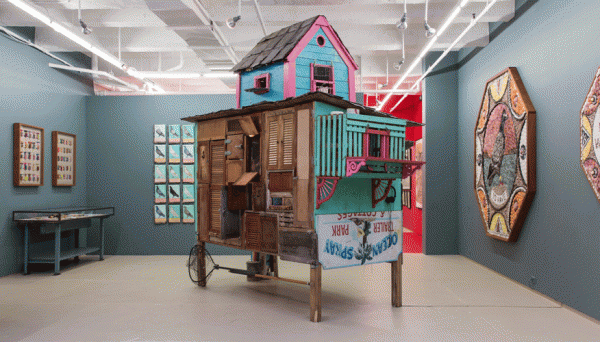
Drew Hamilton’s “Street-Corner Project” is part of inaugural “Housewarming” show at BRIC House in Brooklyn (photo by twi-ny/mdr)

Drew Hamilton’s miniature “Street-Corner Project” is part of inaugural “Housewarming” show at BRIC House in Brooklyn (photo by twi-ny/mdr)

BRIC Arts | Media House
647 Fulton St.
Through December 15, free, 10:00 am – 8:00 pm
718-683-5600
www.bricartsmedia.org

There’s an artistic revolution going on in downtown Brooklyn on the other side of the LIRR station from where the Barclays Center now resides. BAM has added the Fisher to the Howard Gilman Opera House and Harvey Theater, right near the Mark Morris Dance Center, and down the street is Theatre for a New Audience’s dazzling new Polonsky Shakespeare Center, which is currently presenting its first production, Julie Taymor’s A Midsummer Night’s Dream. Another new entry in this growing community is the gorgeously revamped BRIC House, a multidisciplinary arts center that opened in its old digs at the corner of Rockwell and Fulton Sts. in October. Sunday is the last day to see its inaugural art exhibition, the appropriately titled “Housewarming: Notions of Home from the Center of the Universe.” Curated by BRIC director of contemporary art Elizabeth Ferrer, the display features works by twelve Brooklyn-based artists, including eight pieces specifically commissioned for this show, in the downstairs three-thousand-square-foot gallery. Keisha Scarville’s photographs from her “I am here” series offer dark, quiet contemplation of objects that recall home. Garry Nichols’s café mural and weather vanes evoke his Tasmanian birthplace. Abraham McNally’s small-scale wall sculptures contain fragments of a physically broken home. Margaret Reid Boyer’s “Household Objects” photos consists of domestic interiors in which something is often not quite right. Vargas-Suarez Universal’s “Star Chamber” can be seen on the building’s facade. Drew Hamilton re-creates the scene he used to see from his second-floor window at Graham Ave. and Merserole St. in Bushwick in the miniature replica “Street-Corner Project.” There are also works by Njideka Akunyili, Sonya Blesofsky, Esperanza Mayobre, Katarina Jerinic and Chad Stayrook, and Nathan Wasserbauer. It all makes for a tender welcome home to BRIC, which in the next few weeks is also hosting free dance classes with Ronald K. Brown / Evidence and Samita Sinha’s work-in-progress, Cipher, with David Levine, Christian Hawkey, and Joe Diebes’s “Wow” scheduled for January.

AD REINHARDT / DONALD JUDD

Ad Reinhardt

David Zwirner exhibit features thirteen of Ad Reinhardt’s black paintings

AD REINHARDT
David Zwirner
537 West 20th St. between Tenth & Eleventh Aves.
Tuesday- Saturday through December 18, free, 10:00 am – 6:00 pm
www.davidzwirner.com

DONALD JUDD: STACKS
Mnuchin Gallery
45 East 78th St.
Tuesday- Saturday through December 14, free, 10:00 am – 5:30 pm
www.mnuchingallery.com

Two of the most important and influential abstract artists of the twentieth century currently have revelatory gallery shows in New York that focus on very specific aspects of their careers. Both men were fairly or unfairly associated with Minimalism, both were key posthumous inclusions in Gagosian’s 2005 group show “Imageless Icons: Abstract Thoughts,” and both handled shape, form, color, and texture in masterful, revolutionary ways. Donald Judd and Ad Reinhardt were contemporaries who defied convention and died relatively young, Reinhardt at fifty-three in 1967, Judd at sixty-five in 1994. At David Zwirner’s Twentieth St. space, thirteen of Reinhardt’s extraordinary black paintings have been brought together, the most since a 1991 retrospective at MoMA. The exhibit, being held in honor of the centennial of the Buffalo-born artist’s birth, is designed to adhere as close as possible to Reinhardt’s exacting specifications regarding such elements as light, placement, and access. At quick glance, of course, the paintings appear to be all-black squares, but upon closer examination it becomes apparent that each one is very different, containing shades of blue, red, and green, composed in cruciform configurations that emerge into smaller squares and rectangles that Reinhardt painted while the canvas lay flat on a table in his studio. The colors and shapes move in and out of focus as one’s gaze continues, every moment morphing into a new joy. It’s a whirlwind display, thrilling and alive, as if each canvas is a living, breathing object. Here’s how Reinhardt described the black paintings: “A square (neutral, shapeless) canvas, five feet wide, five feet high, as high as a man, as wide as a man’s outstretched arms (not large, not small, sizeless), trisected (no composition), one horizontal form negating one vertical form (formless, no top, no bottom, directionless), three (more or less) dark (lightless) no-contrasting (colourless) colours, brushwork brushed out to remove brushwork, a matte, flat, freedhand painted surface (glossless, textureless, non-linear, no hard edge, no soft edge) which does not reflect its surroundings — a pure, abstract, non-objective, timeless, spaceless, changeless relationless, disinterested painting — an object that is self-conscious (no unconsciousness) ideal, transcendent, aware of no thing but art (absolutely no anti-art).” The stellar exhibit also includes a slide show of hundreds of architectural photographs Reinhardt took over the years, as well as dozens of his playful cartoons, from hysterical takes on Hitler to his “How to Look” series.

(photo by om Powel Imaging, Inc. / all artword © Judd Foundation. Licensed by VAGA, New York, NY)

Mnuchin display includes eleven of Donald Judd’s “Stacks” (Tom Powel Imaging, Inc. / © Judd Foundation)

Meanwhile, uptown at Mnuchin, “Stacks” is the first show to concentrate solely on Judd’s signature oeuvre. Spread across several rooms on two floors, the exhibit features eleven stacks from 1968 to 1990, ten of which consist of ten units of equal size and color, constructed of stainless steel, anodized aluminum, galvanized iron, or copper, most often with colored Plexiglas, the units stacked one above the other from floor to ceiling, the space between as important as the physical objects themselves. The light casts intriguing shadows that extend the works, which are composed in blue, amber, yellow, violet, green, white, or black. Just as Reinhardt spoke of brushwork removing brushwork, the Missouri-born Judd said of his stacks, “Well, I am not interested in the kind of expression that you have when you paint a painting with brush strokes. It’s all right, but it’s already done and I want to do something new. I didn’t want to get into something which is played out and narrow. I want to do as I like, invent my own interests. Of course, that doesn’t mean that people who, like Newman, still paint are worn out. But I think that’s a particular kind of experience involving a certain immediacy between you and the canvass, you and the particular kind of experience of that particular moment. I think what I’m trying to deal with is something more long range than that in a way, more obscure perhaps, more involved with things that happen over a longer time perhaps. At least it’s another area of experience.” As with Reinhardt’s black paintings, Judd’s stacks are also deserving of lengthy views to absorb their full impact as they interact with the light, especially in an upstairs room with windows. The Judd show is being held in conjunction with the opening of Judd’s house at 101 Spring St. to the public. Among the works owned by the Judd Foundation and on view in the house is Reinhardt’s “Red Painting.”

LIGHTNESS OF BEING

“Lightness of Being” offers fun in City Hall Park through December 13 (photo by twi-ny/mdr)

“Lightness of Being” offers fun in City Hall Park through December 13 (photo by twi-ny/mdr)

City Hall Park
Through December 13, free
www.publicartfund.org
lightness of being slideshow

There’s nothing unbearable about the Public Art Fund’s “Lightness of Being,” an airy, playful look at the lighter side of life through shape, form, and color. Continuing in City Hall Park through December 13, the exhibit, curated by Nicholas Baume and Andria Hickey, features an all-star lineup of established and emerging artists having fun with steel, bronze, marble, aluminum, concrete, and other materials. James Angus’s red-and-green “John Deere Model D” tractor lies sideways on the grass, looking like it’s been stretched out in Photoshop. Olaf Breuning’s “The Humans” is a ritualistic circle of white comic-book-like creatures, while Gary Webb’s “Buzzing It Down” is a childlike four-part totem. Be sure to get up close to check out the detail on Evan Holloway’s “Willendorf Wheel.” Stand on the platform in Daniel Buren’s “Suncatcher” to see how the circuslike top transforms the light shining through it and right onto your body. Don’t trip over David Shrigley’s “Metal Flip Flops,” which look more out of place than ever now that the cold weather is here. No, that bicycle is not twisted into a circle as the result of a bad accident but instead is Alicja Kwade’s “Journey without Arrival (Raleigh).” Franz West’s untitled pastel pieces form a set of exclamation points on his career, as these were finished after his death last year. Grab a seat on Sarah Lucas’s cast concrete vegetable benches named “Florian and Kevin.” Cristian Andersen’s “Inverse Reverse Obverse” totem melds cubism with surrealism. And you don’t need to be scared of that clown sitting on the bench; it’s actually Ugo Rondinone and Victoria Bartlett’s “Dog Days Are Over,” a performance piece that takes place Fridays from 11:00 am to 5:00 pm.