this week in art

DUKE RILEY: SEE YOU AT THE FINISH LINE

(courtesy MagnanMetz Gallery)

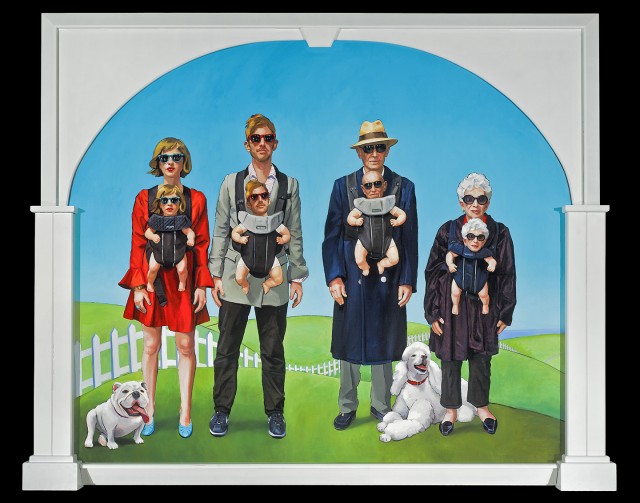
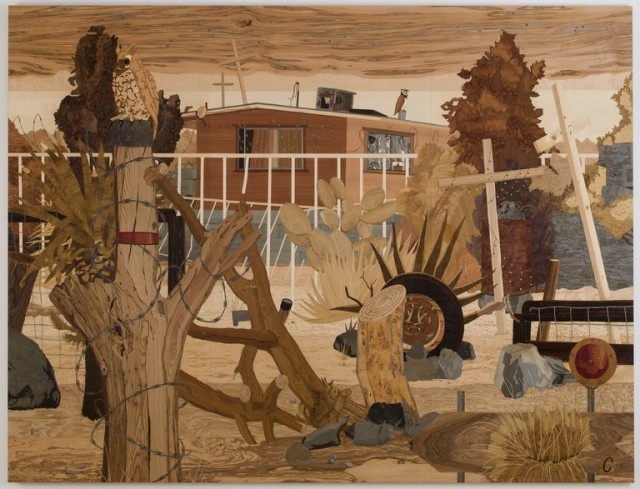
Duke Riley, “Pigeon Coop,” reclaimed wood, roofing, and construction materials, 2012-13 (photo courtesy Magnan Metz Gallery)

Magnan Metz Gallery
521 West 26th St. between Tenth & Eleventh Aves.
Extended through January 25, free, 10:00 am – 6:00 pm
212-244-2344
www.magnanmetz.com
www.dukeriley.info

There are only a few more days left to see Duke Riley’s intensely fascinating “See You at the Finish Line” as it races toward its twice-extended conclusion on Saturday. The fourth solo exhibition by the Boston-born, Brooklyn-based multimedia installation artist is divided into two parts, both filled with exacting details and, well, flights of fancy. In “Trading with the Enemy,” Riley investigates the relationship between Cuba and Key West, which includes smuggling because of the continued U.S. embargo. After four years of planning, Riley bred and trained fifty homing pigeons for eight months in a Key West loft. The pigeons, with tiny cameras attached to them, were released, with some eventually returning to their home coop bearing Cohiba cigars. He named the birds after such smugglers as Jean Lafitte, Whitey Bulger, Billy Hayes, Margaret Sanger, and Pablo Escobar and such controversial filmmakers as Mel Gibson and Larry Clark and reports which ones survived and which ones didn’t. The display includes such elements as the cigars that were brought across the Atlantic, the harnesses the pigeons wore, and the date and cause of death of those that died. Riley has transplanted the entire pigeon coop to the middle of the gallery, an astonishing piece, still an active home to several of the live birds who successfully made the journey. A trio of mosaics made out of found seashells and wood proclaim, “To Have,” “To Have Not,” and “Forget Me Not When Far Away,” while the trip is also documented in the three-channel video See You at the Finish Line, consisting of footage shot by several pigeons equipped with the cameras. It’s hysterical to see how one family responds when a pigeon lands on its boat.

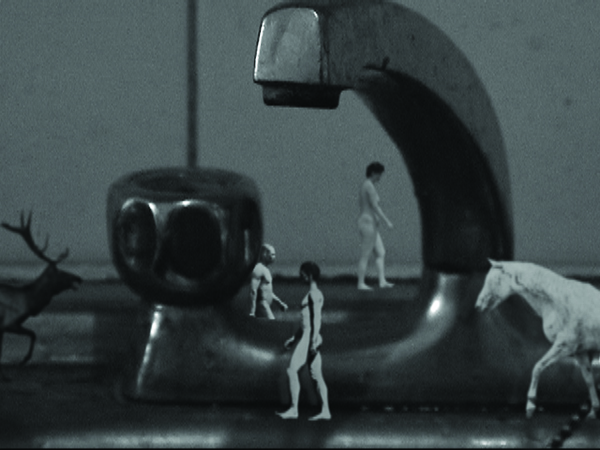
In a back room, visitors can immerse themselves in “The Rematch,” in which Riley restaged the mythological Chinese race that established the zodiac and the measurement of time in a yearly cycle, a race that was won by a cheating rat. Riley went to the Caogang River in Zhujiajiao, China, where a dozen gondolas with live animals, a person wearing an animal mask, and an opera singer performing a song told from the animal’s perspective raced to the Fengshang Bridge, passing by areas where new development has displaced long-standing communities. The exhibit includes video footage of the race, the masks with the legends behind them, the songs, and raffle tickets spread over the floor. Among the songs are the Rabbit’s “I’ve Been Walking Around for 500 Years Depressed with a Broken Nose,” the Rat’s “How Dare They Question My Title,” and the Goat’s “I Probably Would Have Done Something Irresponsible with the Prize.” The exhibit seemingly explores the nature of legend, but Riley explains, “No calendars will be reset at the finish line nor will any closer understanding of that mythical day be realized. The only realization will be a brief moment of divine absurdity between two shores.” Both “The Rematch” and “Trading with the Enemy” deal with animals, history, contemporary issues, and water, a regular theme of Riley’s, displayed as only Riley can, examined from multiple angles through a variety of media. As he says in his artist statement, “I combine populist myths and reinvented historical obscurities with contemporary social dilemmas, connecting past and present, drawing attention to unsolved issues. Throughout my projects I profile the space where water meets the land, traditionally marking the periphery of urban society, what lies beyond rigid moral constructs, a sense of danger and possibility.” In “See You at the Finish Line,” Riley has created another endlessly intriguing, imaginative, and entertaining exhibit, one that requires lengthy attention but is well worth the time.

MLK DAY 2014

MLK Day features a host of special events and community-based service projects throughout the city (photo by twi-ny/mdr)

Multiple venues
Monday, January 21
www.mlkday.gov

In 1983, the third Monday in January was officially recognized as Martin Luther King, Jr. Day, honoring the birthday of the civil rights leader who was assassinated in Memphis on April 4, 1968. Dr. King would have turned eighty-five this month, and you can celebrate his legacy tomorrow by participating in a Martin Luther King, Jr. Day of Service project or attending one of several special events taking place around the city. BAM’s twenty-eighth annual free Brooklyn Tribute to Dr. Martin Luther King, Jr. includes a keynote speech by Angela Davis, live performances by José James and the Christian Cultural Center Choir, the NYCHA Saratoga Village Community Center student exhibit “Picture the Dream,” and a screening of Shola Lynch’s 2012 documentary Free Angela and All Political Prisoners. The JCC in Manhattan will host an MLK Day blood drive and “The Living Legacy of Dr. King,” consisting of the panel discussion “Leading a Socially Responsible Life” with Ruth Messinger, Harrie Bakst, and Rabbi Joanna Samuels, interactive workshops for teens, and the “Artists Celebrate the Living Legacy of Dr. King” performance with Judith Sloan, Susannah Heschel, and Joshua Nelson, the Prince of Kosher Gospel. (Admission is free but preregistration is recommended.)

The Museum of the Moving Image is screening THE NEGRO AND THE AMERICAN PROMISE on MLK Day

The Museum of the Moving Image is screening THE NEGRO AND THE AMERICAN PROMISE on MLK Day

The Museum of the Moving Image will be open on MLK Day, with two screenings of the 1963 documentary The Negro and the American Promise as part of its “Changing the Picture” series (free with museum admission). The Children’s Museum of Manhattan will teach kids about King’s legacy with the “Martin’s Mosaic” workshop, the “Heroic Heroines: Ruby Bridges” book talk, and live performances by the National Jazz Museum in Harlem All Stars Band, while the Brooklyn Children’s Museum has such special hands-on crafts programs as “Let’s March!,” “Let’s Join Hands,” and “Dream Clouds” and live music from the Berean Community Drumline. And the Museum at Eldridge Street will be hosting a free reading of Eloise Greenfield and Jan Spivey Gilchrist’s picture book The Great Migration: Journey to the North.

VERMEER, REMBRANDT, AND HALS: MASTERPIECES OF DUTCH PAINTING FROM THE MAURITSHUIS

Johannes Vermeer, “Girl with a Pearl Earring,” oil on canvas, ca. 1665 (Mauritshuis, The Hague)

Johannes Vermeer, “Girl with a Pearl Earring,” oil on canvas, ca. 1665 (Mauritshuis, The Hague)

The Frick Collection
1 East 70th St. at Fifth Ave.
Through January 19, $20
212-288-0700
www.frick.org

Numerous blockbuster shows in the past year have created massive crowds waiting hours to get into museums and galleries. Among the most popular have been “Yayoi Kusama” at David Zwirner, “Jean-Michel Basquiat” at Gagosian, “Rain Room” at MoMA, and Christian Marclay’s The Clock at MoMA and other locations. The current hottest art spot in New York is the Frick, which cautions on its website, “Please expect to wait in line outside since we are experiencing unprecedented crowds.” (The blocks-long line starts at the Seventieth St. entrance and can wrap around Fifth Ave. onto Seventy-First.) Why are people waiting hours outside in a freezing-cold January to get in? For a chance to get up close and personal with one of the world’s most famous, and most beautiful, works of art.

The centerpiece of “Vermeer, Rembrandt, and Hals: Masterpieces of Dutch Painting from the Mauritshuis” is Johannes Vermeer’s mid-seventeenth-century painting “Girl with a Pearl Earring.” Considered the Dutch Mona Lisa, the glorious tronie resides by itself in the Oval Room, where it can be seen by only small groups of visitors at a time. Restored in 1994, it’s a dazzling tour de force by Vermeer, who sets the fictional subject’s penetrating eyes, soft red lips, shadowy cheeks, blue and yellow turban, and glittering pearl earring against a black background, making the details all the more mesmerizing. The painting is on loan from the Mauritshuis Royal Picture Gallery in The Hague, which is undergoing a major expansion and renovation; among the other fourteen works on view at the Frick are Gerard ter Borch’s “Woman Writing a Letter,” Nicholas Maes’s “Old Lacemaker,” Jan Steen’s “As the Old Sing, So Pipe the Young,” Jacob van Ruisdael’s “View of Haarlem with Bleaching Grounds,” and four canvases by Rembrandt, including “Susanna” and “Simeon’s Song of Praise,” along with “The Goldfinch,” Carel Fabritius’s lovely little painting that plays a key role in Donna Tartt’s current bestselling novel of the same name. As a bonus, the Frick has also brought together three Vermeers from its permanent collection, “Officer and Laughing Girl,” “Girl Interrupted at Her Music,” and “Mistress and Maid,” which can be seen side-by-side-by-side in the East Gallery. Meanwhile, in the Multimedia Room, Rob and Nick Carter re-create every aspect of Ambrosius Bosschaert the Elder’s “Vase with Flowers in a Window” in the animated digital film Transforming Still Life Painting. Although online timed tickets for “Vermeer, Rembrandt, and Hals” are sold out, a limited number of same-day and advance tickets are available at the admissions desk. And be prepared; there’s even a line to get into the special gift shop.

BRUCE SPRINGSTEEN IN FOCUS 1980-2012

(photo by Debra L. Rothenberg)

Fans carry Bruce Springsteen during Wrecking Ball tour (photo by Debra L. Rothenberg)

Rock Paper Photo Pop-Up Gallery
Gallery 151
132 West 18th St. between Sixth & Seventh Aves.
Wednesday, January 15, free, 6:00
www.rockpaperphoto.com
www.debrarothenberg.com

Since 1980, Northern New Jersey-raised Debra L. Rothenberg has been taking pictures of hometown hero Bruce Springsteen, capturing the Boss with the genuine glee of a true fan. “My life was breathing, photography, and Bruce Springsteen; nothing else mattered,” she recently said upon the release of her first book, Bruce Springsteen in Focus 1980-2012: Photographs by Debra L. Rothenberg (Turn the Page, September 2013, $44.95). In celebration of Springsteen’s latest record, High Hopes, Rothenberg, an award-winning photographer who has contributed to such publications as Time, Newsweek, Rolling Stone, and, since 1999, the Daily News, will be signing copies of the book at a reception for her exhibit featuring many of her best Bruce snaps at Rock Paper Photo’s pop-up spot at Gallery 151. Part of the proceeds from sales of the book will go to the Alzheimer’s Association, the Light of Day foundation for Parkinson’s research, and the National Breast Cancer Foundation. On January 18, Rothenberg will be at the Asbury Park Musical Heritage Foundation, where another display of her Springsteen photographs continues through March 2.

DAN ZHU, DODO JIN MING, AND FRIENDS

Dan Zhu

Chinese musician Dan Zhu will give a free performance inspired by DoDo Jin Ming’s “The Sky Inside” exhibit at Laurence Miller

DODO JIN MING: THE SKY INSIDE
Laurence Miller Gallery
20 West 57th St., third floor
Tuesday, January 14, free, 6:30
Exhibition continues Tuesday – Saturday through January 25
212-397-3930
www.laurencemillergallery.com
www.danzhumusic.com

In November, Chinese violinist Dan Zhu gave an impromptu solo performance at the Laurence Miller Gallery in Midtown, inspired by fellow Beijing native DoDo Jin Ming’s latest exhibit, “The Sky Inside,” which had just opened. Now that the exhibit is entering its last two weeks, Zhu is coming back, this time for an announced concert taking place January 14 at 6:30 that also celebrates the upcoming Chinese New Year. Zhu, who has played his 1763 Carlo Antonio Testore violin at festivals around the world and for such conductors as Christoph Eschenbach, Zubin Mehta, and Krzysztof Penderecki, has found inspiration in the seascapes and landscapes taken by Jin Ming, a classically trained concert violinist who gave up that instrument for a camera after seeing a Joseph Beuys show in 1988. For “The Sky Inside,” Jin Ming once again combines two black-and-white negatives to create haunting images, this time of mysterious woods and rocky shores along with, occasionally, a ghostly figure. “My pictures reflect how I feel about the world around me. They are more pictures of nature than of the landscape,” she has said about her work. “They are metaphors not description. They are like poetry and music. This is my journey, through darkness to find a way.” Zhu and Jin Ming will be making visual and aural poetry and music together on Tuesday night at 6:30, followed by a reception; admission is free.

DANISH PAINTINGS FROM THE GOLDEN AGE TO THE MODERN BREAKTHROUGH: COPENHAGEN AND VANGUARD EUROPE

Harald Slott-Møller, “Summer Day,” Oil on canvas, 1888 (Collection of Ambassador John L. Loeb Jr.)

Harald Slott-Møller, “Summer Day,” oil on canvas, 1888 (collection of Ambassador John L. Loeb Jr.)

COPENHAGEN AND VANGUARD EUROPE
Scandinavia House
58 Park Ave. at 38th St.
Monday, January 13, free, 6:30
Exhibit continues Tuesday-Saturday through January 25, free, 12 noon – 6:00
212-847-9740
www.scandinaviahouse.org

More than three dozen works by two dozen artists who were part of the tremendous surge in painting in Denmark from the early eighteenth to early twentieth centuries are on view in the Scandinavia House exhibit “Danish Paintings from the Golden Age to the Modern Breakthrough: Selections from the Collection of Ambassador John L. Loeb Jr.” On January 13 at 6:30, Dr. Patricia G. Berman, who cocurated the exhibition with Dr. Thor J. Mednick and is the author of In Another Light: Danish Painting in the Nineteenth Century, will deliver the free illustrated lecture “Copenhagen and Vanguard Europe,” focusing on Denmark’s capital city as a center for avant-garde artists in the 1890s, particularly while the nation tried to redefine its identity during the social, financial, and political upheaval that followed the Napoleonic wars. Professor Berman has lectured often at Scandinavia House; her clarity and charm make the enormous amount of fascinating information she’s able to deliver all the more enlightening. The lovely show has been extended through January 25 and is highlighted by such beautiful canvases as Harald Slott-Møller’s “Summer Day,” in which two women delicately stand in shallow water on a beach; Bertha Wegmann’s “Interior with a Bunch of Wild Flowers, Tyrol,” a still-life with several surprising items; P. S. Krøyer’s “Self-Portrait, Sitting by His Easel at Skagen Beach,” with its earth-toned foreground colors set off against the blue of the sky and sea; and Vilhelm Hammershøi’s “Interior with a Woman Standing,” a stunning composition featuring open and closed doors, a shadowy woman, and a mysterious silence, as if the viewer is being invited in to something they will never learn anything more about. The show also includes works by Ludvig Find, Christen Købke, Otto Bache, Jens Juel, and husband and wife Anna Ancher and Michael Ancher, among others. The paintings are all from the collection of New York City native John Langeloth Loeb Jr., who served as the U.S. ambassador to Denmark from 1981 to 1983 and then as a delegate to the United Nations.

TWI-NY TALK: BERNARDI ROIG

(photo by twi-ny/mdr)

Bernardí Roig’s “The Mirror (exercises to be another)” will continue to intrigue visitors at Claire Oliver through January 11 (photo by twi-ny/mdr)

BERNARDÍ ROIG: THE MIRROR (exercises to be another)
Claire Oliver
513 West 36th St. between Tenth & Eleventh Aves.
Through January 11, free, 10:00 am – 6:00 pm
212-929-5949
www.claireoliver.com

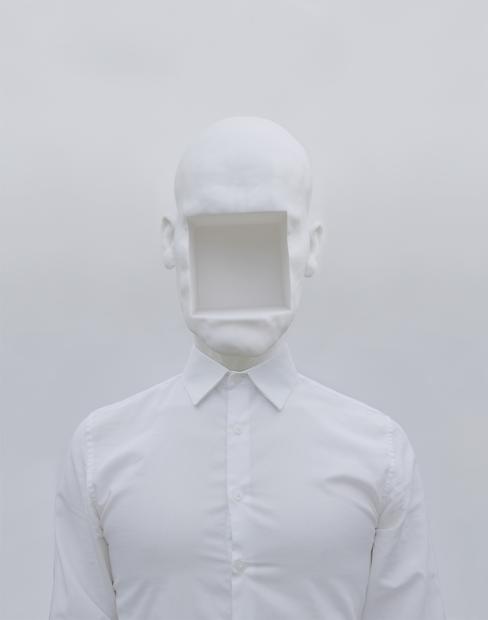
The centerpiece of Spanish artist Bernardí Roig’s latest exhibition at the Claire Oliver Gallery in Chelsea, “The Mirror (exercises to be another),” is the all-white title work, a sculpture of two men on a platform facing each other as if looking in a mirror, a bright fluorescent light both blinding and dividing them. Cast in polyester resin and marble dust, the men stand barefooted, their bellies hanging over their unbuttoned pants, one of the figures with his fingers in his ears, the other having apparently just ripped off part of his face, including his mouth and an eye. It’s a wry comment on one of Roig’s primary themes, people’s inability to communicate in contemporary society, slyly referencing the iconic “See no evil, hear no evil, speak no evil” trope, while also engaging in a search for truth and reality, as one man is a distorted version of the other. In the far corner, “The Invisibility of Memory (La invisibilidad de la memoria)” features a similar white figure (though with a third arm), his head downtrodden, his body defeated, hanging from a metal frame that holds a video screen showing unclear images that eventually fade away. Roig also includes fourteen charcoal drawings, inspired by Ingres’ “Portrait of Monsieur Bertin” and Federico de Madrazo’s “Portrait of Gertrudis G. de Avellaneda,” which, like the sculptures, examine identity through the subject, the viewer, and the artist.

Roig, who was born in Palma de Mallorca and had the first show in this space back in 2002 — he’s been with Claire Oliver for fourteen years — recently said, “Images are like the foam of the subconscious mind.” Although his sculptures are instantly engaging, extremely pleasing to the eye, they are loaded with deeper meaning, inviting those who gaze upon them to go well beyond the surface. “It is gratifying to see the response to his work from curators, critics, and collectors alike; we have watched him grow as an artist and are proud to represent his works,” Oliver told twi-ny. “Working with the artist is a pleasure; Roig is highly intellectual but remains grounded and humorous as well. His thought process is deliberate and the works produced, without exception, are of the highest quality.” A provocative thinker with a strong art-historical bent, Roig discussed language, dialogue, running out of ideas, and the human body while staying in New York City with his family during the run of the show, which closes January 11.

twi-ny: What was your initial impetus behind creating all-white sculptures cast from real people? Do you have favorite models?

Bernardí Roig: I started by casting my father’s body, which was what was closest at hand, to address the symbolic figure of the great castrator. It was a big, heavily built body . . . and then afterwards there came other similar ones, always bulky and always people connected to me. Once positivized, they are white for two reasons: firstly, to gain in visual lightness and refute their affirmative and statuary quality so that they are simply images and, secondly, to help me detain the moment. Sculpture is an instant trapped in a form. All Goethe’s Faust can be reduced to one single sentence: “Time stands still! You are so beautiful. . . .” Only then does one understand that the moment is white. This brooks no doubt. And in all certainty it is white, because light, once stilled, coagulates. We might then say that the gaze has been submerged in a glass of milk, and in this glass of milk we recognize the annunciation of a form of knowledge where the signifieds have still not copulated.

twi-ny: These white figures, especially when bright light is projected onto them, are a kind of blank slate, setting up a potentially wide-open, complex dialogue between object and viewer. While some of your regular themes involve blindness, death, and the individual’s uneasy search for identity, there is something inherently aesthetically pleasing about your sculptures; people immediately react with happiness upon seeing them. Is there an intended contradiction there?

BR: I’d say that the intentions are contradictory because they are made of opposites, just like our thoughts. The themes my work engages with are by no means strange; they are embedded in the medulla of all thinking people. I’m not very sure of people’s relationship with my work. It’s hard to really tell, and I imagine that the spectrum of readings is as wide as the number of individual spectators. The images we make come from deep down, from far back, and they rise like foam to the surface of the unconscious.

Language was invented to try to bridge the gap of noncommunication, but it obviously falls short. I also accept that a convulsive image can produce a feeling of happiness, something that also happens with Surrealism.

twi-ny:The exhibition at Claire Oliver also features charcoal drawings, including several based on Ingres’ “Portrait of Monsieur Bertin” and Madrazo’s “Portrait of Gertrudis G. de Avellaneda.” What struck you about those two portraits?

Bernardí Roig

Bernardí Roig explores language, communication, the human body, and more in latest exhibit (photo by Timothy Greenfield-Sanders)

BR: I started out from two historic paintings to make this new series of fourteen large drawings which I’ve called “Je est un autre.” Seven male portraits reinterpreting the “Portrait of Monsieur Bertin” by Ingres (1832), housed in the Louvre, facing seven female portraits reinterpreting the “Portrait of Gertrudis G. de Avellaneda” (1857) by Madrazo, on view at the Lázaro Galdiano Museum in Madrid. The title of the series, “Je est un autre,” is a celebrated sentence from Rimbaud’s Lettre du voyant (“Letter of the Seer”) to his friend Paul Demeny, where the poet accepted the loss of identity and splitting of the self through negation.

These fourteen drawings play with the superimposition of reflected identities, revealing how any representation of identity contains the latent experience of its opposite. “Monsieur Bertin” is a frontal depiction of a bourgeois man, opulent, arrogant and powerful, even more powerful than the emperor himself, while Gertrudis de Avellaneda is an enlightened, cosmopolitan Spanish poet, born in Cuba, who represents female resistance to the hermetic, masculine, and oppressive academic world in Spain in the mid-nineteenth century.

twi-ny: For “Instante Blanco,” which is currently at el Museo Nacional de Escultura, you placed your white sculptures among the institution’s polychrome works, creating a kind of intervention. Are you pleased with the way it turned out? Do you plan on doing more of these types of installations?

BR: The use of polychrome is in search of realism, to bring the carved wood closer to the truth, to try to produce belief through a whole itinerary marked out by the palpability of the flesh. Most of the works in the Museo Nacional de Escultura were originally devotional religious images whose contemplation held out some kind of guarantee. What I proposed was an itinerary of whispered dialogues with the space itself and not so much with the works.

When you work with historic museum spaces you expand the boundaries of experience. Each exhibition I do has to produce the unforeseen. Though my works hit you immediately as sculptures, I work above all with places and for each place I pose different questions. But I don’t try to answer them. I don’t believe that the purpose of art is to come up with answers but perhaps to hone the incisiveness of the questions.

I’ve already done these kinds of interventions in the Cathedral of Burgos, in Cà Pesaro Galleria Internazionale d’Arte Moderna at the fifty-fourth Venice Biennale, and at the Lázaro Galdiano Museum in Madrid, and at the current moment I am working on a project for the “Intersections” program at the Phillips Collection in Washington.

twi-ny: You’re often quite critical of your own work. You recently said, “I have the feeling that I am always repeating the same ideas and that I am incapable of saying new things. . . . Every time you want to delay more the moment of showing anything, but you have to do it.” Is it difficult for you to let go and open a new exhibition? Is it hard for you to accept praise? The general public, and critics, seem to take pure delight in your work.

BR: It’s true that I find it increasingly more difficult to add something to what has already been said. . . . The edges of words are more and more frayed all the time. That said, it is equally true that you are part of a chain of images from which you can’t escape, and that’s why it is better to get them out of your head before they explode inside it. These images are often only leftover scraps that the head spits out; other times they have the necessary density to guarantee the meaning of the work, just at the moment when the unforeseen appears. That would be the most fertile ground. As Guido, the character played by Marcello Mastroianni in Fellini’s 8½, says: “I really have nothing to say, but I want to say it all the same.”

twi-ny:You just spent the holidays in New York, and now you’ve gotten to see the city blanketed with snow, in a way emulating your sculptures. How are the holidays different in New York than in Mallorca?

BR: There’s one big difference: right now in New York there is a major exhibition of an artist who, in a place infested by banal low-intensity images, makes you believe again in grand Art: Richard Serra. It is worthwhile living in a world where an artist can still produce a shiver in the gaze.