this week in art

KARA WALKER AT DOMINO: A SUBTLETY

(photo by twi-ny/mdr)

Kara Walker’s massive public art project features a sphinxlike mammy figure and life-size child slaves (photo by twi-ny/mdr)

KARA WALKER — A SUBTLETY OR THE MARVELOUS SUGAR BABY: AN HOMAGE TO THE UNPAID AND OVERWORKED ARTISANS WHO HAVE REFINED OUR SWEET TASTES FROM THE CANE FIELDS TO THE KITCHENS OF THE NEW WORLD ON THE OCCASION OF THE DEMOLITION OF THE DOMINO SUGAR REFINING PLANT
Domino Sugar Factory
South First St. at Kent Ave.
Saturday, July 5, and Sunday, July 6, free, 11:00 am – 7:00 pm
www.creativetime.org
kara walker at domino slideshow

For more than 150 years, the Domino Sugar Factory has stood tall on the Williamsburg waterfront, the first sugar refinery in Brooklyn and at one time the largest in the world. The pre-Civil War structure was rebuilt in 1882 after a fire, it closed shop in 2004, and the 30,000-square-foot location is slated for demolition in a few months, giving way to luxury housing and commercial space. But it is getting quite a send-off, temporarily home to a spectacular, multilayered public art project that will have people talking for a long time. Forty-four-year-old California-born MacArthur “Genius” Kara Walker, best known for creating black silhouettes that boldly depict the horrors of slavery (“My Complement, My Enemy, My Oppressor, My Love,” “Gone: An Historical Romance of a Civil War as It Occurred between the Dusky Thighs of One Young Negress and Her Heart”), has installed “A Subtlety or the Marvelous Sugar Baby: an Homage to the unpaid and overworked Artisans who have refined our Sweet tastes from the cane fields to the Kitchens of the New World on the Occasion of the demolition of the Domino Sugar Refining Plant,” which remains on view through July 6. Upon entering the vast, open space, visitors are greeted by more than a dozen “Sugar Babies,” life-size sculptures in resin and molasses of slave children carrying baskets or bananas; some of the figures have melted, turning into what looks like a bloody mess on the floor, as if beaten to death, while also recalling tar. The objects in the baskets are parts of their bodies that essentially dissolved and fell off, as if their true selves have been eviscerated. Meanwhile, the air is filled with an acrid, rotting smell that falls right in line with the bittersweet nature of the installation.

“Sugar Babies” carry remnants of themselves in baskets at the Domino Sugar Factory (photo by twi-ny/mdr)

Melting “Sugar Babies” carry remnants of themselves in baskets at the Domino Sugar Factory (photo by twi-ny/mdr)

Glistening at the end of the large hall is an enormous white sphinx, made of foam and refined white sugar, sitting proudly, a highly sexualized mammy figure that evokes Aunt Jemima, serving as an oracle to the past, present, and future of a culture still dominated by racial tension, discrimination, and violence. A kerchief tied around her head, she stares out, her powerful fists outstretched (one in a gesture that alternately means “good luck” and “fuck you” in different countries), her large breasts both taunting and threatening. The curves of her body lead to giant buttocks and an exposed vulva that both shock and delight, laden in contradiction. The sculpture is yellowing at some points, the sugar crystalizing in the summer heat. When the exhibit ends, some of the slave babies will be able to be shown again, but the sphinx will be destroyed, erased from the annals of history, like so many aspects of slavery — but its memory will live on, a reminder of, among other things, that slavery took place right here in New York City. The controversial piece, totem and caricature, paradox and paradigm, uses stereotypes and racist imagery in referencing the refining of brown sugar into a white substance, the association of sugar with luxury desserts for the wealthy (the word “subtlety” refers to sweet banquet desserts), colonialism, and the exploitation of workers (including child labor, once again an issue on family-owned tobacco farms in America and sugar refineries in the Dominican Republic) in a society dominated by commercialism and corporations, offering an unspoken riddle with no answers. In her preliminary sketches, Walker used such phrases as “Sugar Rules the World,” “Natural processes fueled by industry,” “Production, not-consumption,” and “Refining to achieve desired whiteness which is equated in the modern mind — with purity,” lending crucial insight to her thinking. However, Walker has chosen to give no official artist’s statement about her first large-scale public art installation, preferring that people experience it for themselves, although project sponsor Creative Time has supplemented the work with five “Reports” that explore various aspects of “A Subtlety,” which can be found online: Edwidge Danticat’s “The Price of Sugar,” Tracy K. Smith’s “Photo of Sugar Cane Plantation Workers, Jamaica, 1891,” Jean-Euphèle Milcé’s “To Drink My Sweet Body,” Ricardo Cortés’s “The Act of Whitening,” and Shailja Patel’s “Unpour.”

Bittersweet Kara Walker installation is layered with meaning that is controversial, complex, and purposefully contradictory (photo by twi-ny/mdr)

Bittersweet Kara Walker installation is layered with meaning that is controversial, complex, and purposefully contradictory (photo by twi-ny/mdr)

Central to the work are viewers’ reactions. Some are in awe of its beauty and scope, while others pose in front of it for touristy photographs. Some consider the history and mystery that literally surround it, while others smile and pretend to put their arms around one of the slave babies as if they are friends or perform silly acts with the sphinx’s backside and genitalia. Many are so obsessed with taking pictures and video that they never pause, process, and contemplate what they are looking at. Yes, it’s spectacle, but it’s spectacle on a grand order, an unforgettable experience that places a powerful mirror on America’s four-hundred-year history, revealing telling elements that many still refuse to accept.

There are only two days left to see “A Subtlety,” which is open 11:00 am to 7:00 pm on Saturday and Sunday, July 5-6. Admission is free, but you can expect the lines to be a lot longer than the previous twenty minutes or so. After that, the piece, along with the Domino Sugar Factory itself, will meet its demise, though it will live on in the minds of those who had the opportunity to partake in its majesty.

FIRST SATURDAYS: BROOKLYN SUMMER

David Hammons, “The Door (Admissions Office),” wood, acrylic sheet, and pigment construction, 1969 (California African American Museum, Los Angeles, Collection of Friends, the Foundation of the California African American Museum / © David Hammons)

David Hammons, “The Door (Admissions Office),” wood, acrylic sheet, and pigment construction, 1969 (California African American Museum, Los Angeles, Collection of Friends, the Foundation of the California African American Museum / © David Hammons)

Brooklyn Museum
200 Eastern Parkway at Washington St.
Saturday, July 5, free, 5:00 – 11:00 ($10 discounted admission to “Ai Weiwei: According to What?”)
212-864-5400
www.brooklynmuseum.org

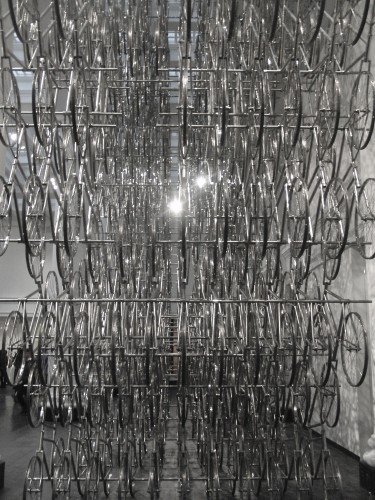
The Brooklyn Museum is throwing a summer party for its July free First Saturdays program, centered by a twenty-fifth-anniversary screening of Spike Lee’s Bed-Stuy classic, Do the Right Thing. In addition, there will be music from Matuto, Blitz the Ambassador, DJ Uhuru, and Nina Sky, a female comedy showcase hosted by Erica Watson, a talk and fashion show led by Afros: A Celebration of Natural Hair author Michael July, a sidewalk chalk drawing project organized by the City Kids, a hula hoop demonstration with Hula Nation, an art workshop in which participants will learn figure drawing with a live model, and an interactive talk with “Brooklyn in 3000 Stills” creators Paul Trillo and Landon Van Soest. In addition, you can check out the current quartet of exhibitions, all of which deal with activism through art: “Ai Weiwei: According to What?,” “Swoon: Submerged Motherlands,” “Chicago in L.A.: Judy Chicago’s Early Works, 1963–74,” and “Witness: Art and Civil Rights in the Sixties.”

Moneta Sleet Jr., “Selma Marchers on road to Montgomery,” gelatin silver photograph, 1965 (courtesy Brooklyn Museum)

Moneta Sleet Jr., “Selma Marchers on road to Montgomery,” gelatin silver photograph, 1965 (courtesy Brooklyn Museum)

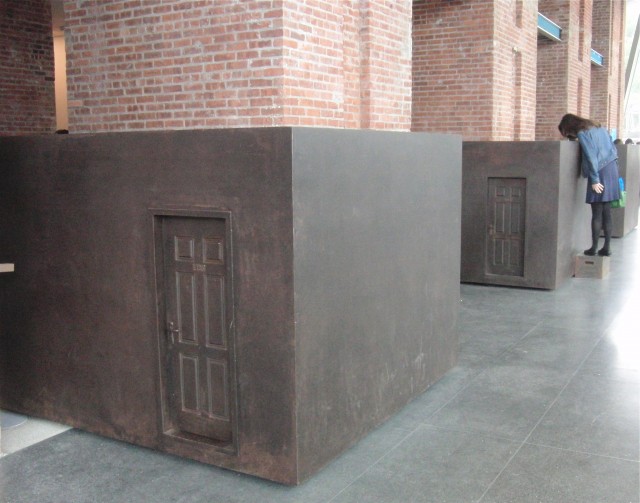
The powerful, wide-ranging “Witness,” which has just been extended through July 13 (the other three exhibits continue into August or September), is a traveling show being held in conjunction with the fiftieth anniversary of the passage of the Civil Rights Act of 1964. More than one hundred paintings, sculptures, photographs, and installations are on view, divided into eight thematic categories: “Integrate Educate,” “American Nightmare,” “Presenting Evidence,” “Politicizing Pop,” “Black Is Beautiful,” “Sisterhood,” “Global Liberation,” and “Beloved Community.” In Bruce Davidson’s “USA. Montgomery, Alabama. 1961,” a black Freedom Rider sits by a window on a bus being escorted by the National Guard. David Hammons’s “The Door (Admissions Office)” is not exactly a welcoming sight. Norman Rockwell’s “New Kids in the Neighborhood (Negro in the Suburbs)” depicts three white children and two black children stopped on a sidewalk, curiously looking at each other. Melvin Edwards’s “Chaino” evokes slavery and lynchings. A trio of cartoonish KKK members drive into town in Philip Guston’s “City Limits.” There are also works by Romare Bearden, Jacob Lawrence, Norman Lewis, Jack Whitten, Faith Ringgold, Ben Shahn, Betye Saar, Gordon Parks, Jim Dine, Yoko Ono, Barkley Hendricks, Robert Indiana, Richard Avedon, and others that examine the civil rights movement from multiple angles, displaying America’s continuing shame.

RAGNAR KJARTANSSON: ME, MY MOTHER, MY FATHER, AND I

(photo by Benoit Pailley/New Museum)

Epic durational performance at the New Museum comes to a close on June 29 (photo by Benoit Pailley/New Museum)

New Museum of Contemporary Art
235 Bowery at Prince St.
Through Sunday, June 29, $16
212-219-1222
www.newmuseum.org

“This is it. Is this it?” a group of musicians sing over and over again on the fourth floor of the New Museum. Today, after more than eight weeks, it will finally be it for the ten guitarists and vocalists who have been performing the song “Take Me Here by the Dishwasher: Memorial for a Marriage” as part of Icelandic artist Ragnar Kjartansson’s first museum show, “Me, My Mother, My Father, and I.” Since May 7, the ten troubadours — eight of whom have remained with the project for its duration — have been playing the song, composed by former Sigur Rós member Kjartan Sveinsson, while sitting on chairs, a couch, stools, or mattresses or walking around barefoot or in socks, boots, or sneakers as a short clip from the first Icelandic feature film, director Reynir Oddsson’s 1977 Morðsaga (Murder Story), is repeated on the far wall. In the scene, Kjartansson’s mother plays a housewife who fantasizes about having sex in the kitchen with the plumber, played by Kjartansson’s father. Supposedly, Kjartan Ragnarsson and Guðrún Ásmundsdóttir had sex for real the next night, conceiving Ragnar. Sveinsson’s ethereal composition, which hints at such familiar tunes as Pink Floyd’s “Comfortably Numb,” the Rolling Stones’ “Wild Horses,” and David Bowie’s “Space Oddity,” becomes a kind of meditative mantra that really can be listened to for hours on end, highlighted by the central recognizable phrase “by the dishwasher” (where the on-screen couple make love). Audience members are encouraged to sit in one of the chairs or lie on a mattress that isn’t being used and even chat with the performers, particularly when they go on break; unsurprisingly, the ten men have received many telephone numbers during the length of the show. (However, keep away from the refrigerator; the beer is for the band only.)

(photo by twi-ny/mdr)

Band members have played “Take Me Here by the Dishwasher: Memorial for a Marriage” for nearly eight weeks straight (photo by twi-ny/mdr)

Meanwhile, in a corner of the space, the video Me and My Mother is looped on a small monitor, depicting Kjartansson’s mom spitting in his face every five years; it was hard not to consider whether the band members have ever thought about spitting on Kjartansson as well, but it turns out that “Me, My Mother, My Father, and I” is not torturous at all. What makes it so visceral is how the musicians approach the song; instead of merely going through the motions, they invest themselves in it, keeping it fresh and alive despite the endless repetition, interacting with the crowd and each other. One guitarist suddenly struts to the center, singing loudly. Another starts noodling on the six-string, adding bluesy notes or echoes of Jerry Garcia. Another is rejuvenated by his girlfriend giving him a shoulder rub as he plays. Yet another, seeing one of his compatriots nodding off, goes over and gives him a little kick, and both jump into action. Several react when a woman gets off a mattress and starts dancing and twirling. And then, as if by magic, the ten musicians gather together for a final flourish fifteen minutes before closing time. Last year, Kjartansson presented “A Lot of Sorrow” at MoMA PS1, in which Brooklyn band the National performed its song “Sorrow” for six consecutive hours in the VW Dome. “Me, My Mother, My Father, and I” takes such durational performance to a whole new level, an inspiring and inspirational show that gets into your soul. You might never look at your dishwasher the same way again.

HIROSHI SUGIMOTO: STILL LIFE

Hiroshi Sugimoto

Hiroshi Sugimoto, “Manatee,” gelatin silver print, 1994 (courtesy Pace Gallery)

HIROSHI SUGIMOTO: STILL LIFE
Pace
510 West 25th St. between Tenth & Eleventh Aves.
Through Saturday, June 28, free, 10:00 am – 6:00 pm
www.pacegallery.com
www.sugimotohiroshi.com

In his “Portraits” series, Tokyo-born, New York City-based artist Hiroshi Sugimoto created what appear to be painting-like photographs, in stark black-and-white, of such figures as Pope John Paul II, Fidel Castro, and Yasser Arafat as well as, quite impossibly, Henry VIII, Napoleon Bonaparte, and Rembrandt. The long-exposure pictures were actually taken of figures from wax museums, set against a dark background to take them out of historical context. In his ongoing “Dioramas” series, Sugimoto similarly plays with reality, as what at first seem to be beautifully composed deep-focus shots of living, breathing nature scenes turn out to be photographs of dioramas of fake trees, painted mountains, and taxidermied animals taken in natural history museums. Seventeen of the stunning photographs are on view in “Hiroshi Sugimoto: Still Life,” running through June 28 at Pace’s 510 West 25th St. gallery.

Hiroshi Sugimoto, “Olympic Rain Forest,” gelatin silver print, 2012 (courtesy Pace Gallery)

Hiroshi Sugimoto, “Olympic Rain Forest,” gelatin silver print, 2012 (courtesy Pace Gallery)

“Upon first arriving in New York in 1974, I did the tourist thing,” Sugimoto points out on his website. “Eventually I visited the Natural History Museum, where I made a curious discovery: the stuffed animals positioned before painted backdrops looked utterly fake, yet by taking a quick peek with one eye closed, all perspective vanished, and suddenly they looked very real. I’d found a way to see the world as a camera does. However fake the subject, once photographed, it’s as good as real.” The inviting pictures look very real indeed, from groups of wapiti, California condors, and South Georgian penguins to several lush forests. The most dazzling of the silver gelatin prints features a manatee floating just above some rocks, rays of sunlight breaking through the surface of the water, bathing the fascinating creature in an otherworldly glow. It practically makes you want to tap the glass to get the large mammal’s attention. Sugimoto, who was just awarded the Isamu Noguchi Award for Kindred Spirits in Innovation, Global Consciousness, and Japanese/American Exchange, has also explored the nature of how we visually interpret what we see in such other series as “Seascapes,” “Theaters,” and “Lightning Fields”; in “Dioramas,” he again makes the viewer question what is real while examining the very meaning of “still life” in his own special way.

TONY MATELLI: SLEEPWALKER

Tony Matelli

Tony Matelli’s “Sleepwalker” sculpture at Wellesley became a crime scene when vandals struck

Marlborough Chelsea
545 West 21st St. between Tenth & Eleventh Aves.
Tuesday – Saturday through August 8, 10:00 am – 6:00 pm
212-463-8634
www.marlboroughchelsea.com
www.wellesley.edu/davismuseum

Several weekends ago, after coming home from a jaunt through Chelsea galleries, I showed my wife photos I’d taken of some of my favorite works. Upon seeing one of them, she immediately said, “I think that’s the same piece that caused such a furor at Wellesley.” Indeed, I had shown her a photo of Tony Matelli’s “Sleepwalker,” a life-size painted bronze sculpture of a zombielike middle-aged white man in his underwear, eyes closed, arms outstretched, standing on the outdoor deck of the Marlborough Gallery on West 21st St. Being a sucker for lifelike sculpture — I can spend hours checking out works by Ron Mueck, Paul McCarthy, Mark Jenkins, and others — I got a huge kick out of the piece, which I found intriguing and humorous, not threatening at all, perhaps even symbolic of an America that often seems to be half asleep. However, context is everything. My wife quickly pointed out that a significant number of Wellesley students were aghast when a fiberglass cast of “Sleepwalker” had been placed outside, on campus, in February as part of the “Tony Matelli: New Gravity” exhibition at the university’s outstanding Davis Museum, the Chicago-born, Brooklyn-based sculptor’s first solo museum show. Coincidentally, we were going to Wellesley the following weekend, where we looked forward to seeing the sculpture for ourselves in an environment very different from the Chelsea deck, but sadly it had had to be removed in May, ahead of the July 20 conclusion of the exhibition, for a very surprising reason.

Shortly after the unveiling of “Sleepwalker,” which was placed outside in a wooded area near the Davis, where it could be seen from a window, hundreds of Wellesley students signed an online petition calling for the work to be moved inside the museum. The petition read in part, “Within just a few hours of its outdoor installation, the highly lifelike sculpture . . . has become a source of apprehension, fear, and triggering thoughts regarding sexual assault for some members of our campus community. While it may appear humorous, or thought provoking to some, the ‘Sleepwalker’ has already become a source of undue stress for a number of Wellesley College students, the majority of whom live, study, and work on campus.” Davis Museum director Lisa Fischman defended the installation, explaining, “Art has an extraordinary power to evoke personal response, and to elicit the unexpected. . . . Art provokes dialogue, and discourse is the core of education. In that spirit, I am enormously glad to have your response.”

(photo by twi-ny/mdr)

“Sleepwalker” will stay up at the Marlborough Chelsea through August 8 (photo by twi-ny/mdr)

Matelli himself chimed in on the debate, telling CBS Boston, “I think that these people are misconstruing this work. I think they’re seeing something in this work that isn’t there. But who am I to say how people should react to this?” He added, “I don’t think they’ll take the statue down. But if they make that decision, that’s fine with me.” I’m not sure it’s fine with Matelli why it ultimately had to be taken down; first, a student (since suspended) spray-painted the statue yellow, her class color (she did the same to Matelli’s nearby small dog sculpture), then a still-unidentified perp broke the five-foot, nine-inch-high “Sleepwalker” at its ankles, apparently in an effort to kick it down. I was shocked when I saw photos of the damage, which totaled the work, leaving it irreparable; was this really possible at such a liberal, free-thinking college as Wellesley? Is this type of censorship any different from Attorney General John Ashcroft and deputy director of public affairs Monica Goodling using a blue curtain to cover up the partially nude “Spirit of Justice” Art Deco aluminum statue in the Great Hall of the Justice Department in 2002? Or when performance artist Alexander Brener spray-painted a green dollar sign over Kazimir Malevich’s “Suprematisme 1920-1927” in 1997 in protest of the commercialism of art? (“I view my act as a dialogue with Malevich,” Brener said in court.) During the Wellesley reunion weekend, I spoke with numerous current and former students of all ages, and each had an individual reaction to the installation of “Sleepwalker” itself and to the eventual damage. Some felt that art is art and people should “get a life” and not interpret everything so personally. Others believed it was a gross error on the part of the museum and the school to put a statue so suggestive to survivors or victims of sexual abuse outside, near a wooded area, at a woman’s college. Fortunately, no one was in favor of the vandalism. Yes, it’s encouraging that a work of art elicited such strong personal feelings on many fronts, but have we become a bunch of whimpering souls, not able to look the other way when it comes to an inanimate sculpture that means different things to different people? If something is displeasing to some but not to others, must it be wished away into the cornfield, hidden where no one will ever see it? Or is it further evidence that the gender divide is still much larger than we imagined, even at such an illustrious college as Wellesley? You can check out Matelli’s “Sleepwalker” at the Marlborough through August 8, but, of course, you’ll never be able to see the Wellesley version.

MIKA ROTTENBERG: BOWLS BALLS SOULS HOLES

Mika Rottenberg’s latest multimedia architectural installation links bingo with global climate change (photo courtesy Andrea Rosen Gallery)

Mika Rottenberg’s “Bowls Balls Souls Holes” is another unique, fascinating, fun, and complex installation (photo courtesy Andrea Rosen Gallery)

Andrea Rosen Gallery
525 West 24th St. between Tenth & Eleventh Aves.
Tuesday — Saturday through June 14, free, 10:00 am – 6:00 pm
212-627-6000
www.andrearosengallery.com

BedStuy-based multimedia artist Mika Rottenberg explores chance, luck, environmental concerns, and mass production on a global scale in her latest architectural video installation, “Bowls Balls Souls Holes.” Born in Argentina and raised in Israel before moving to Brooklyn, Rottenberg creates immersive pieces that combine video and sculpture focusing on wildly imaginative Rube Goldberg-like experimental contraptions that bring together radically diverse labor-intensive elements, along with a cast of men and mostly women who can do extreme things with their bodies. In “Tropical Breeze,” the characters (including professional body builder Heather D. Foster) made an actual product, Lemon-Scented Tropical Breeze Moist Tissue Papers; in “Mary’s Cherries,” various women (including fetish wrestler Rock Rose) perform household-like tasks that use red fingernails to make maraschino cherries. In “Cheese,” which was part of the 2008 Whitney Biennial, old-fashioned Rapunzel-esque farm girls use their very long hair to help make the title product. In one of Rottenberg’s crazier setups, “Squeeze” involves butt misting, wall tongues, and the stomping of iceberg lettuce. And in 2011, Rottenberg teamed up with Jon Kessler for the Performa 11 commission “Seven,” a unique chakras juicer that linked a New York lab with an African community.

Mika Rottenberg’s latest multimedia architectural installation links bingo with global climate change (photo courtesy Andrea Rosen Gallery)

Mika Rottenberg’s latest multimedia architectural installation links bingo with global climate change (photo courtesy Andrea Rosen Gallery)

In the twenty-eight-minute “Bowls Balls Souls Holes,” Rottenberg links a Harlem bingo parlor with polar icebergs and a large sleeping woman who dreams of the moon and wakes up every time a drop of water falls from above and sizzles on her bare shoulder. Occasionally, the bingo caller releases a colored clothespin down a hole, sending it on a journey through multiple trapdoors until it is caught way below by a man (Guinness Book of World Records champion face stretcher Garry “Stretch” Turner, who has Ehlers-Danlos syndrome) who attaches it to his face. The idea of things coming full circle is central to the work, which features many kinds of round objects while also evoking a highly unusual assembly line. As with her other pieces, “Bowls Balls Souls Holes” is filled with some hysterical bits, in addition to some out-and-out confusing ones, which is always part of the fun. (Don’t try too hard to figure everything out.) The video is supplemented with related sculptures, from the bingo board and jars with boiling water to a trio of swirling ponytails and an air conditioner dripping water onto a hot frying pan.

MUSEUM MILE FESTIVAL 2014

Museum Mile Festival

Uptown institutions stay open late and open their doors for free for Museum Mile Festival

Multiple locations on Fifth Ave. between 82nd & 105th Sts.
Tuesday, June 10, 6:00 – 9:00 pm
Admission: free
www.museummilefestival.org

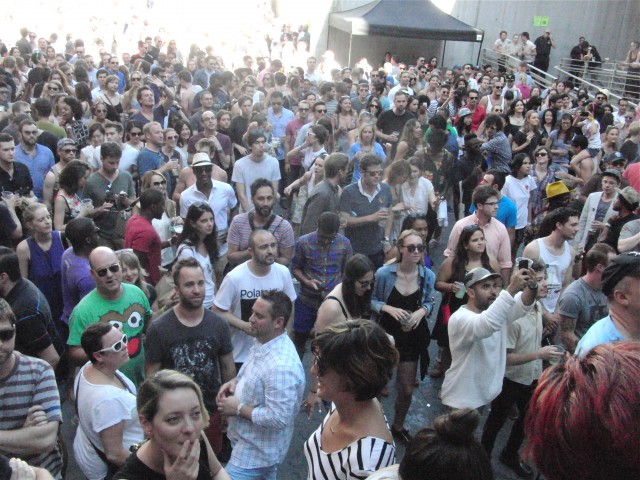
There’s really only one main problem with the annual Museum Mile Festival: It’s too short. On Tuesday, June 10, from 6:00 to 9:00, nine uptown art and cultural institutions will open their doors for free and fill Fifth Ave. between 82nd & 104th Sts. with family-friendly activities for the thirty-fifth year. There will be live outdoor performances by the Asphalt Orchestra, Sammie & Trudie’s Imagination Playhouse, Silly Billy the Very Funny Clown, Avenida B, Josh the Juggler, Bill Ferguson, and Magic Brian, in addition to face painting, art workshops, chalk drawing, the Museum of Motherhood, and more. The participating museums (with at least one of their current shows listed here) are El Museo del Barrio (“Presencia: Works from El Museo’s Permanent Collection”), the Museum of the City of New York (“Palaces for the People: Guastavino and the Art of Structural Tile,” “In a World of Their Own: Coney Island Photographs by Aaron Rose”), the Jewish Museum (“Other Primary Structures,” “Mel Bochner: Strong Language”), the National Academy (“The Annual 2014: Redefining Tradition”), the Guggenheim (“Italian Futurism, 1909-1944: Reconstructing the Universe”), the Neue Galerie (“Degenerate Art: The Attack on Modern Art in Nazi Germany, 1937”), and the Metropolitan Museum of Art (“Charles James: Beyond Fashion,” “Out of Character: Decoding Chinese Calligraphy”), along with the Africa Center / Museum (which is building a new home) and the Cooper-Hewitt, National Design Museum (which is undergoing a major renovation). Don’t try to do too much, because it can get rather crowded; just pick one or two exhibitions in one or two museums and enjoy.