this week in art

MOVIE MEDICINE — A FILM SERIES ABOUT THE HEALING FACTOR IN CINEMA: NIGHT NURSE

Joan Blondell and Barbara Stanwyck play daring nurses in William A. Wellmans pre-code doozy

Joan Blondell and Barbara Stanwyck play daring nurses in William A. Wellman’s pre-code doozy

CABARET CINEMA: NIGHT NURSE (William A. Wellman, 1931)
Rubin Museum of Art
150 West 17th St. at Seventh Ave.
Friday, July 11, free with $10 K2 minimum, 9:30
212-620-5000
www.rubinmuseum.org/cabaretcinema

It’s hard to believe that the Hays Code, a set of standards initiated by two religious figures and named after chief censor Will H. Hays, was enacted and enforced, to varying degrees, in Hollywood from 1934 all the way up to 1968. One of the best examples of the racier pre-code films is William A. Wellman’s rarely screened 1931 doozy, Night Nurse. The first of five collaborations between Wellman and Barbara Stanwyck, Night Nurse, based on Dora Macy’s 1930 novel, stars Stanwyck as Lora Hart, a young woman determined to become a nurse. She gets a probationary job at a city hospital, where she is taken under the wing of Maloney (Joan Blondell), who likes to break the rules and torture the head nurse, the stodgy Miss Dillon (Vera Lewis). Shortly after treating a bootlegger (Ben Lyon) for a gunshot wound and agreeing not to report it to the police, Lora starts working for a shady doctor (Ralf Harolde) taking care of two sick children (Marcia Mae Jones and Betty Jane Graham) whose proudly dipsomaniac mother (Charlotte Merriam) is being manipulated by her suspicious chauffeur (Clark Gable). Wellman pulls out all the stops, hinting at or simply depicting murder, child endangerment, rape, alcoholism, lesbianism, physical brutality, and Blondell and Stanwyck regularly frolicking around in their undergarments. It’s as if Wellman is thumbing his nose directly at the upcoming Hays Code in scene after scene. Although far from his best film — Wellman directed such classics as Wings (1927), The Public Enemy (1931), A Star Is Born (1937), Nothing Sacred (1937), Beau Geste (1939), and The Ox-Bow Incident (1943) — Night Nurse is an overly melodramatic, dated, but entertaining little tale with quite a surprise ending. Night Nurse is screening July 11 as part of the Rubin Museum’s Cabaret Cinema series “Movie Medicine: A Film Series about the Healing Factor in Cinema,” being held in conjunction with the “Bodies in Balance: The Art of Tibetan Medicine” exhibition, and will be introduced by Edna Igoe of the New York Professional Nurses Union. The series continues July 18 with Woody Allen’s Sleeper, introduced by psychotherapist Maggie Robbins, July 25 with Arthur Hiller’s The Hospital, introduced by Dr. Kenneth Perrine, and August 1 with Michael Powell and Emeric Pressburger’s Black Narcissus, introduced by award-winning editor Thelma Schoonmaker.

CONTEMPORARY POETRY TOO

poetry too

Andrew Edlin Gallery
134 Tenth Avenue between 18th & 19th Sts.
Thursday, July 10, free, 6:00
212-206-9723
www.edlingallery.com

On May 10, Sam Gordon curated a marathon poetry reading as part of the NADA New York art fair, presented with BOMB magazine. Gordon, NADA, and BOMB have joined forces again with the follow-up, “Contemporary Poetry Too,” taking place July 10 at Andrew Edlin Gallery in Chelsea. Held in conjunction with the group exhibition “Purple States,” which explores the differences between insiders and outsiders and the merging of blue and red states, and “Café Dancer Pop-Up,” in which Jessie Gold and Elizabeth Hart have turned Edlin’s reception area into a “Gone Fishin’” party space, “Contemporary Poetry Too” will feature approximately eighteen poets reading their works in combination with performance and video art; the participants include Alina Gregorian, Angelo Nikolopoulos, Bianca Stone, Emily Skillings, Jameson Fitzpatrick, Juliana Huxtable, not_I (Ana Boziĉević & Sophia Le Fraga), and Sampson Starkweather. DJs S&M (Shannon Michael Cane and Matt Conners) will provide the music.

DANH VO: WE THE PEOPLE

(photo by twi-ny/mdr)

Danh Vo’s “We the People” offers visitors an alternate view of Lady Liberty’s famed drapery in Brooklyn Bridge Park (photo by twi-ny/mdr)

City Hall Park and City Hall
Brooklyn Bridge Park, Granite Terrace, Pier 3 Uplands
Through December 5, free
www.publicartfund.org
we the people slideshow

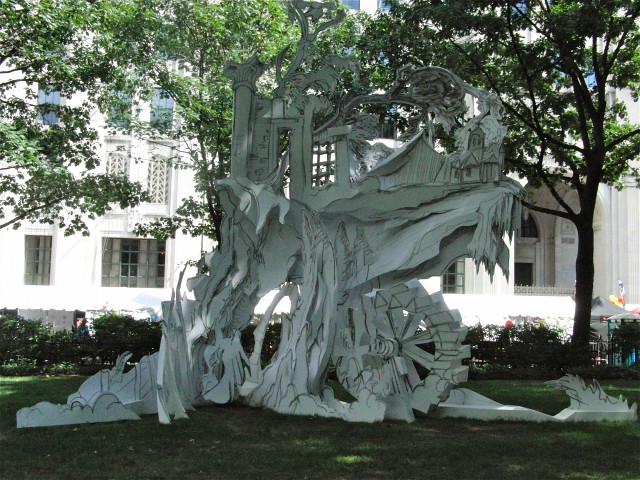
Danish installation artist Danh Vo, who was born in Vietnam in 1975 and lives and works in Berlin and Mexico City, deconstructs a treasured American landmark and international symbol of freedom in unique ways in “We the People.” The Public Art Fund project is named after the first three words of the preamble of the U.S. Constitution, which was ratified on June 25, 1788. Using the same technique nineteenth-century French sculptor Frédéric Auguste Bartholdi employed to construct the 3/32-inch-thick copper drapery that envelops eighty percent of the 305-foot-high, 225-ton “Statue of Liberty Enlightening the World,” Vo, winner of the 2012 Hugo Boss Prize, re-created Lady Liberty’s clothing at scale in Shanghai, dividing it into approximately 250 pieces. Even the fresh copper color is faithful to the original, as the Grand Dame’s well-known green hue is the result of 128 years of weathering in New York Harbor.

(photo by twi-ny/mdr)

Sections of Danh Vo’s “We the People” are scattered throughout City Hall Park and inside City Hall itself (photo by twi-ny/mdr)

A true international affair, “We the People” has been seen in more than fifteen countries over the last few years and now has finally come to America, with select sections on view in City Hall Park and Brooklyn Bridge Park through December 5. The latter installation features three large-scale parts taken from thirteen individual pieces from the sleeve of the Lady on a Pedestal’s torch-raising right arm; as a not-coincidental bonus, the actual statue is visible in the distance. The pieces on display in City Hall Park include various segments on the grass and hidden among the trees; the broken chains and ear are inside City Hall itself, and a flower garden at the southern end further evokes the late-19th-century period in which the statue was built, referencing colonialism and missionary work. Vo has said that the full sculpture will likely never be put together to form a complete whole, metaphorically leaving Liberty naked and fragmented, representing the continuing struggle for freedom throughout the world and the inability of so many nations to unite in peace. The work also has deep personal meaning to Vo, whose family escaped from Vietnam in the late 1970s on a boat his father made, floating toward eventual freedom in Denmark just as so many people still take ships to Ellis Island, passing by the Statue of Liberty on their way to a new life in America.

KARA WALKER AT DOMINO: A SUBTLETY

(photo by twi-ny/mdr)

Kara Walker’s massive public art project features a sphinxlike mammy figure and life-size child slaves (photo by twi-ny/mdr)

KARA WALKER — A SUBTLETY OR THE MARVELOUS SUGAR BABY: AN HOMAGE TO THE UNPAID AND OVERWORKED ARTISANS WHO HAVE REFINED OUR SWEET TASTES FROM THE CANE FIELDS TO THE KITCHENS OF THE NEW WORLD ON THE OCCASION OF THE DEMOLITION OF THE DOMINO SUGAR REFINING PLANT
Domino Sugar Factory
South First St. at Kent Ave.
Saturday, July 5, and Sunday, July 6, free, 11:00 am – 7:00 pm
www.creativetime.org
kara walker at domino slideshow

For more than 150 years, the Domino Sugar Factory has stood tall on the Williamsburg waterfront, the first sugar refinery in Brooklyn and at one time the largest in the world. The pre-Civil War structure was rebuilt in 1882 after a fire, it closed shop in 2004, and the 30,000-square-foot location is slated for demolition in a few months, giving way to luxury housing and commercial space. But it is getting quite a send-off, temporarily home to a spectacular, multilayered public art project that will have people talking for a long time. Forty-four-year-old California-born MacArthur “Genius” Kara Walker, best known for creating black silhouettes that boldly depict the horrors of slavery (“My Complement, My Enemy, My Oppressor, My Love,” “Gone: An Historical Romance of a Civil War as It Occurred between the Dusky Thighs of One Young Negress and Her Heart”), has installed “A Subtlety or the Marvelous Sugar Baby: an Homage to the unpaid and overworked Artisans who have refined our Sweet tastes from the cane fields to the Kitchens of the New World on the Occasion of the demolition of the Domino Sugar Refining Plant,” which remains on view through July 6. Upon entering the vast, open space, visitors are greeted by more than a dozen “Sugar Babies,” life-size sculptures in resin and molasses of slave children carrying baskets or bananas; some of the figures have melted, turning into what looks like a bloody mess on the floor, as if beaten to death, while also recalling tar. The objects in the baskets are parts of their bodies that essentially dissolved and fell off, as if their true selves have been eviscerated. Meanwhile, the air is filled with an acrid, rotting smell that falls right in line with the bittersweet nature of the installation.

“Sugar Babies” carry remnants of themselves in baskets at the Domino Sugar Factory (photo by twi-ny/mdr)

Melting “Sugar Babies” carry remnants of themselves in baskets at the Domino Sugar Factory (photo by twi-ny/mdr)

Glistening at the end of the large hall is an enormous white sphinx, made of foam and refined white sugar, sitting proudly, a highly sexualized mammy figure that evokes Aunt Jemima, serving as an oracle to the past, present, and future of a culture still dominated by racial tension, discrimination, and violence. A kerchief tied around her head, she stares out, her powerful fists outstretched (one in a gesture that alternately means “good luck” and “fuck you” in different countries), her large breasts both taunting and threatening. The curves of her body lead to giant buttocks and an exposed vulva that both shock and delight, laden in contradiction. The sculpture is yellowing at some points, the sugar crystalizing in the summer heat. When the exhibit ends, some of the slave babies will be able to be shown again, but the sphinx will be destroyed, erased from the annals of history, like so many aspects of slavery — but its memory will live on, a reminder of, among other things, that slavery took place right here in New York City. The controversial piece, totem and caricature, paradox and paradigm, uses stereotypes and racist imagery in referencing the refining of brown sugar into a white substance, the association of sugar with luxury desserts for the wealthy (the word “subtlety” refers to sweet banquet desserts), colonialism, and the exploitation of workers (including child labor, once again an issue on family-owned tobacco farms in America and sugar refineries in the Dominican Republic) in a society dominated by commercialism and corporations, offering an unspoken riddle with no answers. In her preliminary sketches, Walker used such phrases as “Sugar Rules the World,” “Natural processes fueled by industry,” “Production, not-consumption,” and “Refining to achieve desired whiteness which is equated in the modern mind — with purity,” lending crucial insight to her thinking. However, Walker has chosen to give no official artist’s statement about her first large-scale public art installation, preferring that people experience it for themselves, although project sponsor Creative Time has supplemented the work with five “Reports” that explore various aspects of “A Subtlety,” which can be found online: Edwidge Danticat’s “The Price of Sugar,” Tracy K. Smith’s “Photo of Sugar Cane Plantation Workers, Jamaica, 1891,” Jean-Euphèle Milcé’s “To Drink My Sweet Body,” Ricardo Cortés’s “The Act of Whitening,” and Shailja Patel’s “Unpour.”

Bittersweet Kara Walker installation is layered with meaning that is controversial, complex, and purposefully contradictory (photo by twi-ny/mdr)

Bittersweet Kara Walker installation is layered with meaning that is controversial, complex, and purposefully contradictory (photo by twi-ny/mdr)

Central to the work are viewers’ reactions. Some are in awe of its beauty and scope, while others pose in front of it for touristy photographs. Some consider the history and mystery that literally surround it, while others smile and pretend to put their arms around one of the slave babies as if they are friends or perform silly acts with the sphinx’s backside and genitalia. Many are so obsessed with taking pictures and video that they never pause, process, and contemplate what they are looking at. Yes, it’s spectacle, but it’s spectacle on a grand order, an unforgettable experience that places a powerful mirror on America’s four-hundred-year history, revealing telling elements that many still refuse to accept.

There are only two days left to see “A Subtlety,” which is open 11:00 am to 7:00 pm on Saturday and Sunday, July 5-6. Admission is free, but you can expect the lines to be a lot longer than the previous twenty minutes or so. After that, the piece, along with the Domino Sugar Factory itself, will meet its demise, though it will live on in the minds of those who had the opportunity to partake in its majesty.

FIRST SATURDAYS: BROOKLYN SUMMER

David Hammons, “The Door (Admissions Office),” wood, acrylic sheet, and pigment construction, 1969 (California African American Museum, Los Angeles, Collection of Friends, the Foundation of the California African American Museum / © David Hammons)

David Hammons, “The Door (Admissions Office),” wood, acrylic sheet, and pigment construction, 1969 (California African American Museum, Los Angeles, Collection of Friends, the Foundation of the California African American Museum / © David Hammons)

Brooklyn Museum
200 Eastern Parkway at Washington St.
Saturday, July 5, free, 5:00 – 11:00 ($10 discounted admission to “Ai Weiwei: According to What?”)
212-864-5400
www.brooklynmuseum.org

The Brooklyn Museum is throwing a summer party for its July free First Saturdays program, centered by a twenty-fifth-anniversary screening of Spike Lee’s Bed-Stuy classic, Do the Right Thing. In addition, there will be music from Matuto, Blitz the Ambassador, DJ Uhuru, and Nina Sky, a female comedy showcase hosted by Erica Watson, a talk and fashion show led by Afros: A Celebration of Natural Hair author Michael July, a sidewalk chalk drawing project organized by the City Kids, a hula hoop demonstration with Hula Nation, an art workshop in which participants will learn figure drawing with a live model, and an interactive talk with “Brooklyn in 3000 Stills” creators Paul Trillo and Landon Van Soest. In addition, you can check out the current quartet of exhibitions, all of which deal with activism through art: “Ai Weiwei: According to What?,” “Swoon: Submerged Motherlands,” “Chicago in L.A.: Judy Chicago’s Early Works, 1963–74,” and “Witness: Art and Civil Rights in the Sixties.”

Moneta Sleet Jr., “Selma Marchers on road to Montgomery,” gelatin silver photograph, 1965 (courtesy Brooklyn Museum)

Moneta Sleet Jr., “Selma Marchers on road to Montgomery,” gelatin silver photograph, 1965 (courtesy Brooklyn Museum)

The powerful, wide-ranging “Witness,” which has just been extended through July 13 (the other three exhibits continue into August or September), is a traveling show being held in conjunction with the fiftieth anniversary of the passage of the Civil Rights Act of 1964. More than one hundred paintings, sculptures, photographs, and installations are on view, divided into eight thematic categories: “Integrate Educate,” “American Nightmare,” “Presenting Evidence,” “Politicizing Pop,” “Black Is Beautiful,” “Sisterhood,” “Global Liberation,” and “Beloved Community.” In Bruce Davidson’s “USA. Montgomery, Alabama. 1961,” a black Freedom Rider sits by a window on a bus being escorted by the National Guard. David Hammons’s “The Door (Admissions Office)” is not exactly a welcoming sight. Norman Rockwell’s “New Kids in the Neighborhood (Negro in the Suburbs)” depicts three white children and two black children stopped on a sidewalk, curiously looking at each other. Melvin Edwards’s “Chaino” evokes slavery and lynchings. A trio of cartoonish KKK members drive into town in Philip Guston’s “City Limits.” There are also works by Romare Bearden, Jacob Lawrence, Norman Lewis, Jack Whitten, Faith Ringgold, Ben Shahn, Betye Saar, Gordon Parks, Jim Dine, Yoko Ono, Barkley Hendricks, Robert Indiana, Richard Avedon, and others that examine the civil rights movement from multiple angles, displaying America’s continuing shame.

RAGNAR KJARTANSSON: ME, MY MOTHER, MY FATHER, AND I

(photo by Benoit Pailley/New Museum)

Epic durational performance at the New Museum comes to a close on June 29 (photo by Benoit Pailley/New Museum)

New Museum of Contemporary Art
235 Bowery at Prince St.
Through Sunday, June 29, $16
212-219-1222
www.newmuseum.org

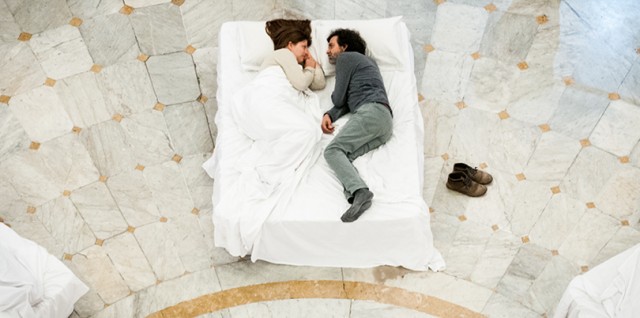
“This is it. Is this it?” a group of musicians sing over and over again on the fourth floor of the New Museum. Today, after more than eight weeks, it will finally be it for the ten guitarists and vocalists who have been performing the song “Take Me Here by the Dishwasher: Memorial for a Marriage” as part of Icelandic artist Ragnar Kjartansson’s first museum show, “Me, My Mother, My Father, and I.” Since May 7, the ten troubadours — eight of whom have remained with the project for its duration — have been playing the song, composed by former Sigur Rós member Kjartan Sveinsson, while sitting on chairs, a couch, stools, or mattresses or walking around barefoot or in socks, boots, or sneakers as a short clip from the first Icelandic feature film, director Reynir Oddsson’s 1977 Morðsaga (Murder Story), is repeated on the far wall. In the scene, Kjartansson’s mother plays a housewife who fantasizes about having sex in the kitchen with the plumber, played by Kjartansson’s father. Supposedly, Kjartan Ragnarsson and Guðrún Ásmundsdóttir had sex for real the next night, conceiving Ragnar. Sveinsson’s ethereal composition, which hints at such familiar tunes as Pink Floyd’s “Comfortably Numb,” the Rolling Stones’ “Wild Horses,” and David Bowie’s “Space Oddity,” becomes a kind of meditative mantra that really can be listened to for hours on end, highlighted by the central recognizable phrase “by the dishwasher” (where the on-screen couple make love). Audience members are encouraged to sit in one of the chairs or lie on a mattress that isn’t being used and even chat with the performers, particularly when they go on break; unsurprisingly, the ten men have received many telephone numbers during the length of the show. (However, keep away from the refrigerator; the beer is for the band only.)

(photo by twi-ny/mdr)

Band members have played “Take Me Here by the Dishwasher: Memorial for a Marriage” for nearly eight weeks straight (photo by twi-ny/mdr)

Meanwhile, in a corner of the space, the video Me and My Mother is looped on a small monitor, depicting Kjartansson’s mom spitting in his face every five years; it was hard not to consider whether the band members have ever thought about spitting on Kjartansson as well, but it turns out that “Me, My Mother, My Father, and I” is not torturous at all. What makes it so visceral is how the musicians approach the song; instead of merely going through the motions, they invest themselves in it, keeping it fresh and alive despite the endless repetition, interacting with the crowd and each other. One guitarist suddenly struts to the center, singing loudly. Another starts noodling on the six-string, adding bluesy notes or echoes of Jerry Garcia. Another is rejuvenated by his girlfriend giving him a shoulder rub as he plays. Yet another, seeing one of his compatriots nodding off, goes over and gives him a little kick, and both jump into action. Several react when a woman gets off a mattress and starts dancing and twirling. And then, as if by magic, the ten musicians gather together for a final flourish fifteen minutes before closing time. Last year, Kjartansson presented “A Lot of Sorrow” at MoMA PS1, in which Brooklyn band the National performed its song “Sorrow” for six consecutive hours in the VW Dome. “Me, My Mother, My Father, and I” takes such durational performance to a whole new level, an inspiring and inspirational show that gets into your soul. You might never look at your dishwasher the same way again.

HIROSHI SUGIMOTO: STILL LIFE

Hiroshi Sugimoto

Hiroshi Sugimoto, “Manatee,” gelatin silver print, 1994 (courtesy Pace Gallery)

HIROSHI SUGIMOTO: STILL LIFE
Pace
510 West 25th St. between Tenth & Eleventh Aves.
Through Saturday, June 28, free, 10:00 am – 6:00 pm
www.pacegallery.com
www.sugimotohiroshi.com

In his “Portraits” series, Tokyo-born, New York City-based artist Hiroshi Sugimoto created what appear to be painting-like photographs, in stark black-and-white, of such figures as Pope John Paul II, Fidel Castro, and Yasser Arafat as well as, quite impossibly, Henry VIII, Napoleon Bonaparte, and Rembrandt. The long-exposure pictures were actually taken of figures from wax museums, set against a dark background to take them out of historical context. In his ongoing “Dioramas” series, Sugimoto similarly plays with reality, as what at first seem to be beautifully composed deep-focus shots of living, breathing nature scenes turn out to be photographs of dioramas of fake trees, painted mountains, and taxidermied animals taken in natural history museums. Seventeen of the stunning photographs are on view in “Hiroshi Sugimoto: Still Life,” running through June 28 at Pace’s 510 West 25th St. gallery.

Hiroshi Sugimoto, “Olympic Rain Forest,” gelatin silver print, 2012 (courtesy Pace Gallery)

Hiroshi Sugimoto, “Olympic Rain Forest,” gelatin silver print, 2012 (courtesy Pace Gallery)

“Upon first arriving in New York in 1974, I did the tourist thing,” Sugimoto points out on his website. “Eventually I visited the Natural History Museum, where I made a curious discovery: the stuffed animals positioned before painted backdrops looked utterly fake, yet by taking a quick peek with one eye closed, all perspective vanished, and suddenly they looked very real. I’d found a way to see the world as a camera does. However fake the subject, once photographed, it’s as good as real.” The inviting pictures look very real indeed, from groups of wapiti, California condors, and South Georgian penguins to several lush forests. The most dazzling of the silver gelatin prints features a manatee floating just above some rocks, rays of sunlight breaking through the surface of the water, bathing the fascinating creature in an otherworldly glow. It practically makes you want to tap the glass to get the large mammal’s attention. Sugimoto, who was just awarded the Isamu Noguchi Award for Kindred Spirits in Innovation, Global Consciousness, and Japanese/American Exchange, has also explored the nature of how we visually interpret what we see in such other series as “Seascapes,” “Theaters,” and “Lightning Fields”; in “Dioramas,” he again makes the viewer question what is real while examining the very meaning of “still life” in his own special way.