this week in art

ONE-WAY TICKET: JACOB LAWRENCE’S MIGRATION SERIES AND OTHER WORKS

Jacob Lawrence

Jacob Lawrence, the Migration Series, 1940-41, Panel 10: “They were very poor,” casein tempera on hardboard (© 2015 the Jacob and Gwendolyn Knight Lawrence Foundation, Seattle / Artists Rights Society, New York)

Museum of Modern Art
Special Exhibitions Gallery, third floor
11 West 53rd St. between Fifth & Sixth Aves.
Through September 7, $25 (including audio program and film screenings)
212-708-9400
www.moma.org

Jacob Lawrence, who was born in 1917 in Atlantic City and moved with his family to Harlem when he was thirteen, depicted the twentieth-century African American experience in stunning, colorful panels painted in a style he called dynamic cubism. Half of his seminal 1941 series about the Great Migration is regularly on view at MoMA, but for this special exhibit, the midtown institution has teamed with the Phillips Collection, which owns the other half, to present the complete sixty-piece work for the first time in New York in twenty years. Lawrence was twenty-three when he created the Migration Series, tracing the movement of African Americans from the south to the north in search of a better life, beginning during the WWI era and continuing into the 1960s. Each panel is a work of art that stands on its own, but together they paint a fascinating portrait that unfolds like a documentary film. The works are arranged chronologically at eye level around the large gallery, with the caption for each right underneath the panel. Taken as a whole, it’s a dizzying array of dazzling color, but individually they tell quite a story as well.

panel 23

Jacob Lawrence, the Migration Series, 1940-41, Panel 23: “In a few sections of the South the leaders of both groups met and attempted to make conditions better for the Negro so that he would remain in the South,” casein tempera on hardboard (© 2015 the Jacob and Gwendolyn Knight Lawrence Foundation, Seattle / Artists Rights Society, New York)

In panel 1, men, women, and children line up at the train station to leave for Chicago, New York, or St. Louis, yellows and blues peeking out among muted browns and greens. In panel 5, a train is barreling past, black smoke floating back, a bright light beaming ahead. In panel 10, a man and a woman are sitting at a table, staring down at their meager food; the caption succinctly states: “They were very poor.” In panel 10, a white judge looks down from on high at two black men huddled below; the caption explains: “Among the social conditions that existed which was partly the cause of the migration was the injustice done to the Negroes in the courts.” In panel 18 (“The migration gained in momentum”), the departure of the men, women, and children is almost biblical in nature, evoking the exodus. Throughout the sixty panels, Lawrence plays with perspective and geometric as well as abstract shapes and patterns, creating scenes that often swirl with movement and life. The Migration Series is a towering achievement, an emotionally powerful work that feels as relevant today as it did when it was first presented more than sixty years ago. The exhibit is supplemented with paintings and drawings by Charles Alston, Romare Bearden, and Charles White, archival footage of Marian Anderson, Duke Ellington, and Billie Holiday, photographs by Dorothea Lange, Ben Shahn, and Gordon Parks, writings by Langston Hughes, Claude McKay, and Richard Wright, and other ephemera related to black life in America in the early to mid-twentieth century. And be sure to visit the excellent MoMA website that examines each panel of the Migration Series in detail.

YOKO ONO: ONE WOMAN SHOW, 1960-1971

Yoko Ono’s “To See the Sky” offers visitors the chance to commune one-on-one with the heavens (photo by twi-ny/mdr)

Yoko Ono’s “To See the Sky” offers visitors the chance to commune one-on-one with the heavens (photo by twi-ny/mdr)

Museum of Modern Art
The International Council of the Museum of Modern Art Exhibition Gallery, sixth floor
11 West 53rd St. between Fifth & Sixth Aves.
Through September 7, $25 (including audio program and film screenings)
212-708-9400
www.moma.org

In December 1971, Yoko Ono staged an unofficial one-woman show at MoMA, which she called the “Museum of Modern [F]art,” in which she supposedly released a glass jar full of flies into the sculpture garden, scattering art everywhere, even though a sign inside noted, “This Is Not Here.” Ono now has an honest-to-goodness solo show at MoMA, an involving and affecting retrospective of her conceptual work from 1960 through 1971, and although it’s titled “One Woman Show,” it’s about as participatory as these things can get. Visitors are invited to walk right on “Painting to Be Stepped On,” although many people still opt to carefully tiptoe around it; play a game of chess in the sculpture garden on “White Chess Set,” in which all of the pieces are white; slip under a black sheet and perform on a small stage for “Bag Piece”; make physical contact with others in “Touch Poem for a Group of People,” although the room was empty the several times I passed by; climb a rickety spiral staircase in “To See the Sky” and privately commune with the outside world via a skylight at the top; and choose to carry out any of the myriad instructions that comprise Ono’s storied Grapefruit book, though not necessarily right on the premises. However, you should not do what John Lennon did when he first met Ono in 1966 and take a bite out of the green apple that sits on a transparent pedestal at the opening of the exhibit. “Ono’s art has uncovered not only often concealed aspects of the act of engaging with an artwork (revealing, for instance, the central role the viewer plays in its creation) but also the ways in which cultural, social, and political life influence and affect each other,” explains MoMA curator-at-large Klaus Biesenbach in his catalog essay, “Absence and Presence in Yoko Ono’s Work,” continuing, “Looking back on her conceptual 1971 exhibition at the Museum of Modern Art, we see that she knew long ago that her groundbreaking practice warranted a solo exhibition there. Forty-four years later, that show is finally a reality, with the same radicality and presence it had when she first imagined it.”

Yoko Ono’s “Half-a-Room” slices domesticity in half (photo by twi-ny/mdr)

Yoko Ono’s “Half-a-Room” slices domesticity in half (photo by twi-ny/mdr)

The MoMA exhibition also includes such other Ono works as “Cut Piece,” a film by Albert and David Maysles of her sitting calmly as audience members cut off parts of her outfit; “A Box of Smile,” small boxes in a wall that provide pleasant surprises; “Film No. 4,” an onscreen procession of derrières; a room of paraphernalia and music she made with the Plastic Ono Band; “Fly,” which follows flies making their way across a woman’s naked body; footage of political demonstrations she and Lennon led, including “Bed-In”; and other drawings, sculptures, films, posters, invitations, and installations. There’s more in the exhibition catalog, which contains a number of essays and letters written by Ono in the section entitled “Yoko’s Voice”; in November 2014’s “Don’t Stop Me!” she writes, “Let me be free. Let me be me! Don’t make me old, with your thinking and words about how I should be. You don’t have to come to my shows. I am giving tremendous energy with my voice, because that is me. Get my energy or shut up.” She might have been referring specifically to her live musical performances, but the admonition relates to this early-career retrospective as well. Many people come to Ono and her work with a preconceived notion of who she is and what she does, often negative; “Yoko Ono: One Woman Show, 1960-1971” reveals her to be a much misunderstood artist who actually has a lot to say about the state of humanity, nearly universally positive, still seeking to attain world peace. And what’s wrong with that? (The final week of the show will feature the Gallery Sessions programs “Yoko Ono: From Grapefruit to Green Apple” on August 31 at 1:30 and September 2-3 at 11:30, “Yoko Ono: One Woman Show, 1960-1971” on September 5 at 1:30, and “Make Your Own Yoko Ono Piece” on September 6 at 11:30, and museumgoers can sit down and play on Ono’s “White Chess Set” in the sculpture garden on Tuesday, Wednesday, Friday, and Saturday from 1:00 to 4:00.)

SAMARA GOLDEN: THE FLAT SIDE OF THE KNIFE

Samara Golden’s “The Flat Side of the Knife” offers a breathtaking perspective on reality (photo by twi-ny/mdr)

Samara Golden’s “The Flat Side of the Knife” offers a breathtaking perspective on reality (photo by twi-ny/mdr)

MoMA PS1
22-25 Jackson Ave. at 46th Ave.
Through August 30, suggested admission $10 (free with paid MoMA ticket within fourteen days except during Warm Up), 12 noon – 6:00
718-784-2084
momaps1.org
the flat side of the knife slideshow

In such installations as “Mass Murder,” “The Fireplace,” “Bad Brains,” and “Rape of the Mirror,” Michigan-born, LA-based artist Samara Golden creates surreal multimedia interiors that combine a ghostlike quality with abstract memories; looking at them, you can almost see what’s occurred in their nonexistent past. That is certainly true about her latest project, “The Flat Side of the Knife,” which continues in MoMA PS1’s vertical, multistory Duplex Gallery through August 30. Visible from several viewing points at different levels, the work is an Escher-like depiction of an impossible room with staircases, beds, a rug, windows looking out at the ocean, musical instruments, wheelchairs, plants, books, and other items, all of which are reflected in mirrors that result in a dizzying yet breathtaking illusion of reality turned upside down and inside out. Golden calls it the sixth dimension — she has also referred to her installations as exorcisms — where the past, present, and future combine, evoking abandoned film sets where something clearly happened, but there’s no way to tell exactly what; that is left for viewers to figure out, searching inside their own consciousness for clues and answers. While at PS1, be sure to also check out “Halil Altindere” Wonderland,” “Wael Shawky: Cabaret Crusades,” “Math Bass: Off the Clock,” “Jos de Gruyter & Harald Thys: Fine Arts,” “IM Heung-soon: Reincarnation,” and the Young Architects Program courtyard project “COSMO” by Andres Jaque and the Office for Political Innovation. And on Saturday, August 30, the next-to-last Warm Up dance party features Matias Aguayo, Kingdom, D∆WN, DJ Windows 98, Murlo, and FALSE WITNESS.

JUNG UK YANG: A MAN WITHOUT WORDS

(photo by twi-ny/mdr)

“A Fatigue Always Comes with a Dream” is centerpiece of Jung Uk Yang exhibition in Chelsea (photo by twi-ny/mdr)

Who: Jung Uk Yang
What: “A Man Without Words”
Where: Doosan Gallery, 533 West 25th St. between Tenth & Eleventh Aves.
When: Through Thursday, August 27
Why: Korean artist Jung Uk Yang’s first solo show in the United States is an intriguing collection of four kinetic sculptures that incorporate movement with light, shadow, and/or sound in fun, mesmerizing ways. Referencing people’s basic, everyday lives, Yang constructs mechanical installations using wood, thread, and motors. On entering Doosan Gallery in Chelsea, visitors are met by “Be of One Same Mind,” an ovular piece that flutters in greeting. On the other side of the wall, “The Hardship Is Whispering Hope” sits on the floor, casting a large shadow, moving ever so slowly until ringing a bell. The intricately designed “Only the Turtle Does Not Know about Our Weekends” features a bevy of moving parts and abstract faces behind a wooden frame, as if a kind of living portrait of humanity. And the centerpiece of the exhibit, the eye-catching “A Fatigue Always Comes with a Dream,” bathes the back room in stunning shadows, a solitary lightbulb in the middle of moving parts including empty bottles held by thread, honoring South Korean apartment security guards who work overnight, confined to their little glass booths.

RON ENGLISH: ALL AMERICAN TEMPER TOT

Baby Hulk is about to throw one helluva tantrum on Houston St. (photo by twi-ny/mdr)

Baby Hulk is about to throw one helluva tantrum on Houston St. (photo by twi-ny/mdr)

Houston Bowery Wall
Houston St. at Bowery
www.popaganda.com
all american temper tot slideshow

American consumerism run amok has got Hulk Baby angry! Street art legend and political activist Ron English has wheat-pasted an enormous American flag on the Houston Bowery Wall, the stars centered with skulls, the stripes consisting of fake supermarket deals (selling such products as “Corn Fed Cow Corpse,” “Rainbow Tinted Unicorn Flesh,” and “Aged Deceased Sheep”) and advertising signs (promoting such items as “Kiss Kids on Coke” and “Morrison Marijuana Cigarettes: Baby we couldn’t get much higher”). Other signs proclaim, “Evolution: It’s Not for Everyone,” “Jesus Returns 06-06-06: Look Religious,” and “The Poor: What Are They Good For?” depicting a boy in clown gear and makeup, wearing an army helmet and holding an assault rifle. English also takes shots at breakfast cereal (from his “Cereal Killers” series), Starbucks, McDonald’s, Wal-Mart, Marlboro, Wall Street, credit cards, oil companies, and U.S. currency — easy targets all, but well deserving of their place on this flag. He also hypes such freak-show characters as Poultry Rex, Multi-Brained Brodmann, Otto Topsy the Internal Alien, and Cathy Cowgirl. Standing in front of it all is English’s trademark Temper Tot, a giant green Hulk Baby with his eyes shut, his face scrunched, his fists tightening, preparing to throw a major tantrum, and you’re not going to want to be around when that happens. Other versions of Temper Tot can be seen in various places around the city, in both green and pink, but this fella on Houston is the one to watch out for. The Dallas-born, culture-jamming English pulls no punches with this large-scale mural, another potent example of his theory of POPaganda.

TATIANA TROUVÉ: DESIRE LINES

(photo by twi-ny/mdr)

Tatiana Trouvé’s “Desire Lines” reimagines the pathways of Central Park into spools of rope (photo by twi-ny/mdr)

Scholar’s Gate, Doris C. Freedman Plaza
Central Park entrance, 60th St. & Fifth Ave.
Through August 30, free
www.publicartfund.org
desire lines slideshow

Paris-based Italian artist Tatiana Trouvé gives 212 pathways in Central Park sculptural form in “Desire Lines.” For her first public exhibition in the United States, Trouvé has mapped out the length of these trails, turning each one into a wooden spool of colored rope stacked together on three metal storage racks at the Scholar’s Gate entrance to the park at Doris C. Freedman Plaza on Sixtieth St. and Fifth Ave. Ranging from about sixty feet to four miles, each length of rope has a name selected by Trouvé to represent the landscape of the park as well as political and artistic statements involving walking, making the time and space of the park tactile, something you can actually touch. Among the names of the spools are “[P063] From East 84th Street to the Reservoir’s south gate house: Belo Monte Protest,” referencing the 1989 marches in Brazil against the Belo Monte Dam; “[P032] From Warriors’ Gate to Artisans’ Gate via West Drive: Prayer Pilgrimage for Freedom,” paying tribute to the 1957 civil rights demonstration at which Dr. Martin Luther King Jr. delivered his “Give Us the Ballot” speech; “[P147] From Cedar Hill towards Miners’ Gate: I’m Walking,” a nod to Fats Domino; “[P025] A detour to the West Drive boat landing: Narcoturismo,” an homage to Francis Alÿs; “[P044] From Scholar’s Gate, around the Dairy and past Cop Cot: Hands Up Walk Out,” calling out specifically the shooting death of Michael Brown and other unarmed men by the police; and “[P062] From Strangers’ Gate to the Great Hill: May 10, 1968, Paris,” referring to the violent student protests in France.

(photo by twi-ny/mdr)

Tatiana Trouvé’s “Desire Lines” honors artistic statements and political protests involving walking (photo by twi-ny/mdr)

There are also spools that represent Lou Reed, David Hammons, the Ronettes, Charles Baudelaire, Yoko Ono, the Pixies, Janet Cardiff, the March on Washington for Jobs and Freedom, the Selma to Montgomery March, and the 1913 Woman Suffrage Parade. Two of the three racks consist of rope of different colors, from blues, grays, and purples to pinks, yellows, and greens (one stack features bright colors, the other more muted hues), while the third is limited to spools of black rope only. Besides being pretty to look at, “Desire Lines” encourages you to walk through the park, a rather healthy activity, following in the footsteps of others, while also reminding you that taking to the streets in marches can have an effect on the world. Central Park can be a daunting space, but Trouvé, whose previous work has incorporated such objects as mattresses, shoes, rocks, gym equipment, and stoves, makes it all the more accessible in this appealing, colorful, and poetic three-dimensional atlas.

CROSSING THE LINE 2015

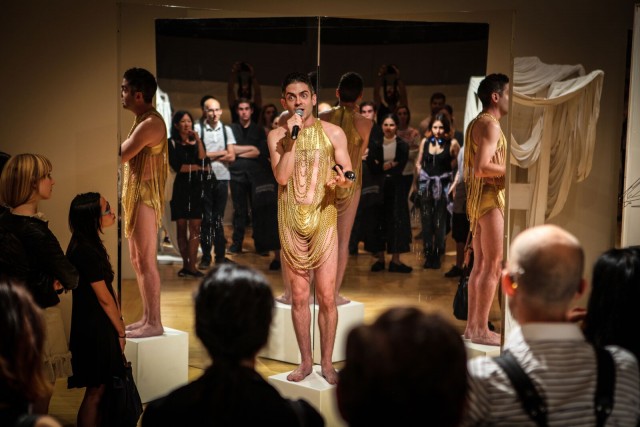
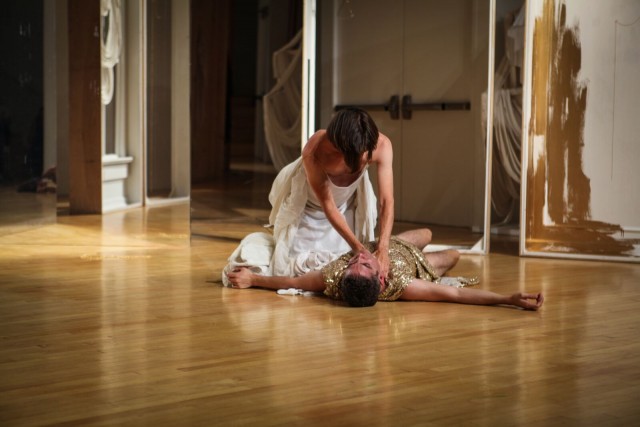
Jack Ferver and Marc Swanson will present CHAMBRE as part of FIAFs annual Crossing the Line festival (photo by Julieta Cervantes)

Jack Ferver and Marc Swanson will present the glittering CHAMBRE as part of FIAF’s annual Crossing the Line festival (photo by Julieta Cervantes)

French Institute Alliance Française and other locations
Florence Gould Hall, 55 East 59th St. between Madison & Park Aves.
FIAF Gallery, 22 East 60th St. between Madison & Park Aves.
September 10 – October 4, free – $35
212-355-6160
www.fiaf.org

Tickets are now available for FIAF’s ninth annual late summer/early fall multidisciplinary arts festival, and you better act fast if you want to see some of this year’s most intriguing programs. For us, the highlight is Jack Ferver and Marc Swanson’s Chambre, an installation and performance piece at the New Museum inspired by Jean Genet’s The Maids and pop-culture elements, with extravagant costumes by Reid Bartelme and experimental sound and music by twi-ny fave Roarke Menzies. British artist Ant Hampton’s Autoteatro series continues with The Extra People, in which participants will go on an individual adventure through FIAF’s Florence Gould Theater. The U.S. premiere of Brazilian artist Gustavo Ciriaco and Austrian artist Andrea Sonnberger’s Here whilst we walk will take small groups, bound by a giant rubber band, on a silent trip through Red Hook. Elana Langer’s free What I Live By will pop up at three locations, examining brand identification and personal values. Iranian artist Ali Moini searches for freedom in the multimedia dance work Lives at New York Live Arts (NYLA). Miguel Gutierrez will present the New York City premiere of all three parts of his Age & Beauty series, Mid-Career Artist/Suicide Note or &:-/; Asian Beauty @ the Werq Meeting or The Choreographer & Her Muse or &:@&; and Dancer or You can make whatever the fuck you want but you’ll only tour solos or The Powerful People or We are strong/We are powerful/We are beautiful/We are divine or &:’////, at NYLA, featuring such collaborators as Mickey Mahar, Michelle Boulé, Jen Rosenblit, Ishmael Houston-Jones, and Alex Rodabaugh. Italian artist Alessandro Sciarroni asks Folk-s, will you still love me tomorrow? in his unique interpretation of Bavarian folk dance at NYLA. French director Joris Lacoste investigates multiple languages and human spoken expression in Suite n°2 in Florence Gould Hall. Also on the bill are Shezad Dawood’s “It was a time that was a time” exhibition at Pioneer Works, a photography show by Mazaccio & Drowilal in the FIAF Gallery, Olivia Bransbourg’s ICONOfly magazine, and Adrian Heathfield and André Lepecki’s three-day symposium, “Afterlives: The Persistence of Performance,” at FIAF and MoMA.