this week in art

DORIS SALCEDO SYMPOSIUM AND EXHIBITION

(photo by David Heald/Solomon R Guggenheim Foundation)

“Plegaria Muda” evokes mass graves in Doris Salcedo exhibition at the Guggenheim (photo by David Heald/Solomon R. Guggenheim Foundation)

Solomon R. Guggenheim Museum
1071 Fifth Ave. at 89th St.
Exhibition: Friday – Wednesday through October 12, $25
Symposium: Friday, October 2, $15, 11:00 am – 6:30 pm
212-423-3587
www.guggenheim.org

Colombian artist Doris Salcedo encapsulated her powerful, emotional oeuvre beautifully and succinctly in a recent interview with Marguerite Feitlowitz: “My work is based on the testimonies of victims of violence, on experiences that are alien to me,” she explained. “I am not a direct witness; I am witness to the witness, a secondary witness. I search for an intimate proximity with the victims of violence that will permit me to stand in for them as I actually make the work, but in such a way that their experience takes precedence over my own.” For three decades, the Bogotá native has been creating installations that examine the social injustice and violence experienced in Colombia and other parts of the world. She uses common domestic objects that each visitor can relate to, building on their evocation of memory and loss. Her current retrospective at the Guggenheim is installed on all four tower levels, allowing museumgoers plenty of time as they go from one section to another to process what they have just seen in one gallery before entering the next. “Plegaria Muda,” roughly translated as “silent prayer,” memorializes both mass gang killings in South Central Los Angeles and murders committed by the Colombian army between 2003 and 2009. The piece is a maze made of pairs of handcrafted tables inverted upon each other, with earth sandwiched between them. Blades of grass rise through the earth, life emerging from dozens of anonymous graves.

“La Casa Viuda”  is part of haunting retrospective at the Guggenheim (photo by David Heald/Solomon R Guggenheim Foundation)

“La Casa Viuda” is part of haunting retrospective at the Guggenheim (photo by David Heald/Solomon R. Guggenheim Foundation)

For “Atrabilarios,” Salcedo takes shoes left behind by los desaparecidos (individuals “disappeared” by security forces) and places them in wall niches, covering them with rectangles of semitranslucent animal fiber that is hand-stitched into the wall with medical sutures, the shoes fading away like slowly forgotten memories or barely healed scars. “A Flor de Piel” is a large floor piece composed of stitched-together, chemically treated rose petals, forming a kind of burial shroud for a Colombian nurse who was kidnapped, tortured, and killed. Salcedo uses silk thread and nearly twelve thousand burned needles to make “Disremembered,” a collection of barely there tuniclike hair shirts that combine beauty and pain. “Untitled” brings together hospital cots wrapped in animal fiber with stacks of crisply folded white shirts impaled by steel rebar, associating loss and violence with a place meant for healing. And “La Casa Viuda” is a room containing doors, dressers, tables, chairs, and other furniture connected, filled in, or closed off with concrete, a house devoid of people, no longer fit for human occupancy. Individually, the pieces demand silent contemplation and introspection, but as a whole, the exhibition will also make you angry about what is still happening all over the globe, brutal murders and disappearances that seemingly cannot be stopped. The moving exhibition, which also includes a video screening of Salcedo’s public projects, continues at the Guggenheim through October 12; on October 2, the artist will participate in an all-day symposium along with Elizabeth Adan, Carlos Basualdo, Katherine Brinson, Leslie Jamison, Roderick Mengham, Jean-Luc Nancy, and Alexander Nemerov.

ART ON GOVERNORS ISLAND

Mary Ellen Mark

Mary Ellen Mark’s last photographs are on view on Governors Island (photo courtesy ICP)

Governors Island
September 26-27, free (ferry $2 round trip), 10:00 am – 7:00 pm
212-673-9074
govisland.com

Fall might be upon us, but it will remain summer for one last blowout weekend on Governors Island. On September 26-27, the remainder of the summer art installations and special projects will come to an end, so this is your last chance to see some very impressive and wide-ranging shows. Most prominent is Mary Ellen Mark’s “Picture This: New Orleans,” a powerful exhibit that turned out to be the famous photojournalist’s last assignment, a CNNMoney commission that sent the Philadelphia-born Mark to document life in the Big Easy a decade after Katrina. Presented by ICP, “Picture This: New Orleans” features large-scale photos of current residents with fascinating stories, along with a video that takes you behind the scenes of the shoots. Mark passed away in May at the age of seventy-five.

Take your time while investigating Sean Boggs’s Paper Polygons (photo by twi-ny/mdr)

Take your time while investigating Sean Boggs’s mysterious “Paper Polygons” (photo by twi-ny/mdr)

The eighth annual Governors Island Art Fair is up and running, spread across more than a dozen rooms in decommissioned army barracks and former military residences along Colonel’s Row and outside on the grounds. Sponsored by 4heads, a nonprofit founded in 2008 by Nicole Laemmle, Jack Robinson, and Antony Zito to offer free space to artists to explore their vision, the fair features painting, drawing, photography, sculpture, video, installation, and sound works. Each artist or independent gallery/collective is assigned his or her own room where they can create to their heart’s content. We highly recommend the second floor of 404A, which features Sean Boggs’s “Paper Polygons,” a circle consisting of hand-cut blue and purple paper triangles, squares, pentagons, and hexagons that shift ever-so-slightly as the installation rotates almost imperceptibly; it’s like watching a clock, but it’s oh-so-satisfying when you see one of the small objects move, like catching a shooting star. Down the hall is Jillian Rose’s “two arrowheads a string of beads and a handful of nails,” a room where a ratty chair and table are precariously about to topple over, white paint is peeling and cracking everywhere, and splinters of wood appear to be growing over the wall, fireplace, and furniture; referencing the early history of Governors Island, the piece gives you the eerie feeling that something not so positive happened there, but you don’t quite know what it could be.

(photo by twi-ny/mdr)

One of the highlights of the Governors Island Art Fair is Jillian Rose’s site-specific “two arrowheads a string of beads and a handful of nails” (photo by twi-ny/mdr)

The Lower Manhattan Cultural Council is sponsoring several exhibitions in Building 110, including “(Counter)Public: Art, Intervention & Performance in Lower Manhattan from 1978-1993,” which features photographs and video documenting works by John Kelly, Richard Serra, Jenny Holzer, Keith Haring, Agnes Denes, and Eiko & Koma, among others. To help celebrate closing weekend, LMCC is hosting open studios with artists in residence, so you’ll be able to meet and talk with Okwui Okpokwasili on Saturday at 1:00, Kyle deCamp at 3:00, and twenty other artists all weekend. A.I.R. Gallery, an advocate for women in the visual arts, has filled a house with work by New York artists while partnering with UnderwaterNewYork. Safe Streets Art Foundation is presenting “Escaping Time: Art from U.S. Prisons,” comprising more than two hundred pieces by inmates from around the country and a look at prison reform. In addition, Brooklyn ARTery is showing “The Art of Mourning: Contemporary Works by Painter John Brendan Guinan” alongside DIY classes and a gift shop of one-of-a-kind items, the New-York Historical Society has the pop-up exhibit “Revolution: Independence and NYC,” local artifacts are on display in “Hidden Beneath Our Feet — Working Archaeology on Governors Island,” the Dysfunctional Collective is presenting “The Paper House,” members of the Sculptors Guild will be on hand for the site-specific “Under Construction Part II,” and the Summer Museum focuses on holographic art. And be sure to come hungry, as Governors Island has a bunch of cool food trucks as well as longtime mainstay, the Caribbean-flavored Veronica’s Kitchen.

ANT HAMPTON: THE EXTRA PEOPLE

THE EXTRA PEOPLE

The audience takes center stage in Ant Hampton’s THE EXTRA PEOPLE

CROSSING THE LINE
French Institute Alliance Française
Florence Gould Hall, 55 East 59th St. between Madison & Park Aves.
Friday, September 25, and Saturday, September 26, $25
Festival continues through October 4
212-355-6160
www.fiaf.org
www.anthampton.com

Swiss-born British multidisciplinary artist Ant Hampton specializes in creating hard-to-categorize immersive performance installations that take place outside of the usual dynamic between performer and audience, making the latter an active participant in the production. Since 2007, Hampton has been presenting his Autoteatro series, works in which audience members and unrehearsed guest performers are given instructions and act out the pieces themselves. For Etiquette, two people sat across from each other in a public space and followed what they were told to do via headphones. For Hello for Dummies, pairs of strangers were sent to sit and interact on outdoor benches. Hampton’s latest work is The Extra People, premiering at FIAF’s Crossing the Line festival. The site-specific piece will take place in Florence Gould Hall, with fifteen audience members onstage and another fifteen sitting in seats. Each person will have a flashlight, a neon vest, and headphones, which will instruct them what to do and where to go. Hampton’s website advises to “avoid eye contact” and explains that “the overall picture is out of your reach: too big, beyond your comprehension, or simply not your job to know. . . . In a challenge to the assumption (often taken for granted) that collectivity is what you find in the theater, the building here reflects society rather differently, with its audience situated as atomized individuals adrift or even asleep among both seating and stage, plugged into their own audio streams, patiently awaiting their call, and eventually acting upon it.” Some of the slots are already sold out, so act fast if you want to have a rather unusual experience in a theatrical setting.

CROSSING THE LINE: CHAMBRE

(photo by Julieta Cervantes)

Jack Ferver reimagines Jean Genet’s THE MAIDS in performance installation at the New Museum (photo by Julieta Cervantes)

New Museum Theater
235 Bowery at Prince St.
Installation: September 23 – October 4
Performances: September 24-25, October 1-2, 7:00, and September 26-27, October 3-4, 3:00, $15
www.fiaf.org
www.jackferver.org

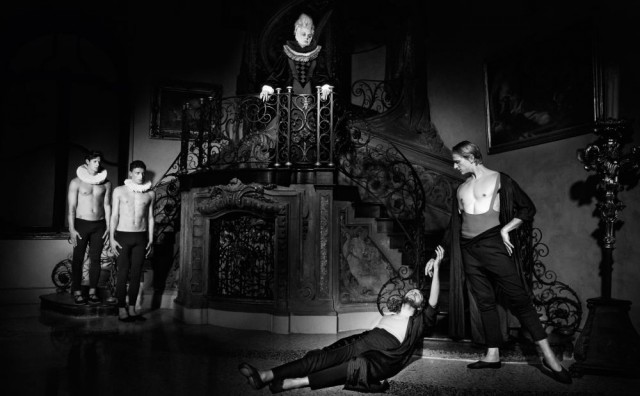
No one tells a story quite like Jack Ferver. In such deeply personal psychodramas as Rumble Ghost, Night Light Bright Light, and Two Alike, the Wisconsin-born, New York-based performer shares intimate, cathartic memories brought to life through a loving pop-culture lens. Melding dance, spoken word, electronic sound scores, and visual art, Ferver explores suicide, abused queer youth, rape, and other serious topics while incorporating references to Tennessee Williams, Poltergeist, Fred Herko, Cleopatra, Madonna, and the 1985 cult film Return to Oz. In Chambre, which runs September 24 to October 4 at the New Museum as part of FIAF’s Crossing the Line festival, Ferver turns to Jean Genet’s The Maids, the 1947 play inspired by a pair of real-life sisters, Christine and Léa Papin, who committed a horrific crime in France in 1933. For the project, which includes eight live performances, Ferver is working with several of his longtime collaborators; the music is composed by Roarke Menzies, the costumes are designed by Reid Bartelme, the art installation (which is on view during museum hours throughout the show’s run) is by Marc Swanson, and Ferver will be joined onstage by Michelle Mola and Jacob Slominski.

Jack Ferver and Marc Swanson will present CHAMBRE as part of FIAFs annual Crossing the Line festival (photo by Julieta Cervantes)

Jack Ferver and longtime collaborators will present CHAMBRE as part of FIAF’s annual Crossing the Line festival (photo by Julieta Cervantes)

“While I’ve been mulling over the material for Chambre for years, we started our first residency at Baryshnikov [Arts Center] two years ago this month. It’s been exciting, to say the least, for me to see how much it has changed,” Ferver told twi-ny about the evolution of the show. “This iteration of Chambre at the New Museum is very different from our premiere at Bard [last year]. The context of the museum obviously has factored into it. Marc and I also originally envisioned it for the white cube. The space is more intimate than where we have performed it so far. Marc’s installation becomes a room in a room, and it is changing the performance, creating a more nuanced, vulnerable, and frightening experience for me. Michelle, Jacob, and I have already started rehearsing in the space. The script and choreography are changing as the psyche of the piece changes in the space of the New Museum.” Menzies added, “The evolution of the score for this work was interesting. I wrote maybe three separate scores before arriving at the final version. A lot of the first music cues I created really capitalized on the notion that this is a murder story. Originally, the main theme had this very suspenseful beat and dark, brooding piano melodies — very campy, and very much in the language of Friday the 13th or Halloween, which has one of the great horror scores in cinema. But I think I ended up scrapping all of those references in lieu of much more raw, uncomfortable, barely recognizable sounds that I created by manipulating and contorting recordings of my voice. As we got to the core of the work, it became clear that the real source of the horror in this piece isn’t the murder but the horror of being embodied, the horror of having to live in this cruel, terrible world. All we really have to escape that horror are the endless games we play.” Sounds like classic Jack Ferver to us, so we can’t wait to catch this highly anticipated New York City premiere.

UNTITLED STANZAS: STAFF/UN/SITE

Kevin Beasley will perform new composition on the High Line this week (photo by Jean Vong, courtesy the artist and Casey Kaplan, New York)

Kevin Beasley will perform new composition on the High Line this week (photo by Jean Vong, courtesy the artist and Casey Kaplan, New York)

Who: Kevin Beasley
What: Untitled Stanzas: Staff/Un/Site
Where: High Line at the Rail Yards, on the High Line at West 30th St. & 12th Ave.
When: September 22-24, free, 6:00
Why: Virginia-born, New York-based artist Kevin Beasley has been roaming the High Line for months, recording sounds of traffic, insects, construction, and other aural vibrations. On September 22, 23, and 24 at 6:00, Beasley, who staged I Want My Spot Back at MoMA in 2012, will perform a composition based on these found sounds, taking place at the open-air Twelfth Avenue Overlook on the High Line at Thirtieth St. In addition to layering his prerecorded sounds, he will add a recording of each show to the next performance.

WAYNE McGREGOR, OLAFUR ELIASSON, AND JAMIE xx: TREE OF CODES

(photo by Stephanie Berger)

Wayne McGregor’s movement, Jamie xx’s music, and Olafur Eliasson’s visual concept come together to reimagine Jonathan Safran Foer’s TREE OF CODES, which reimagines Bruno Schulz’s STREET OF CROCODILES (photo by Stephanie Berger)

Park Ave. Armory
643 Park Ave. between 66th & 67th Sts.
Through September 21, $30-$90
212-933-5812
armoryonpark.org

Choreographer Wayne McGregor, composer Jamie xx, and artist Olafur Eliasson have created quite an audiovisual spectacle with Tree of Codes, their sparkling adaptation of Jonathan Safran Foer’s 2010 book of the same name, which used die cuts to repurpose Bruno Schulz’s Street of Crocodiles. As ticket holders enter the vast Wade Thompson Drill Hall, they encounter large screens to the north and south on which their elongated silhouettes are projected in different colors, reminiscent of Nam June Paik’s “Three Camera Participation / Participation TV,” welcoming them to the show while letting them know they are part of it. The performance itself takes place in the center of the vast Wade Thompson Drill Hall, the audience sitting in rising rows on the east side. Over the course of seventy-five dazzling minutes, various mirrored, translucent, and transparent walls descend from above, altering the perception of the highly athletic dancers, who move about virtually nonstop in an impressive array of solos, duets, and trios, set to a multilayered score that ranges from choral singing to soul, from pulsating dance beats to indie pop, sometimes all at the same time. Just as Safran Foer cut into Schulz’s story, Eliasson’s props cut into themselves, altering space and time, with refracted sections, orbiting circles, and spotlights that wander over the audience, and Jamie xx’s diverse score does the same to itself, coming up with new sounds as the music forms a kind of aural palimpsest. The dancers, meanwhile — consisting of Jérémie Bélingard, Julien Meyzindi, Sébastien Bertaud, Lydie Vareilhes, Lucie Fenwick, and the extraordinary Marie-Agnès Gillot from the Paris Opera Ballet and Louis McMiller, Daniela Neugebauer, Anna Nowak, James Pett, Fukiko Takase, and Jessica Wright from Company Wayne McGregor — are reflected multiple times in the mirrors, or fade away in ghostly images. At times, dancers in front of a see-through partition interact with dancers on the other side as if they are physically together; at other times, they appear to be dancing with multiple versions of themselves. The experience changes depending on where you sit, as the reflections and colors shift based on your angle of vision — and you might even get to see yourself in the background mirror as the spotlight hits you. It never gets very deep, but you can’t stop immersing yourself in its splendor. The performance actually begins with some cool but gimmicky Pilobolus-like moments, but don’t let that worry you. It quickly evolves into a beautifully rendered treat.

REVOLUTION OF THE EYE: MODERN ART AND THE BIRTH OF AMERICAN TELEVISION

(photo by David Heald)

Jewish Museum show explores relationship between early television and modern art (photo by David Heald)

The Jewish Museum
1109 Fifth Ave. at 92nd St.
Thursday – Tuesday through September 27, $7.50-$15 (children eighteen and under free; free admission Saturday 11:00 am – 5:45 pm, pay-what-you-wish Thursday 5:00 – 8:00)
212-423-3200
thejewishmuseum.org

I am a proud TV baby, born into the first generation that treated television like a cherished member of the family. I actually took great offense that my bonus sibling — it was much more than a mere babysitter to me — was referred to as the boob tube and that many people claimed that watching too much of what I even as a kid considered a legitimate art form was bad for your physical and mental well-being. In Annie Hall, Alvy Singer (Woody Allen) famously explains to his actor pal, Rob (Tony Roberts), and girlfriend, Annie (Diane Keaton), why it’s so clean in California: “They don’t throw their garbage away. They make it into television shows.” Which leads me to the Jewish Museum’s fun and fascinating new look at the medium, the informative and entertaining exhibition “Revolution of the Eye: Modern Art and the Birth of American Television,” continuing through September 27. “Rarely is TV discussed in terms of art — and when it is, critics have usually focused on the ways television has influenced high art, or been critiqued and ridiculed by it,” UMBC Center for Art, Design, and Visual Culture executive director Symmes Gardner writes in his foreword to the catalog. “Yet as network television now shares the stage with other forms of broadcasting and video dissemination, we can see the ways in which this popular, commercial mechanism aided art, responded to art — and was, many times, itself art.”

Exhibition includes clip of Salvador Dali appearance on WHATS MY LINE? (© Fremantle Media)

Exhibition includes clip of Salvador Dali appearance on WHAT’S MY LINE? (© Fremantle Media)

The multimedia show follows the development of television from the 1940s through the 1970s, tracing the impact that modern art had on the telly, which in turn influenced contemporary American society. Lovingly curated by Maurice Berger — although a bit noisy, with too many of the sounds bouncing off one another — the exhibition explores links between Rod Serling’s anthology series The Twilight Zone and surrealism (including a startling comparison of the opening title sequence to clips of short films by Marcel Duchamp, Fernand Léger, and René Clair), and Ernie Kovacs and Dada (and how the comic master was among the first to exploit the technology of the medium itself while playfully attacking the corporations that sponsored it). The development of television logos, advertising, and title sequences turns out to be quite a tale, involving such cutting-edge graphic designers as Saul Bass and established artists as Ben Shahn. Rowan and Martin’s Laugh-In is seen in conjunction with Pop, Op, and psychedelic art, while the tongue-in-cheek Batman series is compared to the comic-book Pop art of Roy Lichtenstein. Even Dinah Shore and Ed Sullivan make the cut, the latter’s mod sets matched with sculptures by Sol Lewitt, Donald Judd, and Robert Morris. The exhibit also has rare clips of artists on television, including Salvador Dali, Andy Warhol, Alexander Calder, Willem de Kooning, John Cage, Duchamp, Shahn, and Lichtenstein, although they are all far too short, but a segment of Aline Saarinen’s Sunday Show with Alberto Giacometti is a real treat. There are also works by Lee Friedlander (mocking the medium), Georgia O’Keeffe, Man Ray, Robert Motherwell, Eero Saarinen (Aline’s husband), Agnes Martin, and others, in addition to sections devoted to Winky Dink and You, which invited kids to be artists using the television screen, and the Museum of Modern Art’s Television Project, which sought to place the medium in a higher art form, something that the Jewish Museum has ably accomplished in this splendid exhibit that justifies my longtime love affair with the boob tube.