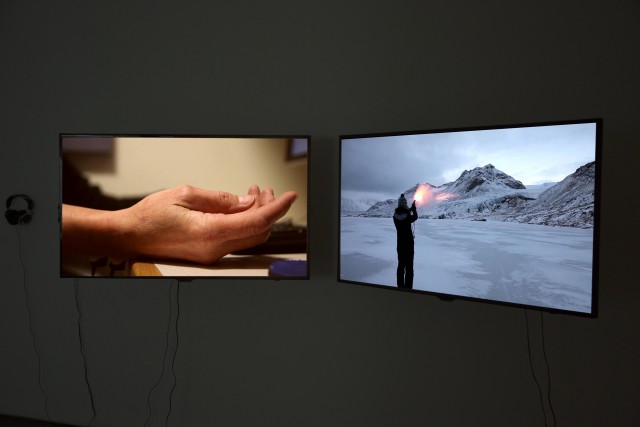
Janet Biggs tries to erase painful personal memories in “Written on Wax” (Janet Biggs, “Written on Wax,” 2015. Two-channel, HD, video installation with sound. Length: 5:36. Courtesy of Cristin Tierney Gallery, New York, NY, Galerie Analix Forever, Geneva, Switzerland, and CONNERSMITH, Washington, DC)
Cristin Tierney Gallery
540 West 28th St. between Tenth & Eleventh Aves.
Tuesday – Saturday through February 20, free, 10:00 am – 6:00 pm
212-594-0550
www.cristintierney.com
jbiggs.com
In our 2011 twi-ny talk with Janet Biggs, the Pennsylvania-born, Brooklyn-based video artist told us, “I am drawn to the ends of the earth. Locations that represent empty lands and blank spaces are ripe for interpretation. Even though these once unknown places have been mapped and surveyed, increased knowledge has not replaced my endless fantasies of discovery in these regions.” Biggs’s previous adventures have taken her to a sulfur mine in the Ijen volcano in East Java (A Step on the Sun), the Taklamakan desert in the Xinjiang Uyghur Autonomous Region of China (Point of No Return), a coal mine in the Arctic (Brightness All Around), and the Bonneville Salt Flats in Utah (Vanishing Point). For her latest show, “within touching distance,” which has just been extended through February 20 at the Cristin Tierney Gallery in Chelsea, Biggs ventures into new territory, deep into the human brain while also turning the camera on herself. In the four-channel installation Can’t Find My Way Home, Biggs interlocks three separate narratives: Inspired by family members’ battles with Alzheimer’s disease, she follows a mineral collector at a gem exhibition, films University of Houston PhD candidate Mahshid Sadat Hosseini-Zare as she studies a rat’s brain in a lab, and hikes down into the Merkers salt mine in Thuringia, Germany, to see its remarkable crystal cave, where the formations resemble the plaque found in a brain with Alzheimer’s disease.
In the two-channel video Written on Wax, Biggs makes herself the subject as she participates in an experimental study in which she receives jolts of electricity while looking at quick clips from her videos, focusing extensively on her experiences with horses as well as such athletes as synchronized swimmers and wrestlers as she attempts to turn positive associations into negative ones. With Can’t Find My Way Home and Written on Wax, Biggs explores memory in intimate, poetic ways, facing recognizable, everyday fears with beauty and grace. For this latest twi-ny talk, the engaging, thoughtful, and funny Biggs discusses erasing remembrances, riding horses, Alzheimer’s disease, Charles Baudelaire, and where she’s going next while her husband and occasional cinematographer, Bob Cmar, weighs in on the risks they both sometimes take.
twi-ny: At one point during the gallery opening, you were being crowded by well-wishers as you stood in between the two video pieces, both of which feature you prominently. Is it difficult to watch yourself onscreen, especially in front of other people?
Janet Biggs: I am much more comfortable behind the camera than in front of it, but there comes a point in the process, especially during editing, where I stop being self-conscious. I don’t see the protagonist as me any longer and I can make decisions without worrying if the shot is flattering or not. It’s almost as if the piece takes over and I’m along for the ride. When I watch the work, I’m aware of the ideas behind it rather than my image . . . at least most of the time.
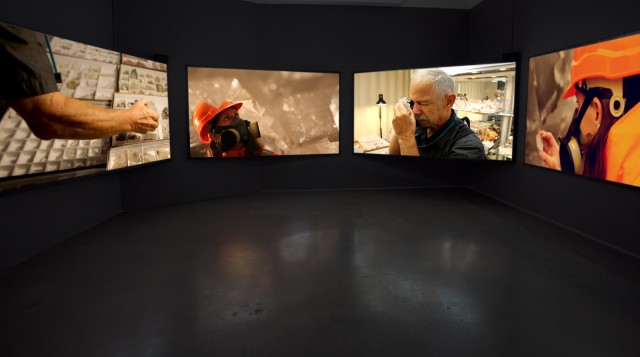
Video artist Janet Biggs goes deep down into the Merkers salt mine in Germany to explore the human brain in “Can’t Find My Way Home” (Janet Biggs, “Can’t Find My Way Home,” 2015. Four-channel, HD, video installation with sound. Length: 8:19. Courtesy of Cristin Tierney Gallery, New York, NY, Galerie Analix Forever, Geneva, Switzerland, and CONNERSMITH, Washington, DC)
twi-ny: You’ve now appeared in several of your latest videos. In our 2011 twi-ny talk, you said that you appeared in In the Cold Edge for practical considerations. How did that change for Can’t Find My Way Home and Written on Wax?
JB: I was on an artist’s expedition in the high Arctic when filming the flare shot for In the Cold Edge. I was the only one certified to shoot a firearm so I had to make my first appearance in front of the camera.
Can’t Find My Way Home traces very specific memories of my family. Memory tracing became part of the conceptual underpinning as well as part of a physical exploration in this piece. I frequently mine my personal history as part of my process, but in a much more general way. With Can’t Find My Way Home it felt false to use an actor. It was essential that I document my personal journey.
My grandfather was an amateur mineral collector. Long past the time when he could recognize his children or other family members and friends, he could tell you detailed information about the samples in his collection . . . details like where they came from, specific extraction information, and their scientific names. I wanted to figuratively and at times literally place myself inside the minerals as a way of immersing myself in my grandfather’s experience, to physically inhabit his moments of presence in the sea of loss that occurs with Alzheimer’s disease.
As part of my research and production on Can’t Find My Way Home, I spent a lot of time with neuroscientists. I learned about new work being done on memory altering and erasure. Having just completed a project on a disease that strips memories, I was fascinated by the idea of voluntarily choosing to alter or erase a memory. I volunteered as a subject for a human study on altering and erasing memories and used some of the information I gained through the process as inspiration for Written on Wax.
Written on Wax was also too personal to ask someone else to undergo the process . . . especially as it involved electric shock to change a positive memory to a negative one.
twi-ny: What drove your decision to make Can’t Find My Way Home in three distinct sections and turn it into a four-channel installation?
JB: Can’t Find My Way Home exists as both a four-channel installation and as a single channel piece. [Only the installation is shown at Cristin Tierney Gallery.] I rarely create pieces that exist in multiple forms, but occasionally some subject matter demands that I look at it both in terms of an experiential and immersive installation, and also in terms of its emotional, intimate impact, better conveyed in a single-channel video. A minute detail, a small gesture can be as powerful as being surrounded by twenty tons of gigantic crystals!
The three distinct sections grew out of a desire to explore memories from my personal perspective, imagine them from my grandfather’s perspective, as well as try to understand them from a biological perspective.
Exploring the crystal cavern allowed me to feel as if I had stepped inside a geode. I decided on the Merkers crystal cavern in Germany for a number of reasons. It was definitely immersive, absolutely gorgeous and otherworldly, but there were some specific details that made me sure it was the right location. The shape of the cavern is a negative of the shape of the hippocampus, the location of memory within a brain. Also, the crystal formations had an uncanny similarity to the shape of amyloid proteins and tau tangles in the brain of someone with Alzheimer’s disease.
I also thought that the conditions in the cavern, the extreme heat and the need to filter particles in the air with a respirator, might challenge me physically and cause disorientation . . . some of the same sensations that my grandfather experienced as the disease progressed.
So, on one hand, I have this intense physical experience inside the cavern that alters my perceptions of things around me, which I juxtapose with the sterile, quantifiable, scientific methodology of a bio/chem lab.
Things like seizures, brain trauma, and Alzheimer’s disease all cause a hyperactive state in the brain. For my project, I filmed a University of Houston PhD candidate, Mahshid Sadat Hosseini-Zare, as she takes a disembodied brain from a rat that was bred for predisposition to seizures and places it under a high-powered microscope that can identify individual cells in the brain. She uses audio sensors and permeates the exterior membrane of two individual cells, induces a seizure, and records the sound of cells communicating in a hyperactive brain such as one with Alzheimer’s disease. I used both the visual footage of this process in my video and the recorded sound as part of the soundtrack for my piece.
The final component in Can’t Find My Way Home is footage of a mineral collector that I met at a gem and mineral exhibition in Denver. He ties the other two visual elements together by symbolizing a kind of presence, a sense of self, within the extremes . . . of loss, of a diagnosis like Alzheimer’s, of overwhelming and extreme physical conditions.
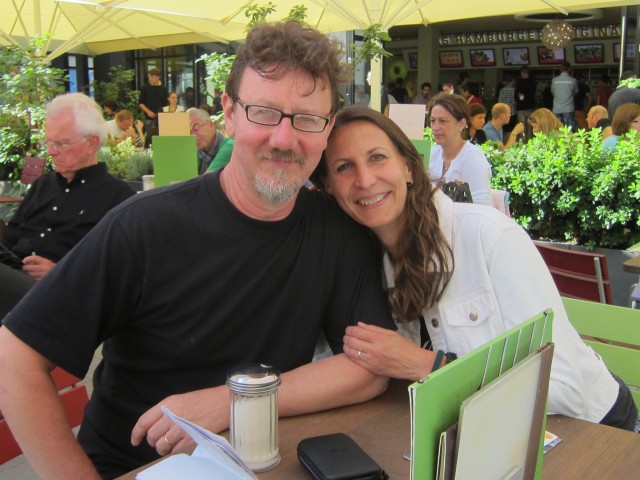
Janet Biggs and husband Bob Cmar take a well-earned break in Germany (photo courtesy Bob Cmar)
twi-ny: In some ways, Written on Wax is a melding of your past, present, and future, as you react to clips from your personal and professional life. Besides the general positive and negative reactions we see on your face onscreen, what else was going through your mind as you watched the clips? What kind of memories did they stir up?
JB: As I’ve mentioned, I was thinking about willingly altering or erasing memories when so many experience loss that is out of their control. I was also thinking about how we are remembered; the role memory plays in our individual senses of self, as well as cultural memory in relationship to past, present, and future. I was thinking about moments of intent and moments that are inadvertent; both can be personally and historically pivotal.
twi-ny: In the catalog to your “Echoes of the Unknown” show at the Blaffer Art Museum, Barbara Polla compares you to Baudelaire. What do you think of the comparison? Have you been directly or indirectly influenced by his work?
JB: Barbara Polla is a wonderful writer and I was honored and inspired by her comparison. Baudelaire was certainly someone who struggled with the complexities of individual survival, self-definition, and morality, never turning away from things hard to witness and always willing to confront the unknown . . . something I aspire to.
I have always said that the act of pointing my camera is political, whether at a sulfur miner working inside an active volcano, at someone struggling with an extreme diagnosis, or at the disappearing Arctic. While there is certainly an activist side to my projects, I judge their success by my ability to find poetry.
twi-ny: Many of your works feature men and women either performing dangerous actions and/or risking their health, and ultimately their lives, because of the type of job they do. What attracts you to these kinds of situations?
JB: I am attracted to extreme locations and situations, and to people who have found a way to exist and define a sense of self in the extreme. I didn’t originally intend for my work to address risk in terms of occupations. I originally looked at risk as an extreme athlete often does . . . a possible result of an action, but one well worth taking for the chance to excel at one’s given sport.
As my work developed, it began to focus on extreme landscapes and often included high-risk jobs within these landscapes. The stark, elemental, and otherworldly locations that draw me also often included sulfur dioxide fumes, frozen seas, methane gases, blinding salt particles, and molten lava. To hold a job in these landscapes can often mean unimaginable health risks.
twi-ny: What about your own health and safety?
JB: For me, “feet on the ground” filming can include experiences with a degree of risk, but I’m a tourist, a momentary witness of the risk taken by the people I focus on.
twi-ny: Bob shot all of the scenes in which you appear, including descending into the crystal caves in Germany with you. How was he as your photographer?
JB: Assisting me is no easy job. Bob has assisted me on some of my more extreme shoots, including riding camels for eleven hours a day in 120+ degrees across the Taklamakan desert of western China and filming inside an active volcano in Indonesia during an earthquake. He occasionally asks me why I can’t just make a project in the south of France.
I think he considers the crystal cave a fairly easy project even though he had the added pressure of being primary camera . . . It was only eight hundred meters down, twenty-six kilometers into the earth, and only around one hundred degrees.
twi-ny: Bob, what was the shooting like for you?
Bob Cmar: Shooting the footage for Can’t Find My Way Home was actually quite pleasant. We’ve dealt with far more difficult conditions — A Step on the Sun required a hike up a steep, tropical volcano — lugging backpacks filled with heavy equipment. Once inside the volcano, we’d shoot until almost asphyxiated. We alternated sleeping on the rim in gas masks with hiking back down to eat a bowl of rice at the one local guesthouse, wash it down with coffee (as we couldn’t trust local unboiled water), catch sleep, then start again in a few hours. Luckily, the rainy season began on our last day.
The crystal mine, on the other hand, is located near a small, pleasant resort town in the former East Germany. The shoot itself was tough — hot as hell, but once we got out, we were back in civilization and creature comfort. Janet always travels on a tight budget, but the hotel provided luxuries we don’t usually get on shoots — WiFi, color TV, and sit-down toilets. I also got to watch the Germans win the World Cup in a local strip club!
twi-ny: Do you ever worry about Janet when she goes off to these unique, often dangerous locations, or are you used to it by now?
BC: Do I worry? Of course, and with increased awareness, I probably worry now more than ever. Janet and I often talk about safety and risk. The thing is, once she gets a vision (“Filming motorcycles while hanging off a truck at one hundred mph!” “Armed salt miners in a war zone!” “Kayaking around icebergs to film polar bears!”), there is no stopping her. We both know the reality of risk. We’ve had close calls, she’s broken bones, and we’ve mourned the loss of other artists, people she’s filmed, and journalists who have pushed safety limits. However, we both know that life isn’t worth living without taking risks.
twi-ny: Janet, you’re an accomplished equestrian, but a while back you suffered a severe accident in a fall. Written on Wax includes new footage of you riding a horse standing up, learning equestrian vaulting. Was it easy to get back up on a horse like that?
JB: My accident actually occurred when I was on the ground, hand walking a horse, so getting back on wasn’t a problem. I’ve done quite a bit of riding since my accident (although it’s been about five years since the last time I sat on a horse). Standing on a horse, especially when it’s cantering, is a completely new proposition.
twi-ny: Would you say you were doing it primarily for the video, or for yourself, or is there no difference between the two for you?
JB: Passion, desire, fear, pleasure, pain, freedom, terror, success, and failure all coexist in my work as they do in life.
twi-ny: Where might you be going for your next piece?
JB: I recently filmed local Afar militia and Ethiopian Army soldiers as they patrolled Ethiopia’s northern border with Eritrea, part of the Afar Triangle region. The landscape is extremely harsh and volcanic, with daily temperatures hovering between 100 to 115 degrees, but also extremely beautiful and breathtakingly otherworldly. It was once named “the most unlivable place on the planet” by National Geographic magazine, so I was curious about the people who lived there and were defending a land that much of the planet thinks is unlivable.
I’m now hoping to travel to Eritrea and Djibouti. I want to witness the other sides of the borders that split the Afar Triangle.